





About this worksheet
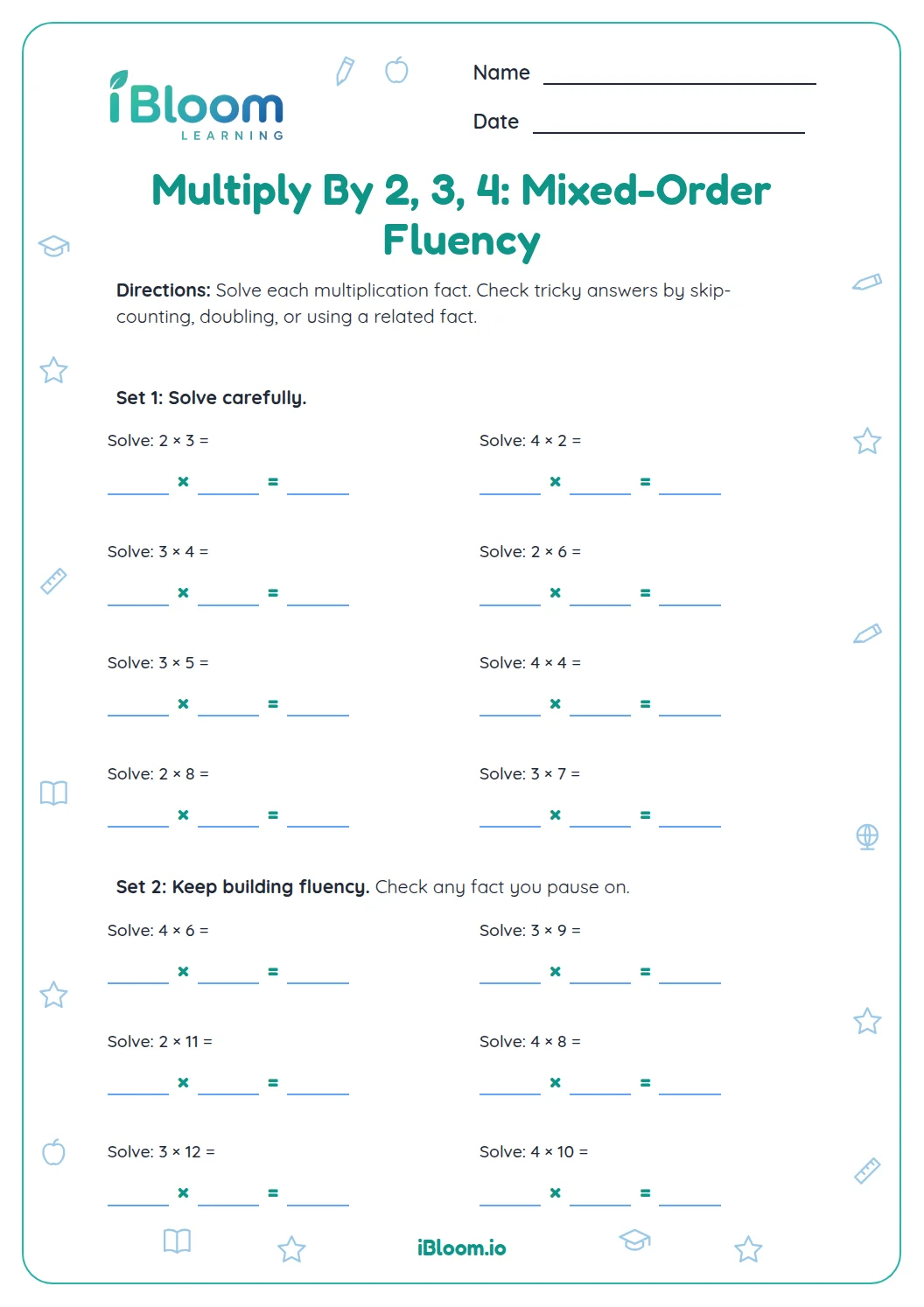
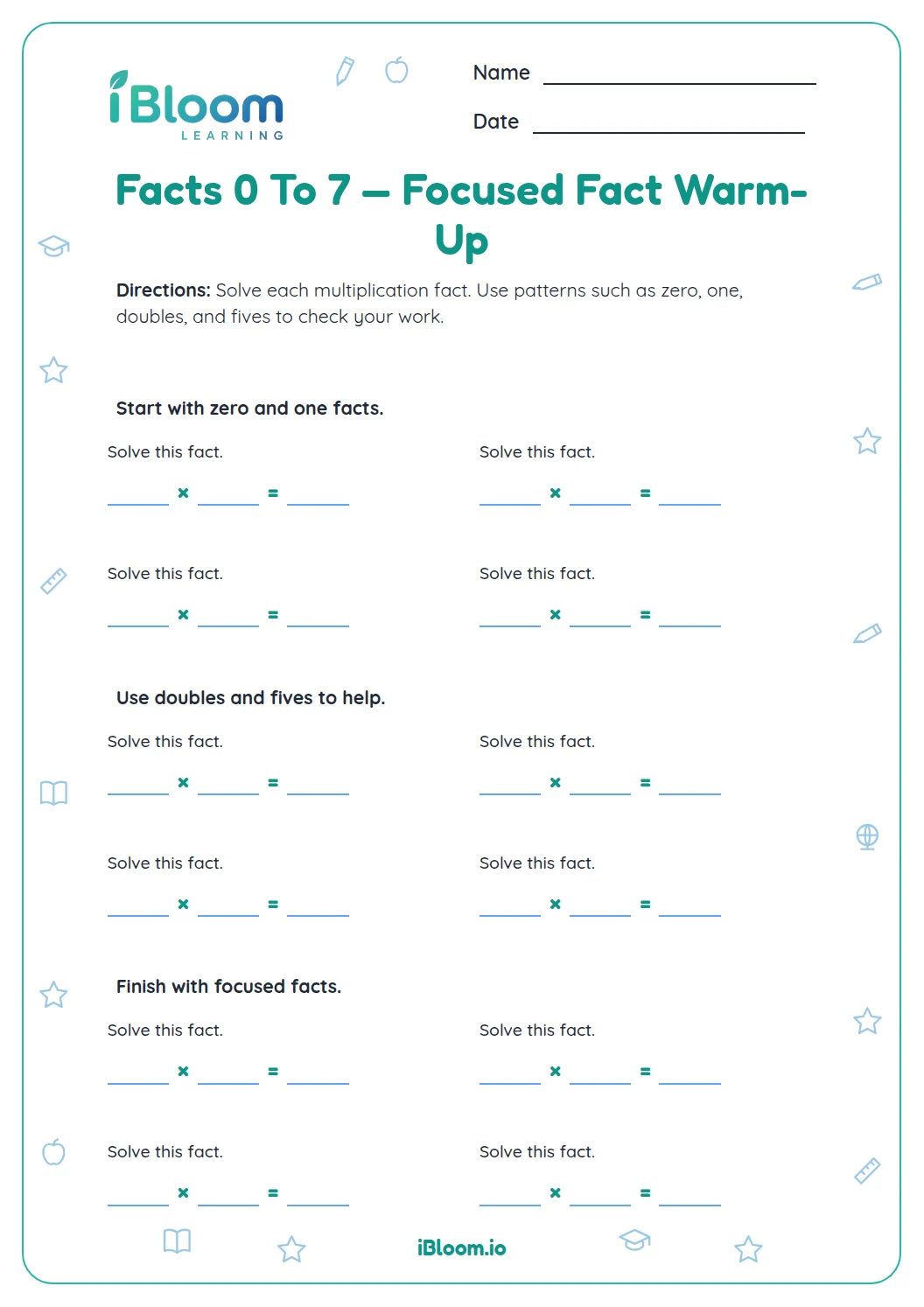
This free printable multiplication drill gives Grade 3 and Grade 4 learners 48 facts in mixed order across the 0, 1, 2, 3, 4, and 5 tables. Each table includes partner factors from 0 through 5 plus 8 and 12, matching the source drill’s use of larger partners. Products range from 0 to 60. Children write each product and check it with the separate answer key. The practice supports multiplication fluency in Common Core 3.OA.C.7; timing is optional.
Aligned to 3.OA.C.7
Why mix the facts instead of listing each table in order?
A shuffled set asks the child to read both factors every time. The next answer cannot be found just by continuing a counting pattern down the page. Zeros and ones are mixed among the other facts, so their meanings need attention too.
This sheet contains two sets of 24. Part A uses factors from 0 through 5. Part B mixes in partner factors from 6 through 12, so children apply familiar tables to products such as 6 × 4 = 24. Use one set per sitting if helpful.
How can a known fact help with another one?
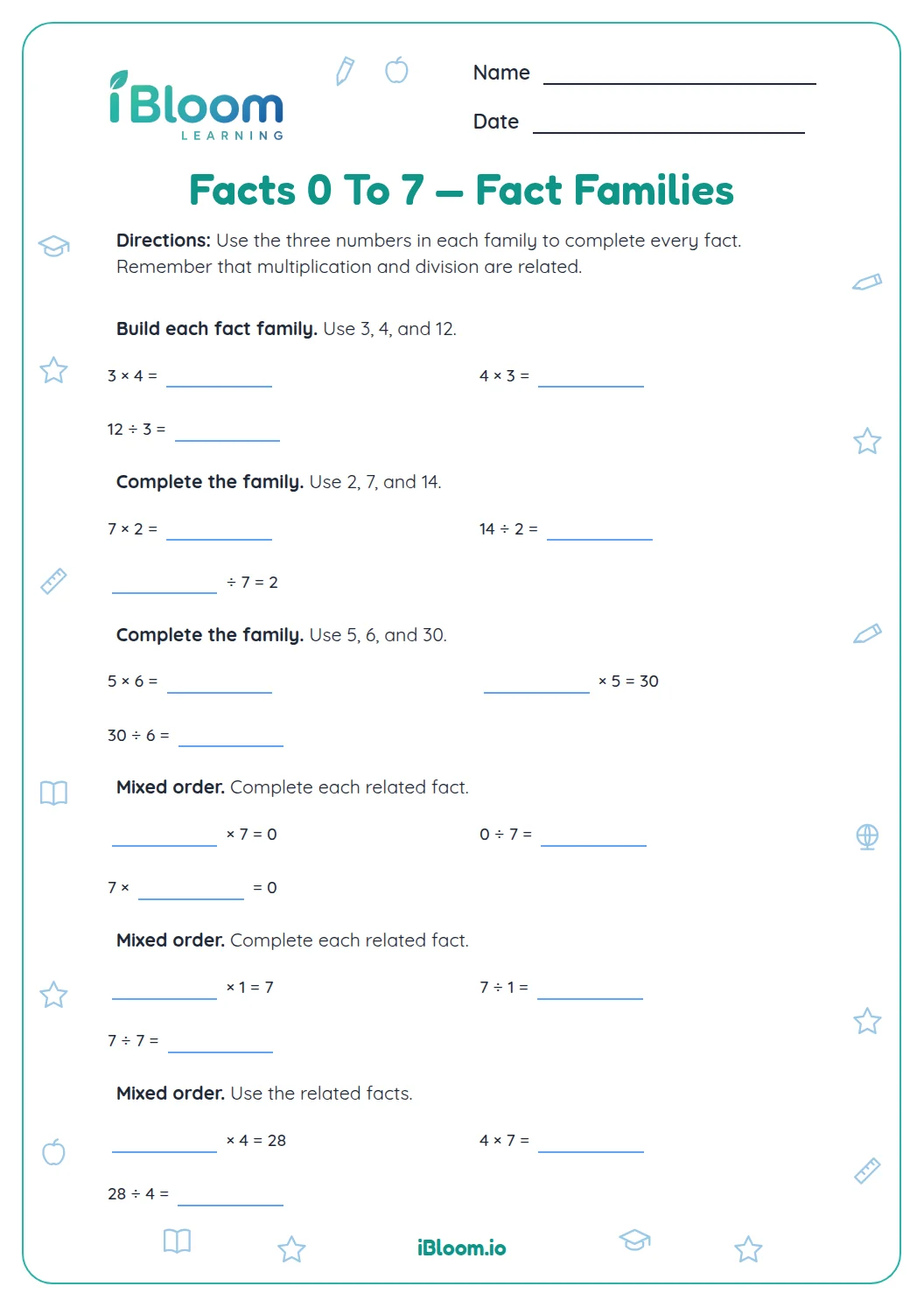
Reversing the factors keeps the product the same. Question 1 and question 13 are a useful pair: one asks for 3 × 4, and the other asks for 4 × 3.
- 13 × 4 = 12.
- 2Four groups of three also total 12.
- 34 × 3 = 12; the reversed pair agrees.
How should missed facts be reviewed?
Mark an uncertain fact with a small star while working. After checking the key, choose two or three starred facts to explain using equal groups, repeated addition, or a known product.
For 5 × 4, count 4, 8, 12, 16, 20 or use 4 × 5 = 20. A short explanation makes the corrected answer more useful than copying the key alone.
How to use this worksheet
- 1Read the × sign aloud and identify both factors in question 1.
- 2Complete Part A, placing a small star beside any uncertain fact.
- 3Check starred facts with equal groups or repeated addition.
- 4Complete Part B, using a known fact to check larger products; for 6 × 4, add 4 to 5 × 4 = 20.
- 5Use the key to correct answers, then retry a few missed facts orally.
Mistakes to notice and fix
The mistake
Writing 5 for 0 × 5.
The fix
Zero groups of five contain zero objects; any factor of zero makes the product zero.
The mistake
Adding the factors, such as answering 3 × 4 with 7.
The fix
Say “three groups of four” and add 4 + 4 + 4 to get 12.
The mistake
Giving reversed pairs different products.
The fix
Compare 3 × 4 and 4 × 3 with an array turned sideways; both contain twelve dots.
Common Core alignment
Recall and check products from the 0–5 tables, with partner factors through 10.
On this sheet: Two shuffled sets develop recall of products and invite checks using known facts.
Show the official wordingHide the official wording
Fluently multiply and divide within 100, using strategies such as the relationship between multiplication and division (e.g., knowing that 8 × 5 = 40, one knows 40 ÷ 5 = 8) or properties of operations. By the end of Grade 3, know from memory all products of two one-digit numbers.
What to practice next
Make more practice
Further reading
Questions parents and teachers ask
Which numbers are included in this drill?
Every problem has one factor from 0 through 5. Each of the six tables pairs that factor with 0, 1, 2, 3, 4, 5, 8, and 12. Across 48 questions, the largest product is 60. The answer key lists each product.
Is this a timed test?
Timing is optional for this worksheet. Let the child complete the facts accurately and mark any that need a strategy. If you use a timer, compare the child’s own attempts on similar practice and review mistakes afterward, keeping the focus on correct products and growing confidence.
Why do some questions reverse the same factors?
Reversed pairs help children check that changing the order of the factors keeps the product the same. For example, 3 × 4 and 4 × 3 both equal 12. Ask the child to find that pair and explain it with equal groups or an array.
What is the difference between multiplying by zero and by one?
Multiplying by zero gives zero, while multiplying by one keeps the other number. The sheet mixes both types with other facts. Read 0 × 5 as zero groups of five and 1 × 5 as one group of five to make the difference clear.
How can I use the answer key after practice?
Use the key to check all 48 products, then focus on a few uncertain or incorrect facts. Ask the child to explain each correction with equal groups or a related fact. Try those facts again later in a different order to check that the products can be recalled.