




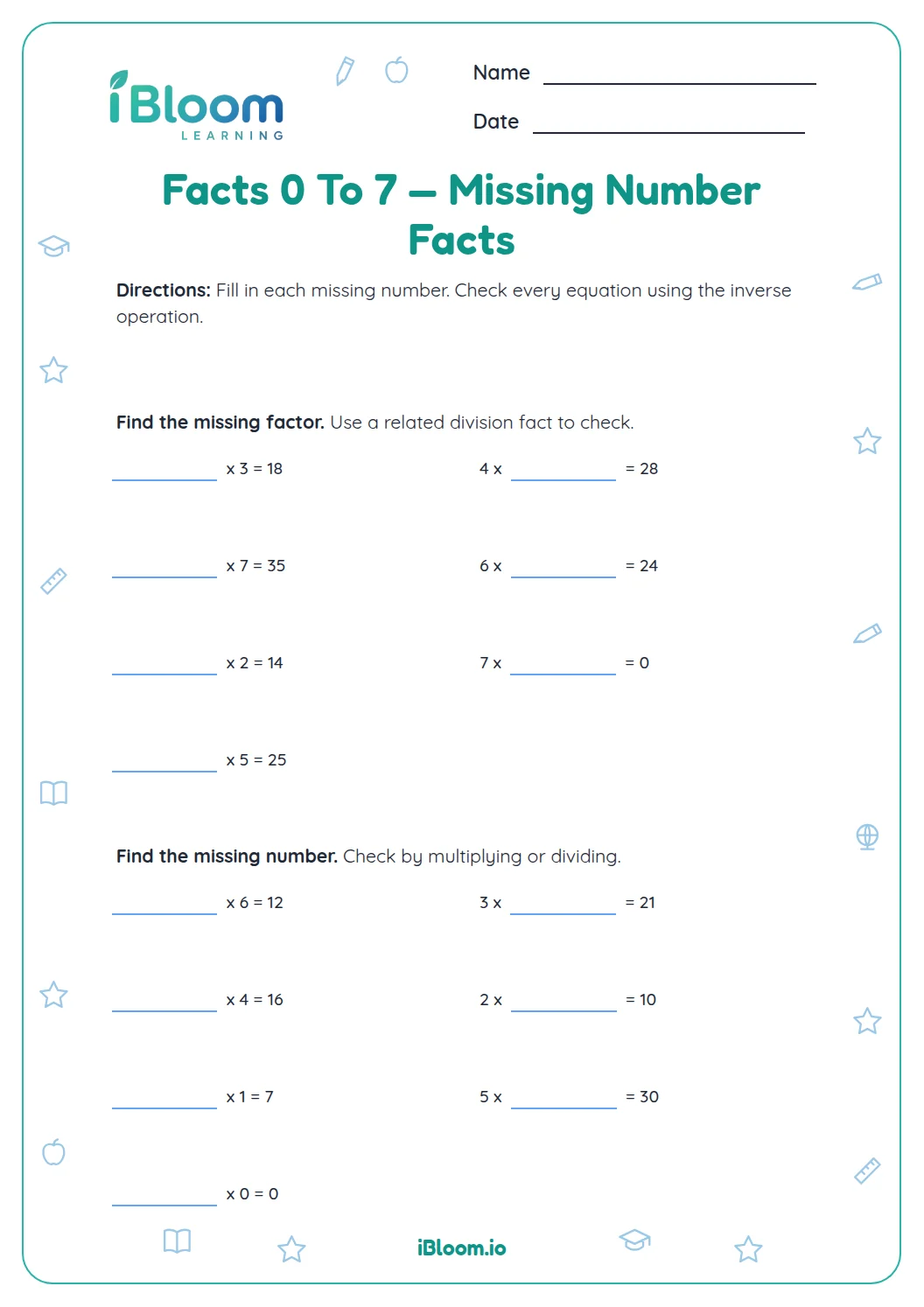
About this worksheet
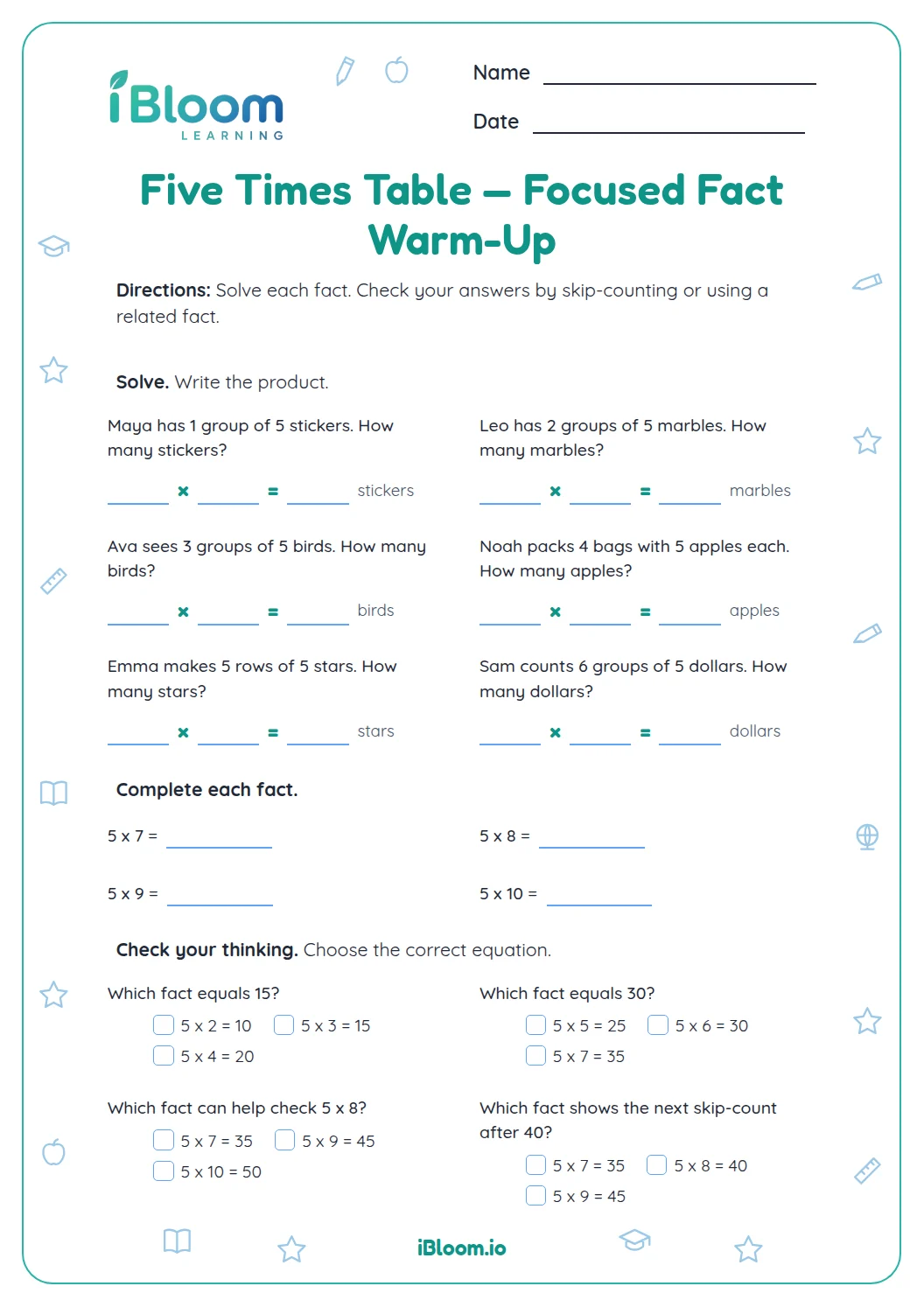
This free printable Grades 3–4 worksheet gives focused practice with multiplication facts using factors from 0 through 5. The 20 questions start with zero and one, move through mixed facts, and finish with products to recall. A separate answer key makes it easy to check each product and revisit a fact.
Aligned to 3.OA.C.7
What does a multiplication fact tell us?
A multiplication fact combines equal groups. In 4 × 3, there are four groups of three, for a total of 12. The factor order can switch without changing the product: 4 × 3 and 3 × 4 both equal 12.
Question 7, 5 × 3, has a product of 15.
What happens with zero and one?
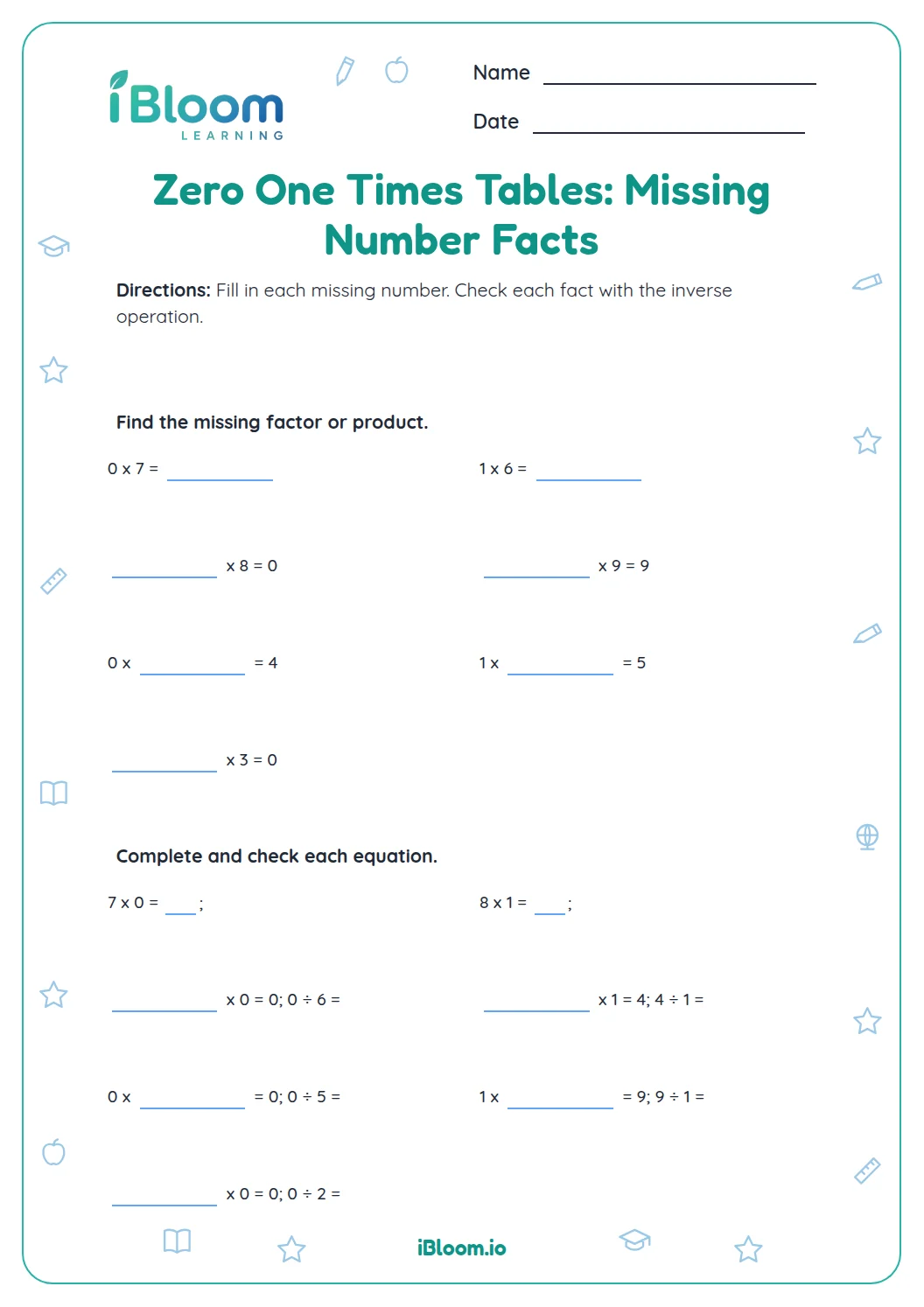
Any number multiplied by zero gives zero because there are no objects in zero groups. Multiplying by one keeps the other factor unchanged. Part A includes both special cases.
What facts does this page practice?
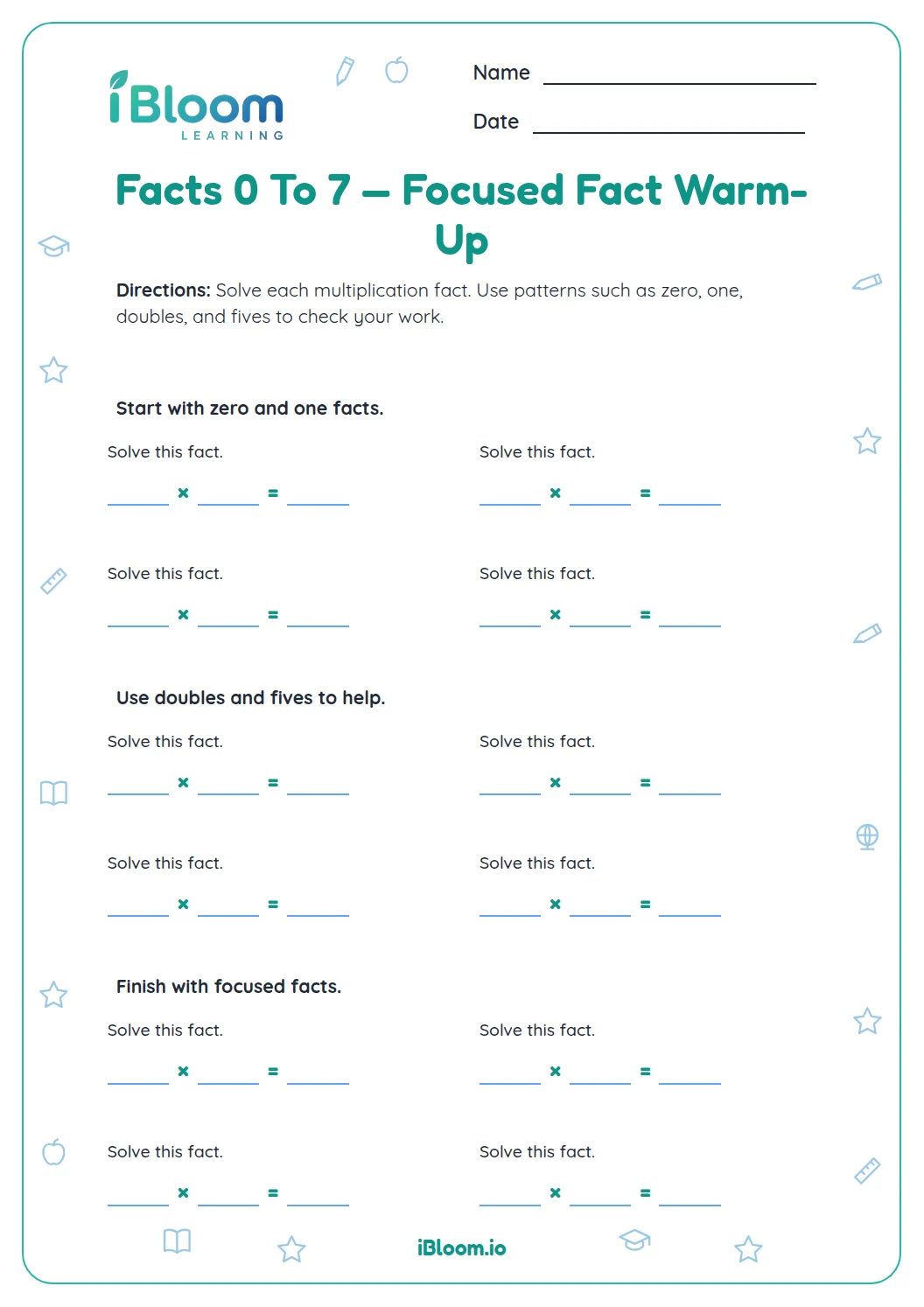
The 20 questions use factors from 0 through 5. Part A includes zero and one, Part B mixes the facts, Part C asks for more products, and Part D is a final short check.
How to use this worksheet
- 1Read the multiplication sign and both factors.
- 2Think of one factor as the number of equal groups.
- 3Find the total in all groups.
- 4Check by reversing the factors or using repeated addition.
Common mistakes and quick fixes
The mistake
Adding the factors instead of multiplying them.
The fix
Picture equal groups and count all items.
The mistake
Writing a nonzero answer when one factor is zero.
The fix
Recall that zero groups contain zero items.
The mistake
Changing the product when factors switch places.
The fix
Check with the matching reversed fact.
Common Core alignment
This worksheet practices the skill described in the standards below.
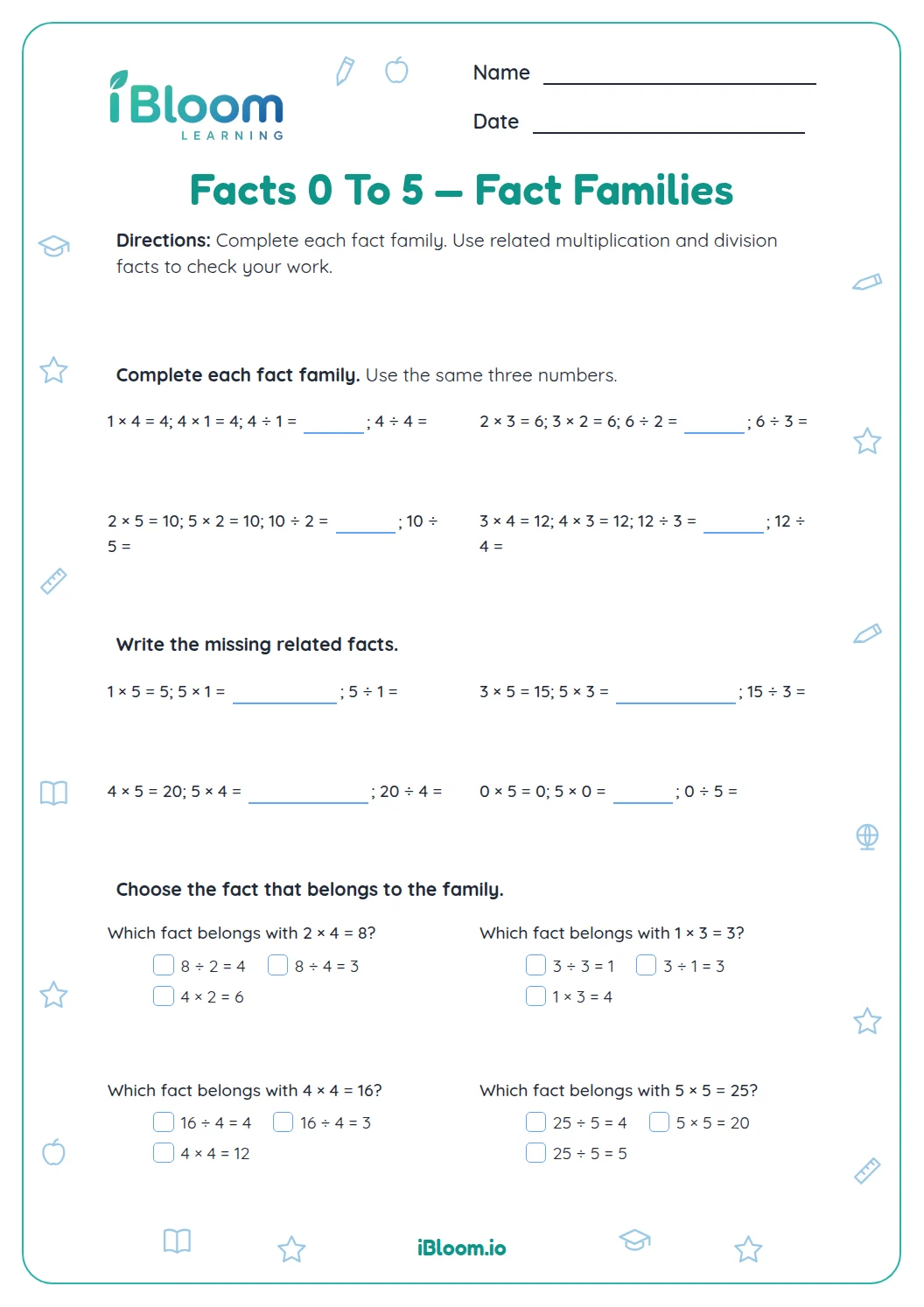
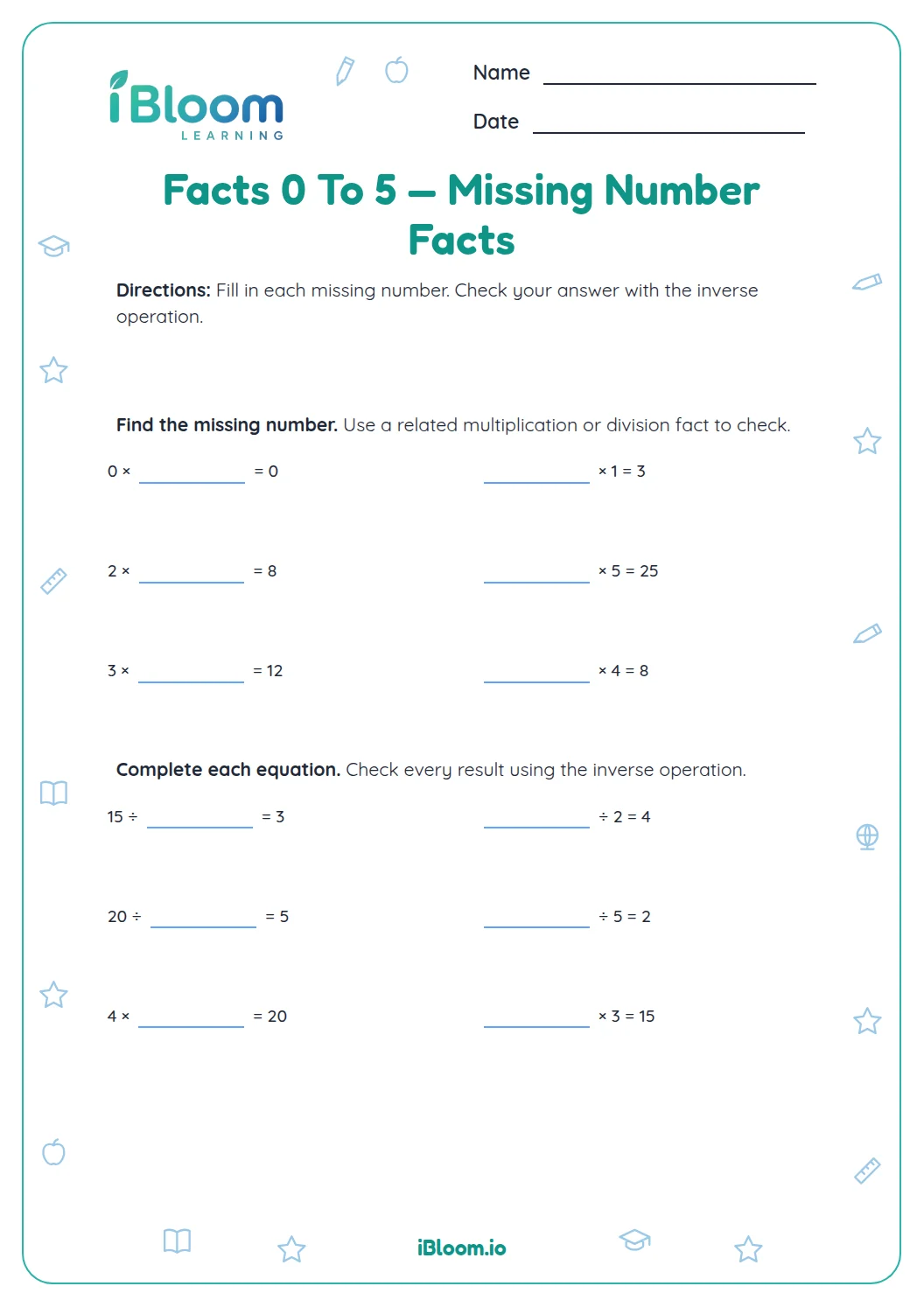
Recall and use related multiplication and division facts to solve division facts.
On this sheet: Recall and use related multiplication and division facts to solve division facts.
Show the official wordingHide the official wording
Fluently multiply and divide within 100, using strategies such as the relationship between multiplication and division (e.g., knowing that 8 × 5 = 40, one knows 40 ÷ 5 = 8) or properties of operations. By the end of Grade 3, know from memory all products of two one-digit numbers.
What to practice next
Make more practice
Further reading
Questions parents and teachers ask
What does 4 × 3 mean?
It means four equal groups of three, or three equal groups of four. Both arrangements total 12. On the worksheet, learners can use equal groups or a known multiplication fact to find each product. This gives the learner another chance to explain the idea clearly.
Why does multiplying by zero give zero?
Zero groups contain no items, so the total is zero. The worksheet includes zero facts to reinforce this pattern alongside the other factors from 0 through 5. This gives the learner another chance to explain the idea clearly. This gives the learner another chance to explain the idea clearly.
How can I check a multiplication answer?
Reverse the factors or add equal groups. For example, 5 × 3 can be checked as 3 × 5, or by adding 3 + 3 + 3 + 3 + 3. Both checks give 15. This gives the learner another chance to explain the idea clearly.
Are the facts timed?
No timer is needed. This is a focused warm-up, and learners can work carefully at a comfortable pace. After accuracy improves, an adult may repeat the page and notice whether recall feels easier. This gives the learner another chance to explain the idea clearly.
How many questions are on the page?
There are 16 multiplication questions across three parts. All use factors no larger than 5, including facts with zero and one. A separate key lists every product. This gives the learner another chance to explain the idea clearly. This gives the learner another chance to explain the idea clearly.
What should learners practice next?
They can review a single table such as the five times table, then expand to facts from 0 through 7. The linked pages provide a natural next step while preserving familiar fact practice. This gives the learner another chance to explain the idea clearly.