

About this worksheet
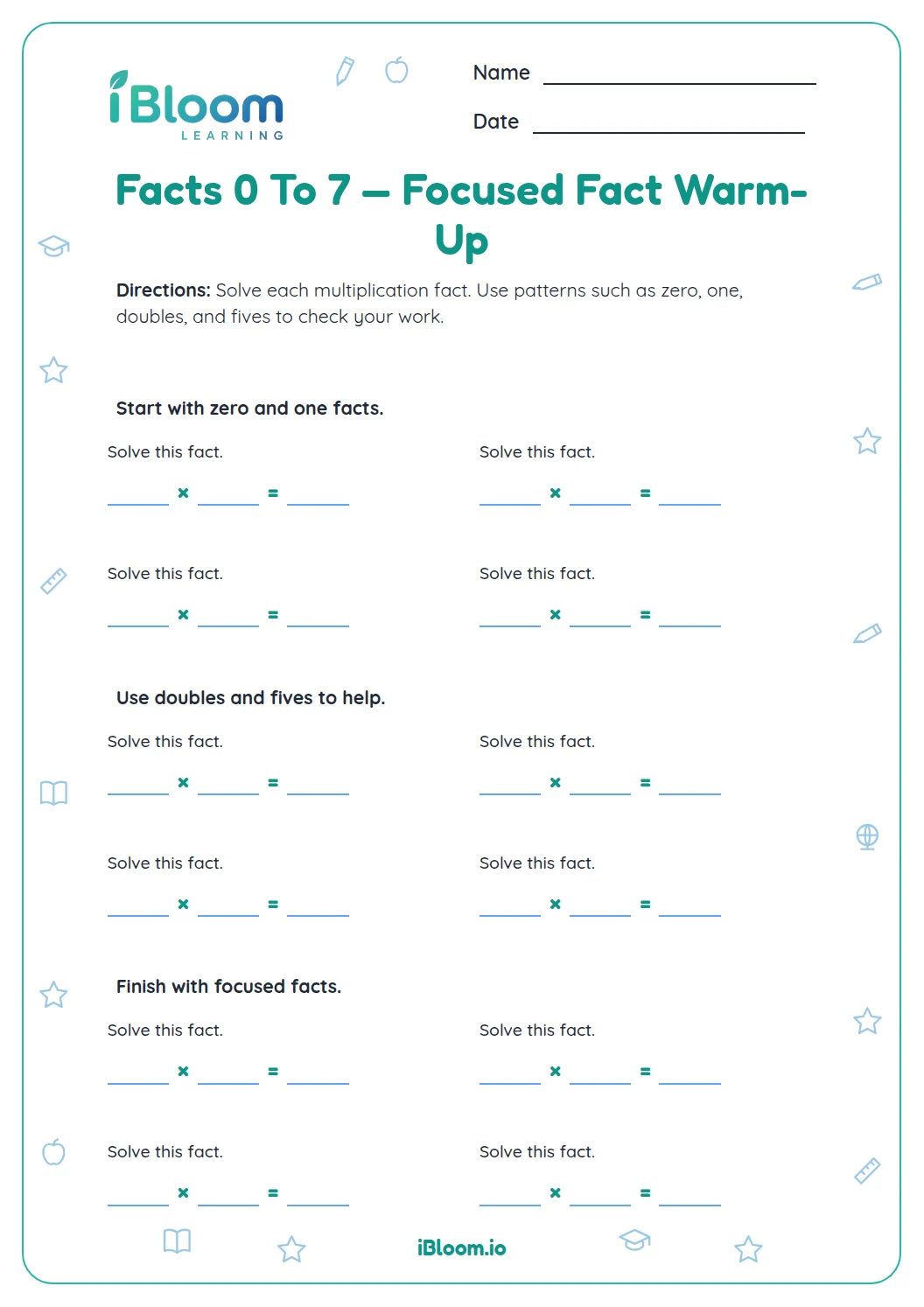
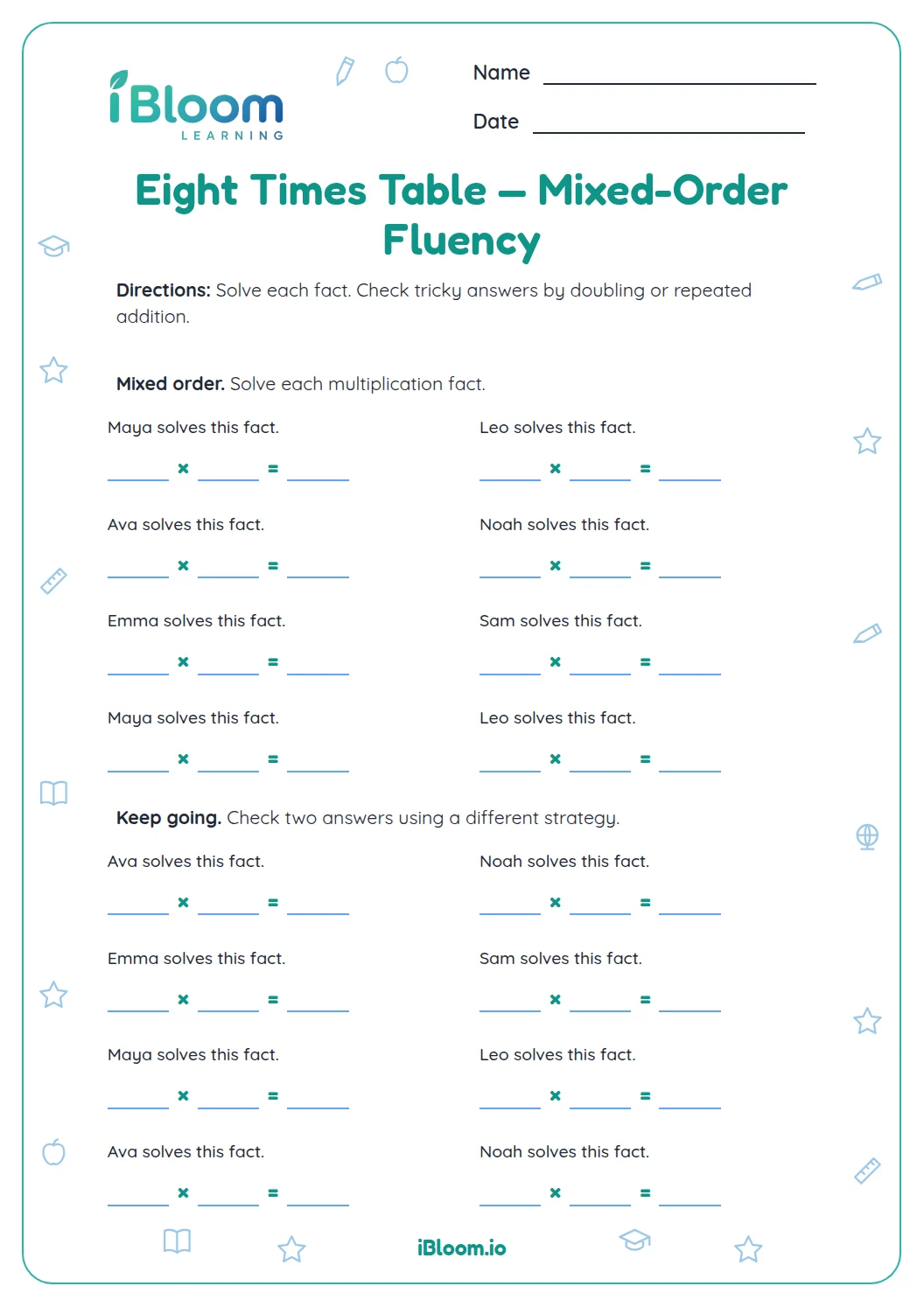
This Grade 3 printable gives students 20 multiplication facts in mixed order, using factors from zero through seven. The set includes zero and one facts, doubles, and other combinations. Students can use equal groups, arrays, or known facts when needed, then check products with the answer key. The practice connects to CCSS.MATH.CONTENT.3.OA.C.7.
Aligned to CCSS.MATH.CONTENT.3.OA.C.7
How can equal groups help with a fact?
Multiplication describes equal groups. For 6 × 4, picture six groups of four or an array with six rows of four. The total is 24.
- 16 × 4 = 24
- 2Six groups of four make 24.
How can a known fact help with a harder one?
Build from a nearby fact. Seven groups of four are one more group of four than six groups of four, so 7 × 4 is 24 + 4, or 28.
How should students use the answer key?
Check each product after solving. For a missed fact, sketch groups or connect it to a nearby known product, then try the fact again without looking at the key.
Practice for fluency
- 1Work through the mixed facts without rushing.
- 2If you pause, picture equal groups or an array.
- 3Mark a difficult fact and return after completing the others.
- 4Check each product with the key and practice missed facts again.
Fact checks
The mistake
Treating a zero factor like a one factor.
The fix
Any number of groups with zero in each group has a total of zero.
The mistake
Changing the product when the factors switch places.
The fix
The order can switch: 3 × 5 and 5 × 3 both equal 15.
Common Core alignment
This practice supports Grade 3 multiplication fluency and understanding of equal groups.
Fluently multiply and divide within 100.
On this sheet: Students practice accurate recall of multiplication facts within the 0–7 range.
Show the official wordingHide the official wording
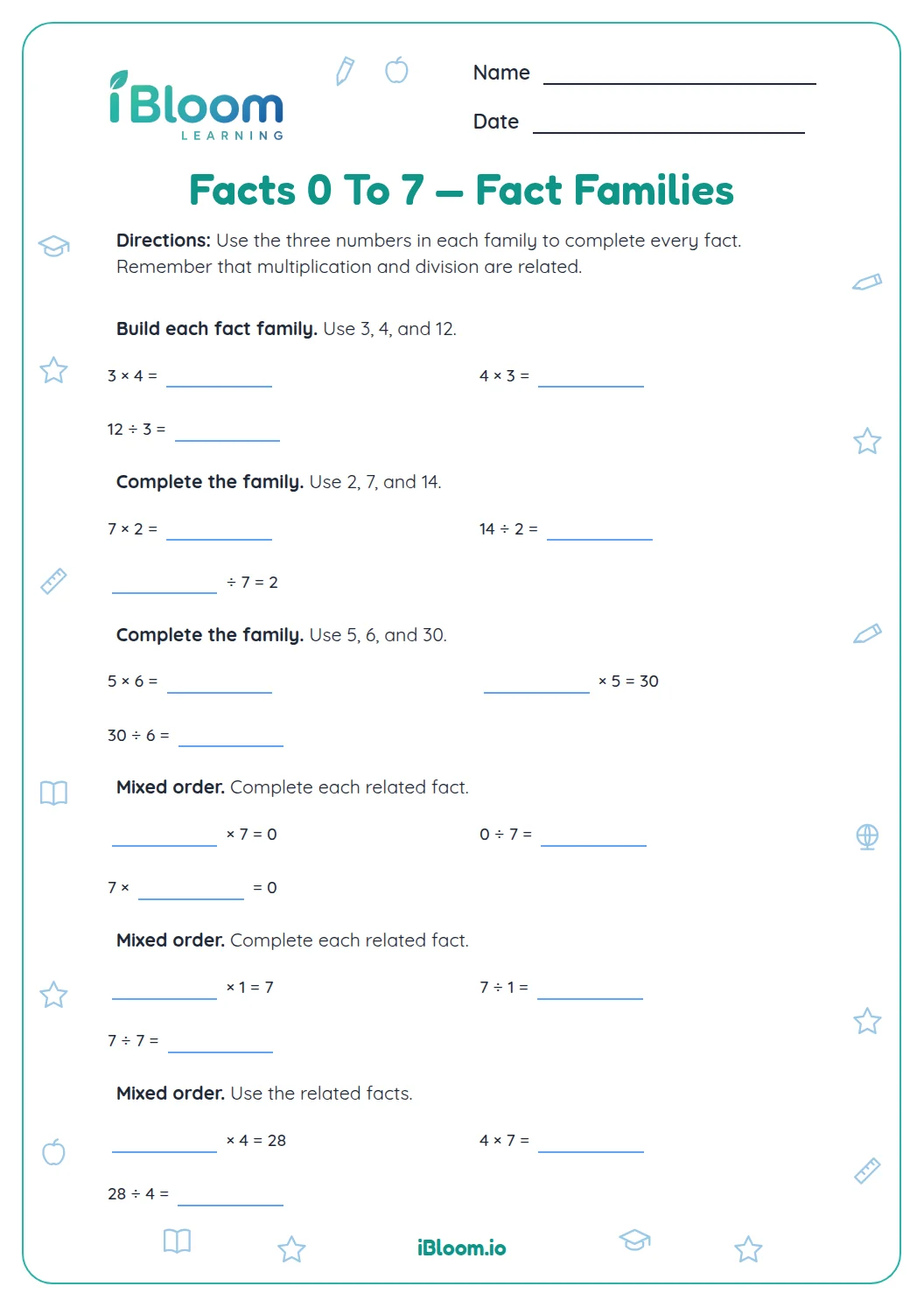
Fluently multiply and divide within 100, using strategies such as the relationship between multiplication and division (e.g., knowing that 8 × 5 = 40, one knows 40 ÷ 5 = 8) or properties of operations. By the end of Grade 3, know from memory all products of two one-digit numbers.
What to practice next
Make more practice
Further reading
Questions parents and teachers ask
Which multiplication facts are included?
Every factor is from zero through seven, and the questions appear in mixed order. The set includes zero and one facts, doubles, and other combinations so learners practice recalling products across the range. The answer key lists the product for each question in its printed order.
What can a child do when a fact is hard to remember?
Picture equal groups, build an array, or use a nearby fact already known. For example, seven groups of four is one more group of four than six groups of four. A quick sketch can make the equal groups easier to see.
Is this a timed test?
No timing is required. Students can work at a steady pace and use the extra working space in the second set to show equal groups or a related fact when they need it. The page is practice, so accuracy matters more than finishing quickly.
How can the answer key help?
Use it after completing the page to check each product. For any missed fact, build the groups or use a known fact to work it out, then try the fact again later. Repeated practice can make these one-digit products easier to recall over time.
Are all multiplication factors between zero and seven?
Yes. Every factor in the 20 equations is between zero and seven, inclusive. The questions appear in mixed order and include zero facts, one facts, doubles, and other combinations. The answer key lists the matching product for each equation.
What is one way to work out 7 × 4?
Use the nearby fact 6 × 4 = 24, then add one more group of four. That gives 24 + 4 = 28. A student can also draw seven groups with four objects in each group or make an array with seven rows and four columns.