


About this worksheet
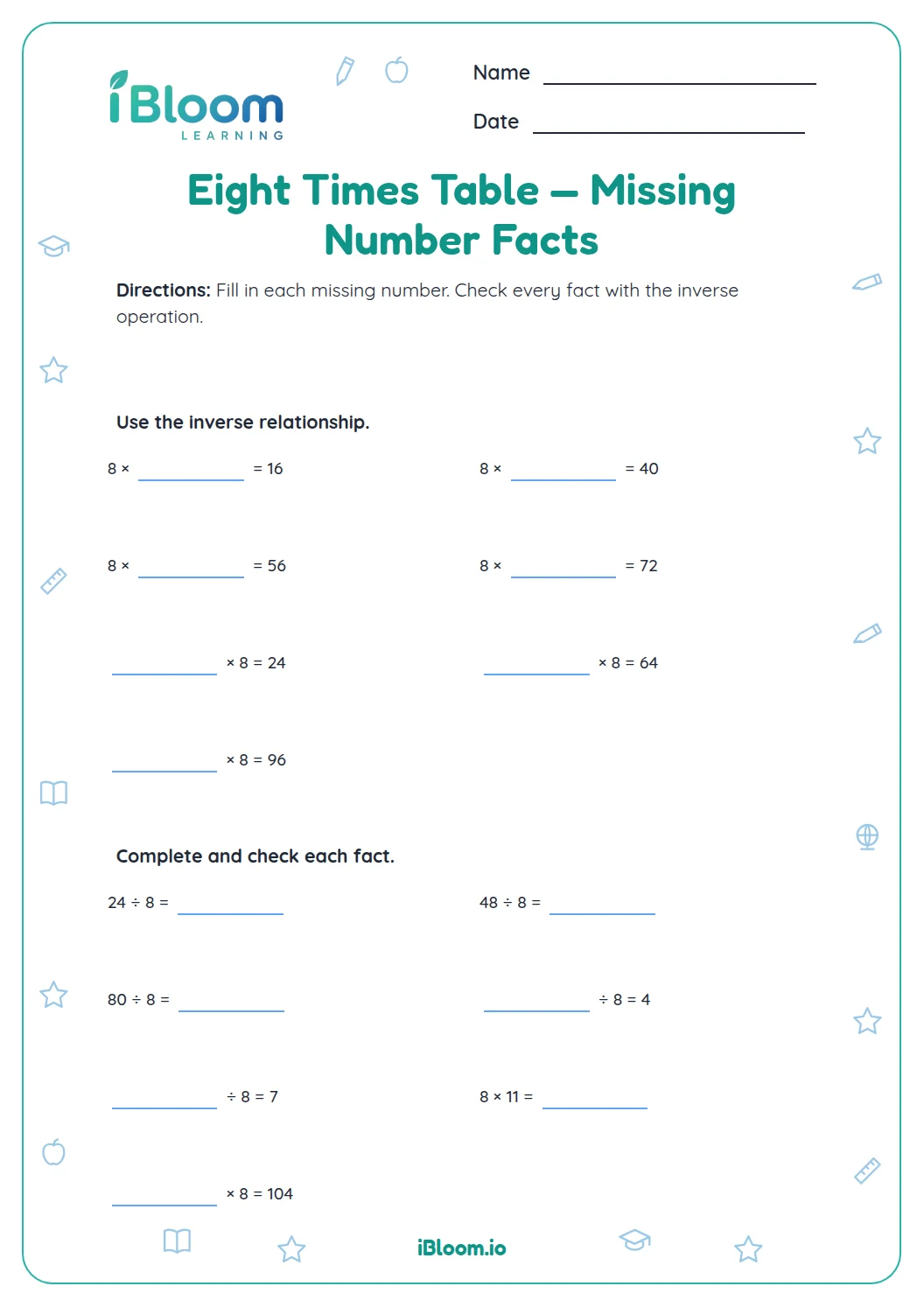
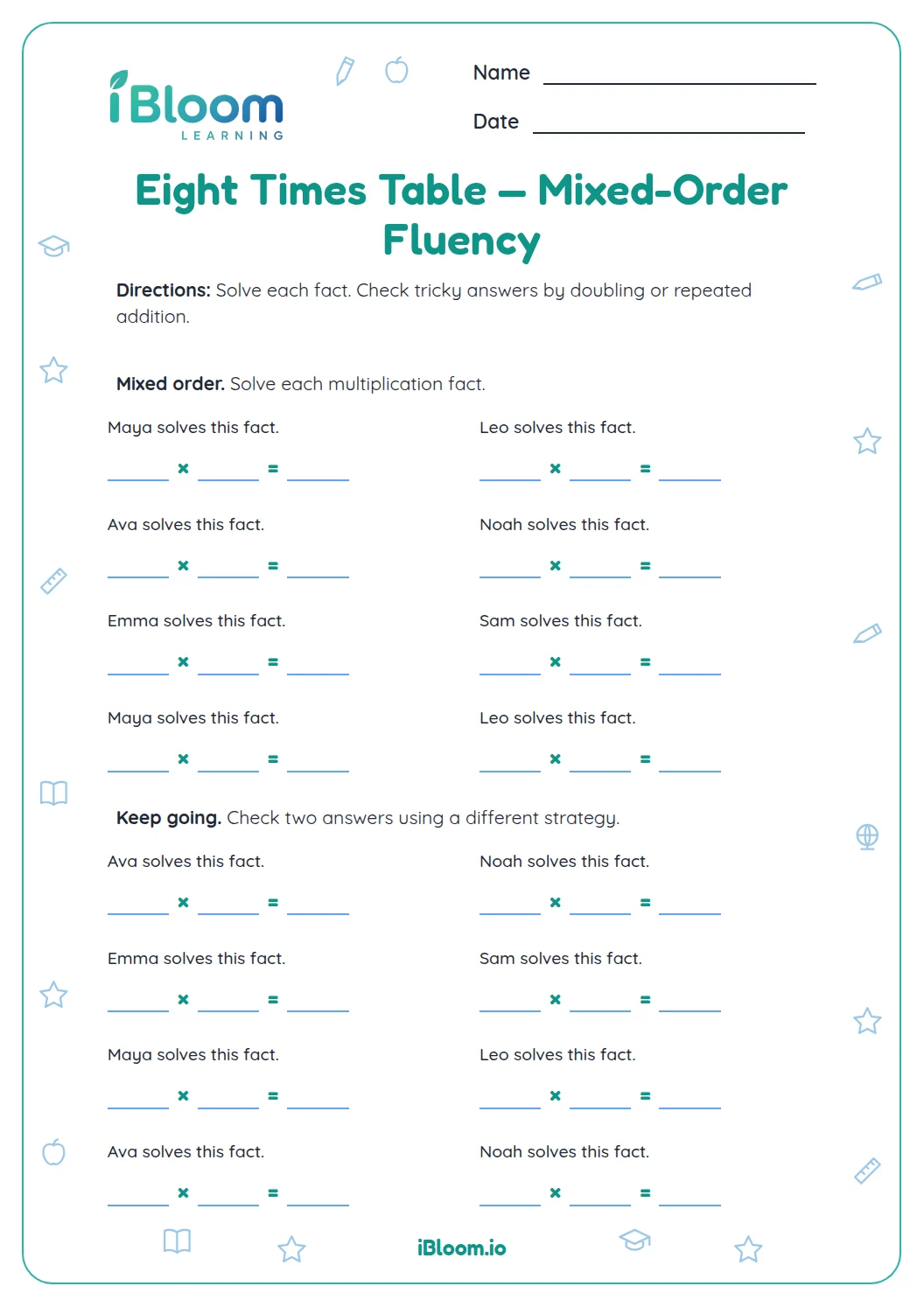
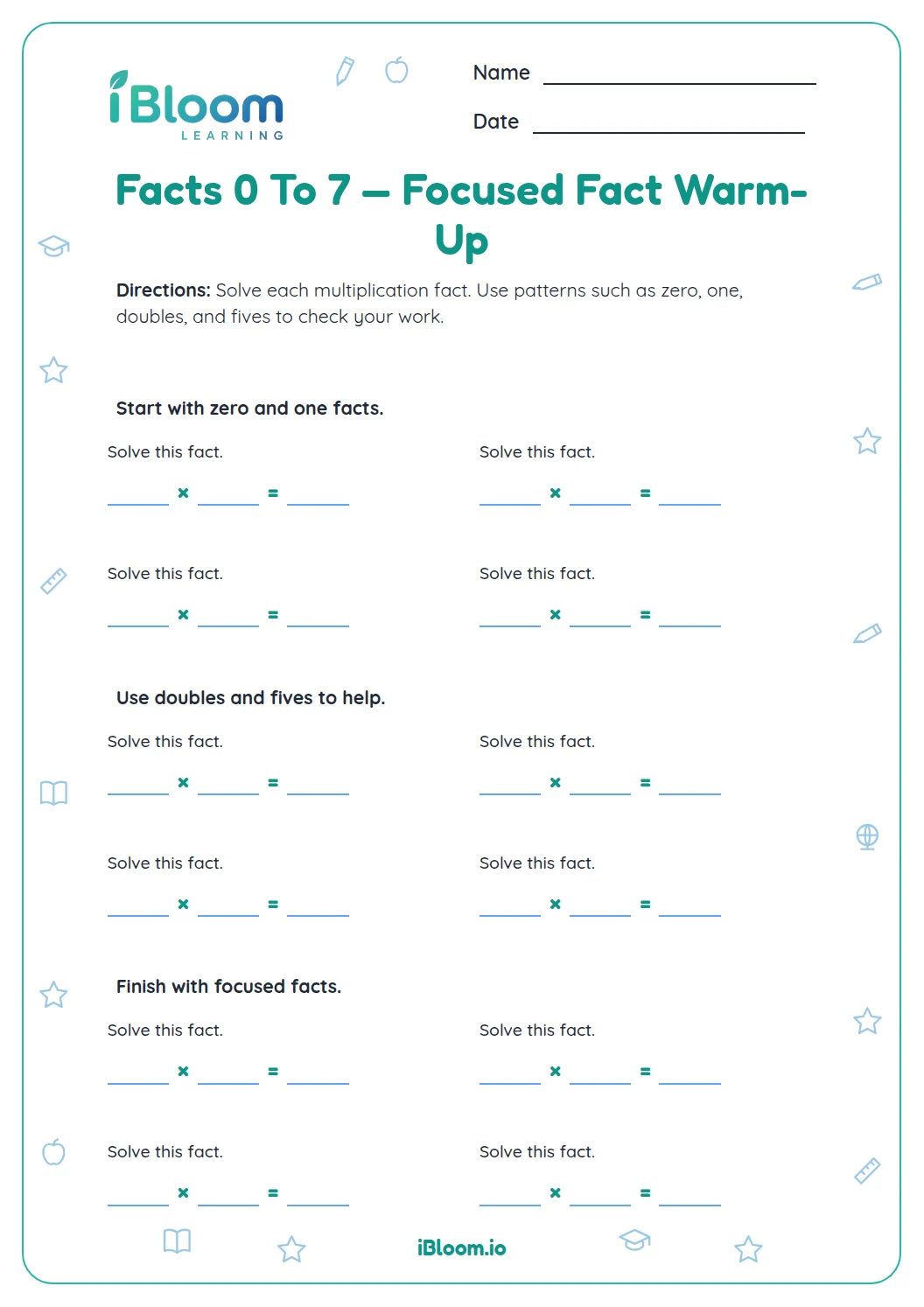
This Grade 3 printable gives focused practice with the eight-times table. Learners solve direct facts, switch factor order, find missing factors, and apply one fact to a short box problem. The variety supports recall and strategy use; an answer key is included.
Aligned to 3.OA.C.7
What patterns help with the eight facts?
The eight facts can be built by doubling four facts, then doubling again. For 8 × 6, double 4 × 6 = 24 to get 48. Check the factor and operation sign before writing the product.
Can you switch the factors?
Part B uses the same multiplication fact in a different order. Since 8 × 9 and 9 × 8 have the same product, a fact you know can help you solve its partner.
How do you find a missing factor?
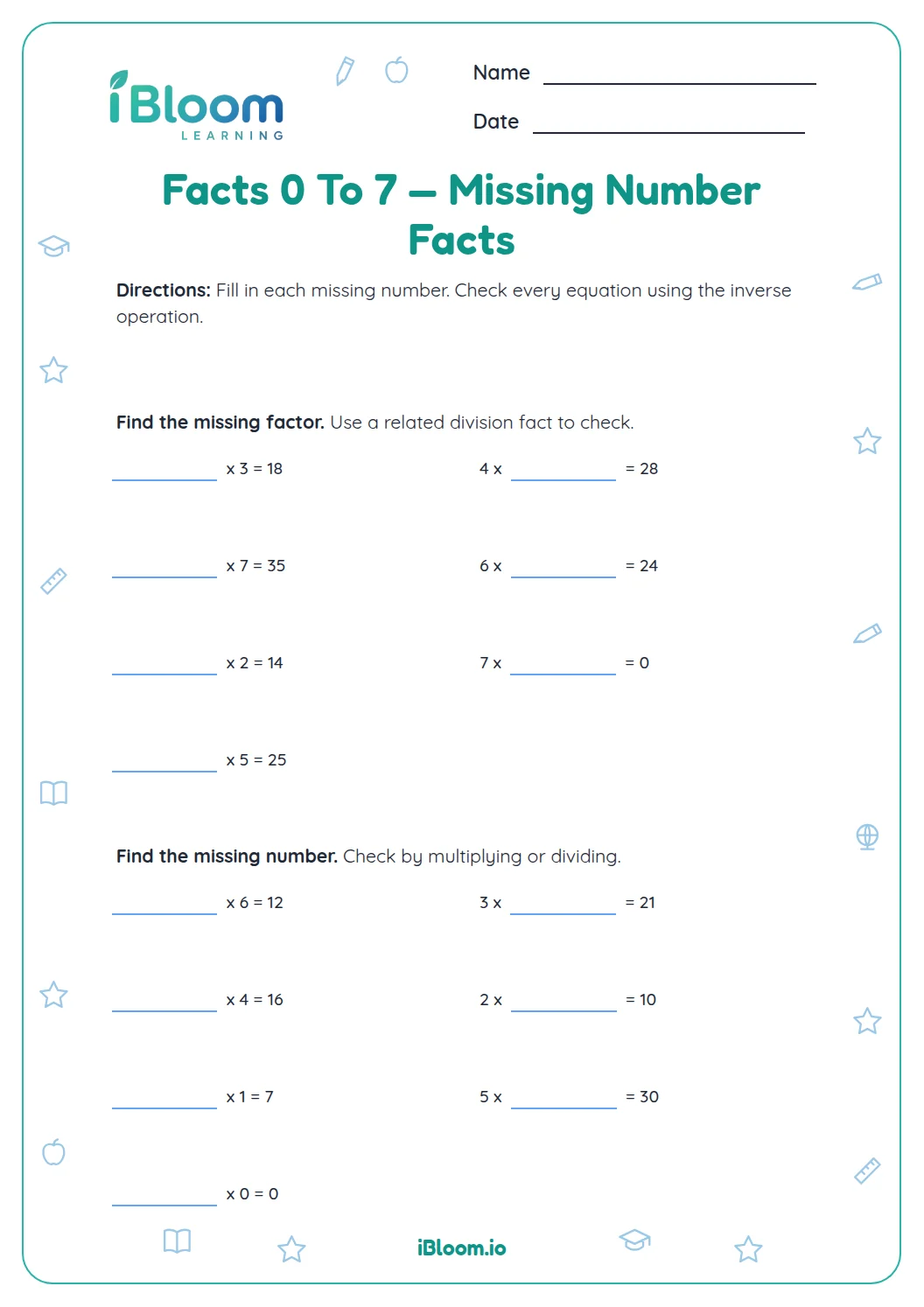
For 8 × ___ = 40, think: what number of groups of 8 makes 40? Count by eights or use 40 ÷ 8 to find 5.
- 1___ × 8 = 40
- 2Think 8 × 5 = 40.
- 3The missing factor is 5.
How to use this worksheet
- 1Read the factors and say the fact aloud.
- 2Use a known fact, such as 4 × 6, to help build an eight fact.
- 3Check whether a blank asks for a factor or a product.
- 4For the story, find the number of equal groups before multiplying.
- 5Review any missed fact using the answer key.
Common mistakes and quick fixes
The mistake
Writing a factor where the product belongs
The fix
Read the whole equation and identify which number is missing.
The mistake
Skipping a count when using eights
The fix
Count each group in order or use a related fact to check.
The mistake
Treating 8 × 9 and 8 + 9 alike
The fix
Look for the multiplication sign and think of equal groups.
Common Core alignment
This practice connects the worksheet skill to classroom learning goals.
Recall products of one-digit factors, including facts with 8.
On this sheet: The warm-up practices the eight facts with varied factors and formats.
Show the official wordingHide the official wording
Fluently multiply and divide within 100, using strategies such as the relationship between multiplication and division (e.g., knowing that 8 × 5 = 40, one knows 40 ÷ 5 = 8) or properties of operations. By the end of Grade 3, know from memory all products of two one-digit numbers.
What to practice next
Make more practice
Further reading
Questions parents and teachers ask
What is a good way to practice the eight times table?
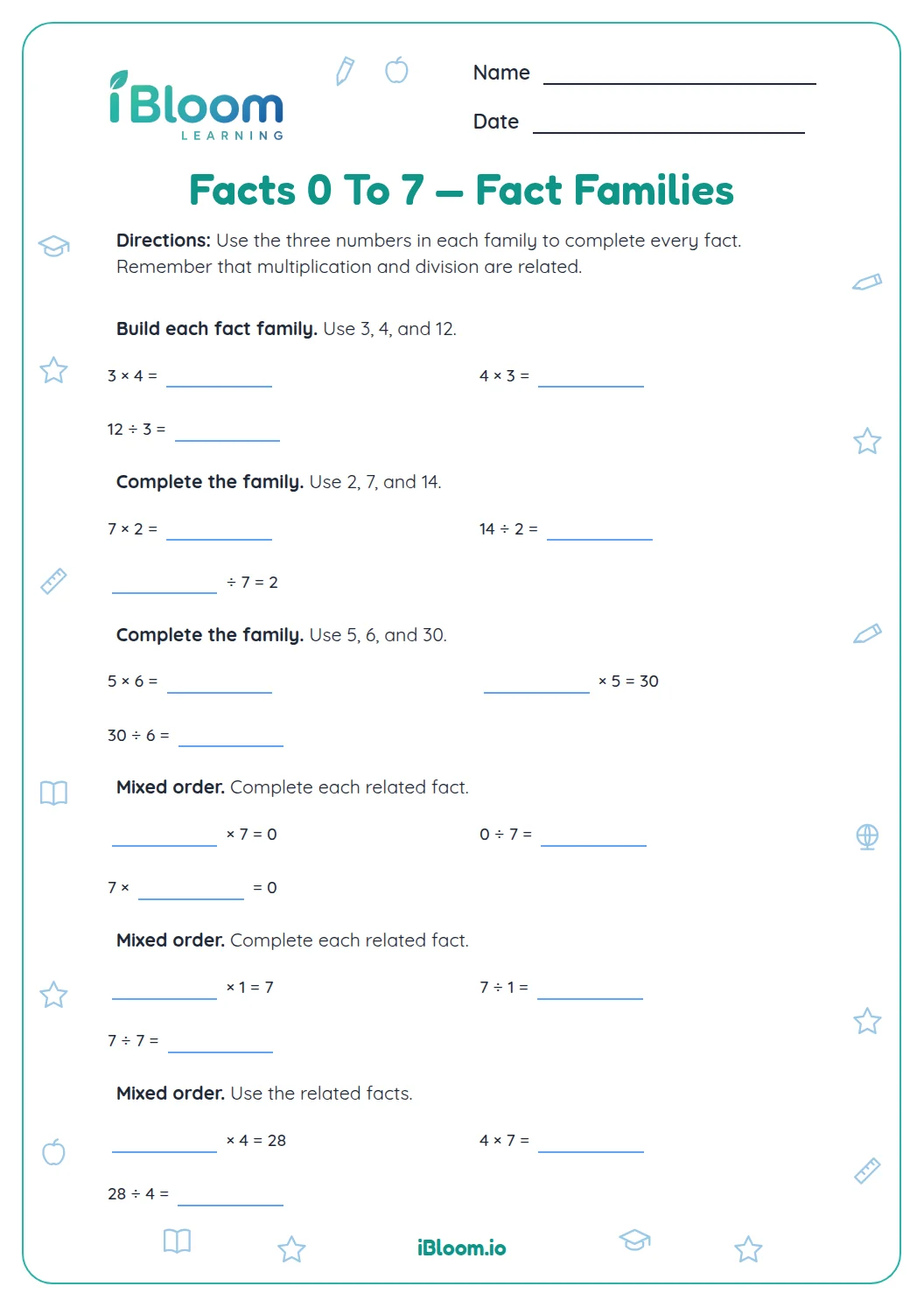
A fact family uses multiplication and division to describe the same groups. This worksheet practices products with 8, missing factors, and related division facts such as 56 ÷ 8. The answer key lists each result so children can check how the operations connect.
Does the printable include an answer key?
Yes. A separate answer key gives the expected answers for checking completed work. For an open-ended response, it offers a sample so an adult can compare the child’s idea without expecting identical wording. Review it after the learner finishes, then discuss any answer that needs another look.
How should I introduce the activity?
Read the short directions together and model one item from the first part. Then let the learner work through the remaining questions at a comfortable pace. Check the key after finishing and talk through one item that felt tricky.
Can a child complete this independently?
A child who knows the skill can try most items independently. An adult can read directions aloud or talk through one example first, then invite the child to explain a choice or check a result. Offer help with directions as needed, and give the learner time to think when useful, too.
How long does this worksheet take?
About 15 minutes. The 20 questions include multiplication facts, missing factors, a groups story, and division facts with 8. Children can use skip counting or repeated addition as a check, then compare their answers with the separate key.