


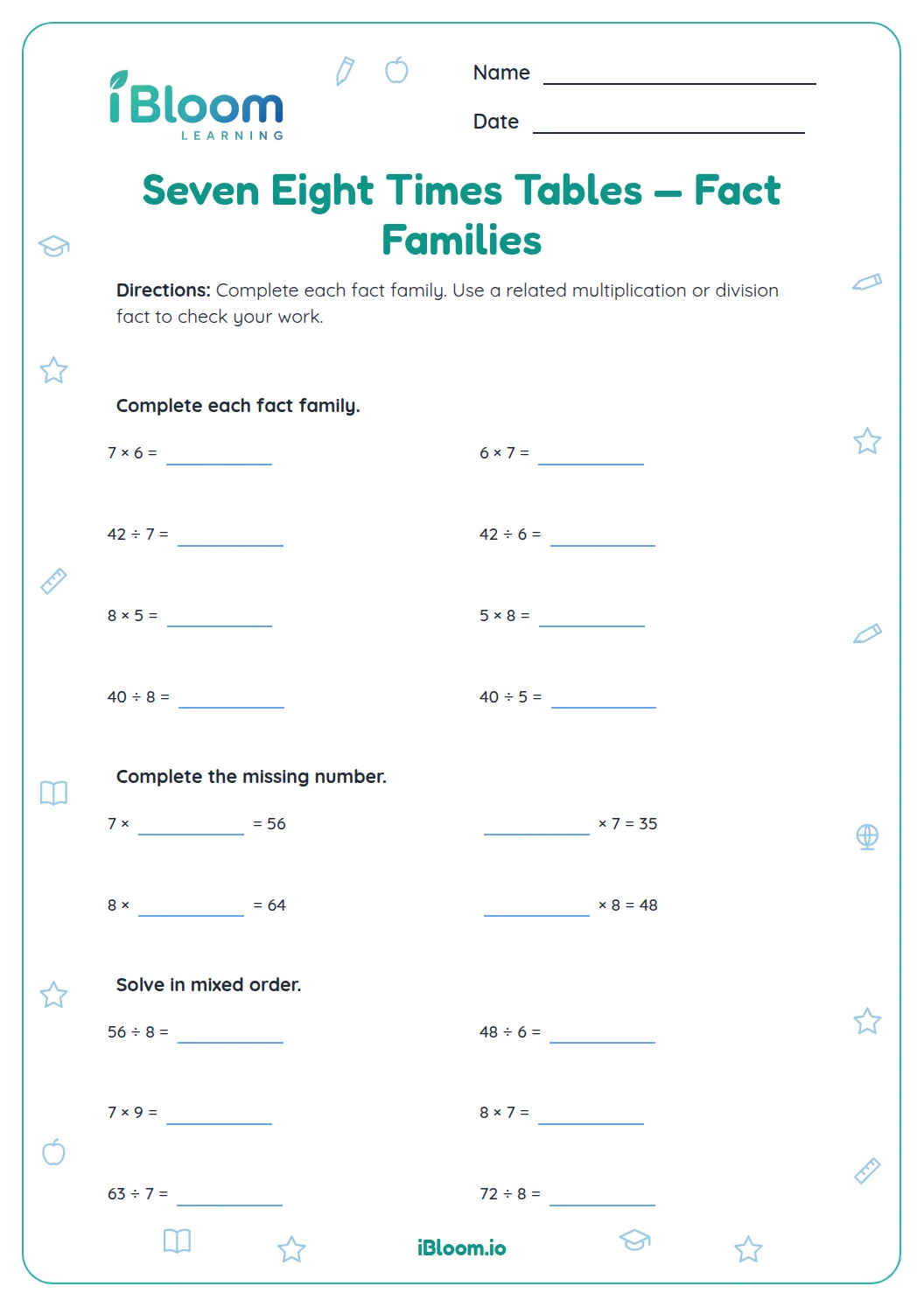
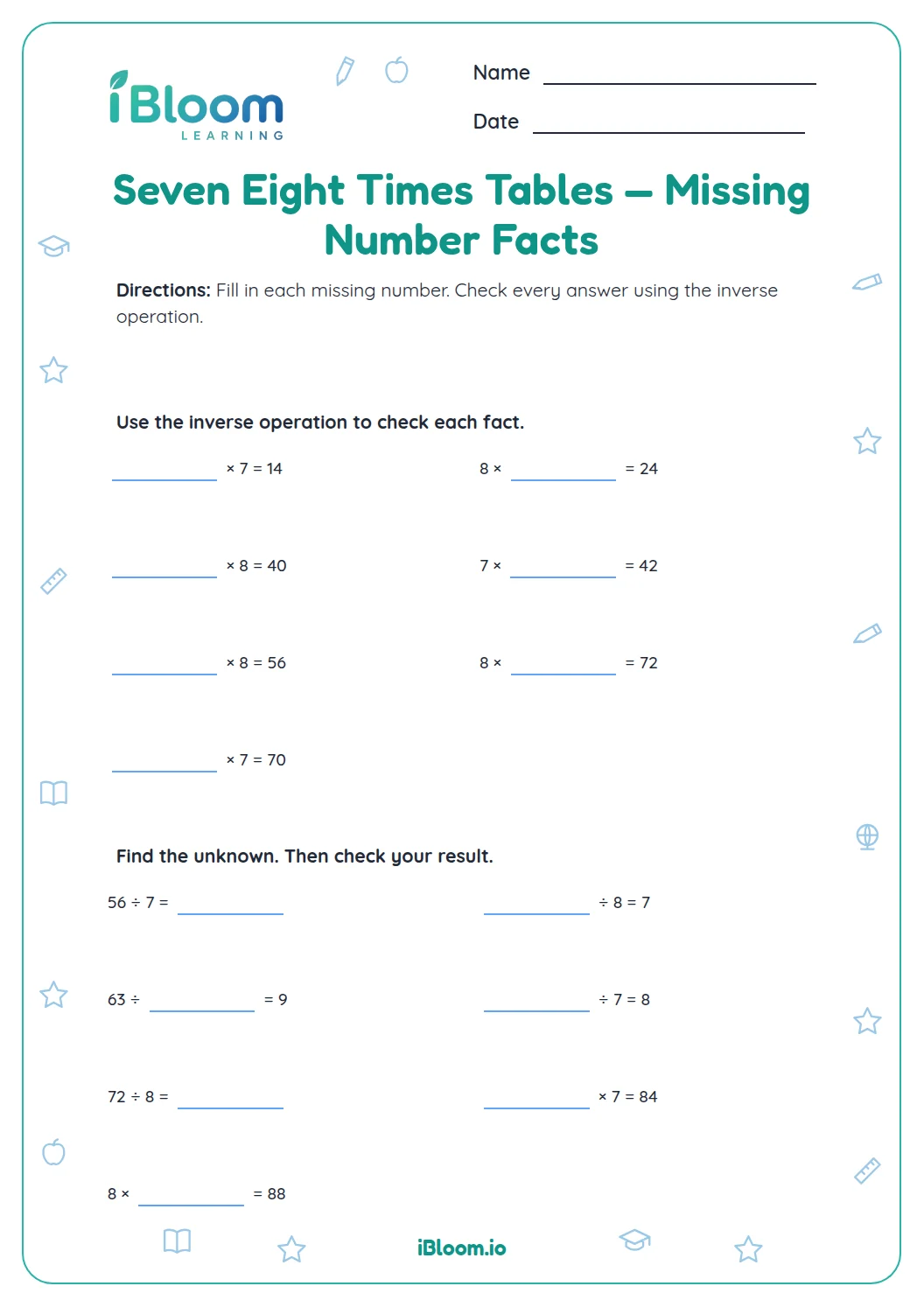
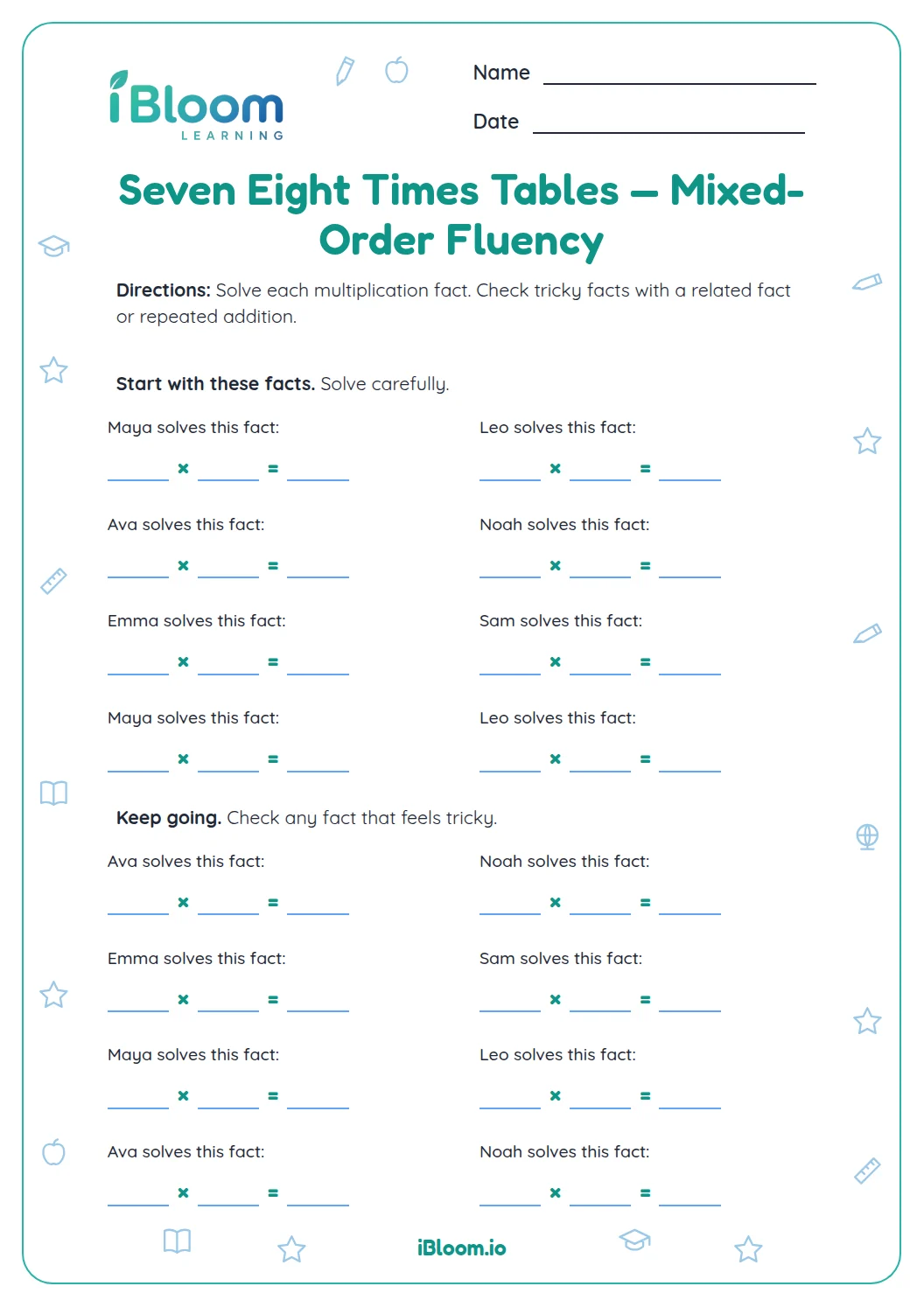


About this worksheet
This free printable is a focused check of the eight times table for students in Grades 3–4. It starts with direct products, moves to missing factors, and then applies the facts to equal groups and an array. Students can use known doubles, such as 4 × 7, to reason about 8 × 7, but the page also checks independent recall. The 16 questions include a visual array and a separate answer key. It aligns with Common Core 3.OA.C.7 for fluent multiplication and division facts within 100.
Aligned to 3.OA.C.7
How can students recall an eight fact?
An eight fact can be built by doubling a known four fact. For example, 4 × 7 = 28, so 8 × 7 is twice 28.
- 14 × 7 = 28
- 2Double 28: 28 + 28 = 56
- 3So 8 × 7 = 56.
How do you find a missing factor?
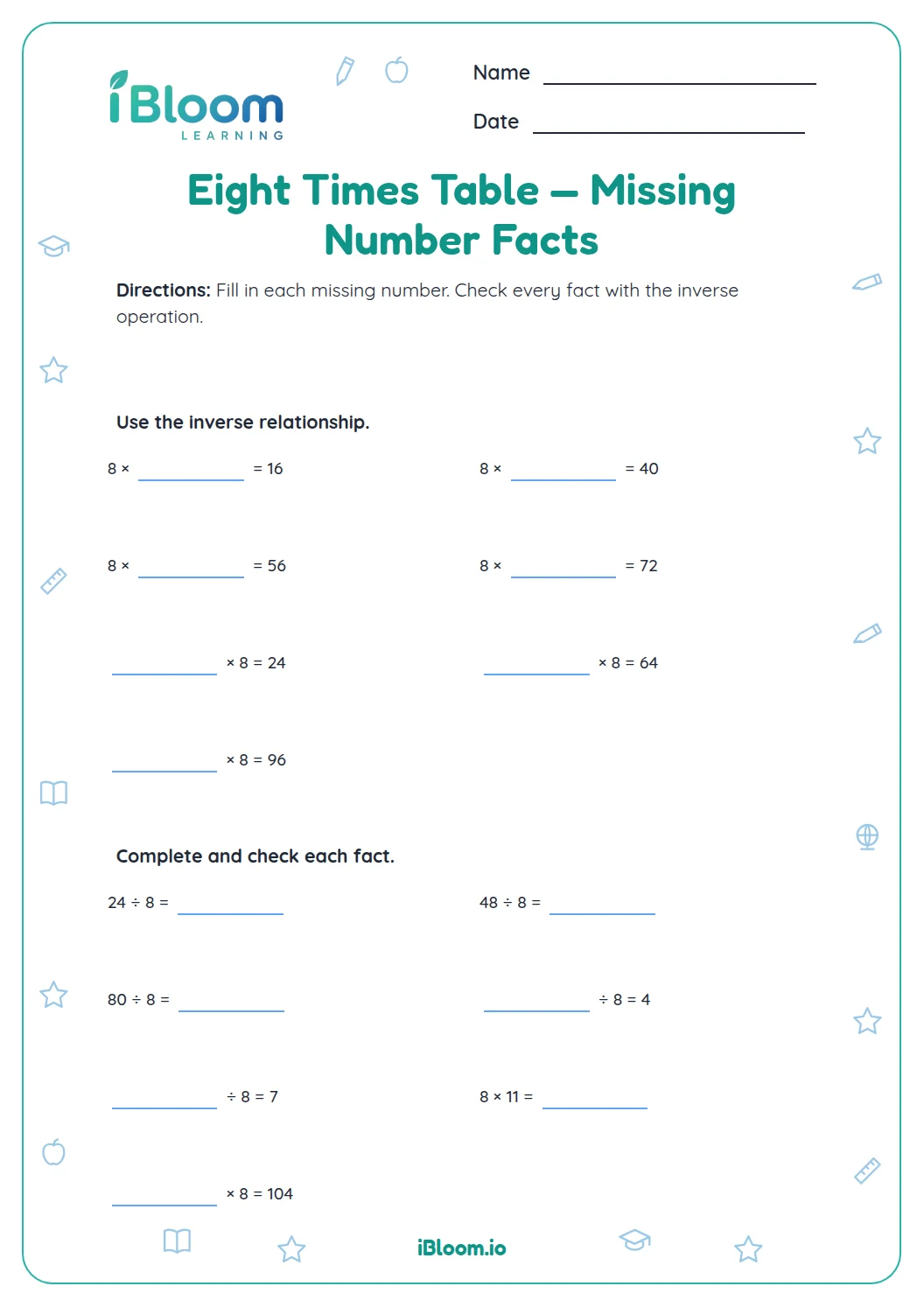
Ask which number of groups or how many in each group makes the product. For ___ × 8 = 40, count by eights until you reach 40: five groups.
How do equal groups connect to multiplication?
Eight rows of seven objects represent 8 × 7. Count by rows or use the fact to find the total.
How to use this worksheet
- 1Read the factors and operation sign carefully.
- 2Recall the product or use a related fact to reason it out.
- 3For a missing factor, ask what number makes the equation true.
- 4Translate equal groups into a multiplication equation.
- 5Check by skip counting or using division.
Common mistakes and quick fixes
The mistake
Mixing up nearby products, such as 8 × 6 and 7 × 6.
The fix
Say the factors aloud and count by eights to check the product.
The mistake
Writing a product in the missing-factor blank.
The fix
Test a factor in the equation and multiply to see whether it reaches the product.
The mistake
Counting only the rows or columns in an array.
The fix
Multiply the number of rows by the number in each row.
Common Core alignment
The questions practice multiplication facts within 100 with a focus on factors of eight.
Build fluency with multiplication facts within 100, including the eight facts.
On this sheet: Students recall and apply products from the eight times table, including missing-factor and equal-group problems.
Show the official wordingHide the official wording
Fluently multiply and divide within 100, using strategies such as the relationship between multiplication and division (e.g., knowing that 8 × 5 = 40, one knows 40 ÷ 5 = 8) or properties of operations.
What to practice next
Make more practice
Further reading
Questions parents and teachers ask
Which products are included?
The questions practice products for eight multiplied by factors from zero through twelve. Direct products are mixed with missing-factor equations and equal-group situations. Students should be able to use recall or a strategy that reliably produces the product. The products stay within 100, supporting practice with basic multiplication fluency.
What is 8 times 7?
8 × 7 = 56. One way to reason it out is to double 4 × 7, which is 28. Doubling 28 gives 56. Question 15 asks students to describe that kind of strategy. Students may also count eight groups of seven to verify the result.
Can students use skip counting?
Yes. Counting by eights can help students check a product or find a missing factor. For example, five counts of eight reach 40, so ___ × 8 = 40 has the missing factor 5. Repeated addition gives another check when the fact is not yet automatic.
What does the array show?
The array has 8 rows with 7 apples in each row. That is 8 groups of 7, or 8 × 7, for a total of 56 apples. Students can count each row or use the multiplication fact. The array makes both factors visible, so students can connect groups with a product.
Is the timed goal required?
No timing is printed as a requirement on this mastery check. Students can work at a steady pace, show a strategy when needed, and use the answer key to review facts they want to practice again. A calm pace leaves room to use a strategy and check the answer.