






About this worksheet
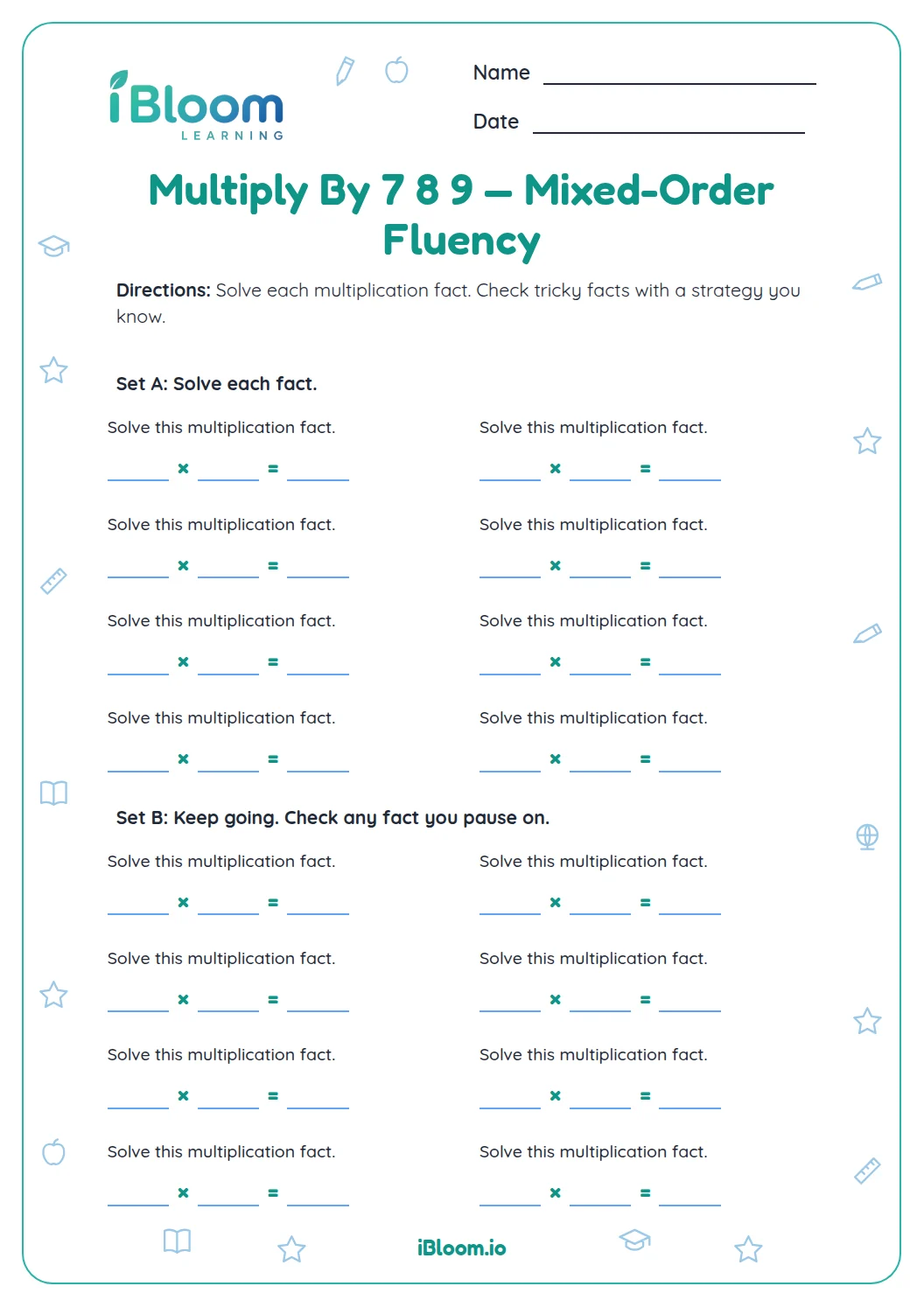
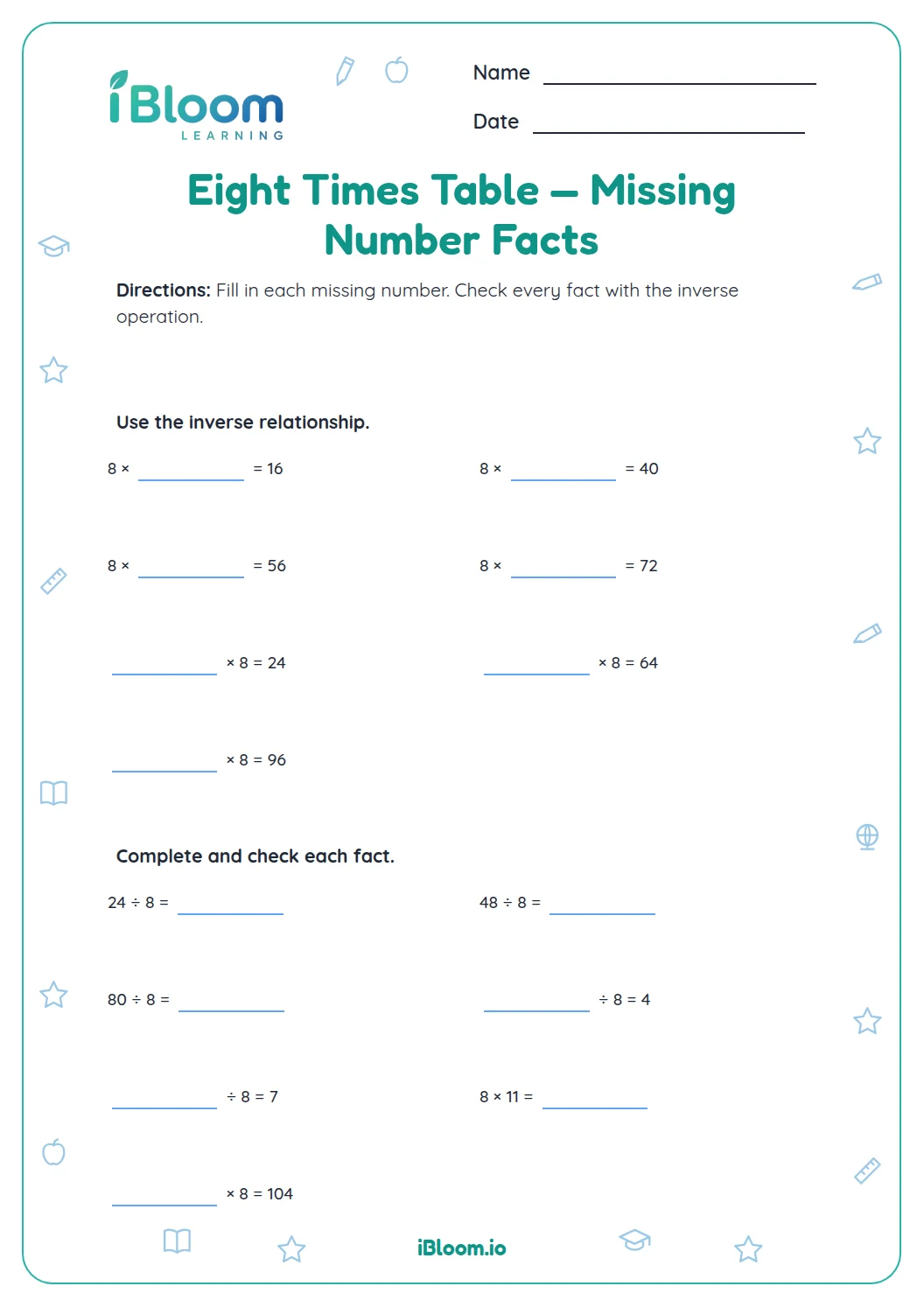
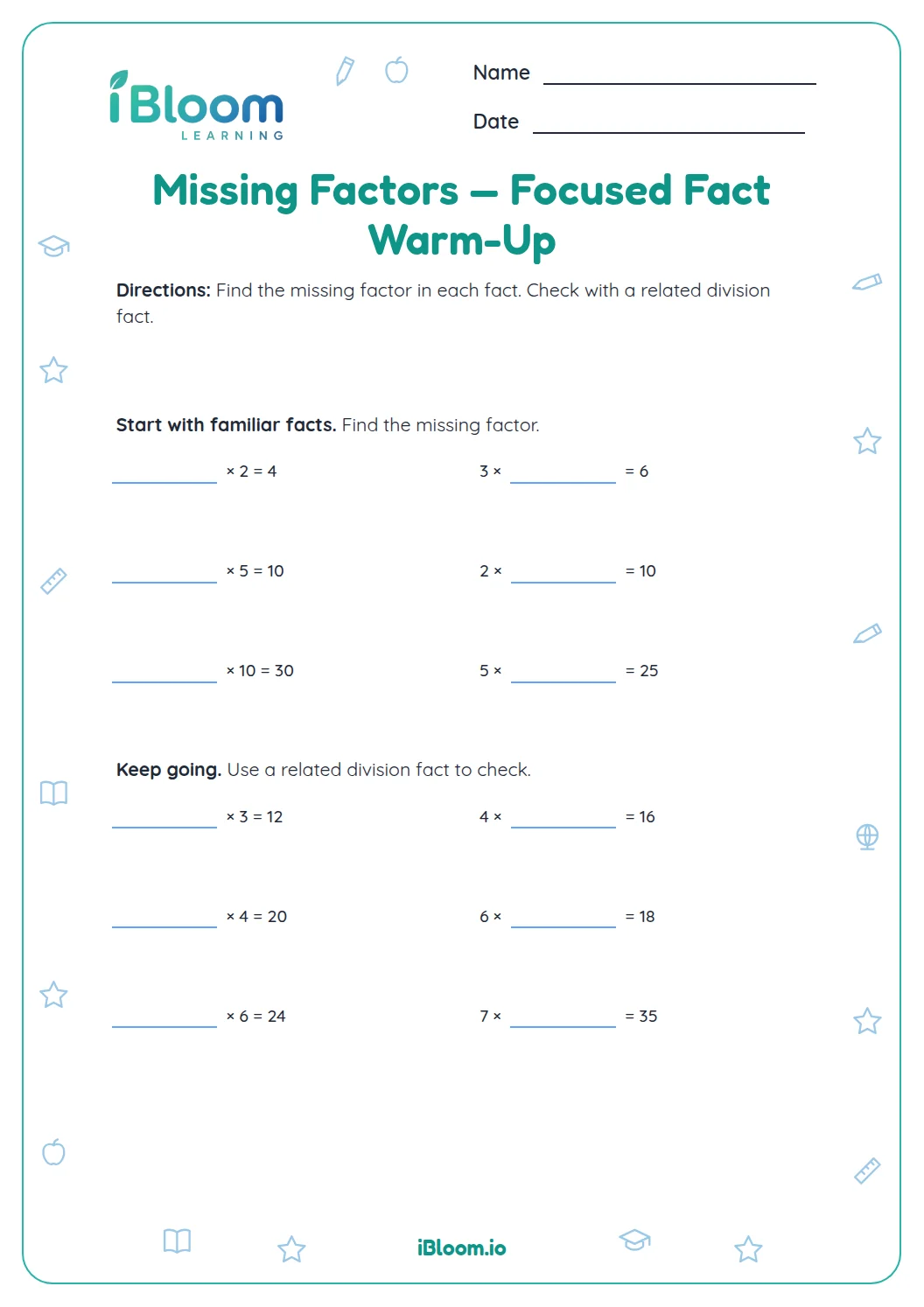
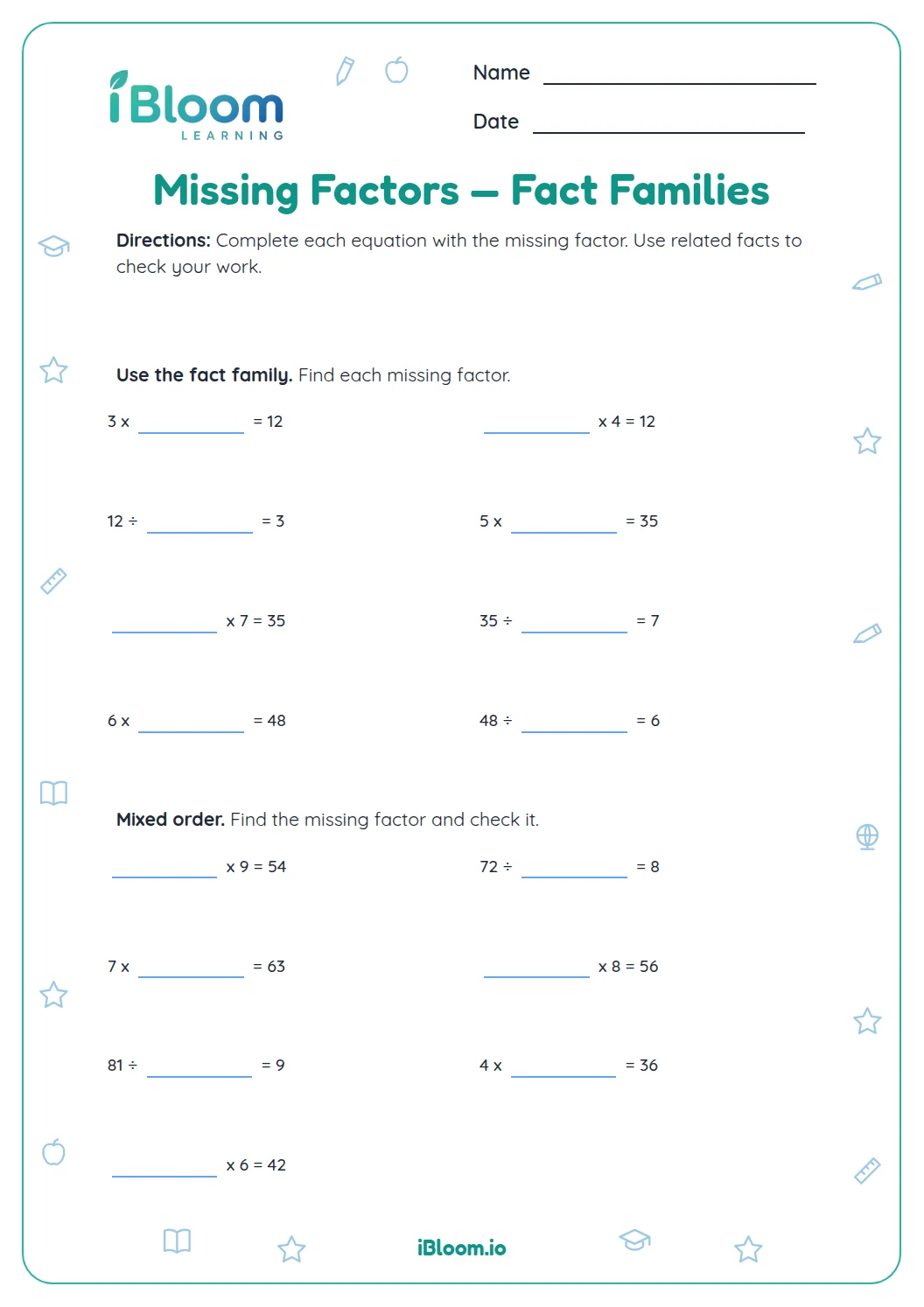
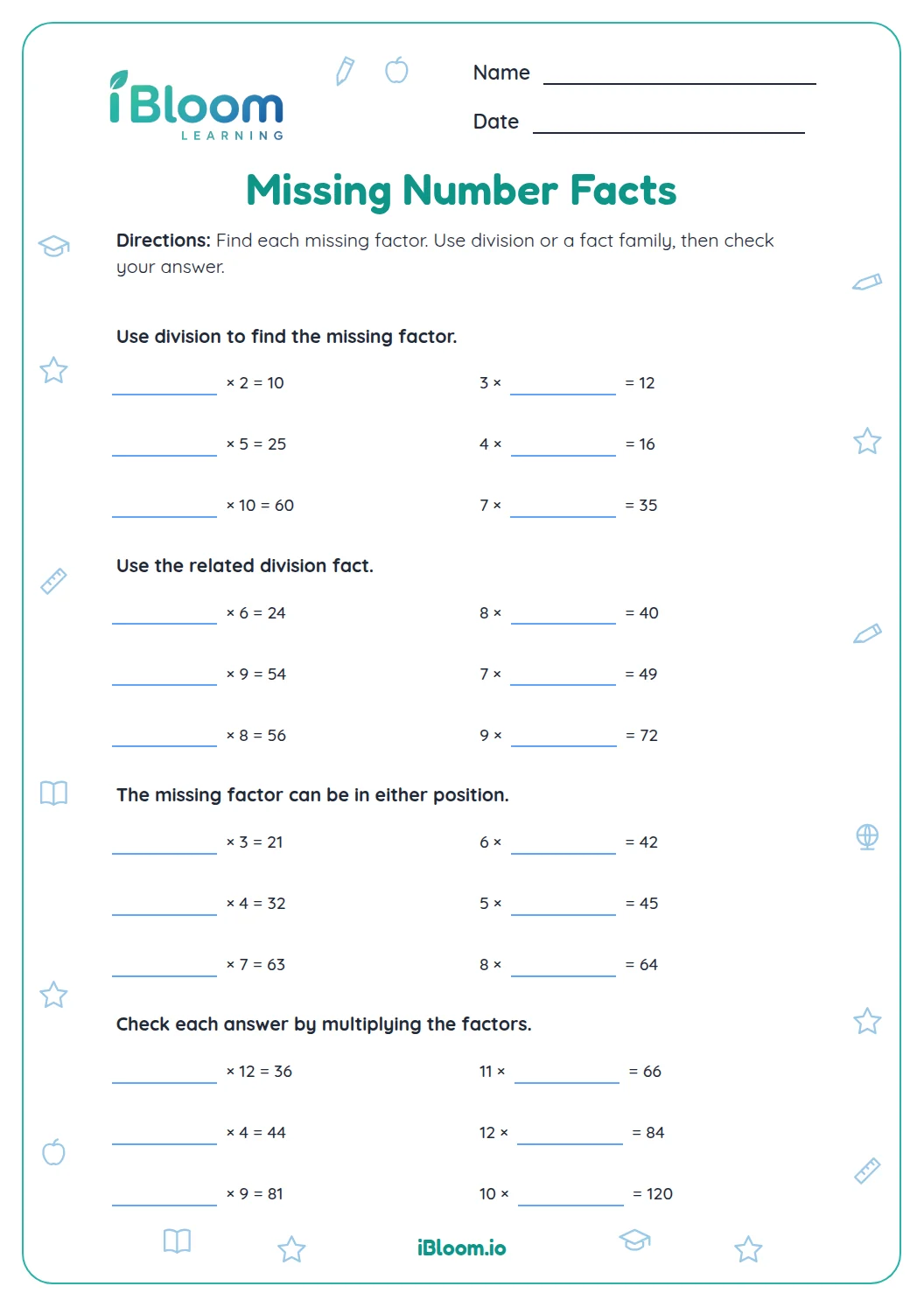
This free printable math worksheet is for students in Grades 3–4 who are learning to find a missing factor. Twenty equations mix the 7, 8, and 9 times tables, with the blank placed before or after the known factor. Students can divide the product by the known factor, then multiply to check. The practice supports Common Core 3.OA.C.7, which connects multiplication and division within 100. A separate answer key lists all 20 missing factors.
Aligned to 3.OA.C.7
How can division reveal a missing factor?
A product and one factor are enough to find the other factor. In ___ × 7 = 35, divide 35 by 7 to get 5, then check 5 × 7 = 35. The worksheet varies which factor is missing and mixes the 7, 8, and 9 facts.
- 1___ × 7 = 7
- 27 ÷ 7 = 1
- 3The missing factor is 1.
How is the practice organized?
Parts A, B, and C focus on the 7, 8, and 9 facts. Part D mixes the tables. Missing factors vary within each part, and each equation has one blank.
How can students check an answer?
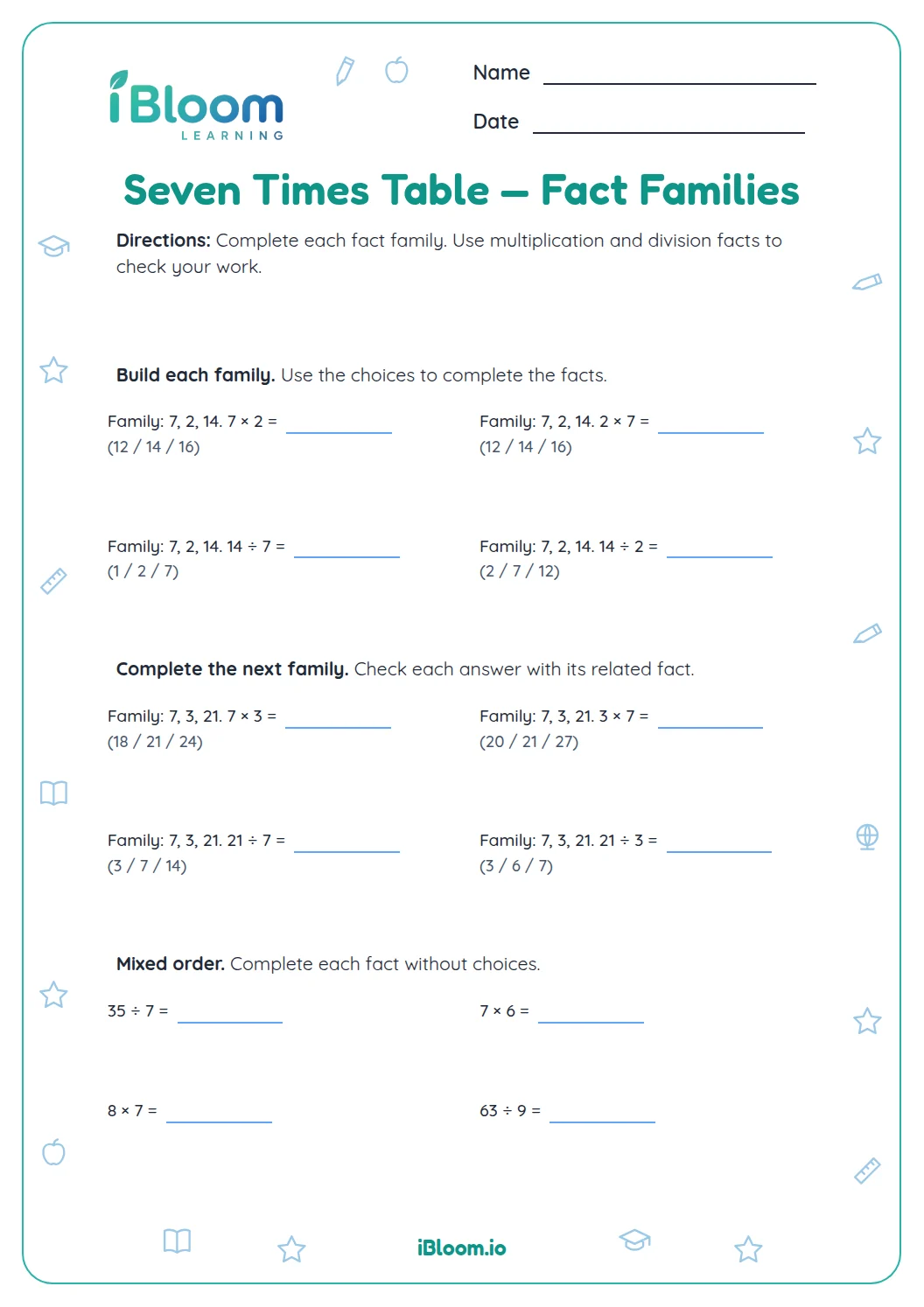
Multiply the missing factor by the printed factor. The result should match the product after the equals sign. For example, 1 × 7 gives 7.
How to use this worksheet
- 1Read the operation sign and identify the known numbers.
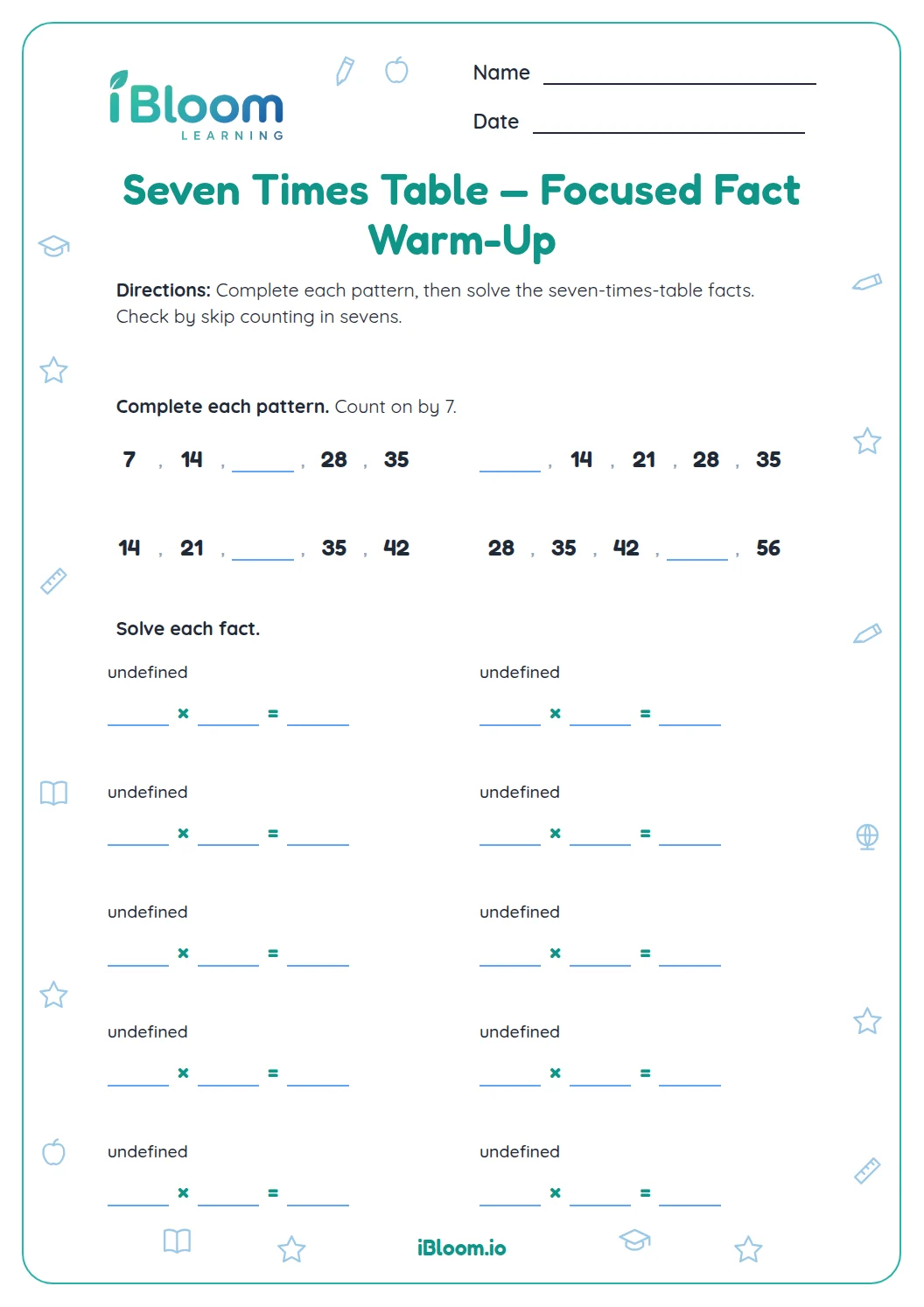
- 2Solve with a multiplication fact, skip-counting, or the inverse operation.
- 3Check that the completed equation is true.
- 4Use the answer key after finishing a part.
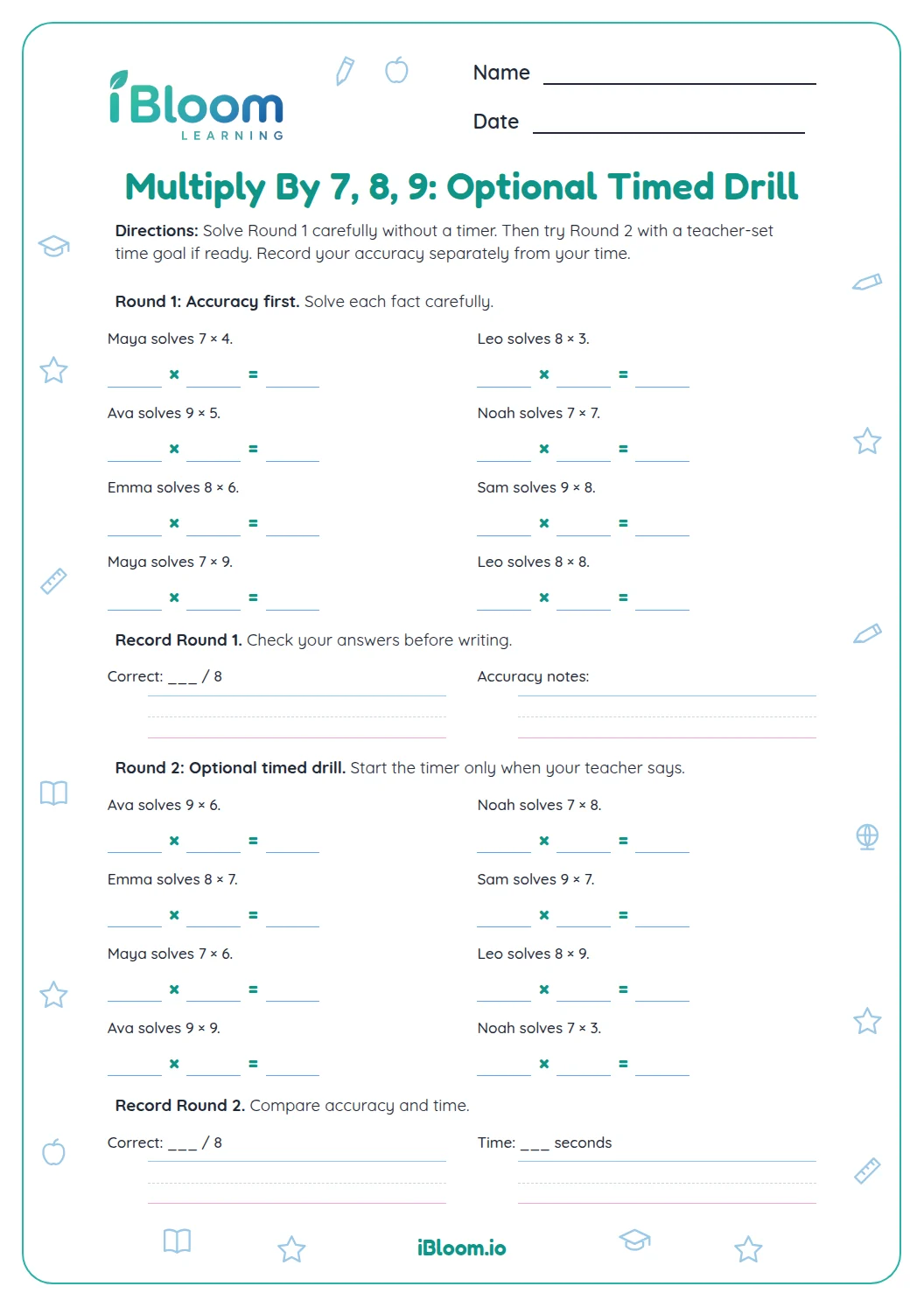
- 5Try timing only after the untimed work is accurate.
Common mistakes and quick fixes
The mistake
Adding the factors instead of multiplying.
The fix
Think of equal groups or recall the matching product.
The mistake
Using the wrong divisor to find a missing factor.
The fix
Divide by the factor that is already printed in the equation.
The mistake
Rushing because a timer is available.
The fix
Finish carefully first; timing is an optional way to notice progress.
Common Core alignment
This practice connects multiplication and division facts within 100.
Build fluency with multiplication and division facts within 100.
On this sheet: The questions practice products, related quotients, or missing factors using facts within 100.
Show the official wordingHide the official wording
Fluently multiply and divide within 100, using strategies such as the relationship between multiplication and division (e.g., knowing that 8 × 5 = 40, one knows 40 ÷ 5 = 8) or properties of operations. By the end of Grade 3, know from memory all products of two one-digit numbers.
What to practice next
Make more practice
Further reading
Questions parents and teachers ask
What is a missing factor?
The worksheet has 20 missing-factor equations across the 7, 8, and 9 tables. Parts A-C focus on one table at a time, and Part D mixes two more items. Each item has one blank. A separate answer key lists every factor in order for checking.
How can division help find the blank?
Divide the printed product by the factor you already know. For 8 × ___ = 40, calculate 40 ÷ 8 = 5. Put 5 in the blank, then multiply 8 × 5 to confirm the product is 40. This check works for every table on the sheet.
Which multiplication tables appear?
The questions use the 7, 8, and 9 times tables. Parts A, B, and C focus on one table at a time, while Part D mixes the tables. The missing factors vary, so students must use the equation instead of repeating one answer.
Can the blank appear in different places?
Yes. Some equations place the blank before the known factor, and others put it after the multiplication sign. In each case, look at the known factor and product, divide to find the missing number, and multiply to check the completed equation. Check the completed equation carefully.
Is an answer key included?
Yes. A separate answer key gives the answer for all 20 questions in worksheet order. Finish a part before checking it, then return to any missed item and use the related fact to correct the work. The key supports independent practice and adult review.