





About this worksheet
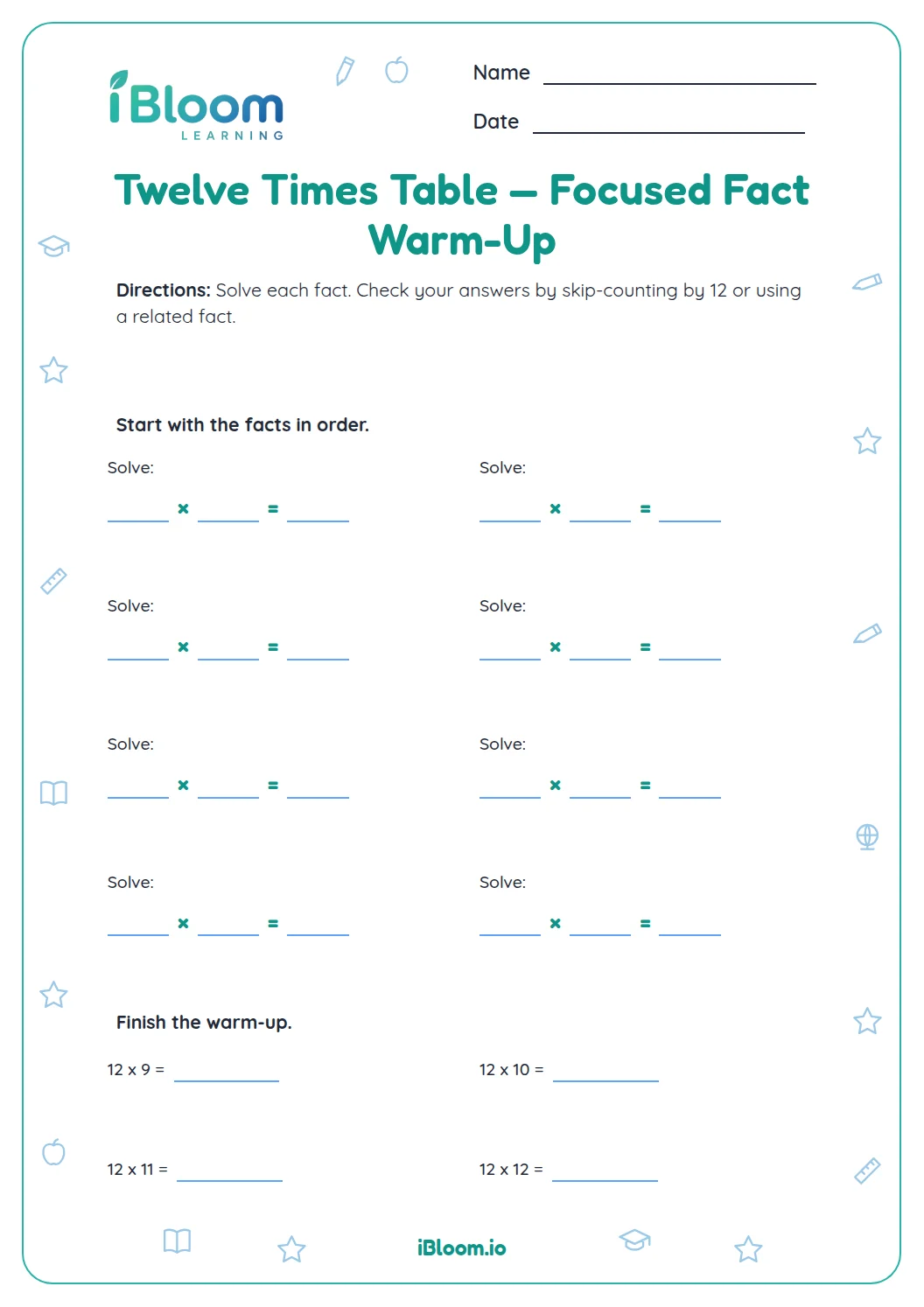
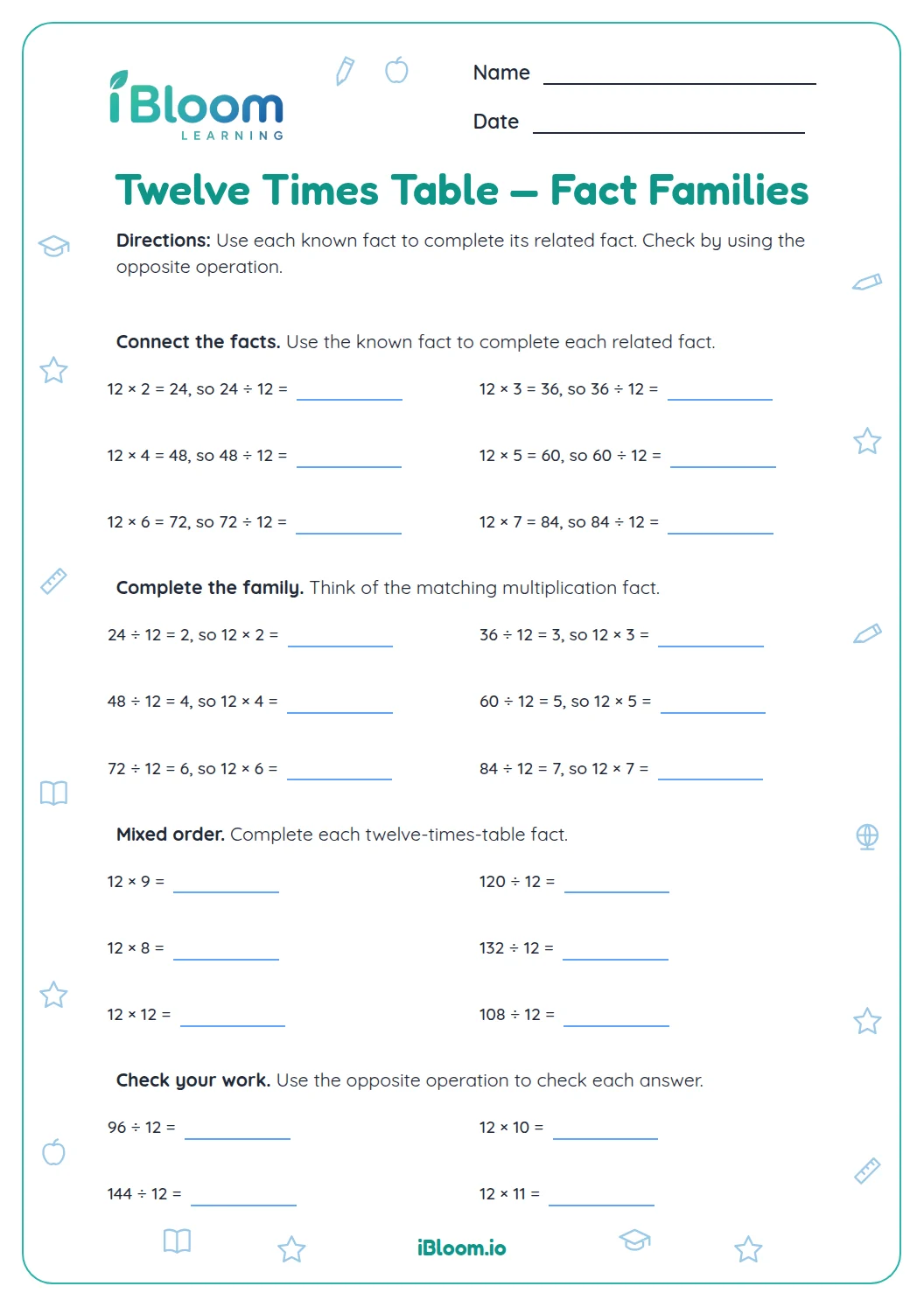
Learners retrieve products with 9, solve two missing-factor equations, and use multiplication in two equal-group situations. The facts are shuffled so students must recall each product instead of following the table in order. The answer key includes all 16 products and story totals.
Aligned to 3.OA.C.7
How does the warm-up move beyond memorizing a list?
Learners retrieve products with 9, solve two missing-factor equations, and use multiplication in two equal-group situations. The facts are shuffled so students must recall each product instead of following the table in order. The answer key includes all 16 products and story totals.
- 19 × 4 = ___
- 2Answer: 36
How does the warm-up move beyond memorizing a list?
Part A mixes the order of the 9 facts, then Part B asks for a missing factor and Part C applies multiplication to rows and groups.
How can a child check a nine-times fact?
Use a known fact or split 9 into 10 − 1; for 9 × 4, compute 40 − 4 = 36, then check that product in the key.
How to use this worksheet
- 1Work through the shuffled facts without a calculator.
- 2For a missed fact, use a known product or the 10-times fact minus one group.
- 3Solve the missing-factor equations by asking what number times 9 gives the product.
- 4Represent each story as equal groups before multiplying.
- 5Check products and story totals with the answer key.
Common mistakes and quick fixes
The mistake
Adding 9 to find a product such as 9 × 6.
The fix
Use six groups of 9, or calculate 10 × 6 − 6 = 54.
The mistake
Writing the known product in the missing-factor blank.
The fix
Ask which number multiplied by 9 equals the product.
The mistake
Using the number of groups as the total in a story.
The fix
Multiply groups by the number in each group to find the total.
Common Core alignment
Fluently multiply and divide within 100, using strategies such as the relationship between multiplic
On this sheet: Sixteen shuffled nine-times-table facts, missing factors, and two equal-group problems.
Show the official wordingHide the official wording
Fluently multiply and divide within 100, using strategies such as the relationship between multiplication and division (e.g., knowing that 8 × 5 = 40, one knows 40 ÷ 5 = 8) or properties of operations. By the end of Grade 3, know from memory all products of two one-digit numbers.
What to practice next
Make more practice
Further reading
Questions parents and teachers ask
Is an answer key included?
Yes. A separate answer key lists all 16 products, missing factors, and equal-group totals. It is useful after the learner has tried the shuffled facts and shown a multiplication equation for each story. Ask the learner to name the two factors, describe the equal groups, and explain how the product answers the equation or story.
How should the learner check an answer?
Use a known fact or the 10-times product minus one group. For 9 × 6, calculate 60 − 6 = 54, then check that multiplying 54 by 9 is not needed because the original factor pair is 9 and 6. Ask the learner to name the two factors, describe the equal groups, and explain how the product answers the equation or story.
Can this be used for independent practice?
Yes. The sheet begins with short equations and ends with two clearly stated equal-group situations. Learners can complete the facts independently and use the answer key to check afterward. Ask the learner to name the two factors, describe the equal groups, and explain how the product answers the equation or story.
What materials are needed?
A pencil is enough. The equations and story problems are printed on the page; no counters or calculator are required. Ask the learner to name the two factors, describe the equal groups, and explain how the product answers the equation or story.
How long does it take?
Plan for about 15 minutes. The shuffled facts are brief, while the learner may spend longer explaining a strategy for missed products or showing the two story equations. Ask the learner to name the two factors, describe the equal groups, and explain how the product answers the equation or story.