


About this worksheet
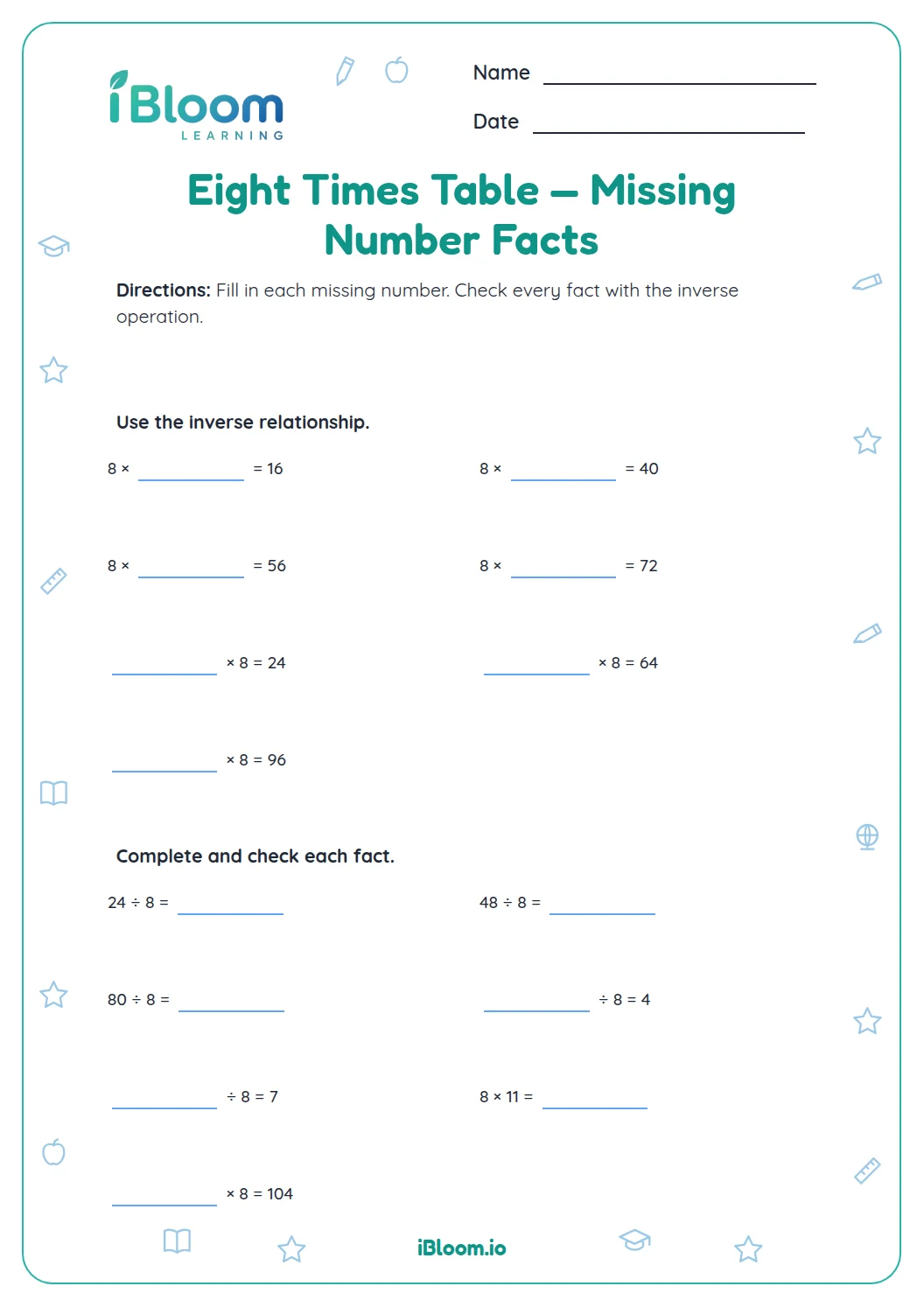
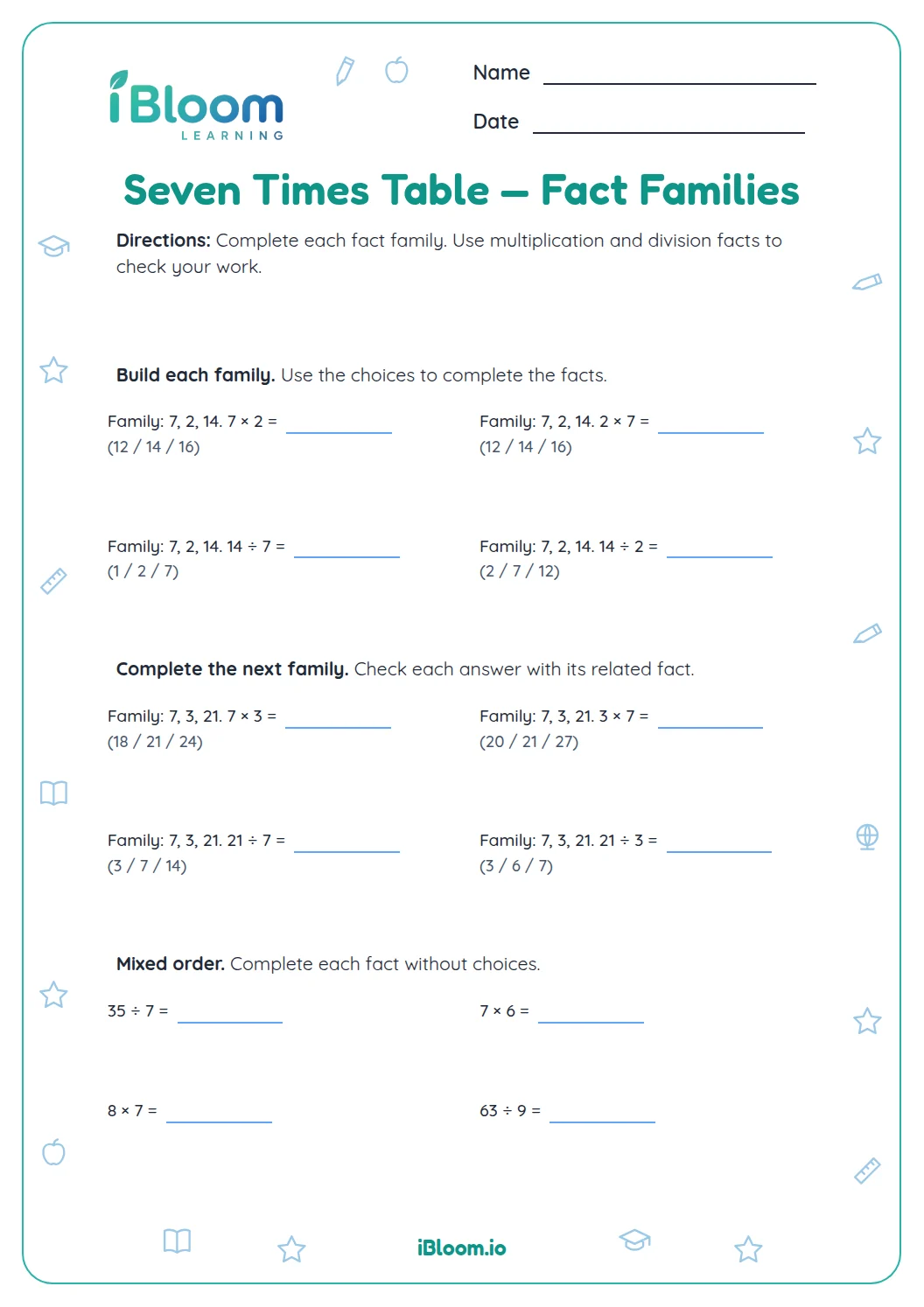
This two-page multiplication worksheet focuses on the eight times table through both direct facts and fact families. Part A checks products and missing factors. Part B gives three related numbers and asks students to write two multiplication and two division equations, reinforcing how the operations undo one another. The answer key lists all equations in each family so students can check both the products and the order of the factors.
Aligned to 3.OA.C.7
Which eight-times facts come first?
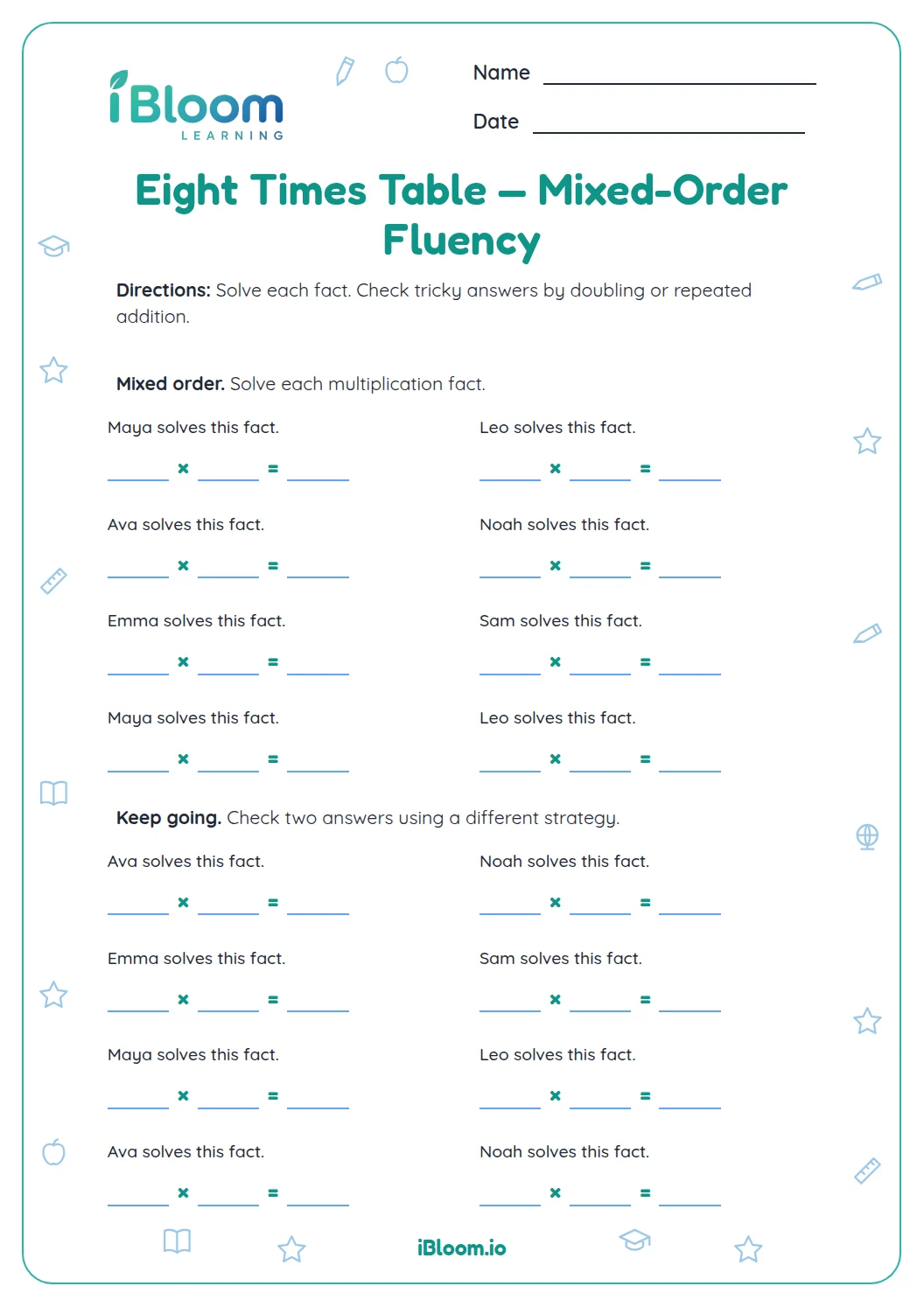
Part A mixes known products and missing factors. Use repeated addition, a known nearby fact, or a multiplication strategy to find each answer; then check that the product fits the eight table.
- 18 × 7 = 56
- 2Check with 8 × 5 = 40 and 8 × 2 = 16; together they make 56.
How do three numbers make four equations?
Part B uses each set of three numbers to write two multiplication equations and two division equations. The factors can switch places in multiplication, while the product becomes the starting number in division.
- 1Numbers: 8, 3, 24
- 28 × 3 = 24; 3 × 8 = 24; 24 ÷ 8 = 3; 24 ÷ 3 = 8
How can I check a division fact?
Multiply the quotient by the divisor. If 24 ÷ 8 = 3, then 3 × 8 must return to 24. This inverse check confirms the family stays connected.
How to use this worksheet
- 1Solve each Part A fact and check the product with the eight table.
- 2For a missing factor, ask how many groups of 8 make the product.
- 3In Part B, identify the two factors and their product in the given set.
- 4Write both factor orders for multiplication.
- 5Use the product first in each division equation, then check by multiplying back.
Common mistakes and quick fixes
The mistake
Using the product as a factor in the division sentence.
The fix
Start each division equation with the largest family number, the product.
The mistake
Writing the same multiplication equation twice.
The fix
Switch the two factors to make the second multiplication fact.
The mistake
Changing the product when the factors switch.
The fix
Multiplication order can switch, but the product stays the same.
Curriculum alignment
Practice eight-times products and use multiplication to connect each fact family to division.
On this sheet:
Show the official wordingHide the official wording
Fluently multiply and divide within 100, using strategies such as the relationship between multiplication and division (e.g., knowing that 8 × 5 = 40, one knows 40 ÷ 5 = 8) or properties of operations. By the end of Grade 3, know from memory all products of two one-digit numbers.
What to practice next
Make more practice
Further reading
Questions parents and teachers ask
How many fact families are included?
There are eight fact families, each built from three numbers. Students write two multiplication equations and two related division equations for every set, then use those relationships to see how the facts fit together across the worksheet. Each family is one set of related facts.
Why are there two multiplication facts in a family?
The factors can switch places without changing the product. With 8 and 3, both 8 × 3 and 3 × 8 equal 24, giving two multiplication equations from the same numbers. The product remains fixed in both equations.
What is the relationship between multiplication and division here?
Division reverses multiplication. If 8 × 3 = 24, then 24 ÷ 8 = 3 and 24 ÷ 3 = 8. Checking with multiplication is a useful way to confirm a division equation before writing the remaining facts in the family.
What should a student do with the blank in Part A?
Find the missing factor or product so the equation is true. For example, in 8 × ___ = 64, ask how many groups of eight make 64; the missing number is 8. Check by multiplying to return to 64. Use the equation to verify that the numbers balance.
Can I use repeated addition for the eight facts?
Repeated addition can help build a product, especially while a student is learning the table. For 8 × 7, adding seven groups of eight gives 56, and later the fact can be recalled more quickly for division relationships.