


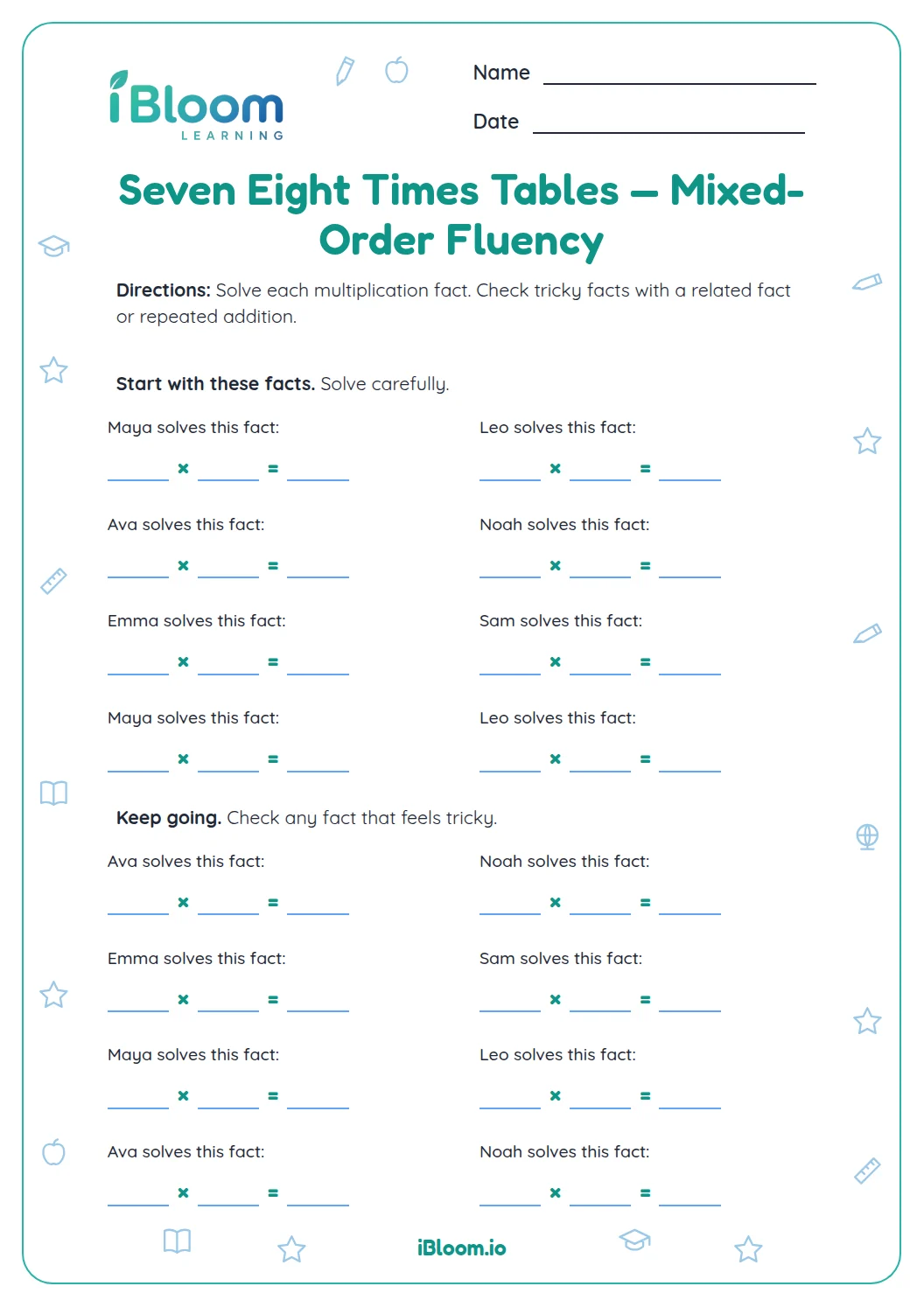
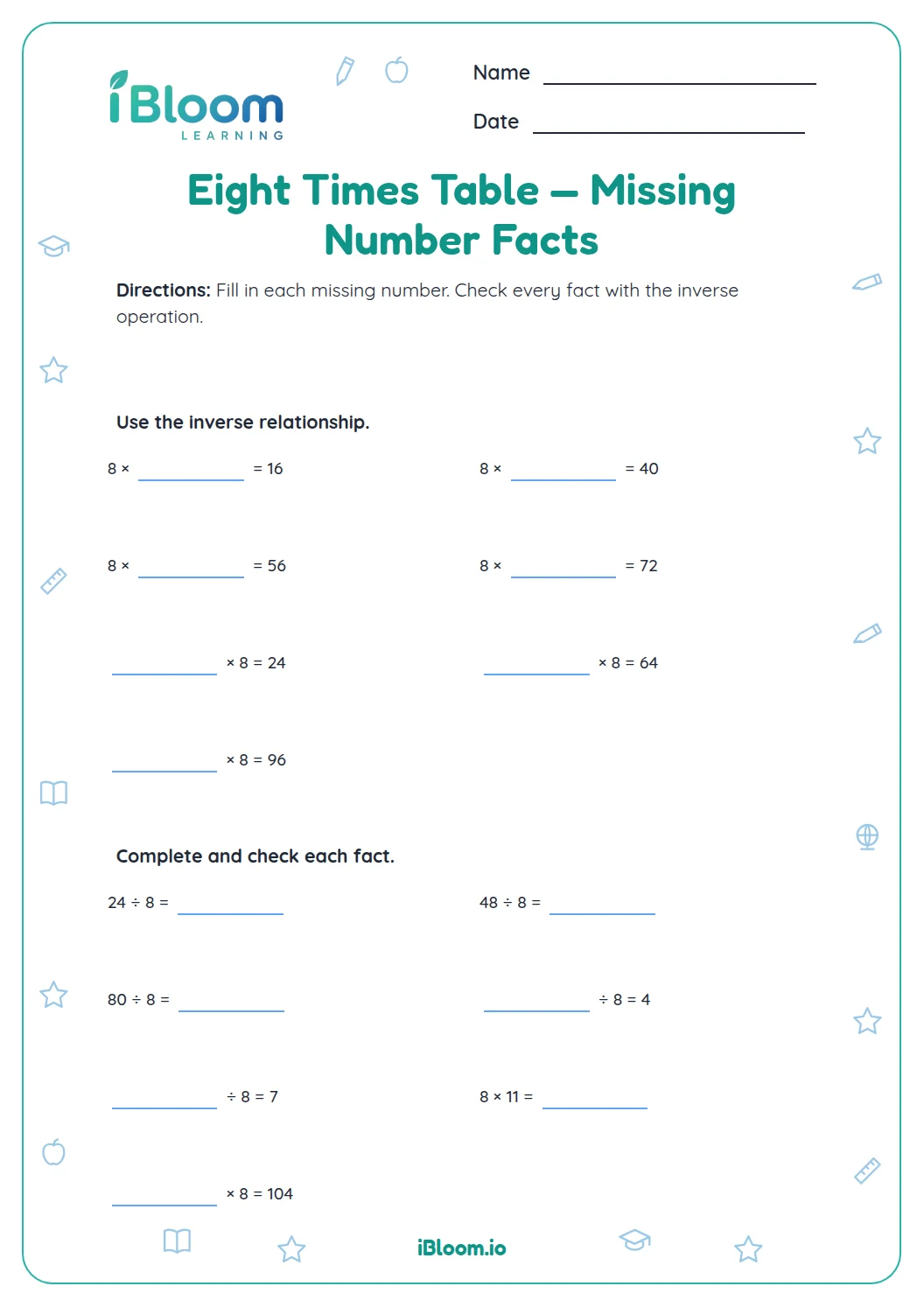
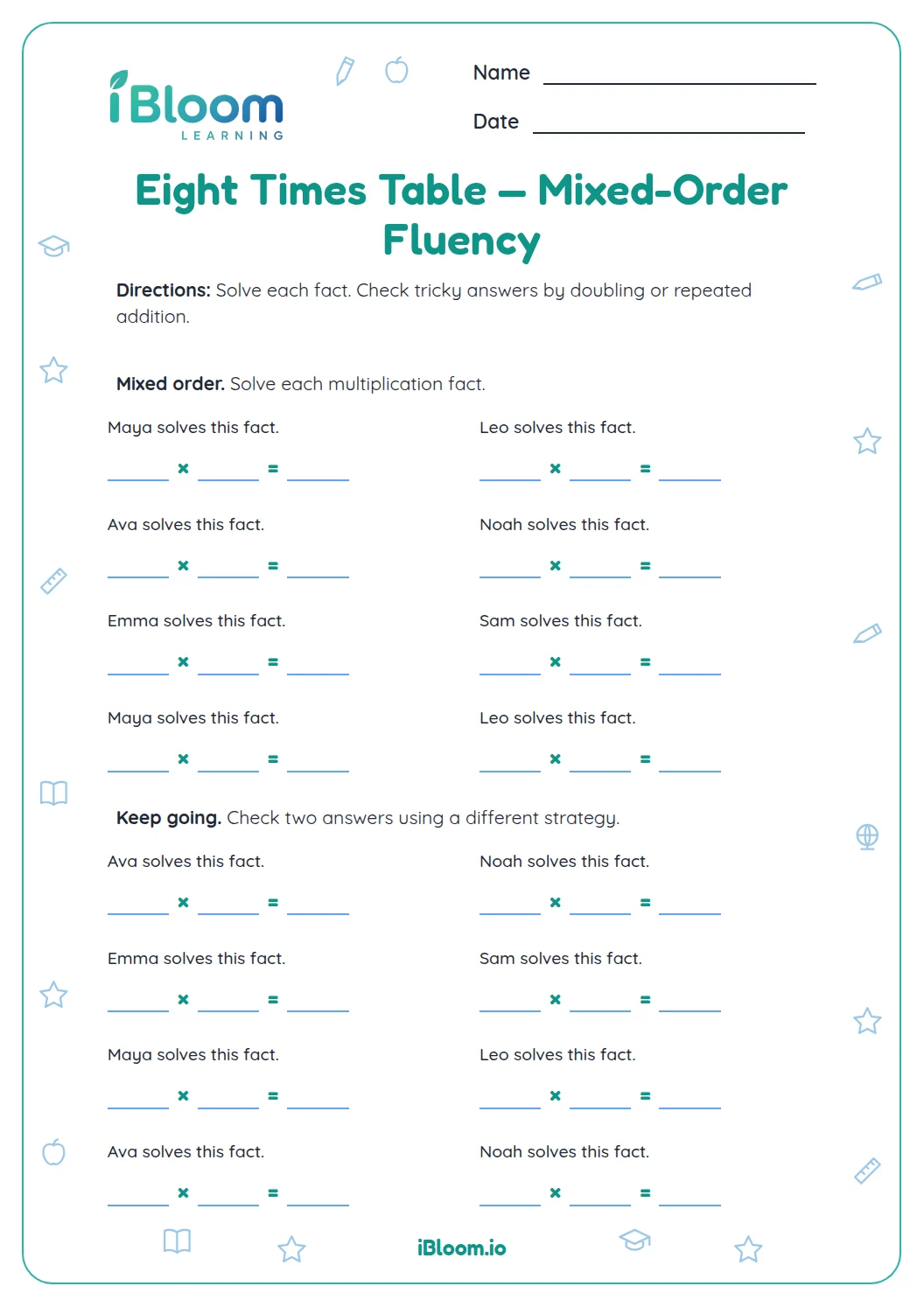
About this worksheet
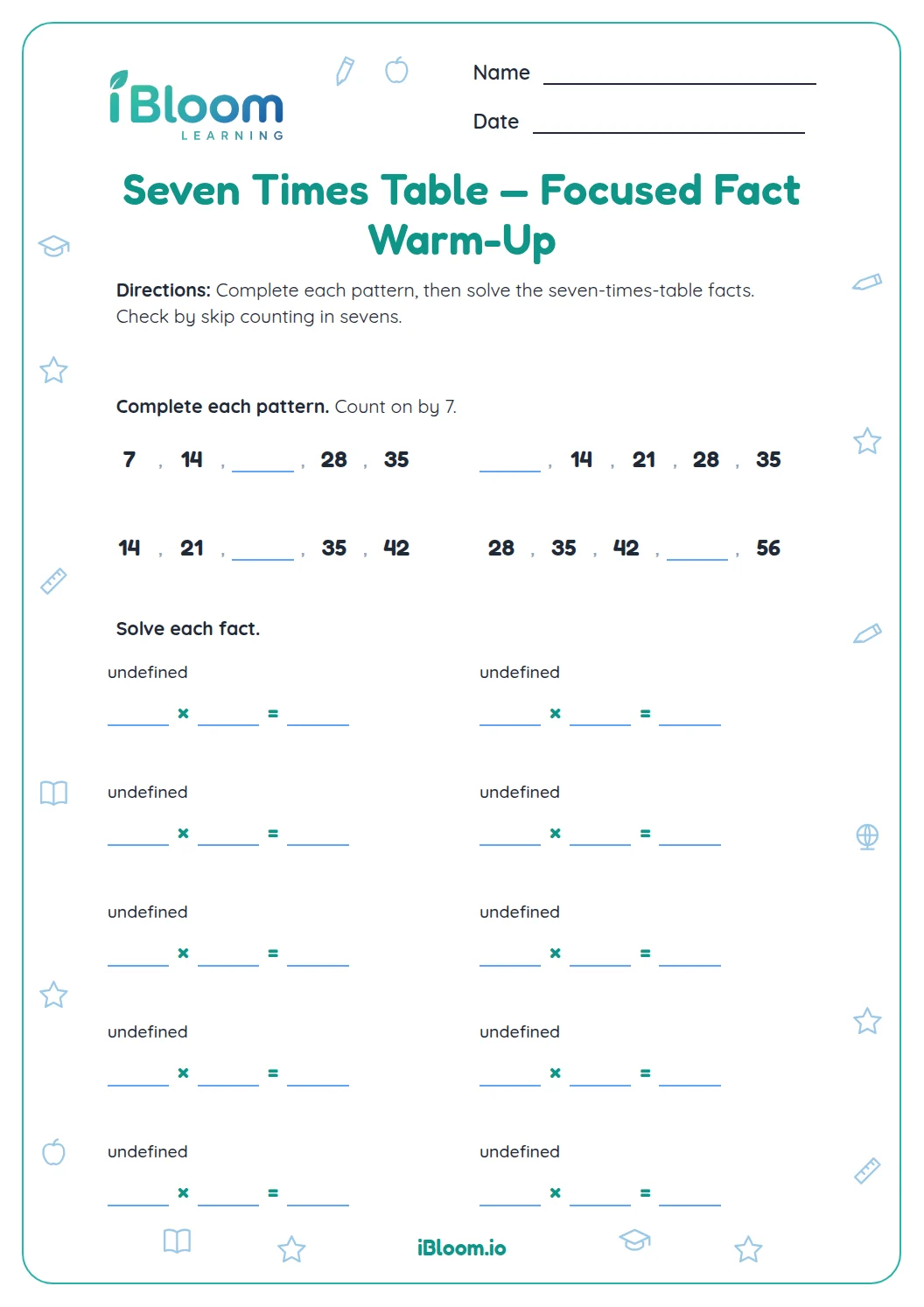
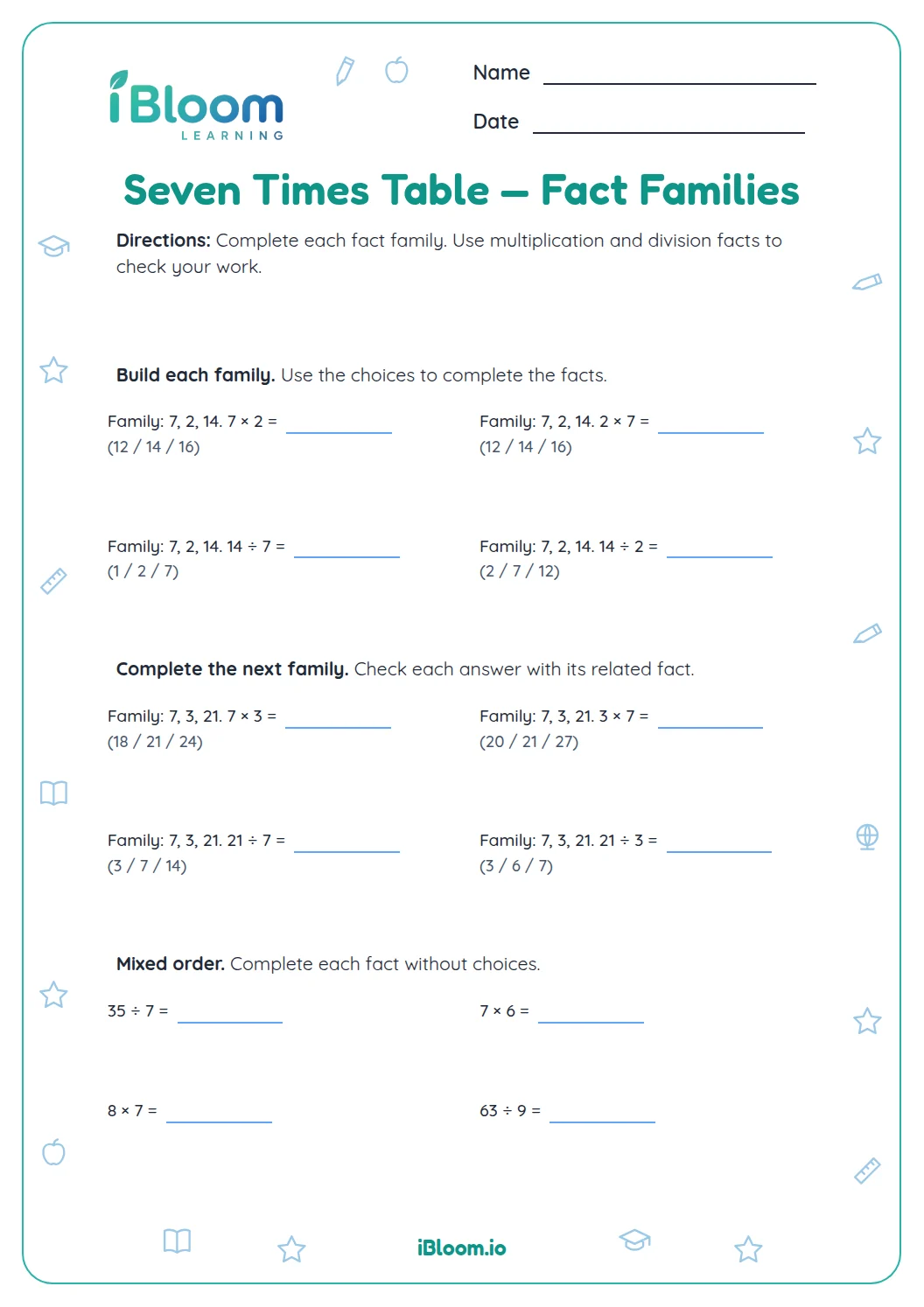
This free printable gives Grade 3 and Grade 4 learners 20 chances to use the seven-times table without following it in order. Part A mixes 12 facts from 7 × 0 through 7 × 12, and Part B adds the remaining 7 × 7 fact, missing factors, a product correction, and equal-group or division checks. The questions practice multiplication fact fluency from CCSS 3.OA.C.7, and the answer key is on a separate page.
Aligned to 3.OA.C.7
How does the mixed order help fact recall?
Part A mixes 12 seven-times facts, including every factor from 0 through 12 except 7. Question 17 in Part B supplies 7 × 7, so the full range appears across the sheet.
For example, question 1 is 7 × 6. Six groups of 7 make 42, so write 42 in the blank. The same product can check 42 ÷ 7 = 6.
- 17 × 6 = ___
- 26 groups of 7
- 37 + 7 + 7 + 7 + 7 + 7 = 42
- 4Answer: 42
How do the last questions use multiplication?
Part B moves from finding missing factors to spotting a product error and interpreting equal groups. Question 16 models 5 bags with 7 crayons each; the final question asks how many stickers each of 7 children receives from 84 stickers.
Use a factor pair as a check: 5 × 7 = 35 crayons, and 84 ÷ 7 = 12 stickers for each child.
What is included across the practice pages?
The sheet has 20 questions in two parts and a separate key. Part A contains 12 mixed facts; Part B adds two missing-factor facts, one correction, one more seven-times fact, and four applications or related checks.
How to use this worksheet
- 1Say the factors aloud before solving each fact.
- 2Use skip-counting by 7 only when a product is not yet automatic.
- 3Check a product with a related fact, such as 42 ÷ 7 = 6.
- 4Read the final question for the number of groups and the amount in each group.
- 5Compare all 20 answers with the key.
Common mistakes and fixes
The mistake
Switching the factors or product, as in 7 × 6 = 13.
The fix
Think of six groups of seven and add 7 six times.
The mistake
Using the next number in a skip-counting list as the product.
The fix
Count the jumps, not the spoken numbers: six jumps of 7 land on 42.
The mistake
Treating 7 crayons in 5 boxes as 7 + 5.
The fix
Draw five groups of seven or write 5 × 7.
Common Core alignment
This worksheet practices the standard below through its own question set.
Recall and use one-digit multiplication facts, including the seven facts.
On this sheet: The drill practices seven-times products and uses them in missing-factor and equal-group questions.
Show the official wordingHide the official wording
Fluently multiply and divide within 100, using strategies such as the relationship between multiplication and division (e.g., knowing that 8 × 5 = 40, one knows 40 ÷ 5 = 8) or properties of operations. By the end of Grade 3, know from memory all products of two one-digit numbers.
What to practice next
Make more practice
Further reading
Questions parents and teachers ask
How many questions are on this sheet?
There are 20 questions: 12 mixed facts in Part A, then two missing-factor equations, one product correction, one more seven-times fact, and four applications or related checks in Part B. The worksheet uses two pages, followed by a separate two-page answer key for adult checking.
Does the worksheet include every seven-times fact from 0 to 12?
Yes. Across the full sheet, every factor from 0 through 12 appears in a seven-times fact. Part A mixes 12 of them, and question 17 revisits 7 × 7 in Part B; the remaining questions use missing factors, equal groups, or related division facts.
How can a child check a seven-times answer?
Use the inverse division fact or repeated addition. For example, 7 × 6 = 42 can be checked with 42 ÷ 7 = 6, or by adding six sevens. The related fact is especially useful for the missing-factor questions and the two division checks.
Is timing required?
No timer or speed goal is part of the instructions. Learners can focus on accurate recall, then use a related fact to check an answer. If an adult chooses to time later practice, the score should not replace checking the products.
What can learners practice next?
After reviewing the seven-times facts, learners can try the eight-times table or a broader fact range. The links above lead to those related skill pages, so a family can move from one table to another without changing the practice format.