





About this worksheet
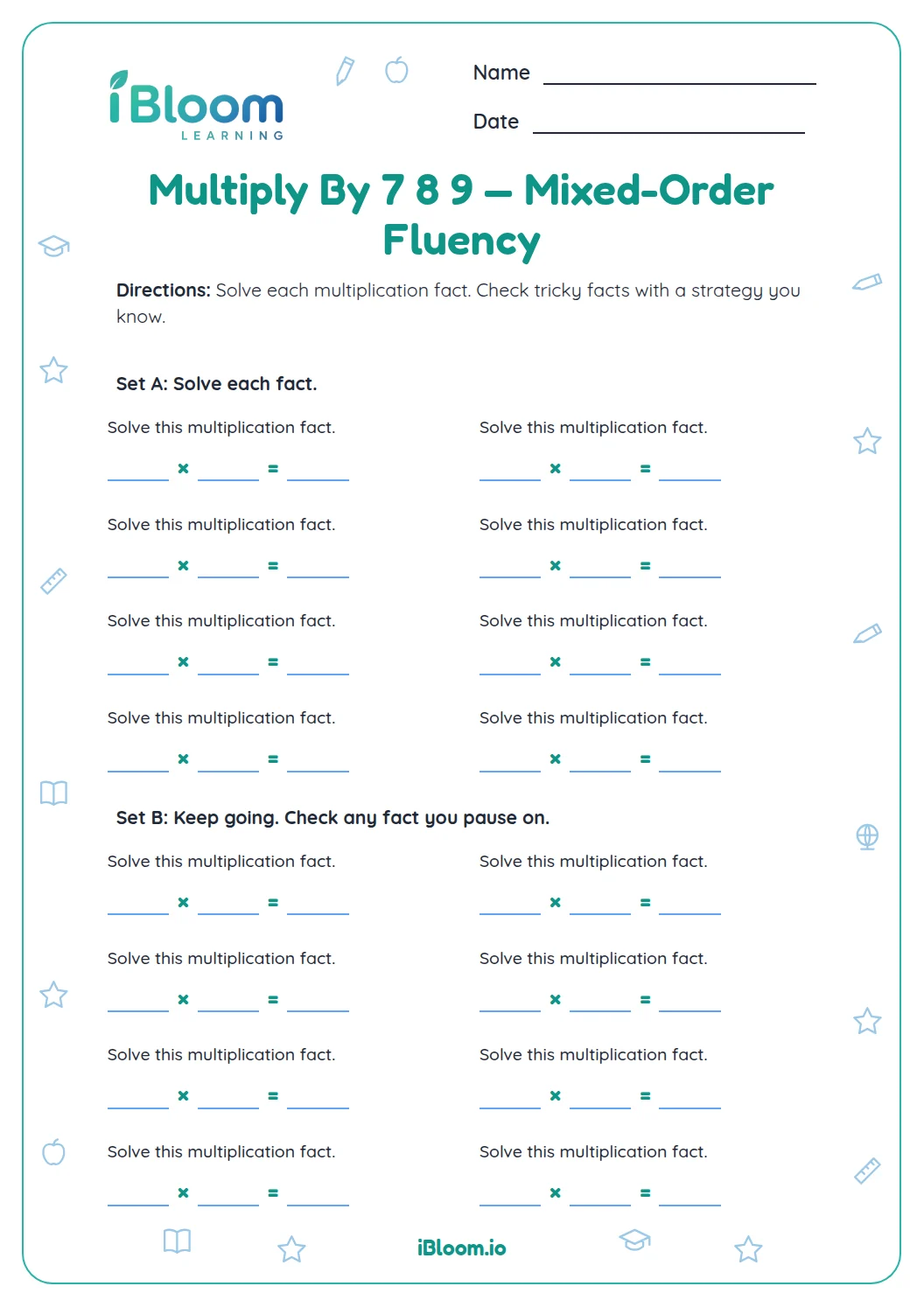
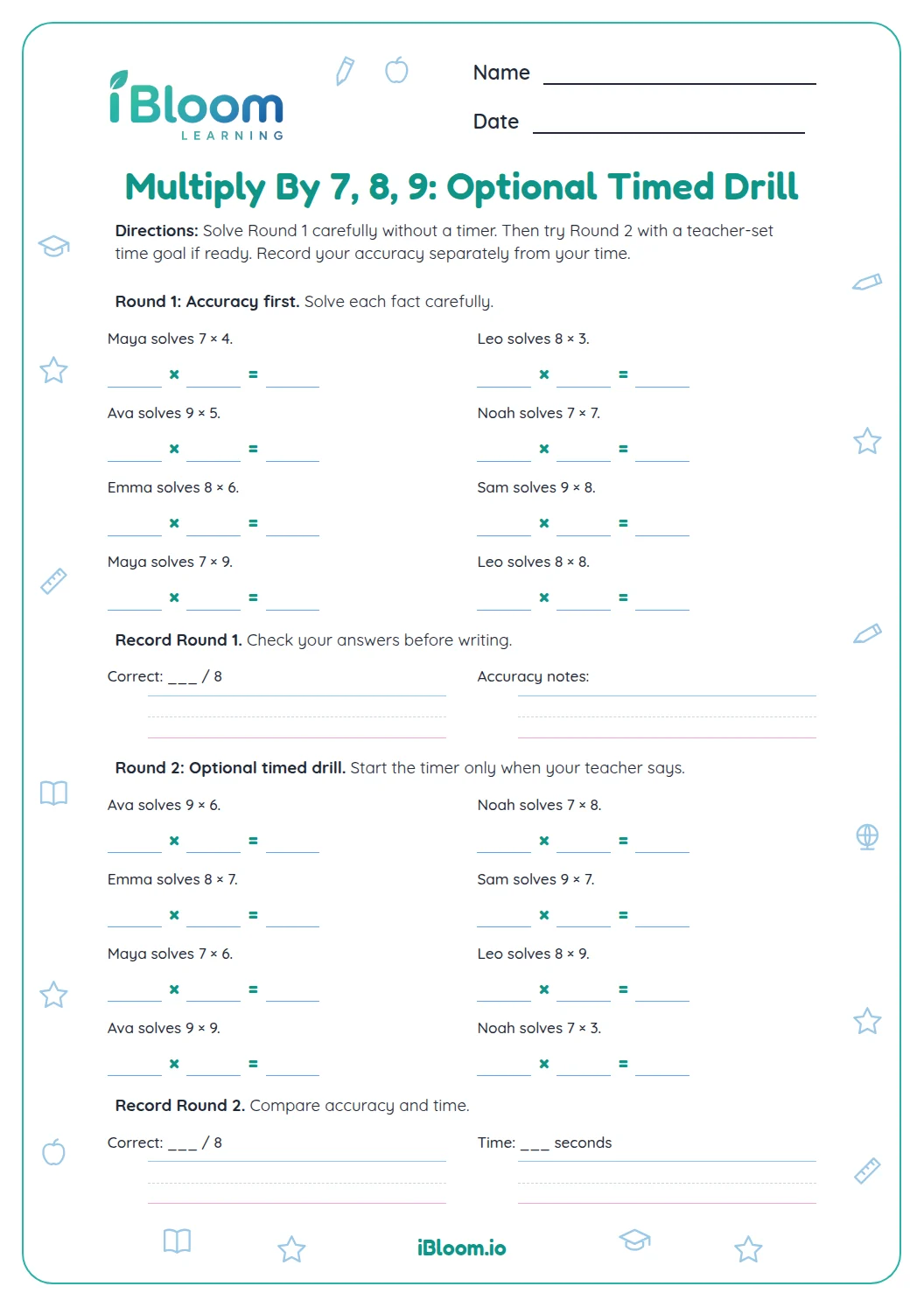
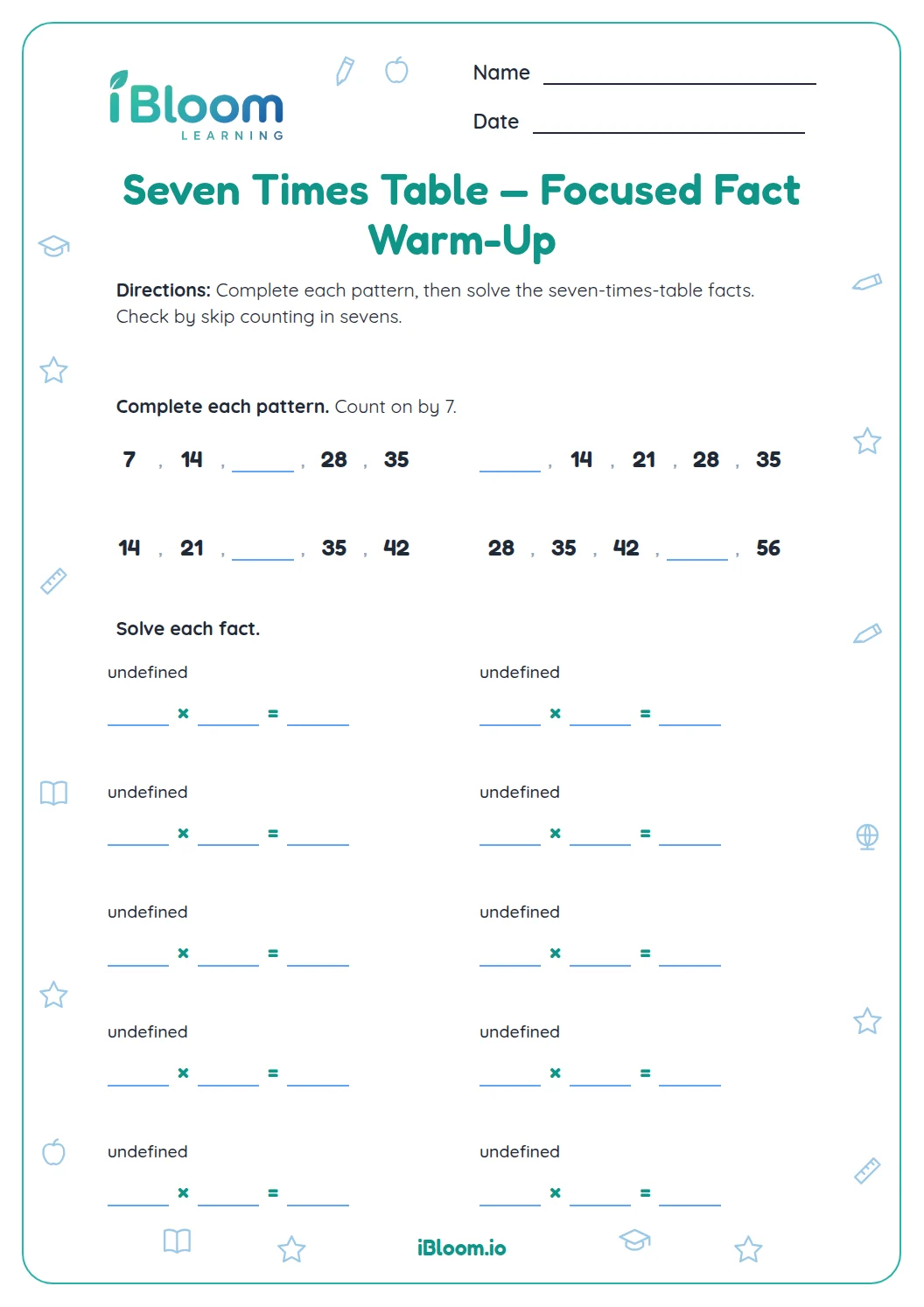
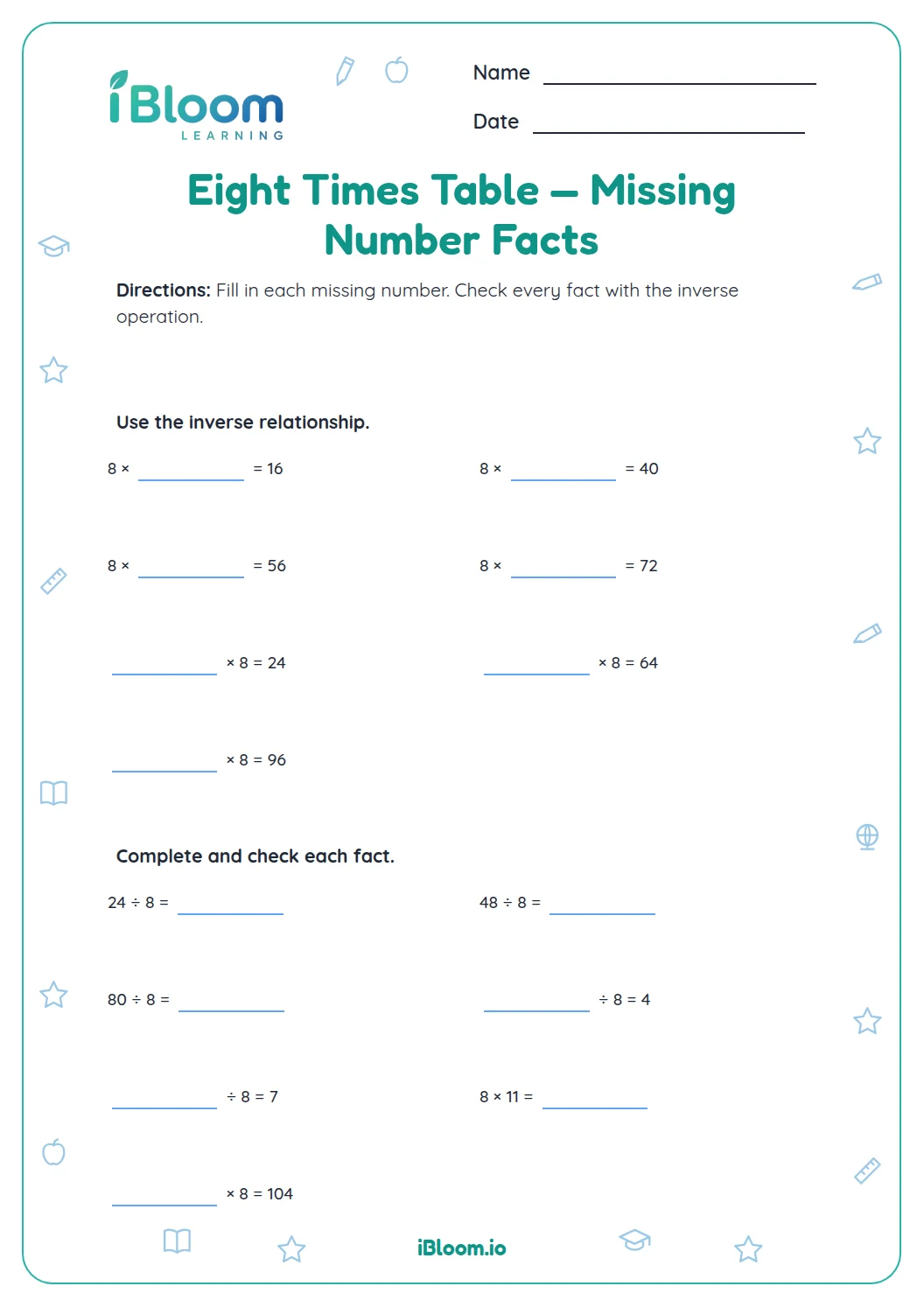
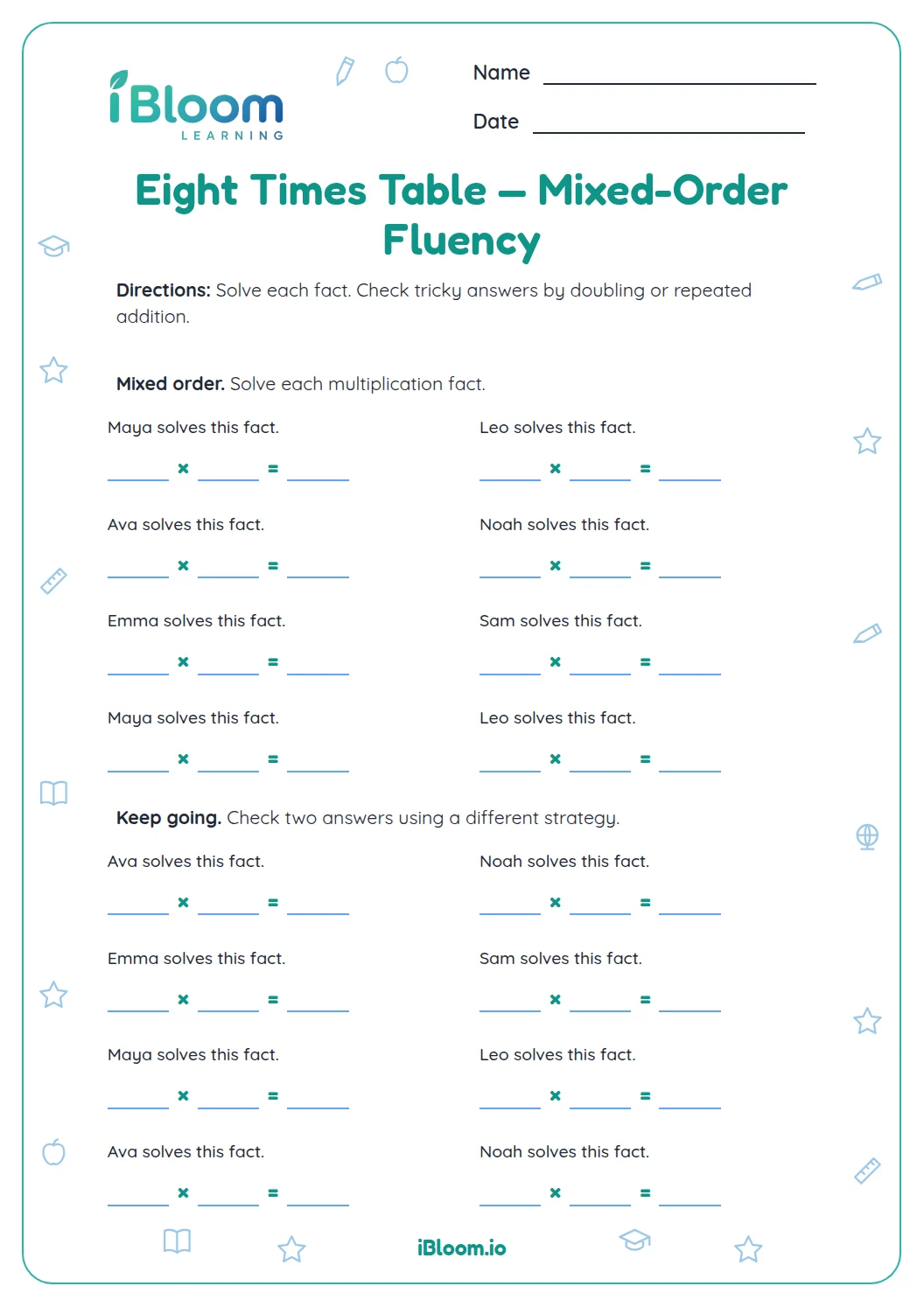
This printable multiplication drill gives Grades 3–4 20 questions on 7, 8, and 9 facts. Part A warms up with products; Part B connects products to missing factors and division facts; Part C applies fact families to equal groups. A separate answer key supports quick checking.
Aligned to 3.OA.C.7
How can you find a product quickly?
Use a fact you know or split a factor into parts. For 7 × 6, think 5 groups of 7 and 1 more group of 7: 35 + 7 = 42. Repeated practice helps facts become easier to recall.
- 17 × 6 = (7 × 5) + 7
- 235 + 7 = 42
- 3Answer: 42
How do multiplication and division facts connect?
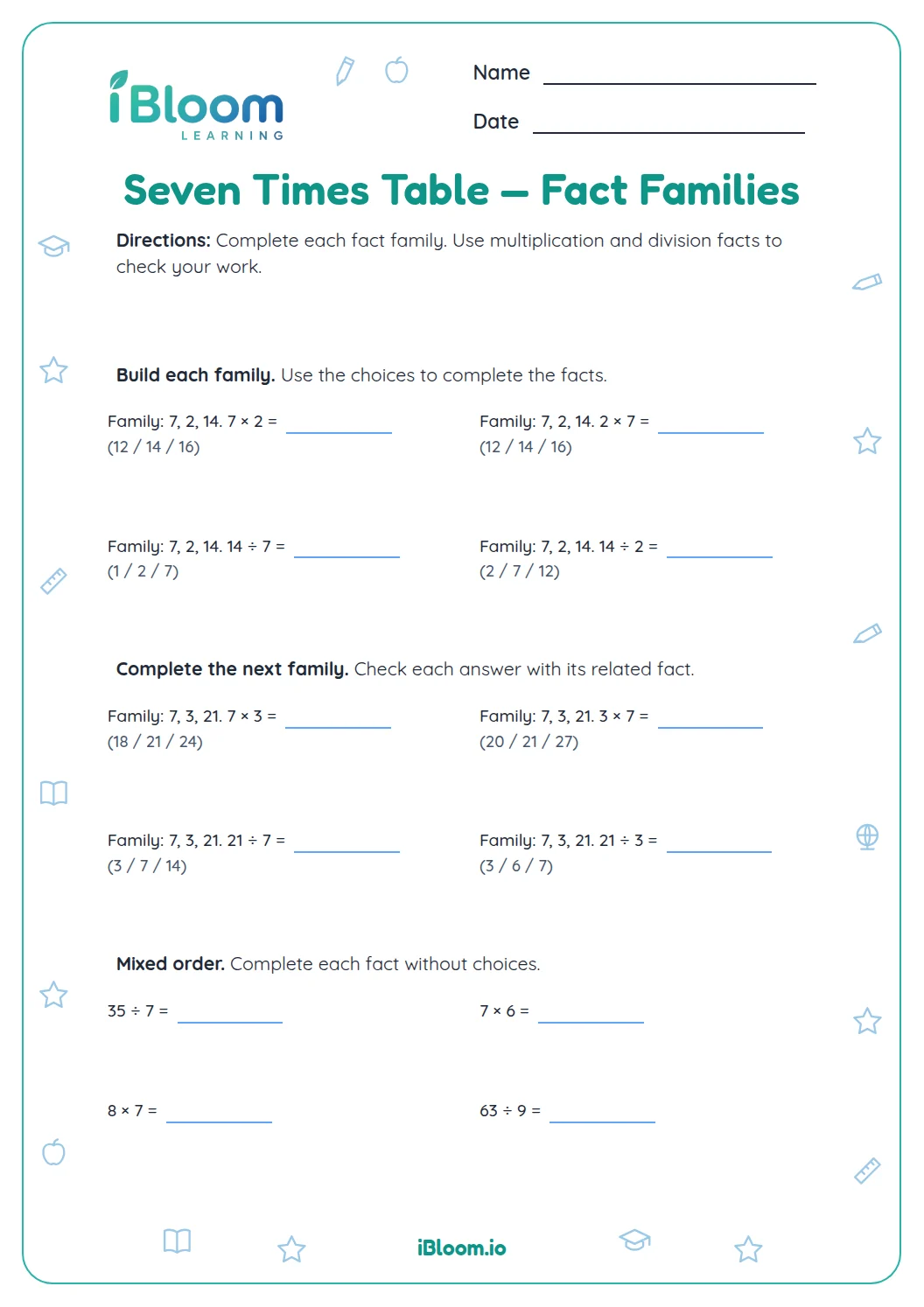
The same three numbers make a fact family. From 7 × 8 = 56, we can write 56 ÷ 7 = 8 and 56 ÷ 8 = 7. The product becomes the starting number for division.
What should you check in a fact family?
Check that the two factors multiply to the product. Then use the product and one factor to see whether the missing division answer is the other factor.
How to use this worksheet at home or in class
- 1Complete the six products in Part A.
- 2Use a known fact or split a factor into friendly parts.
- 3In Part B, find the related factor or quotient.
- 4Use multiplication to check each division answer.
- 5Solve the four equal-group situations in Part C.
- 6Check all 20 responses with the answer key.
Common mistakes and quick fixes
The mistake
Adding instead of multiplying the factors.
The fix
Think of equal groups: 7 × 6 means six groups of seven.
The mistake
Writing the product as a quotient answer.
The fix
For 56 ÷ 7, ask which number times 7 equals 56; the answer is a factor, not the product.
The mistake
Changing a factor while recalling a familiar fact.
The fix
Say both factors aloud, then check the product with a related fact.
Common Core alignment
This page gives focused practice with the listed grade-level skill.
Use multiplication facts and related division facts for 7, 8, and 9.
On this sheet: The fact families practice multiplication and inverse division within 100.
Show the official wordingHide the official wording
Fluently multiply and divide within 100, using strategies such as the relationship between multiplication and division (e.g., knowing that 8 × 5 = 40, one knows 40 ÷ 5 = 8) or properties of operations. By the end of Grade 3, know from memory all products of two one-digit numbers.
What to practice next
Make more practice
Further reading
Questions parents and teachers ask
Which multiplication facts does this worksheet practice?
It practices products using 7, 8, and 9, then connects those products to missing factors and division facts. The final four questions use equal groups and sharing situations. There are 20 questions across two worksheet pages, with a separate two-page answer key.
How does a fact family help with division?
A multiplication fact gives the product and two factors, which can be rearranged into two division facts. For example, 7 × 8 = 56 helps solve 56 ÷ 7 = 8 and 56 ÷ 8 = 7. Check a quotient by multiplying it by the divisor.
Can students use strategies instead of memorizing every fact?
Yes. A learner can use a known fact, break a factor apart, or connect a fact to a nearby one. For 7 × 6, think of 7 × 5 plus one more group of 7: 35 + 7 = 42. The goal is to solve each fact accurately.
What is in Part C?
Part C has four short equal-group situations: finding the total in rows or bags, and finding the amount in equal shares or the number of groups. Students write an equation and solve it. These prompts use the same multiplication and division relationships practiced earlier.
How long does the multiplication worksheet take?
Plan for about 15 to 20 minutes. Students who recall the facts quickly may finish sooner, while learners who show equations or check each related fact may need more time. The answer key is separate so an adult can review work after the student finishes.