


About this worksheet
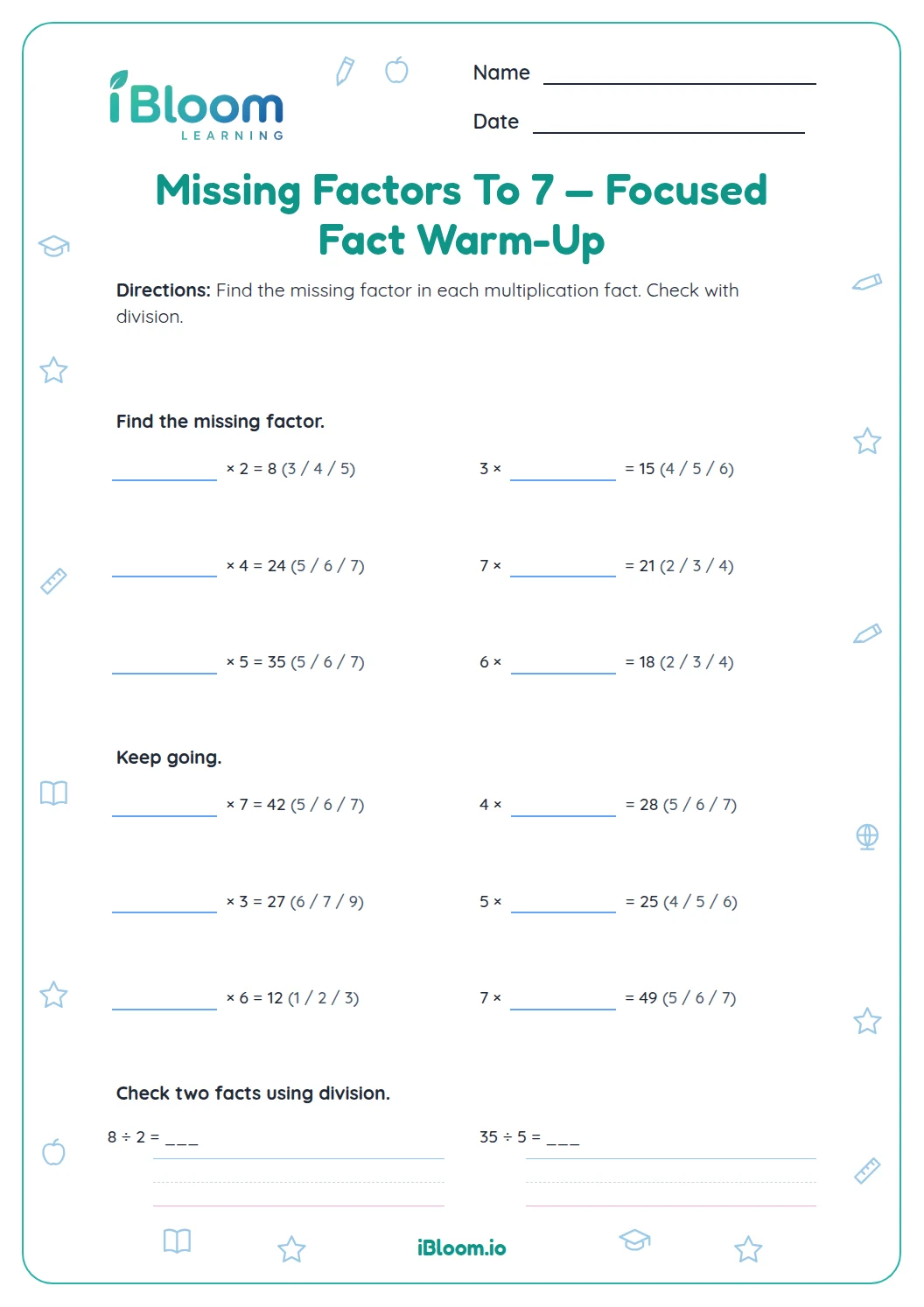
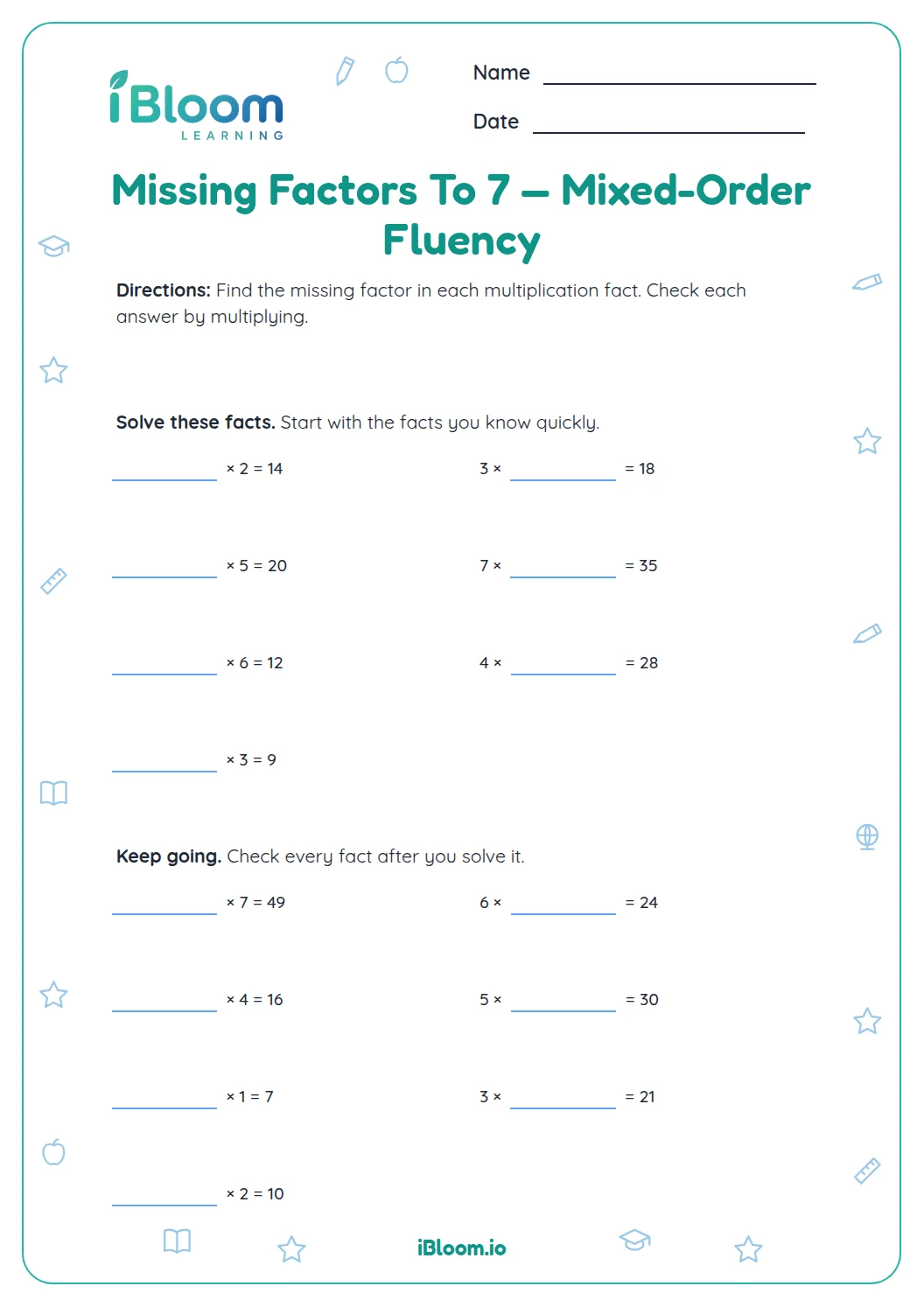
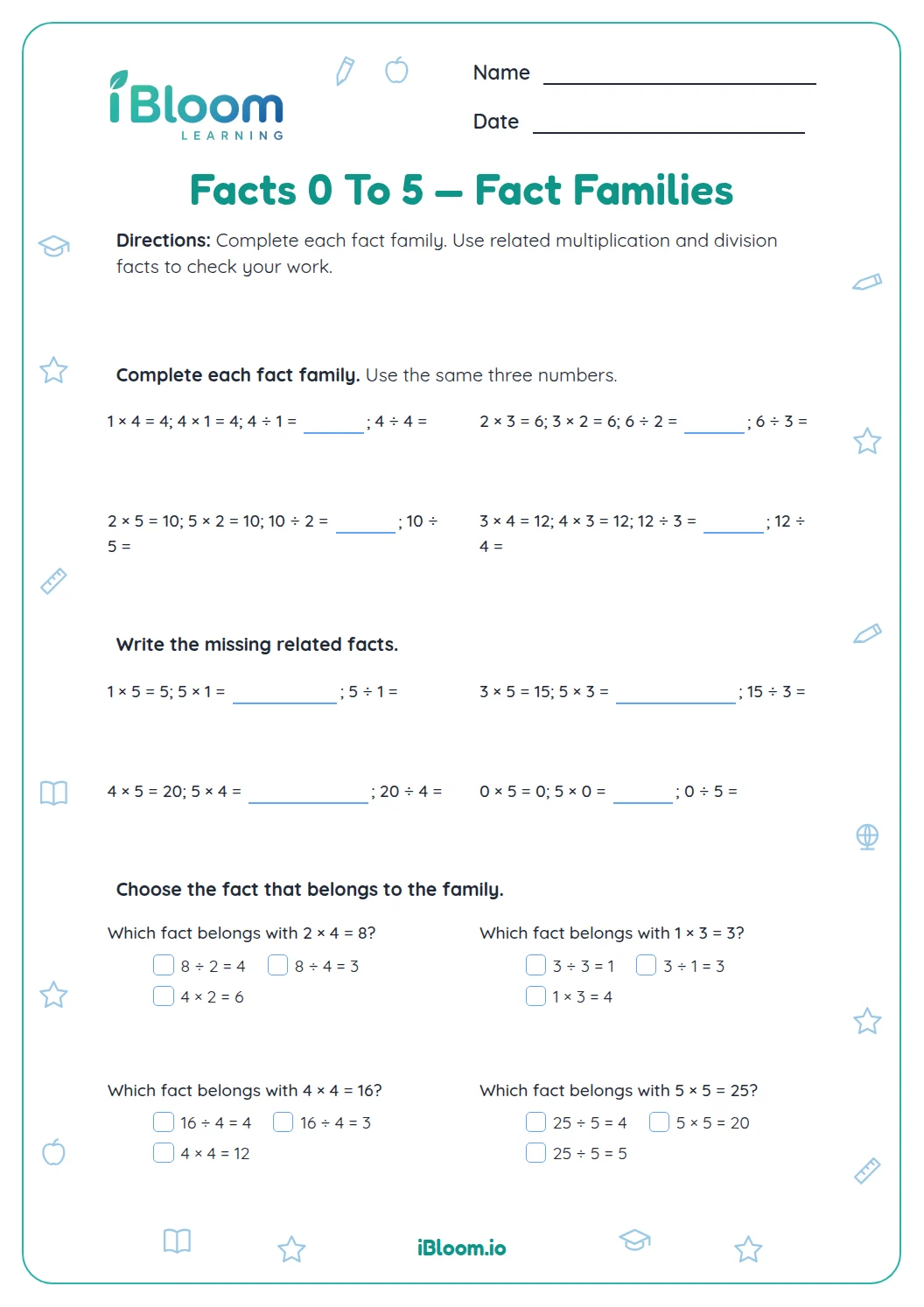
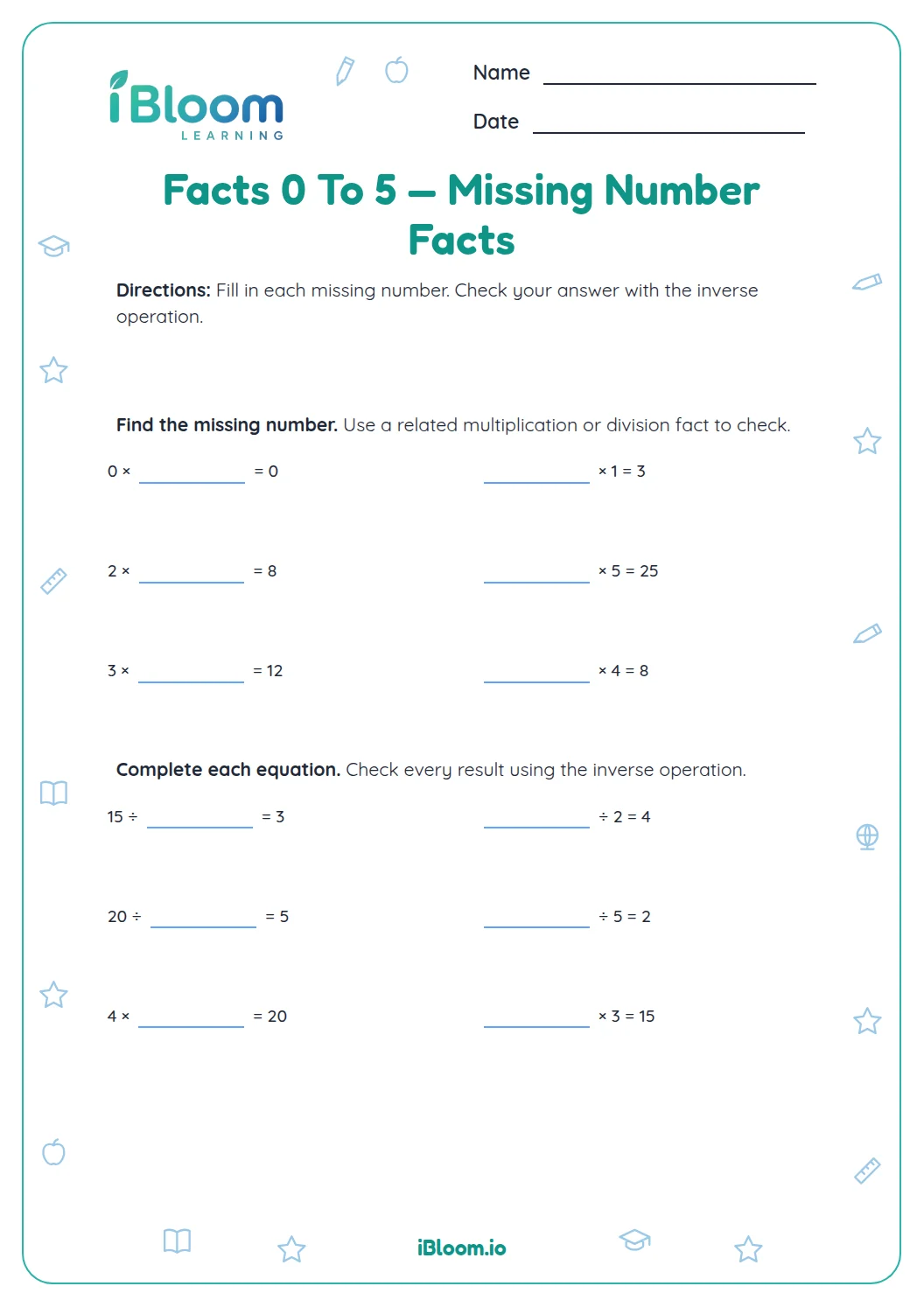
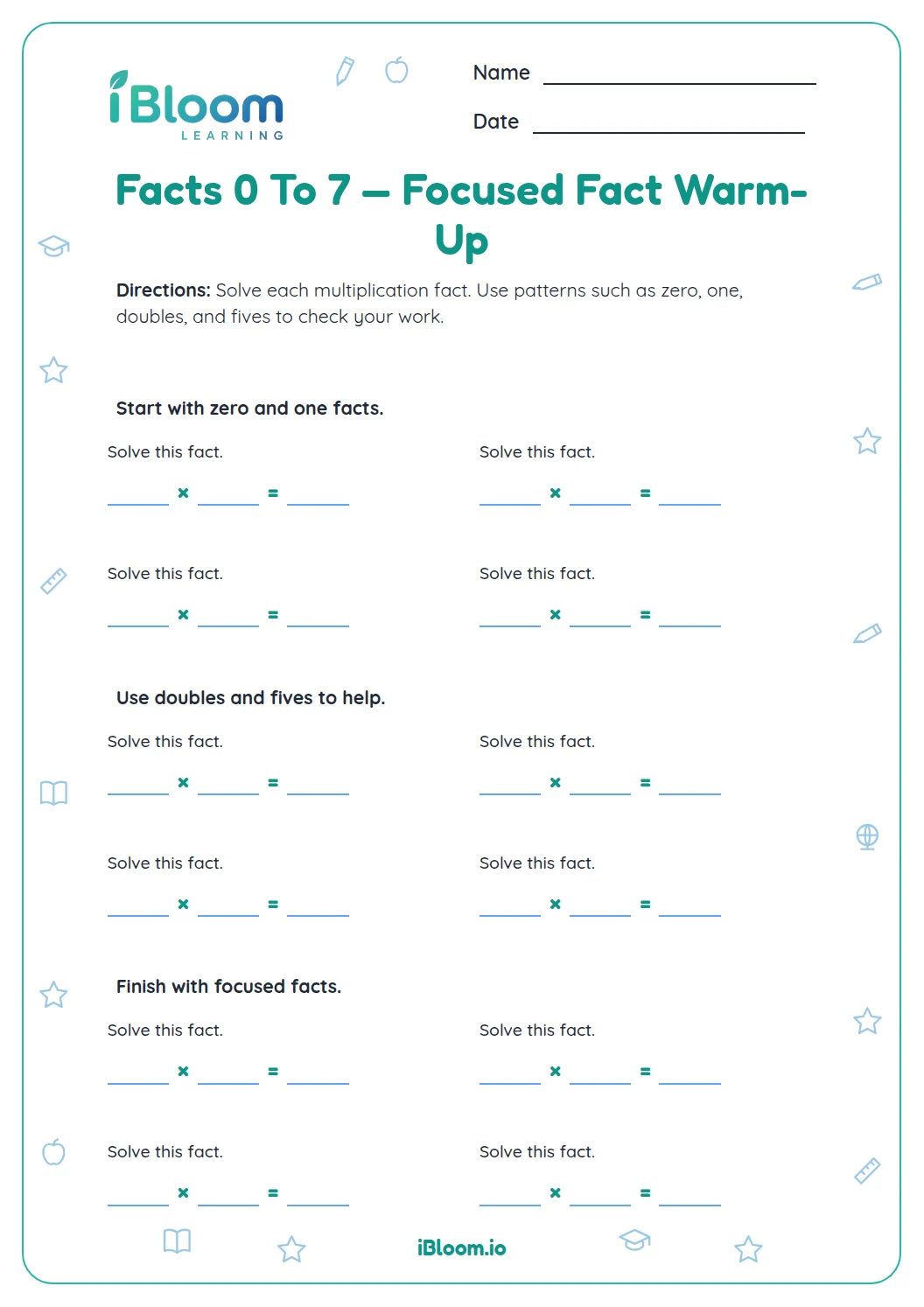
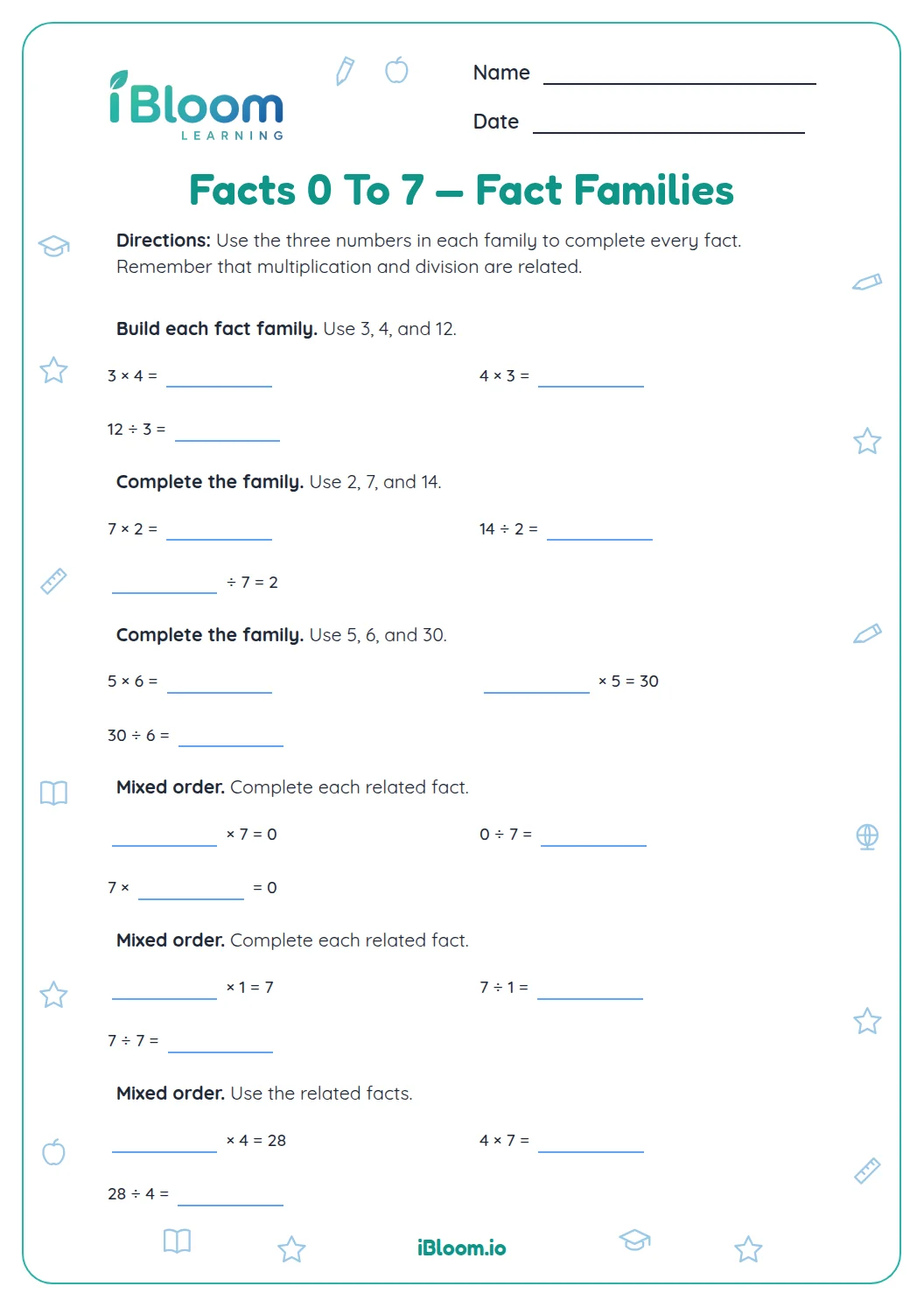
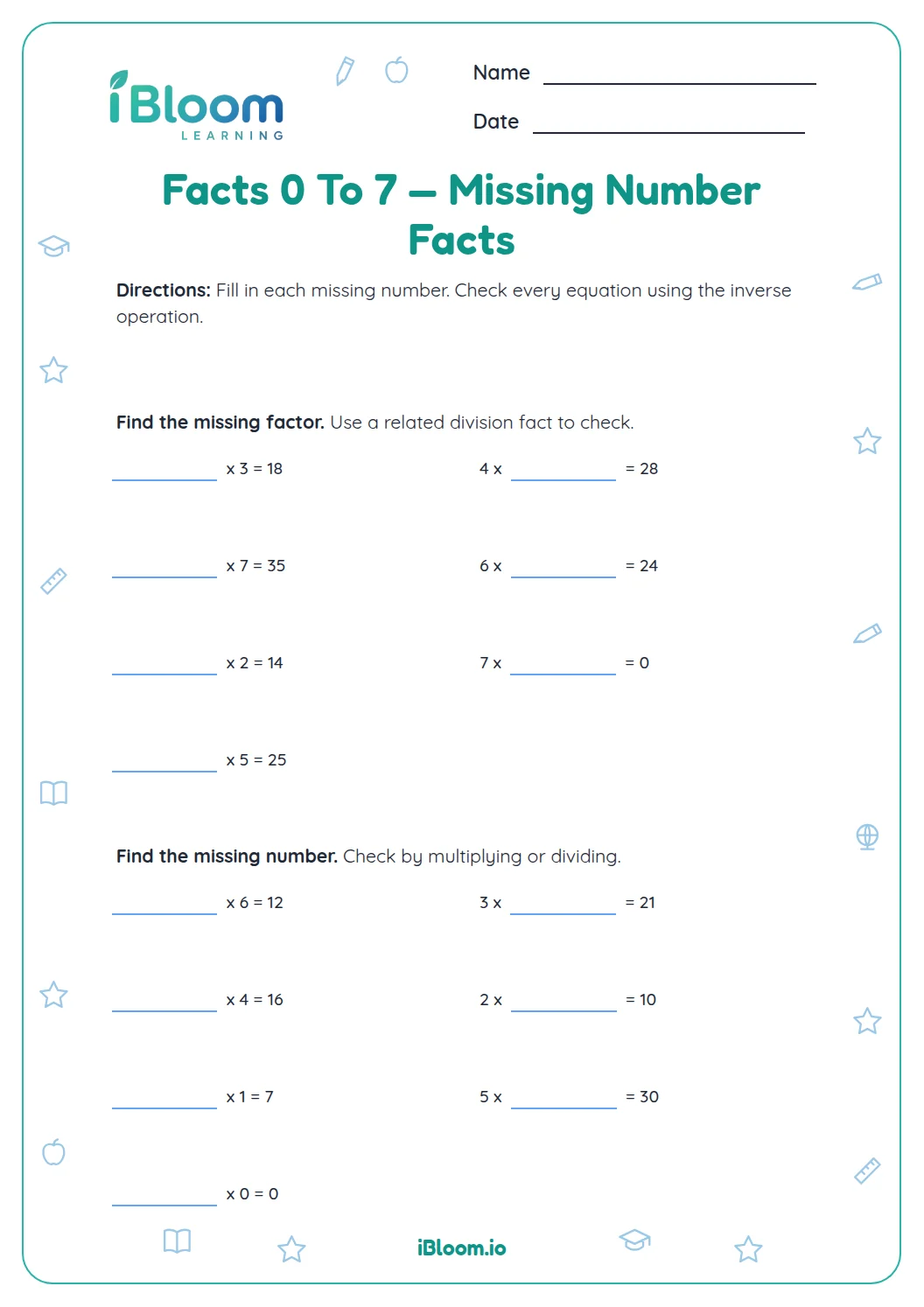
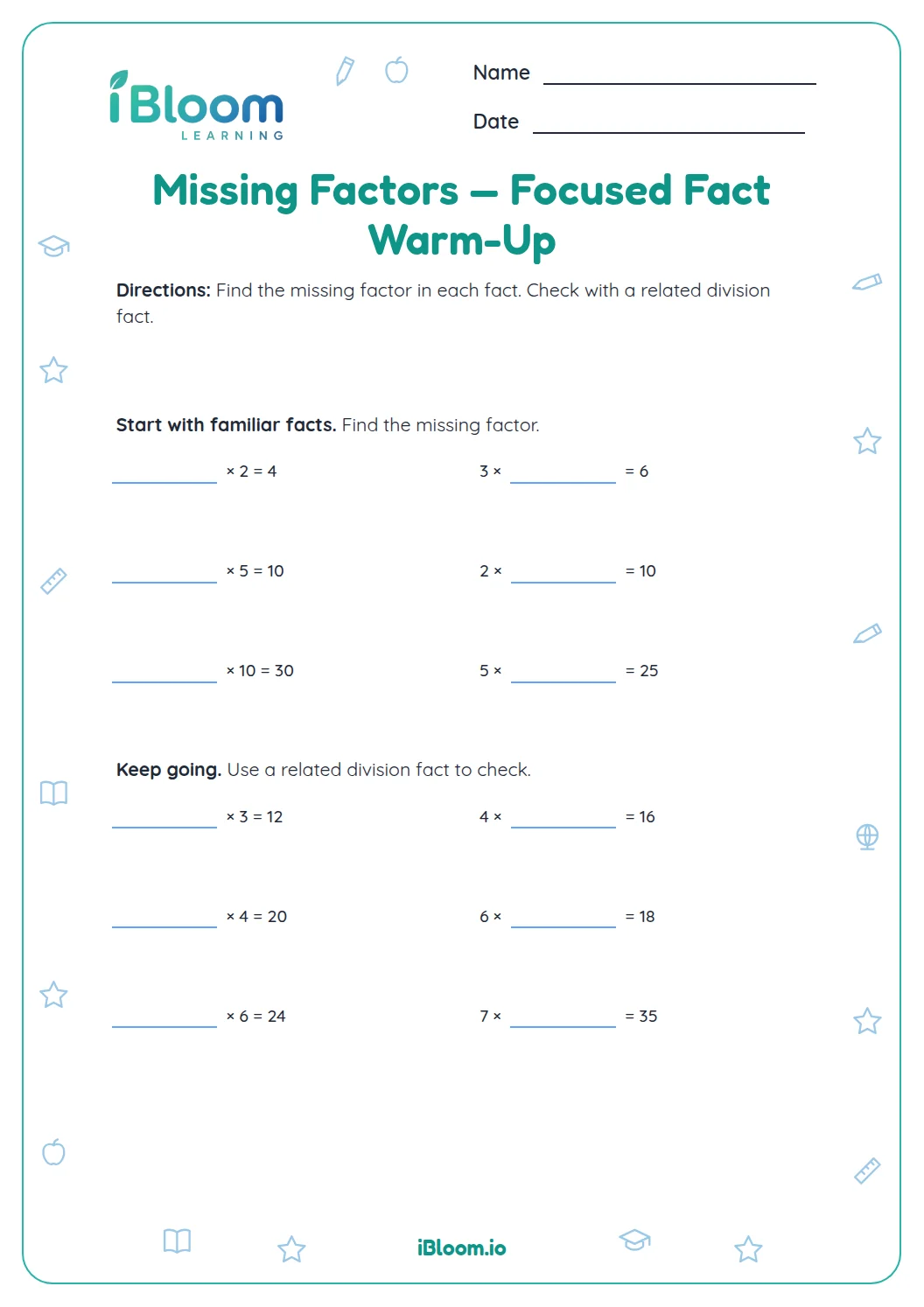
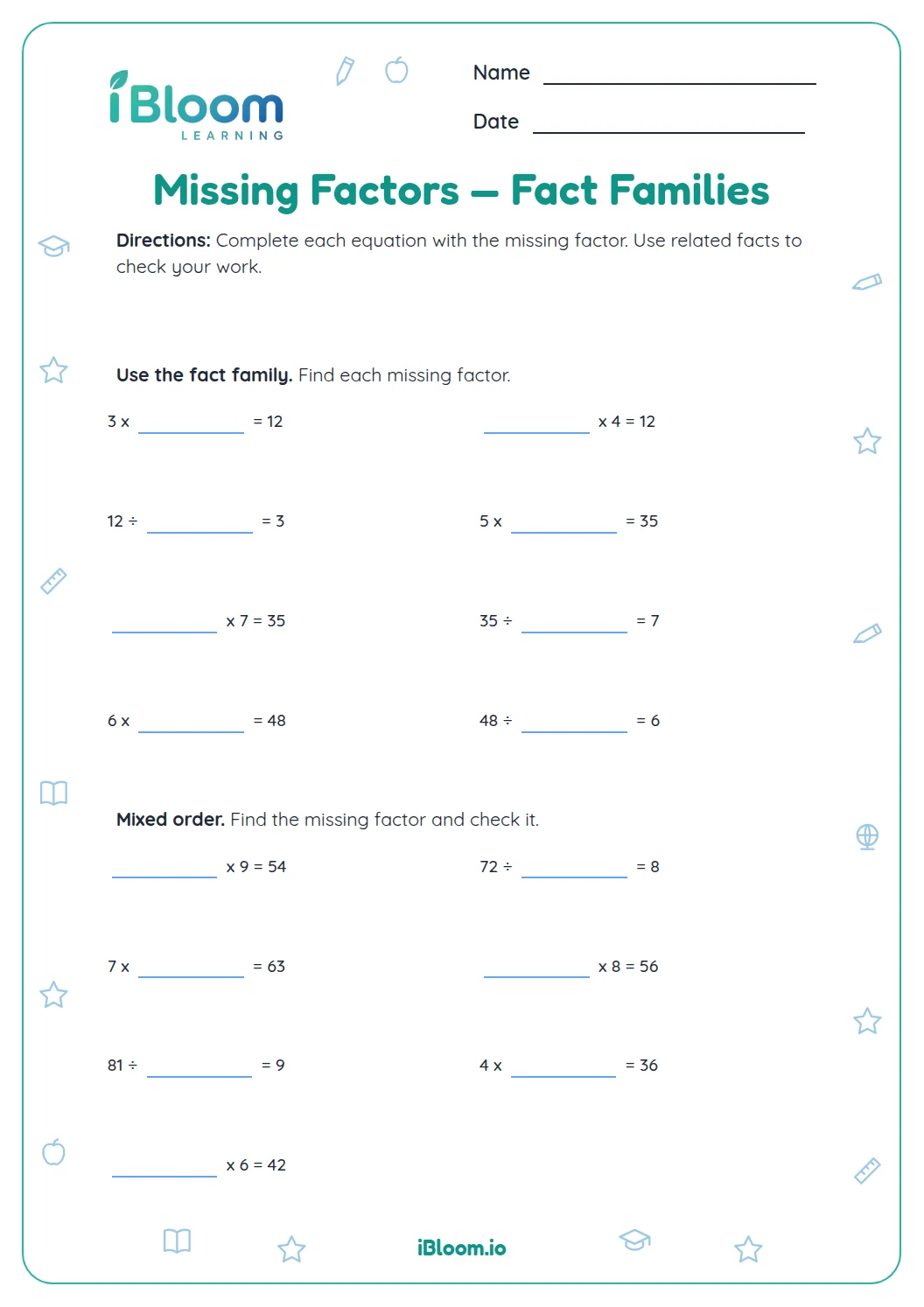
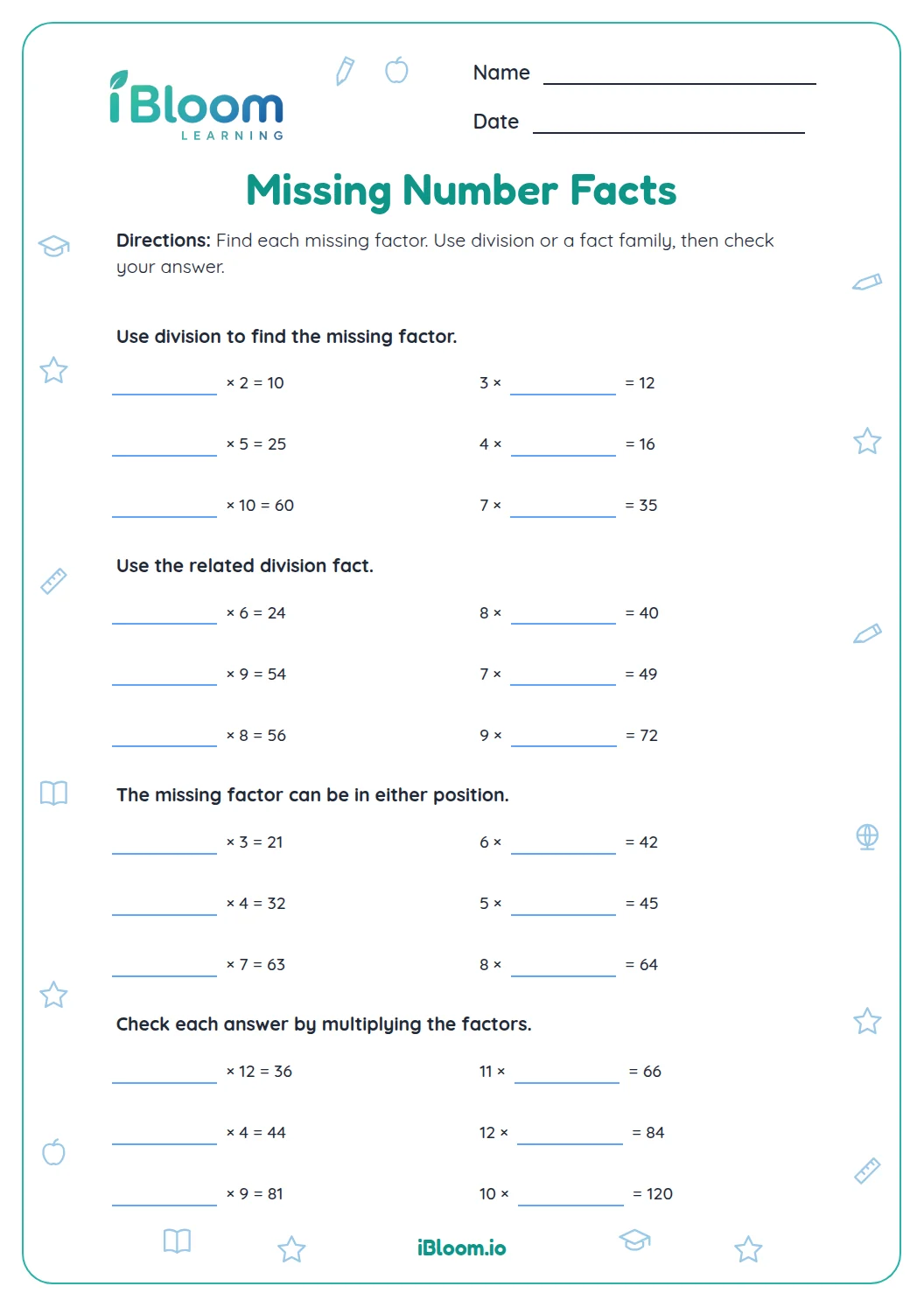
This Grade 3 printable gives students 24 questions built around multiplication factors from 1 through 7. They solve missing-factor equations, use related multiplication and division facts, then choose the number that completes a fact. The old sheet’s fact-family approach remains central: one known product can support more than one equation. A separate answer key includes every missing value.
Aligned to 3.OA.B.6
How do you find an unknown factor?
The 24 questions move from missing-factor equations to related facts, then multiple-choice checks. The factors include every whole number from 1 through 7, including the factor 1.
- 1___ × 4 = 24
- 2Think: 4 times what equals 24?
- 36 × 4 = 24, so the missing factor is 6.
How are multiplication and division connected?
From 7 × 6 = 42, we can write 42 ÷ 7 = 6 and 42 ÷ 6 = 7. The product and factors stay together as a fact family, so a known multiplication fact can help solve a division equation.
What is included in the practice?
The sheet moves from eight missing-factor equations to six related facts, then six choice questions. The factors include every whole number from 1 through 7, including the factor 1.
How to use this worksheet
- 1Complete Part A by asking which factor makes the product.
- 2For Part B, name the multiplication fact that matches each division equation.
- 3Use the family members to check that both operations are consistent.
- 4Try the six Part C checks without using the choices as a first step.
- 5Check all 20 responses with the answer key.
Common mistakes and quick fixes
The mistake
Dividing the product by the wrong factor
The fix
Use the factor shown in the equation and ask what number completes that specific fact.
The mistake
Confusing a product with a factor
The fix
In 7 × 6 = 42, 42 is the product; 7 and 6 are factors.
The mistake
Using a related fact with the wrong numbers
The fix
Keep the same three numbers together and check by multiplying the quotient and divisor.
Common Core alignment
Use multiplication facts to solve division and unknown-factor problems.
On this sheet: Students solve missing-factor and division equations by using related multiplication facts.
Show the official wordingHide the official wording
Understand division as an unknown-factor problem. For example, find 32 ÷ 8 by finding the number that makes 32 when multiplied by 8.
What to practice next
Make more practice
Further reading
Questions parents and teachers ask
What does “to 7” mean on this worksheet?
The missing-factor questions use factors from 1 through 7, including 1, 2, 3, 4, 5, 6, and 7. Some products are larger than 7 because they come from multiplying those factors. The related division questions use the same multiplication facts.
How many questions are included?
There are 24 questions in three parts. Eight ask students to find a missing factor, six ask them to use a related multiplication or division fact, and ten are multiple-choice checks. Each item uses whole-number facts with a factor no greater than 7.
How can multiplication help with division?
Think of division as finding a missing factor. For 42 ÷ 7, ask what number multiplied by 7 equals 42. Since 7 × 6 = 42, the quotient is 6. This relationship is the reason the worksheet groups multiplication and division facts together.
Is an answer key included?
Yes. The separate answer key shows the missing number for all 24 questions. A student can complete the three parts first, then check each answer and use a related equation to revisit any item that was incorrect. This also helps reinforce the matching fact family.
What should students do when a factor is missing?
Read the equation carefully and identify the known factor and product. Then use a multiplication fact to find the number that completes it. For a division equation, rewrite it as a related multiplication question and check the result by multiplying.