


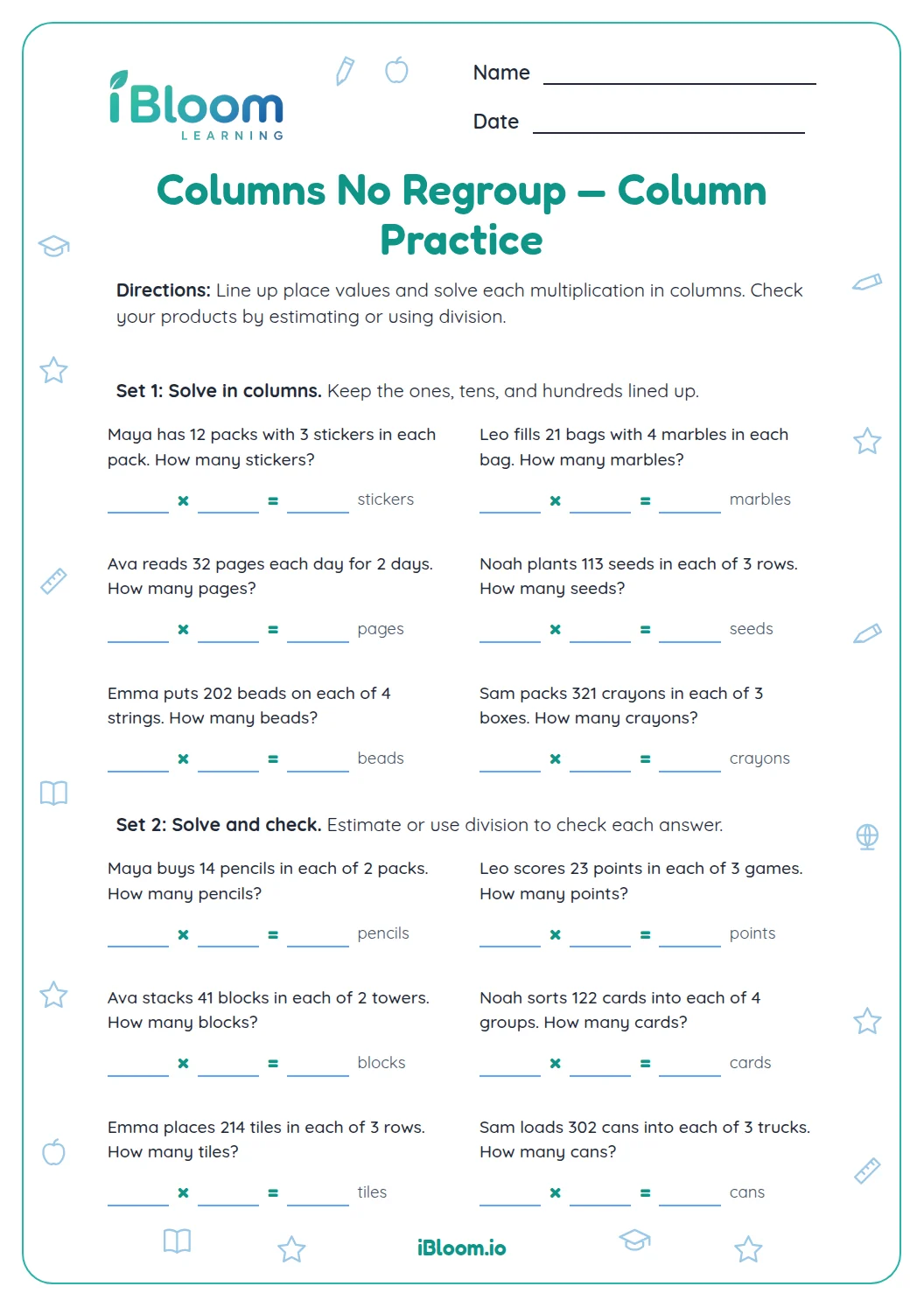
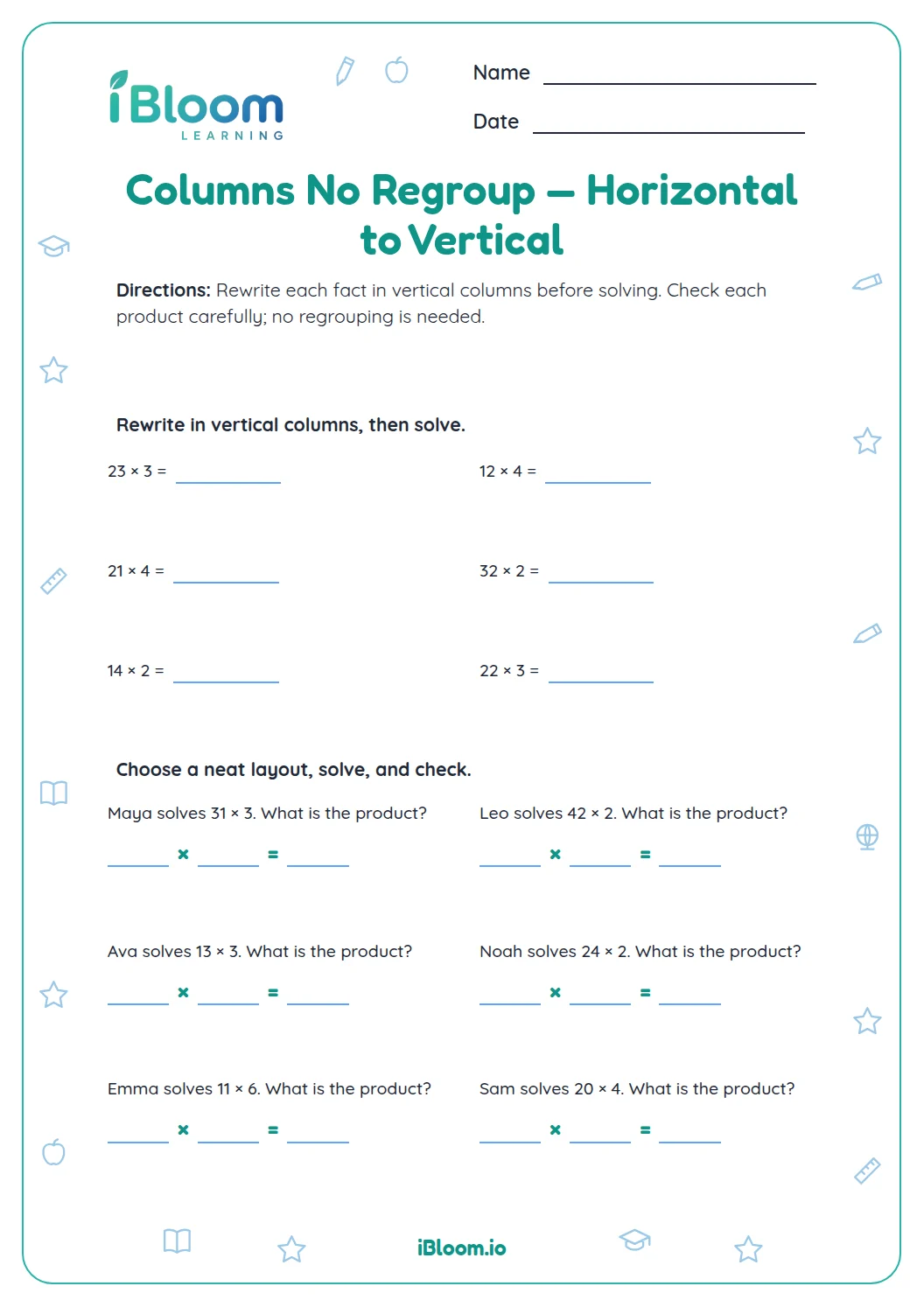
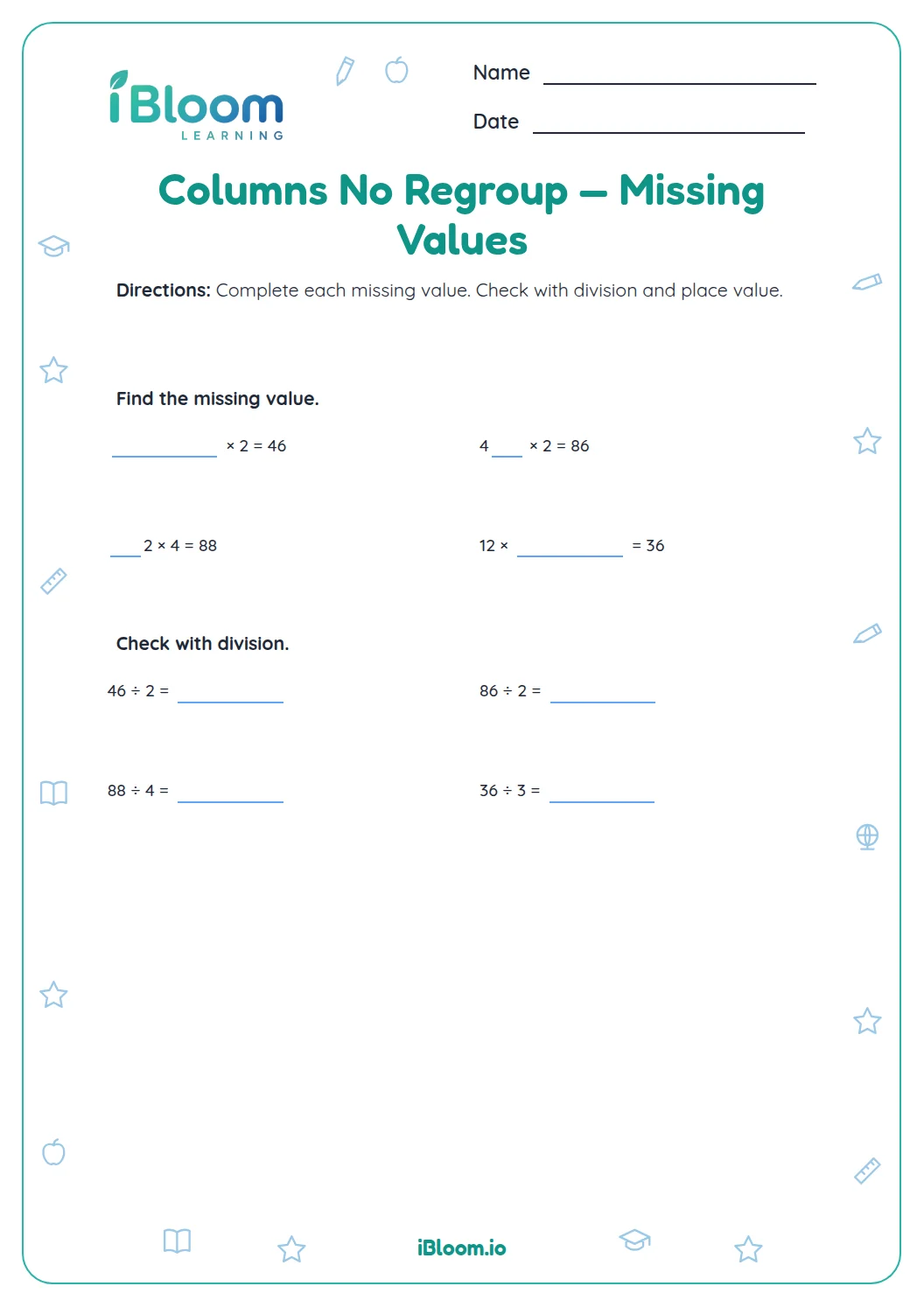
About this worksheet
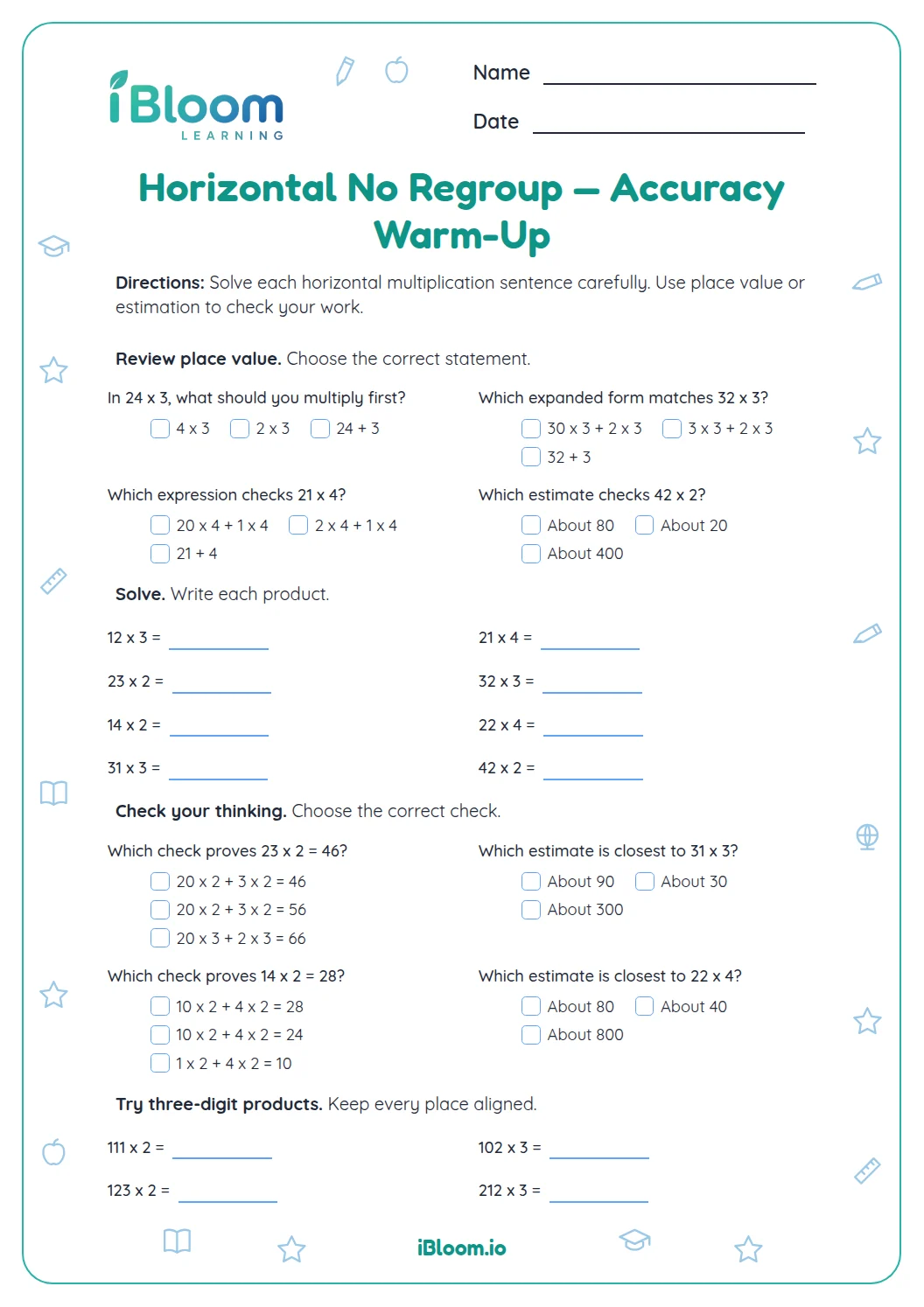
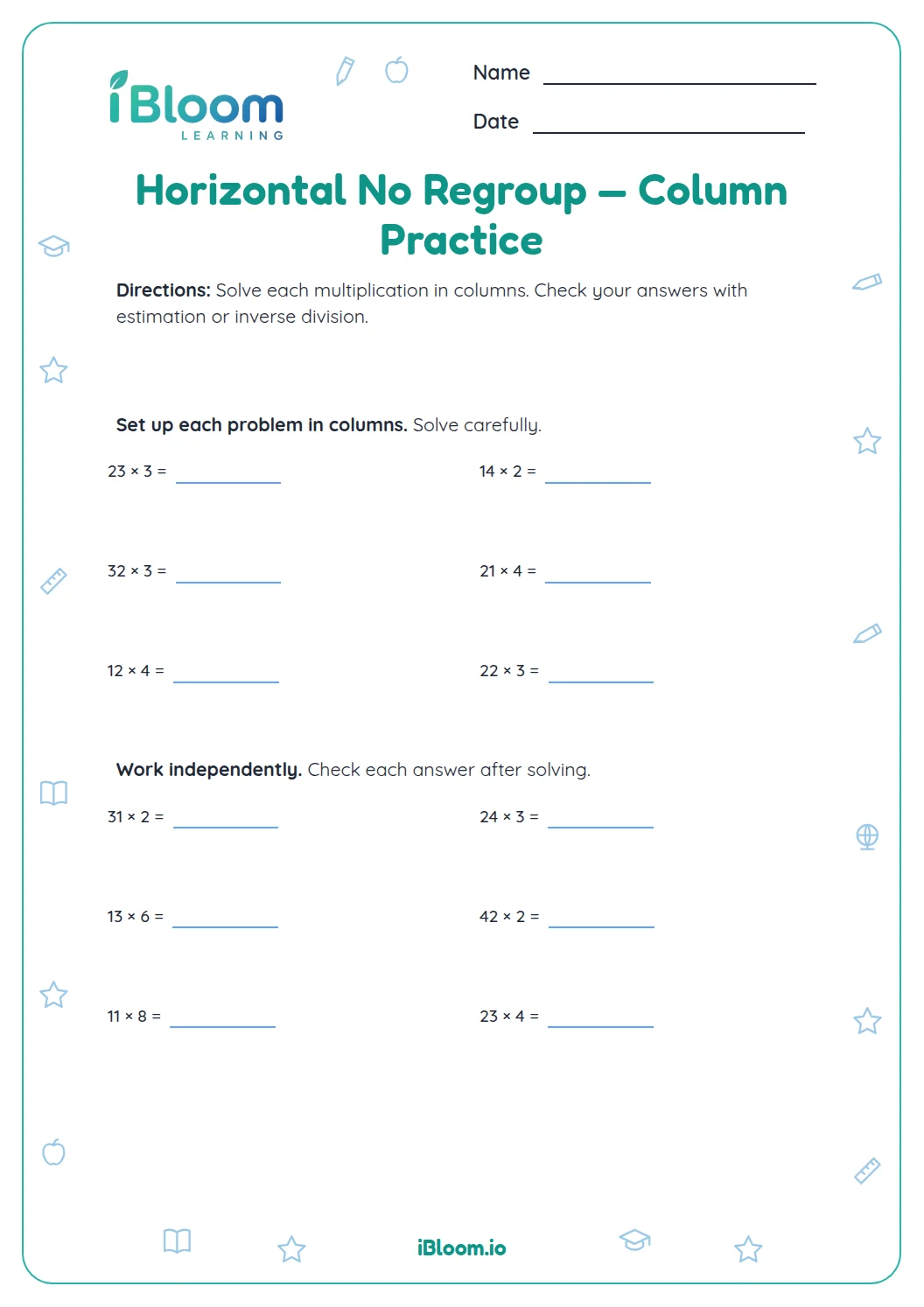
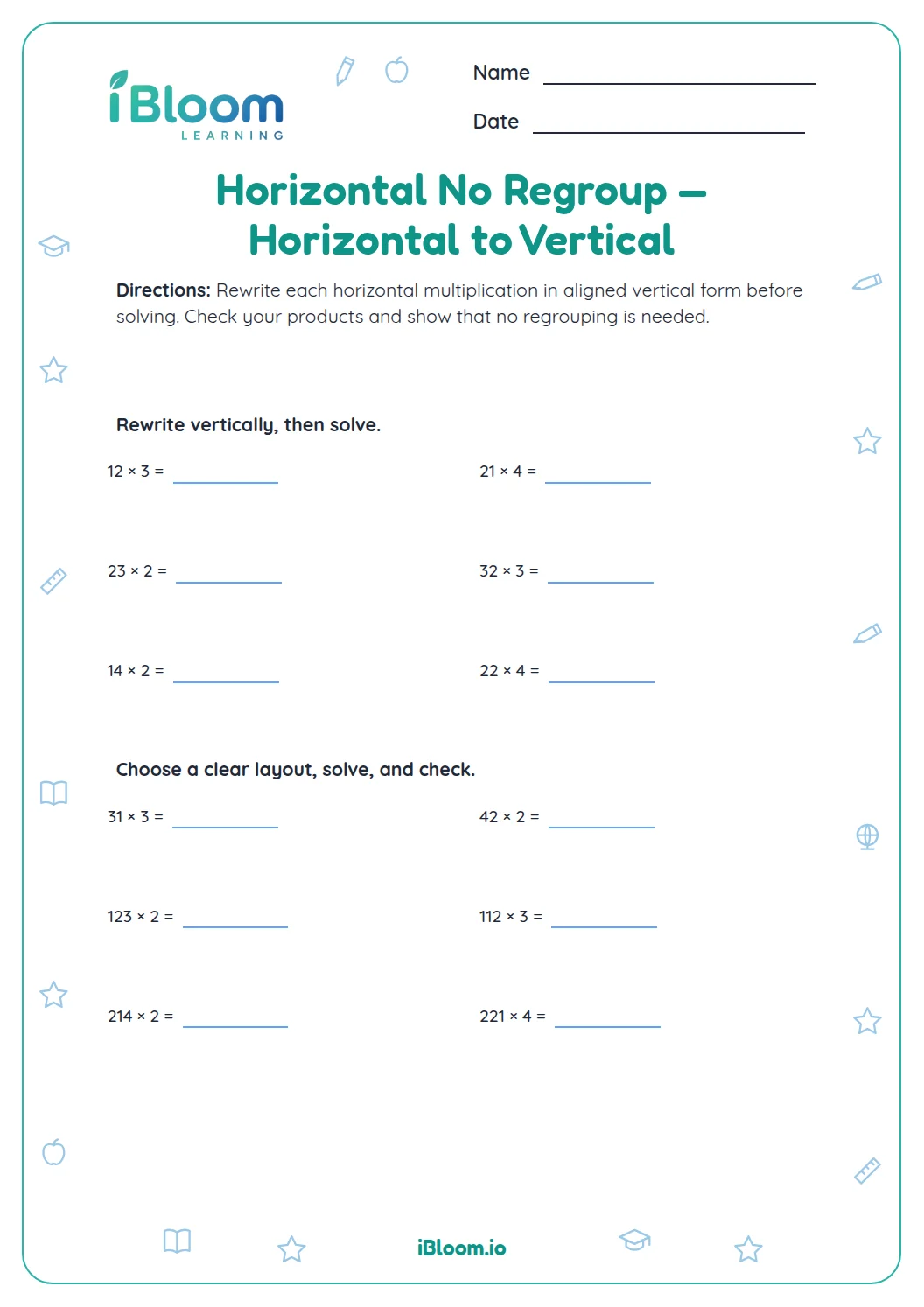
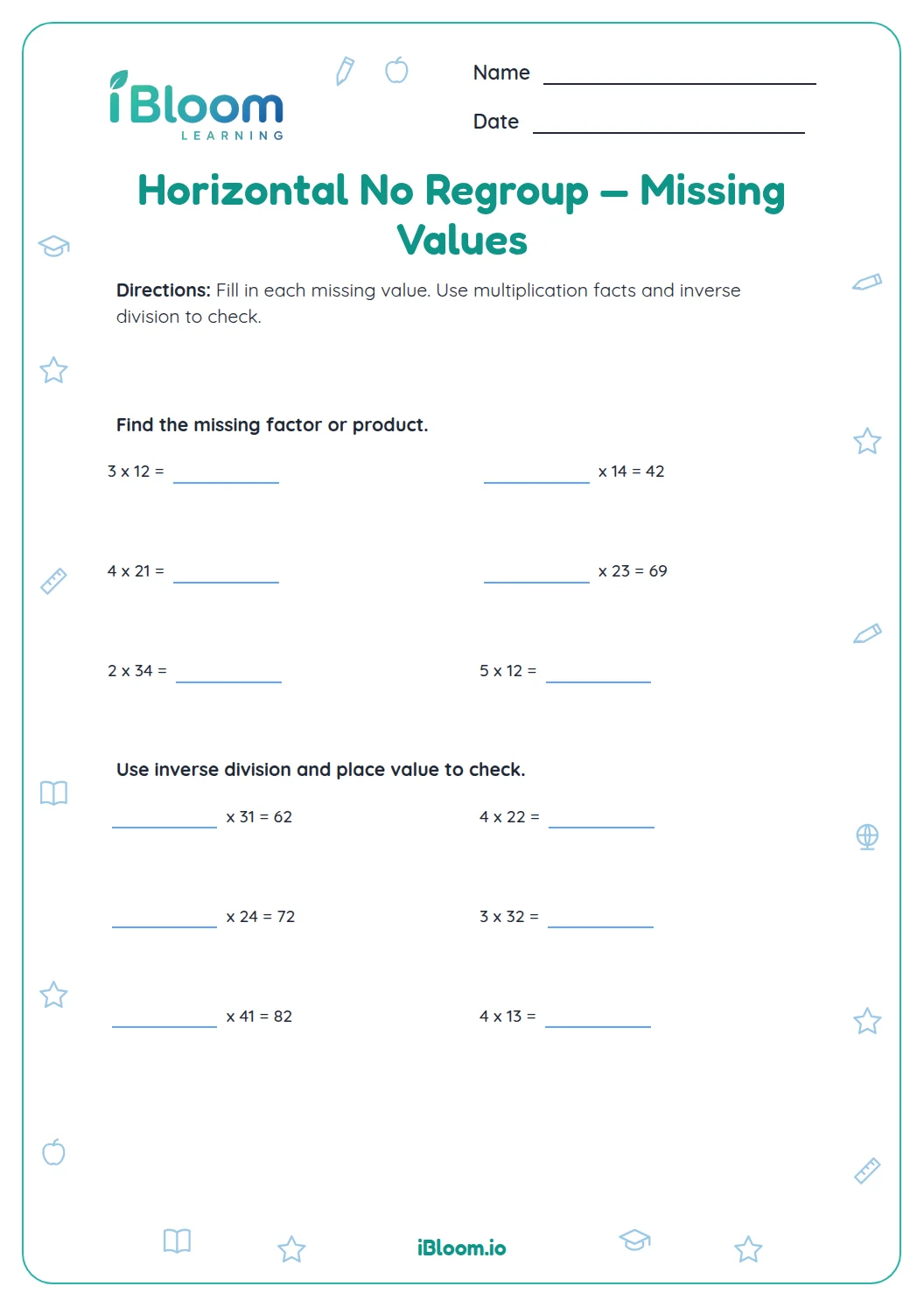
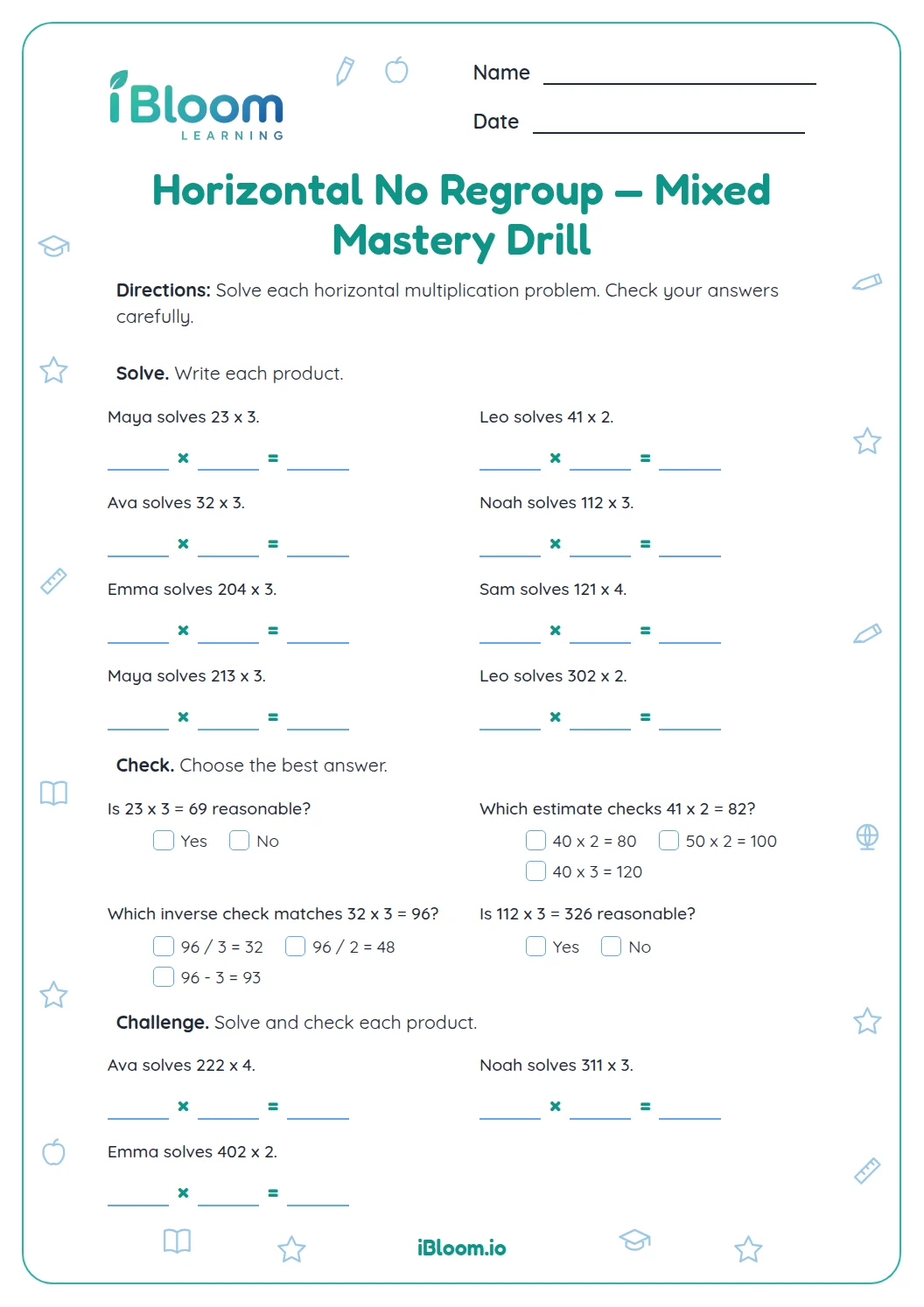
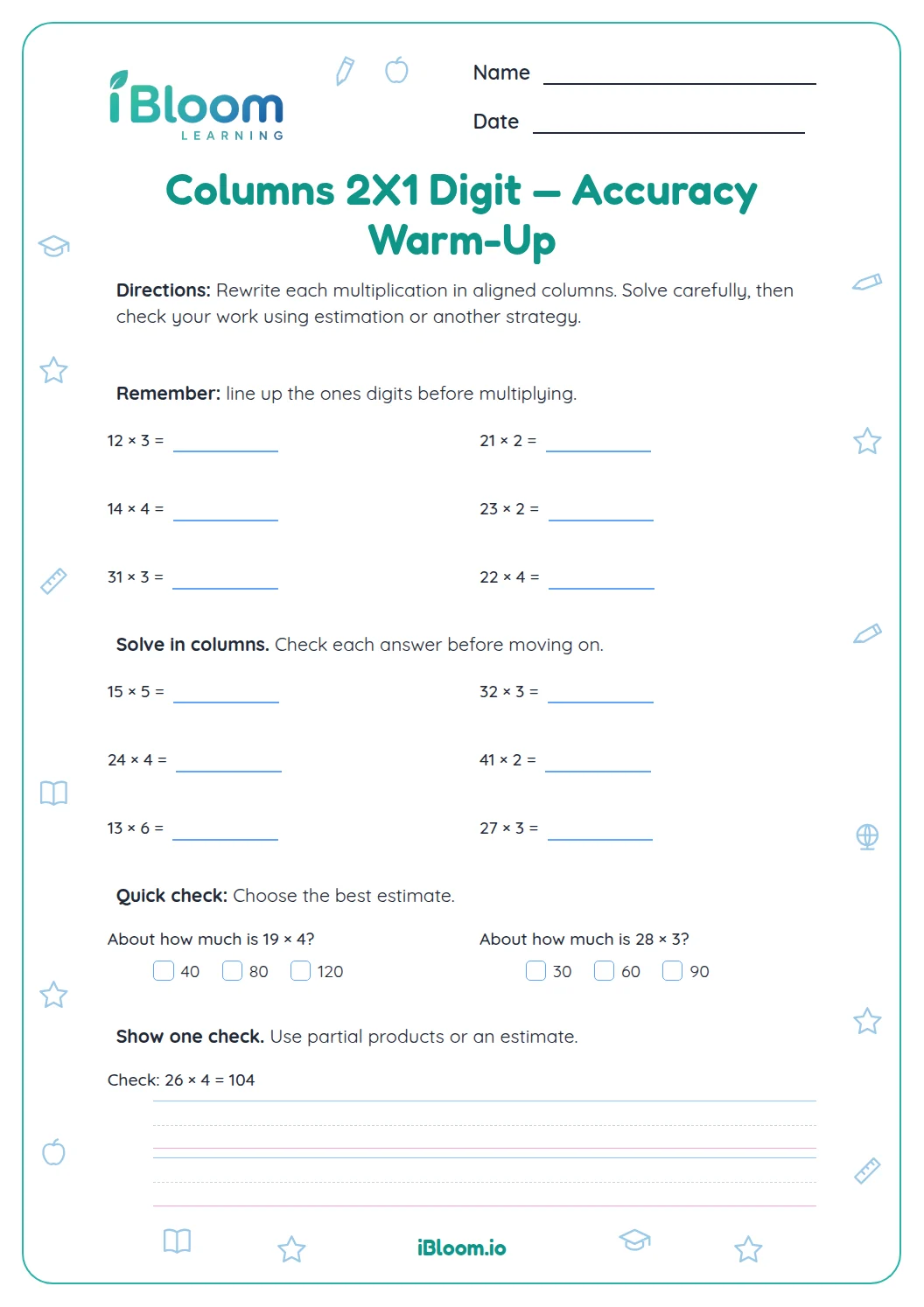
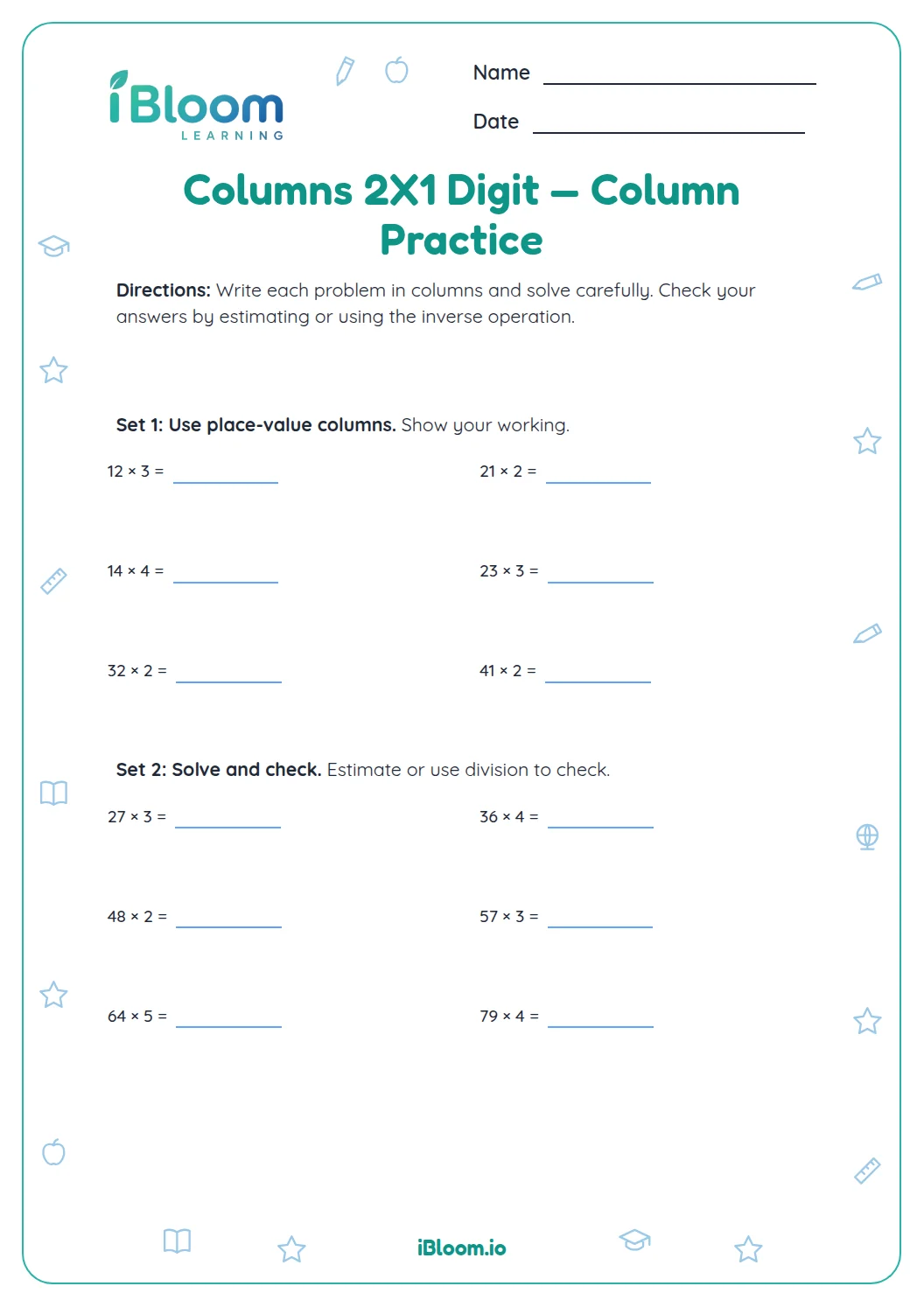
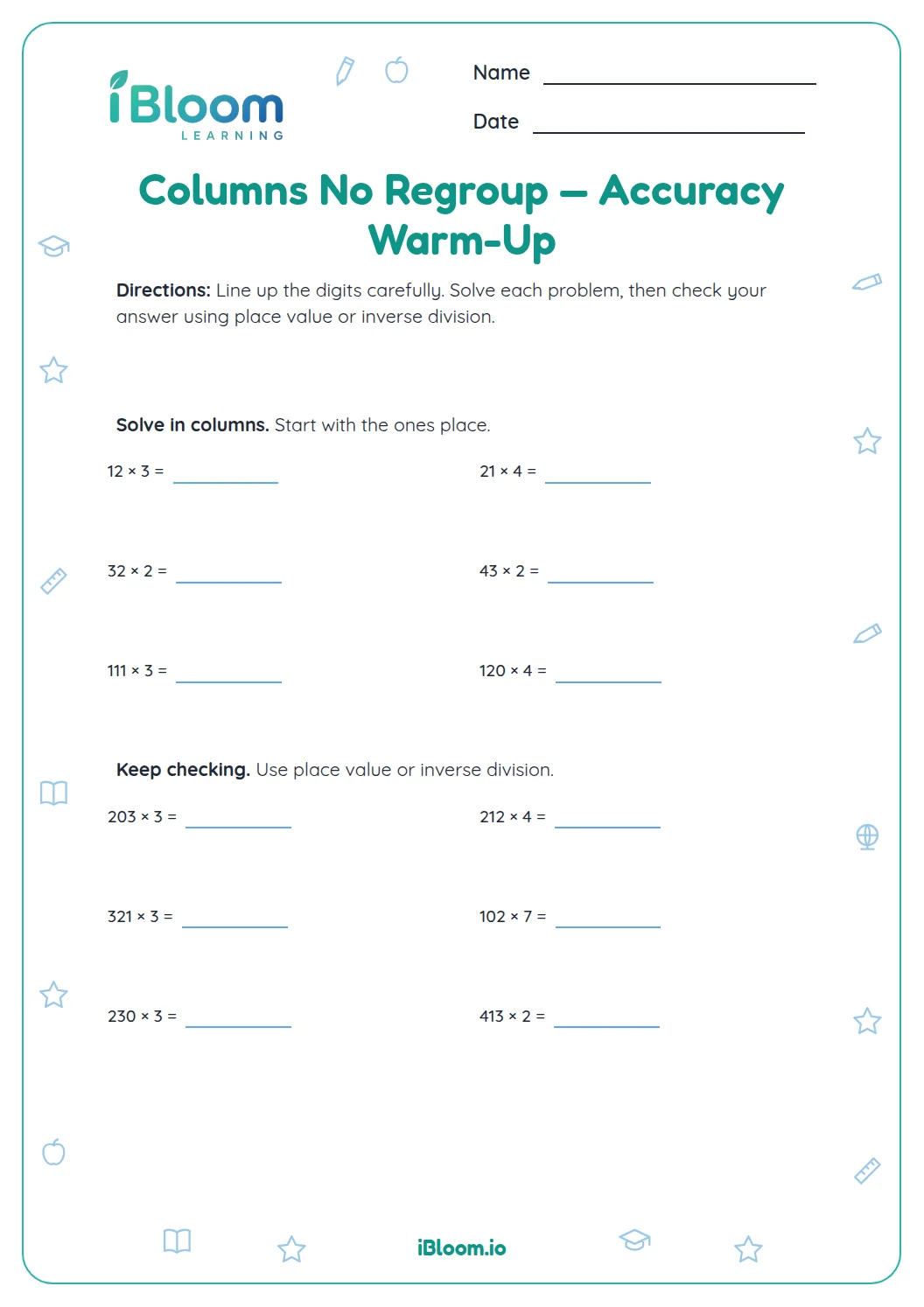
This free printable worksheet is for Grade 3 learners practicing horizontal multiplication facts and error analysis. Its 15 questions use familiar examples to build the skill step by step. The separate answer key gives a response for every item.
Aligned to 3.OA.A.1
How does the worksheet practice horizontal multiplication facts and error analysis?
Part A practices horizontal products with no regrouping. Part B asks learners to check sample incorrect products. Part C applies the same facts to equal groups, comparisons, and a missing factor.
- 112 × 3 = ___
- 2Answer: 36
How can a learner check an answer?
Read the direction for each part and identify the detail the question asks for. Solve it, then use the answer key to check the result and revisit any step that needs attention.
What is on the printable?
The worksheet has 15 questions across three parts, followed by a separate answer key.
How to use this worksheet
- 1Read both factors and keep the multiplication sign in view.
- 2Break a two-digit factor into tens and ones when useful.
- 3Calculate the product before checking a sample student answer.
- 4For equal groups, multiply the number of groups by the amount in each group.
- 5Compare the two products when asked which is greater.
Checks for multiplication slips
The mistake
Multiplying the tens digit but missing the ones digit.
The fix
Break the two-digit factor into tens and ones, then add both partial products.
The mistake
Accepting a claimed product without recalculating it.
The fix
Work out the fact yourself before comparing it with the student’s answer.
The mistake
Comparing only one factor in two products.
The fix
Find both products, then compare the results.
Common Core alignment
Interpret multiplication as equal groups and find products.
On this sheet:
Show the official wordingHide the official wording
Interpret products of whole numbers, e.g., interpret 5 × 7 as the total number of objects in 5 groups of 7 objects each.
What to practice next
Make more practice
Further reading
Questions parents and teachers ask
What does the multiplication worksheet practice?
Learners find horizontal products, check incorrect products, and apply multiplication to equal groups. The facts use two-digit factors times one digit and stay within 100. The error examples prompt learners to calculate independently before selecting the correct product.
How many questions are on the sheet?
There are 15 questions in three parts. Five items ask for products, five ask learners to check a mistaken product, and five apply or compare multiplication facts. The examples give practice with the horizontal format named in the worksheet title.
Does the worksheet include an answer key?
Yes. The separate answer key lists the product or response for every question. For an error-analysis item, calculate the multiplication fact first, then compare the result with the student’s claim and select the correct product. Review the factors and product together to locate a possible place-value slip.
How can a learner check a product?
Break a two-digit factor into tens and ones, multiply each part, and add the partial products. For 23 × 3, calculate 20 × 3 and 3 × 3, then add 60 and 9 to get 69. This also helps locate an error in a claimed answer.
How long should the worksheet take?
Plan for about 20 minutes. Learners can complete the direct product questions first, then pause and calculate each sample error on their own. The final situations give a chance to connect multiplication facts with equal groups. Encourage careful checking instead of rushing to finish.