





About this worksheet
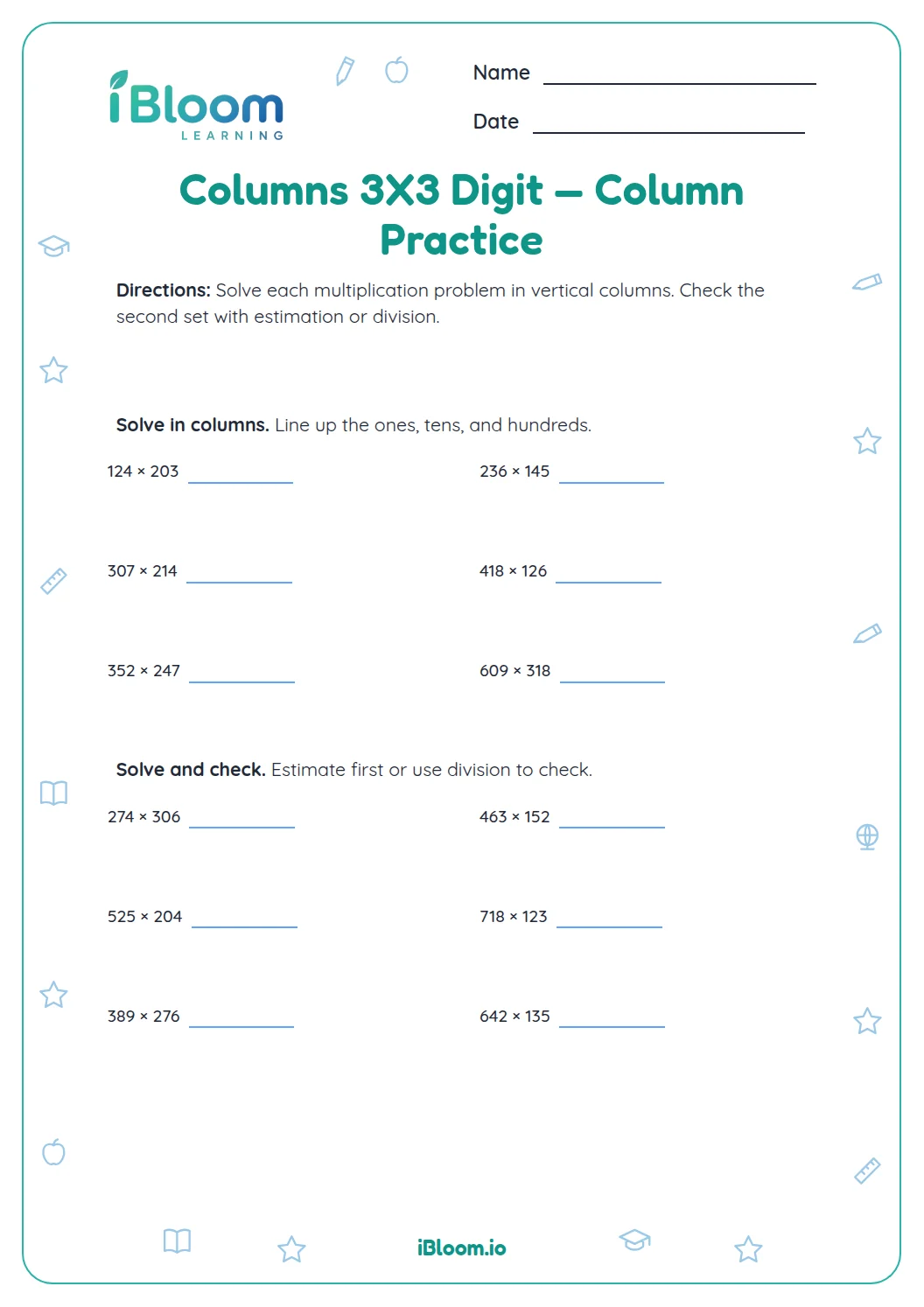
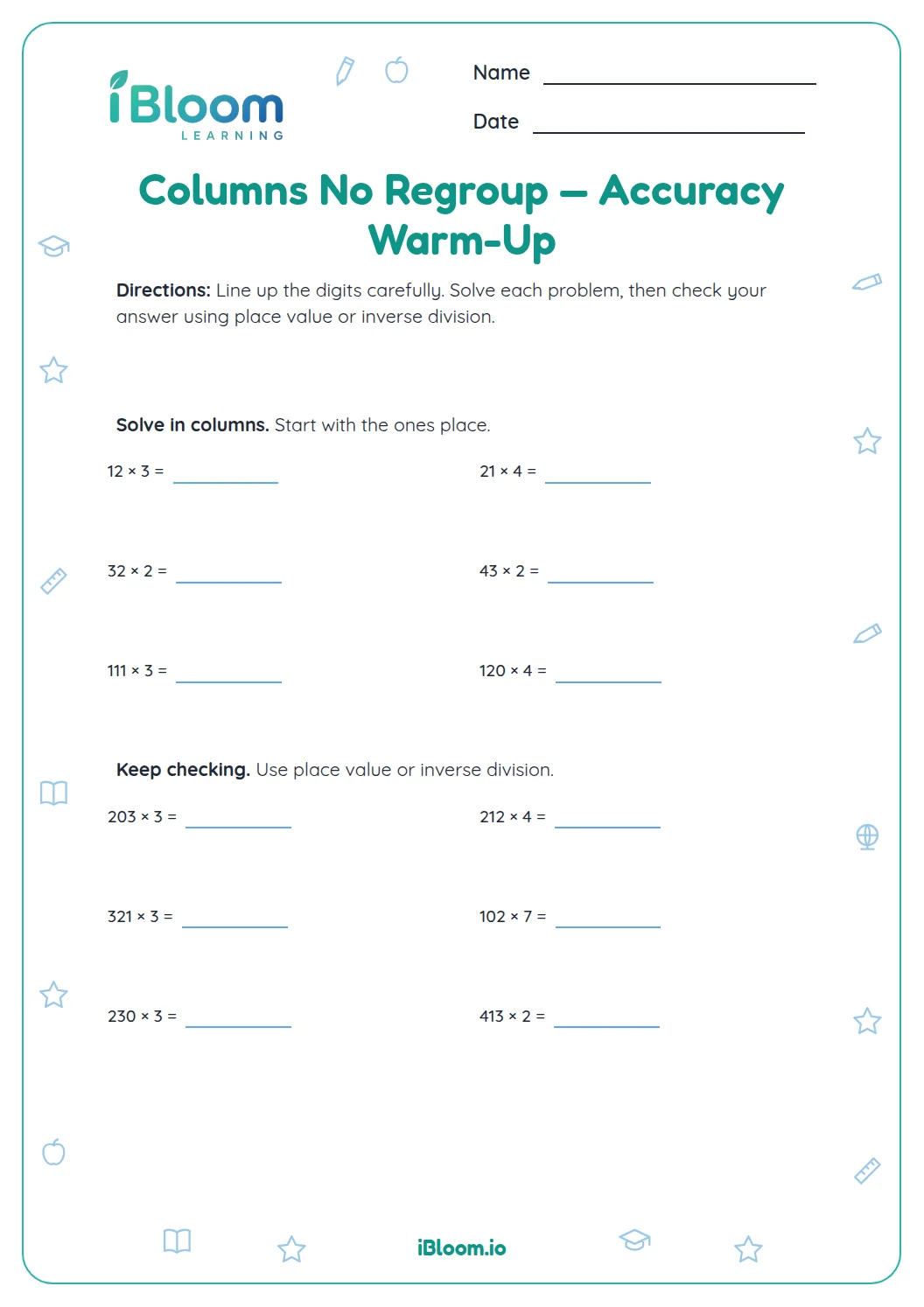
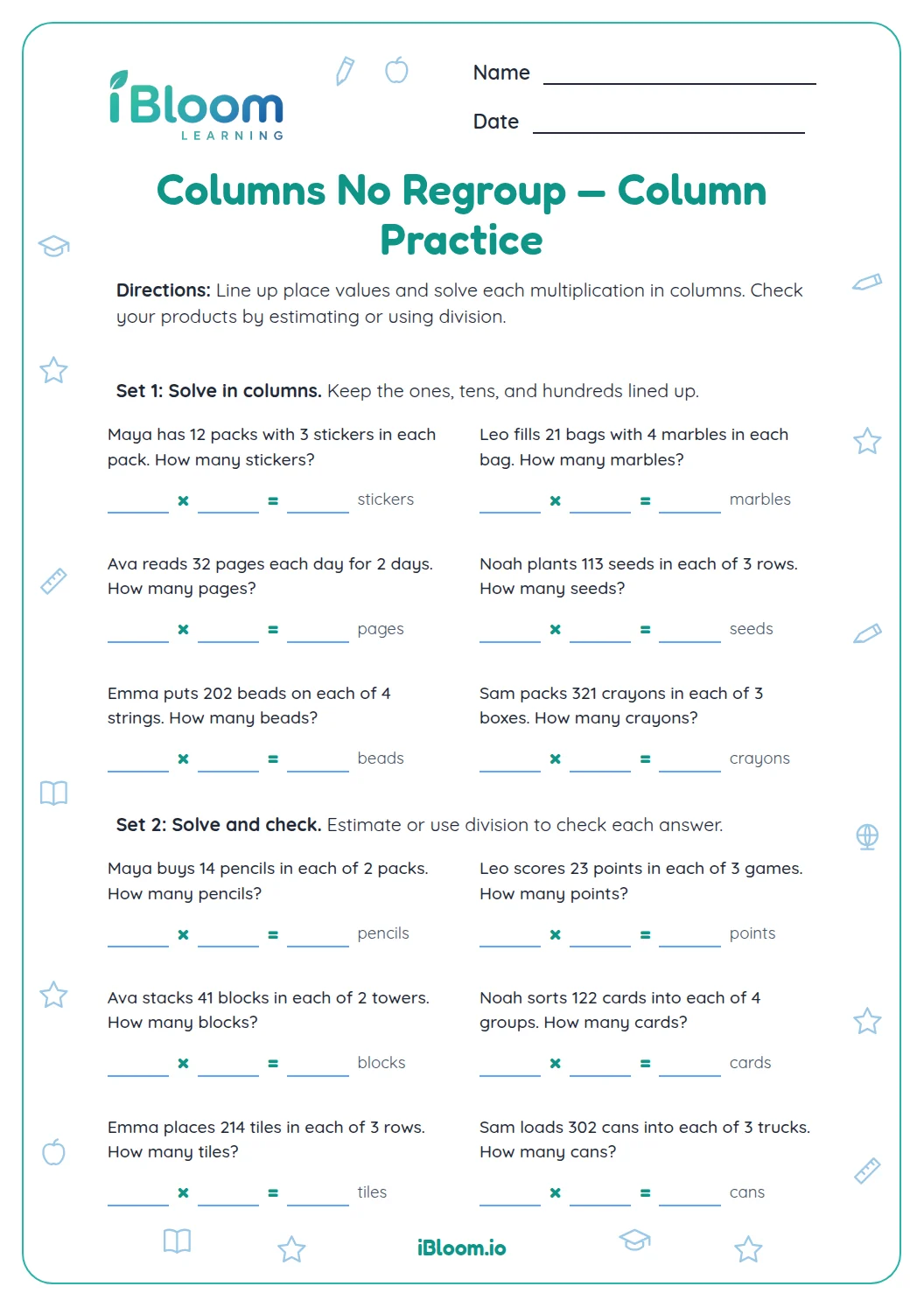
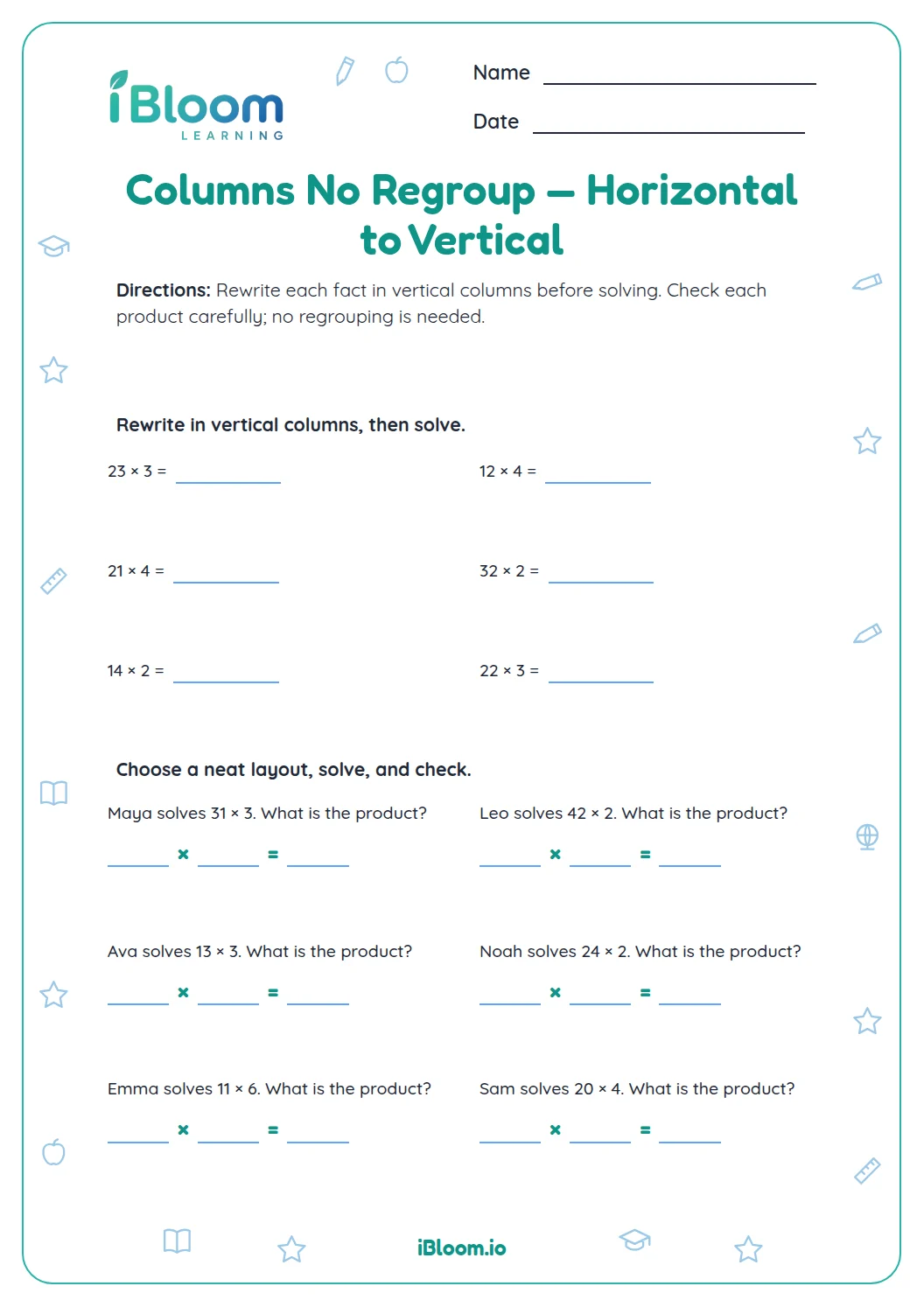
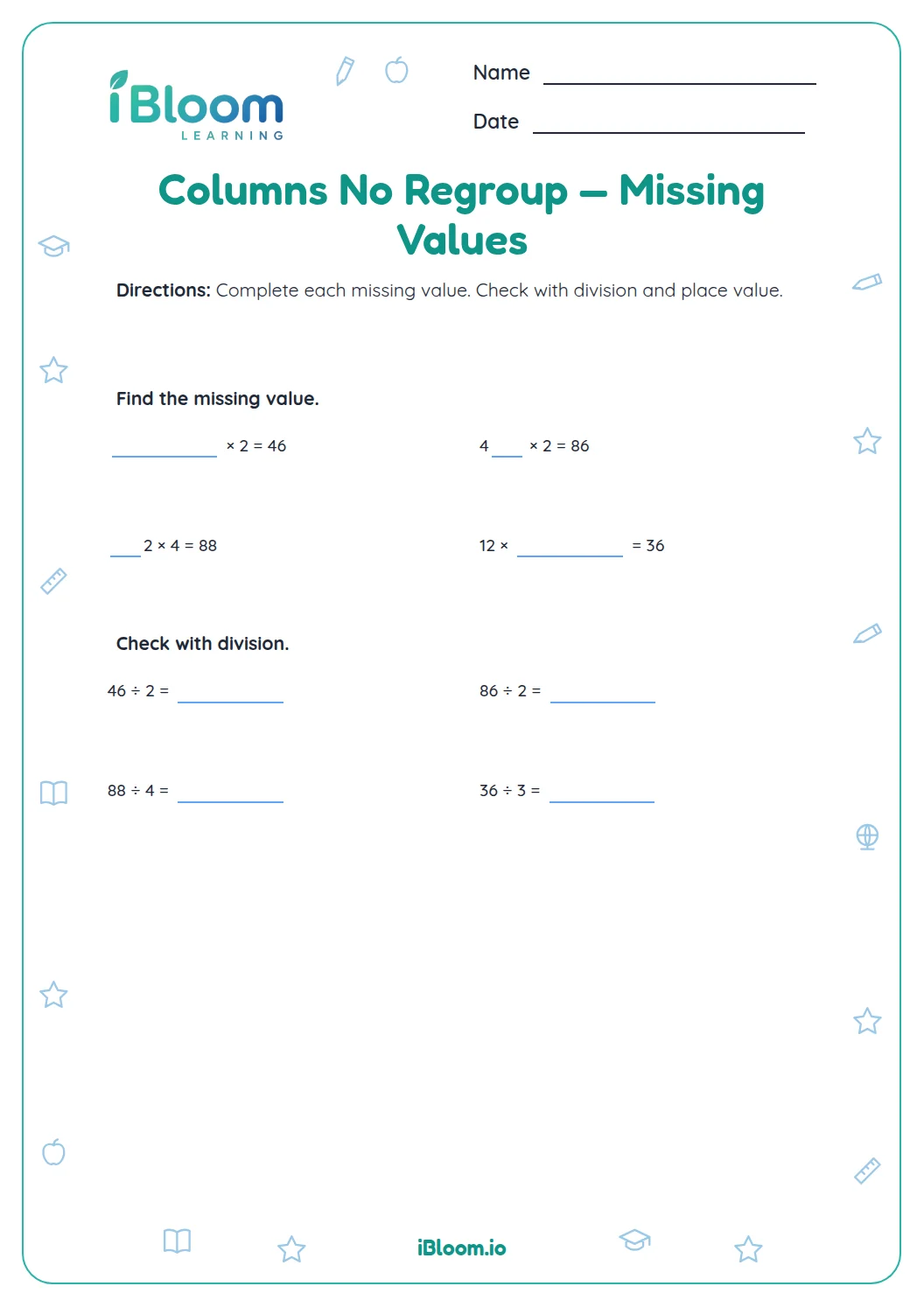
This free printable Grade 4 math worksheet gives learners 16 column-multiplication questions. In the first part, they use a product and a one-digit factor to find a missing three-digit factor; in the second, they find missing products. A separate answer key supports checking place-value work and regrouping.
Aligned to 4.NBT.B.5
How can a learner work through 3-digit by 1-digit multiplication?
The first part asks learners to find a missing three-digit factor from a product and a one-digit factor. The second part gives a three-digit factor and asks for the missing product; both parts allow written column work.
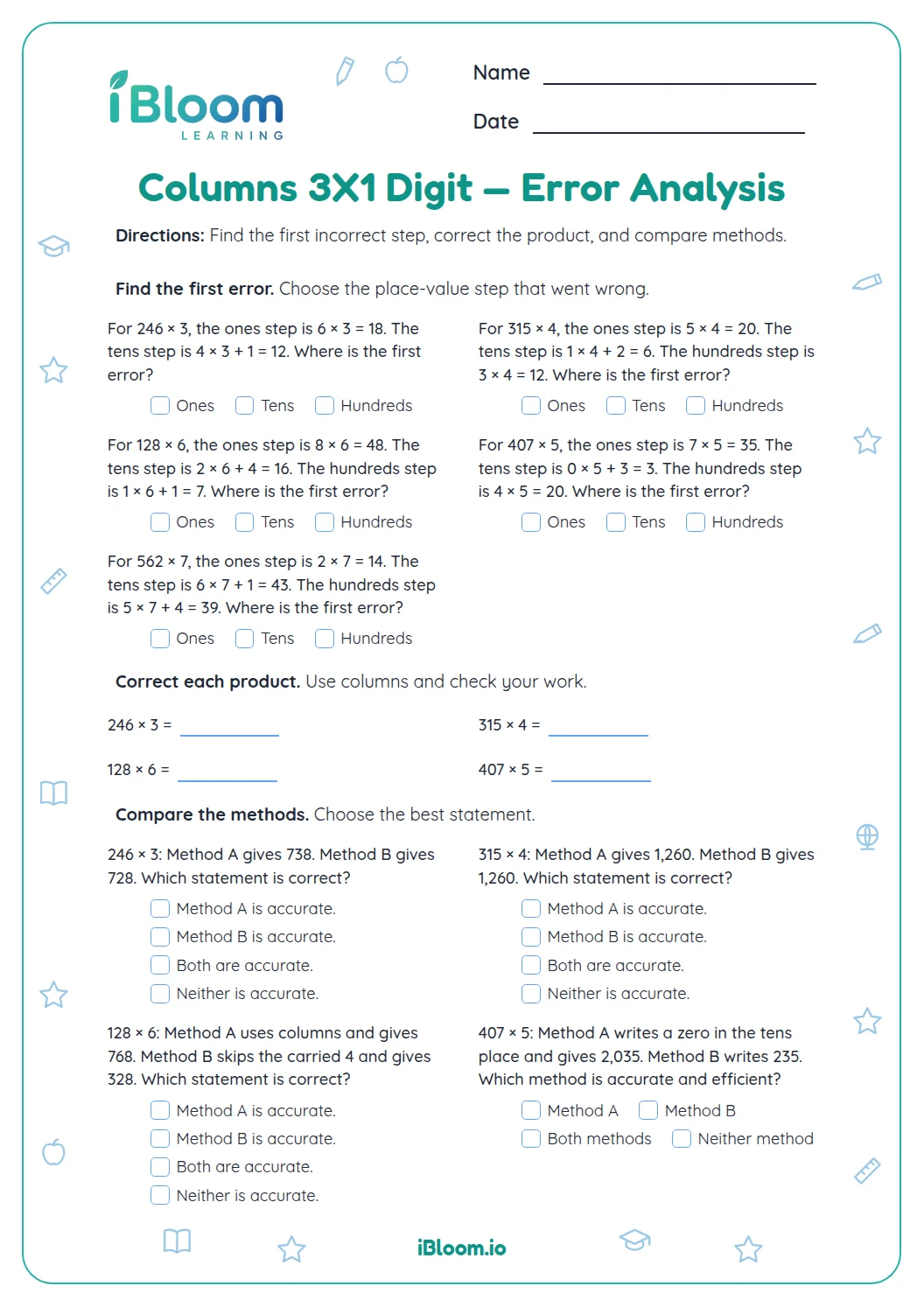
For 316 × 5, multiply from right to left: 5 × 6 = 30, write 0 ones and regroup 3 tens; 5 × 1 ten plus 3 tens is 8 tens; then 5 × 3 hundreds is 15 hundreds. The product is 1,580.
- 1Ones: 6 × 5 = 30
- 2Tens: 1 × 5 + 3 = 8
- 3Hundreds: 3 × 5 = 15
- 4Product: 1,580
What will the worksheet ask the learner to do?
The printable has 16 questions in 2 parts: 8 missing factors and 8 missing products. Each item provides space for calculation, and the separate key lists the missing value.
How can an adult support this practice?
Read the direction for each part, then ask the learner to explain one choice or calculation. Use the answer key to discuss the method as well as the final answer.
How to use this worksheet
- 1Line up the ones digits before starting.
- 2Multiply the ones digit and regroup any tens.
- 3Multiply the tens digit and add the regrouped tens.
- 4Continue through the hundreds place.
- 5Estimate the product and then check the answer key.
Common mistakes and quick fixes
The mistake
Forgetting a regrouped ten.
The fix
Write it above the next place and add it to that product.
The mistake
Adding the regrouped digit after multiplying the next place.
The fix
Multiply first, then add the small regrouped value.
The mistake
Misaligning digits.
The fix
Keep ones under ones, tens under tens, and hundreds under hundreds.
Standards alignment
This page connects the worksheet practice to the standards listed below.
Multiply multi-digit whole numbers by one digit using place value and explain the calculation.
On this sheet: The product questions practice multiplying a three-digit whole number by a one-digit whole number using place value and regrouping.
Show the official wordingHide the official wording
Multiply a whole number of up to four digits by a one-digit whole number, and multiply two two-digit numbers, using strategies based on place value and the properties of operations. Illustrate and explain the calculation by using equations, rectangular arrays, and/or area models.
What to practice next
Further reading
Questions parents and teachers ask
What does “in columns” mean here?
The first eight questions give a product and one factor, so the learner finds the missing factor with inverse division. The final eight show a three-digit factor and one-digit multiplier, with room to set up the multiplication vertically and find the missing product.
Why are the products not all the same difficulty?
Some problems require regrouping in the ones place, some in more than one place, and others have a zero digit in the top number. This variety helps learners attend to place value in each column. The key also makes it straightforward to find the place where regrouping needs another look.
Can a learner estimate before multiplying?
Yes. Rounding the three-digit number to a nearby hundred gives a quick size check. For example, 236 is near 200, so 236 × 4 should be near 800; the exact product is 944. The key also makes it straightforward to find the place where regrouping needs another look.
What is a reliable way to check a product?
Multiply each place carefully and check with an estimate. If possible, divide the product by the one-digit factor to see whether the original three-digit number is recovered. The key also makes it straightforward to find the place where regrouping needs another look.
Is the answer key separate?
Yes. The separate answer key lists all 16 missing factors and products. After the learner finishes, check the value and review the place where regrouping was needed. The first eight items ask for a factor; the final eight ask for a product.