



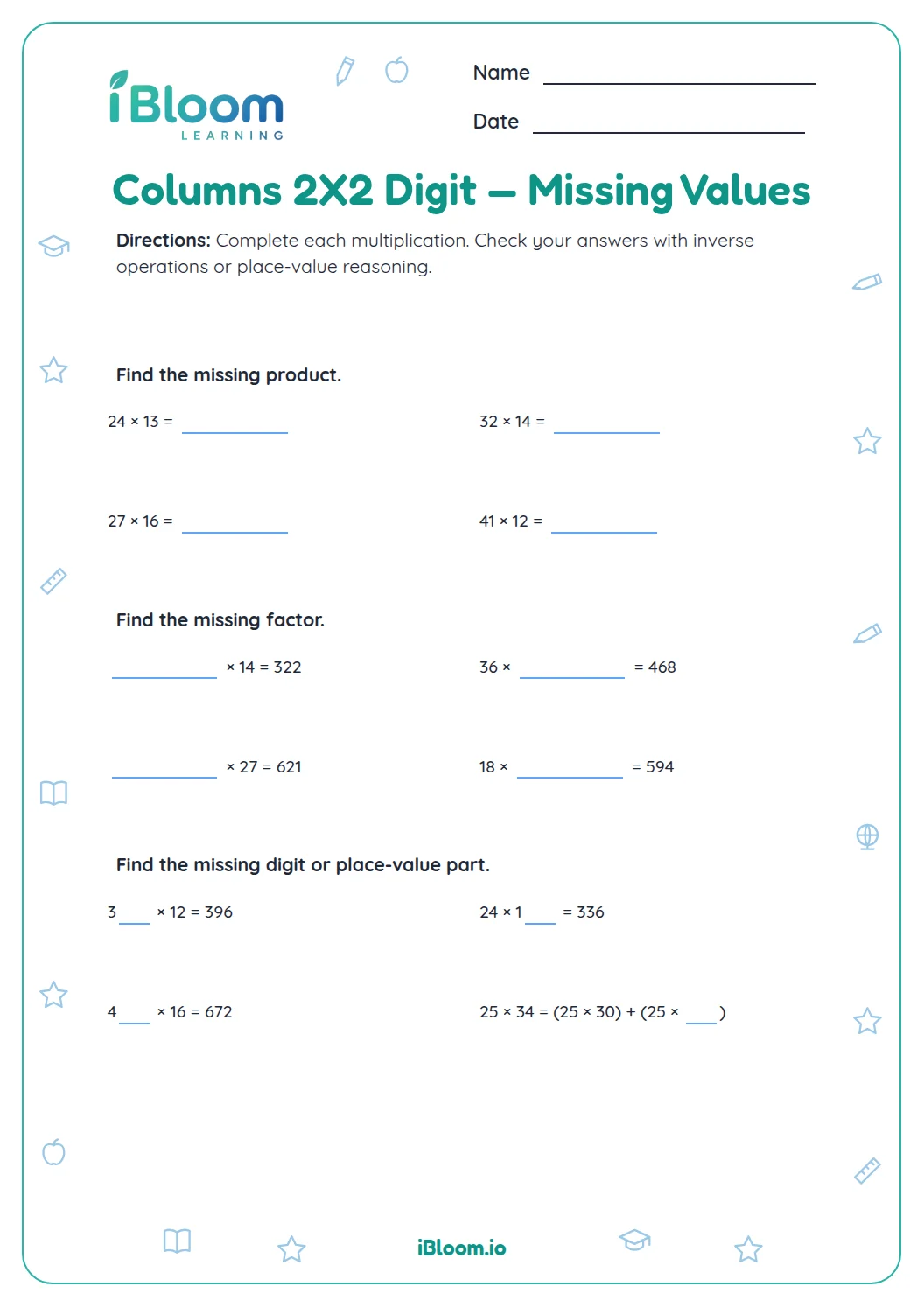


About this worksheet
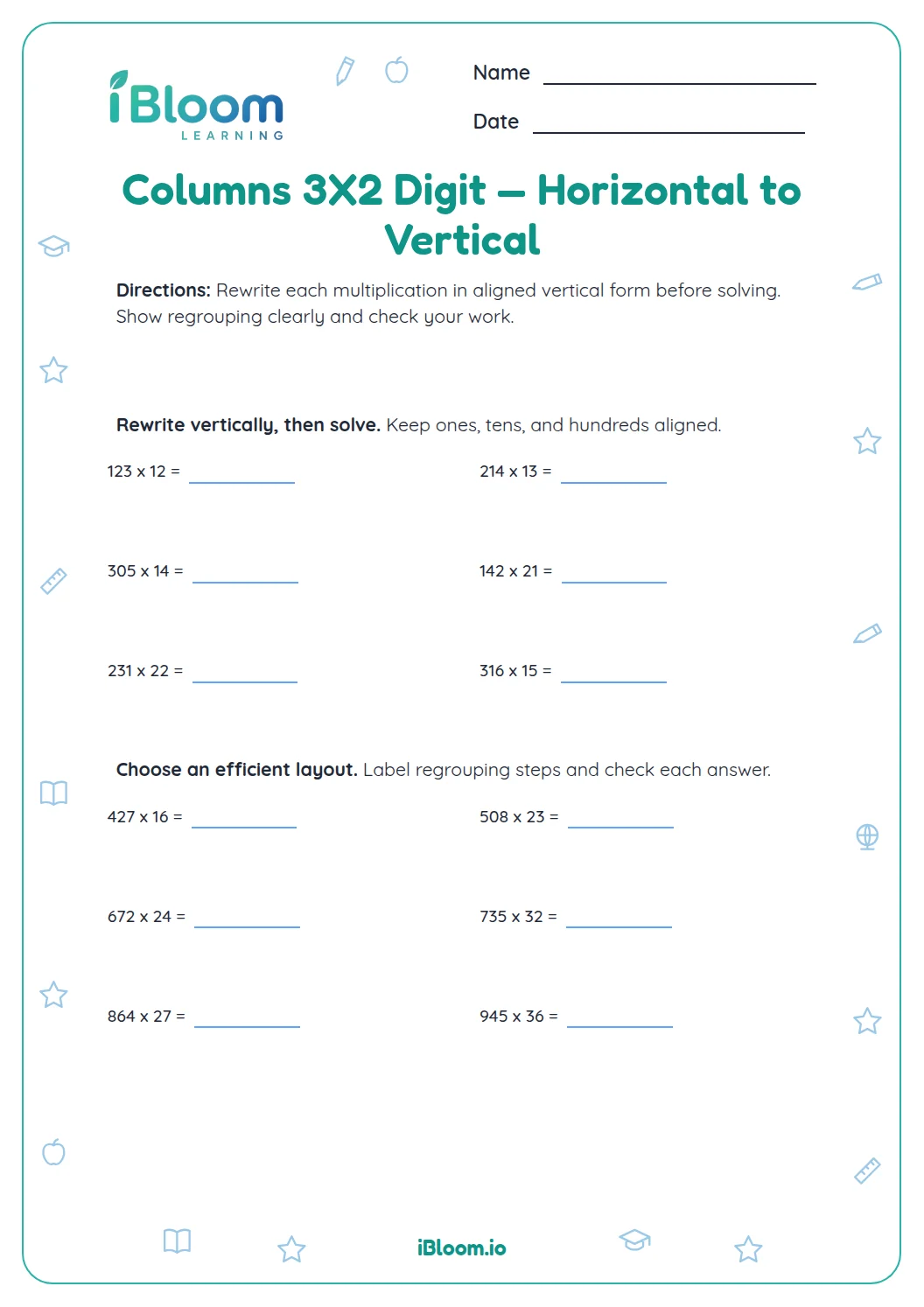
This free printable Grade 5 math worksheet gives learners 16 problems multiplying 3-digit numbers by 2-digit numbers. They solve products in columns, use multiplication in two short situations, and check partial products and place value. The separate answer key lists the products. The work practices Common Core standard 5.NBT.B.5: fluently multiplying multi-digit whole numbers with the standard algorithm.
Aligned to 5.NBT.B.5
How do column products use place value?
Multiply the ones digit and the tens digit separately, then add the partial products. Keep each digit in its place-value column.
For 124 × 23, the partial products are 372 and 2,480. Add them to get 2,852.
- 1124 × 23
- 2124 × 3 = 372; 124 × 20 = 2,480
- 3372 + 2,480 = 2,852
How does the practice build?
Questions 1–8 and 14–16 ask for products. Questions 9–10 put multiplication in short contexts; questions 11–13 check tens place value and partial products.
How can I use the answer key?
Complete one part at a time. Use the key to check each product and revisit any partial product that is misaligned.
How to work through the page
- 1Read the direction at the start of each part.
- 2Try the first question carefully and check what it asks.
- 3Complete the rest of the part independently.
- 4Review answers with the key and correct any slips.
Common slips and quick checks
The mistake
Treating the tens digit as ones, such as using 4 instead of 40 in 23.
The fix
Write the tens partial product one place to the left, or multiply by 20.
The mistake
Adding partial products before checking each multiplication.
The fix
Compute each row separately, then add the rows.
The mistake
Shifting a digit into the wrong place-value column.
The fix
Line up ones under ones, tens under tens, and hundreds under hundreds.
Curriculum alignment
Multiply multi-digit whole numbers using the standard algorithm.
On this sheet: The column problems multiply 3-digit by 2-digit whole numbers.
Show the official wordingHide the official wording
Fluently multiply multi-digit whole numbers using the standard algorithm.
What to practice next
Make more practice
Further reading
Questions parents and teachers ask
How do children multiply a 3-digit number by a 2-digit number?
Multiply by the ones digit first, then by the tens digit, and add the partial products. For 124 × 23, compute 124 × 3 and 124 × 20. Keep each product lined up by place value before adding. The example totals 372 + 2,480 = 2,852.
Why does a 3-digit by 2-digit problem have two partial products?
The second factor has a ones digit and a tens digit. In 23, the 2 means 20, so it creates a tens partial product. Multiply 124 by 20, not by 2, then add that result to 124 × 3. The place-value shift represents those two tens.
What does the worksheet mean by accuracy warm-up?
The page begins with column products, applies multiplication in two short situations, and checks place value. It has no timer, so learners can take time to align digits and review each row. Use the separate key after completing a part. The questions move from direct products to applications.
How can I check a product without repeating every step?
Round 124 to about 100 and 23 to about 20. Their product is about 2,000, so the exact answer should be in that range. A closer estimate, 120 × 20 = 2,400, also helps check that 2,852 is reasonable. Compare the size before checking the exact product.
Which question practices multiplying by a tens digit?
Question 11 asks for the partial product from 326 × 40. Since 40 is four tens, first find 326 × 4 = 1,304, then multiply by 10 to get 13,040. That extra zero shows the tens place value. Question 13 also checks a tens partial product.