



About this worksheet
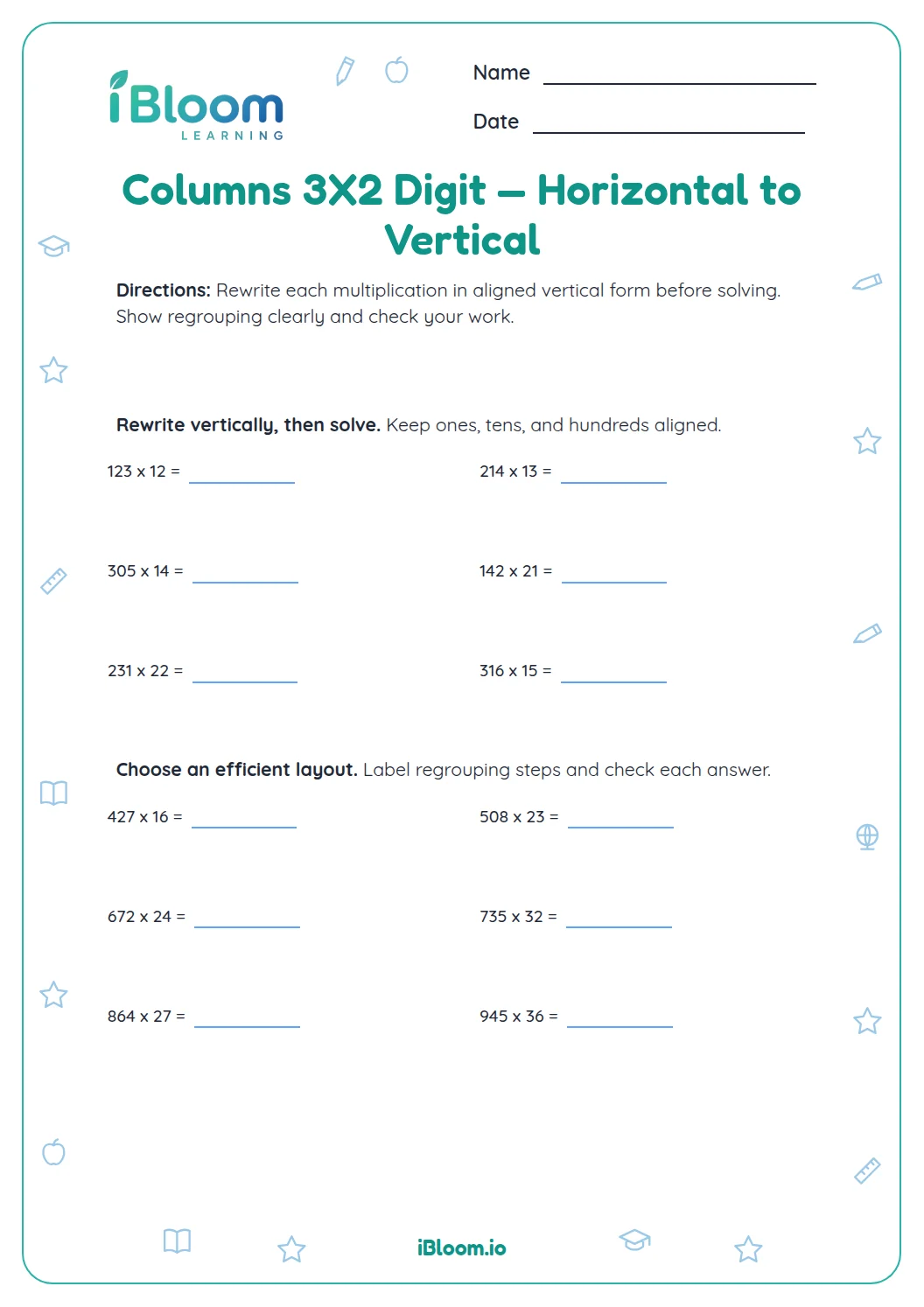
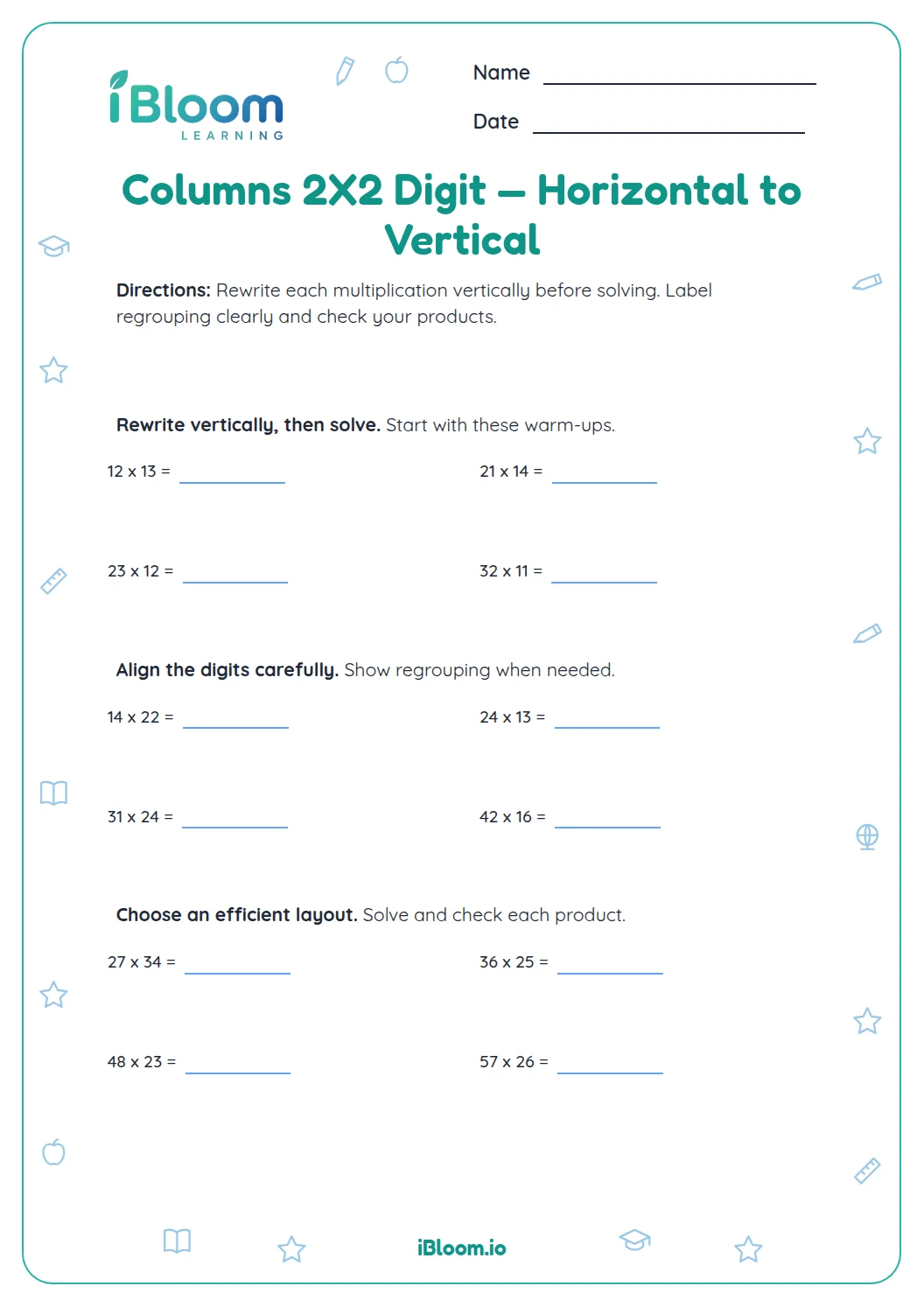
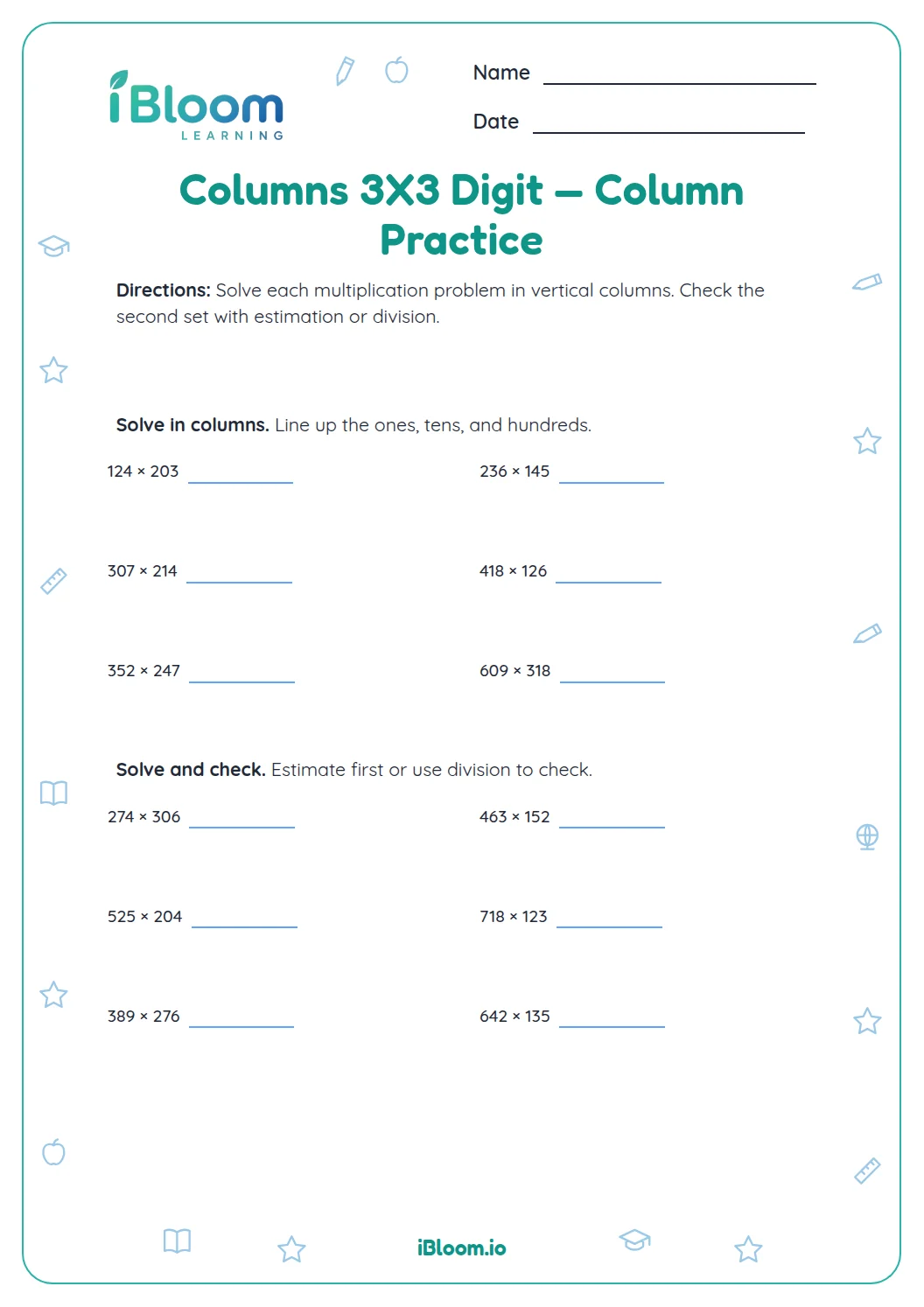
Solve three-digit by two-digit products in columns, then estimate four more products to judge their size. The final four problems add regrouping practice. Factors include zeros in different places. The key lists each exact product and estimate.
Aligned to 5.NBT.B.5
How do partial products keep place value clear?
Split the two-digit factor into tens and ones. Multiply the three-digit number by each part, then add the two products. In question 1, 23 means 20 + 3.
- 1124 × 23 = 124 × 20 + 124 × 3
- 2124 × 20 = 2,480
- 3124 × 3 = 372
- 42,480 + 372 = 2,852
What should you watch for in a mixed drill?
A zero in a factor still has a place value. For 306 × 14, multiply by 10 and by 4, then add. When a partial product has more than one digit in a place, regroup it into the next column.
How can you check a product?
Round each factor to estimate, then compare that estimate with the exact product. For example, 124 × 23 is about 120 × 20 = 2,400, so 2,852 is a sensible result. Questions 9–12 use this kind of reasonableness check.
- Eight three-digit by two-digit column products
- Four reasonableness checks using estimates
- Four challenge products to solve and check
- Separate answer key page
Use the column method carefully
- 1Write the three-digit number above the two-digit number, aligning the ones digits.
- 2Multiply by the ones digit and record the first partial product.
- 3Multiply by the tens digit, beginning in the tens column.
- 4Add the partial products.
- 5Estimate the product to see whether its size makes sense.
- 6Use the answer key to check and correct any place-value slips.
Common column multiplication mistakes
The mistake
Starting the tens partial product in the ones column.
The fix
Shift one place left, or write a zero placeholder in the ones place.
The mistake
Dropping a regrouped digit during a partial product.
The fix
Record each carried value above the next column before multiplying on.
The mistake
Adding partial products without aligning their place values.
The fix
Stack them with the ones, tens, hundreds, and thousands columns lined up.
Common Core alignment
The problems practice multiplying multi-digit whole numbers with the standard algorithm and place-value reasoning.
Fluently multiply multi-digit whole numbers using the standard algorithm.
On this sheet: Each problem multiplies a three-digit whole number by a two-digit whole number using column multiplication.
Show the official wordingHide the official wording
Fluently multiply multi-digit whole numbers using the standard algorithm.
What to practice next
Make more practice
Further reading
Questions parents and teachers ask
What does 3-digit by 2-digit multiplication mean?
There are eight column products, four multiple-choice estimation questions, and four more products to solve in columns. All use a three-digit factor and a two-digit factor. The four estimates check whether students can judge a product’s size without carrying out the full multiplication.
Why does the tens row shift left?
Align the factors by place value, record a partial product for each digit of the two-digit factor, and add those rows. Shift the tens row one place to the left so its value stays clear. When a column total reaches ten or more, regroup it into the next place.
What is the answer to 124 × 23?
124 × 23 = 2,852. Multiply 124 by 3 to get 372, then by 20 to get 2,480. Add the partial products. An estimate of 120 × 20 = 2,400 also shows that 2,852 is a reasonable size.
How many multiplication problems are included?
Round the factors to nearby friendly numbers and multiply the rounded values. Compare that estimate with the exact product; the four check questions ask for the closest estimate. This quick size check can catch a misplaced digit or an answer that is far too large or small.
How can a student check a large product?
Allow about 25 minutes for 16 questions, including written partial products for the column calculations. Students can complete the eight products first, then move to the four estimates and four challenge products. A separate answer key is included for checking.
Is there an answer key?
Yes. A separate answer key page lists the products and the reasonableness choices. Compare the result with the key after working, then review the partial products or estimate if the answer differs. The key supports checking both the arithmetic and the reasonableness decision.