



About this worksheet
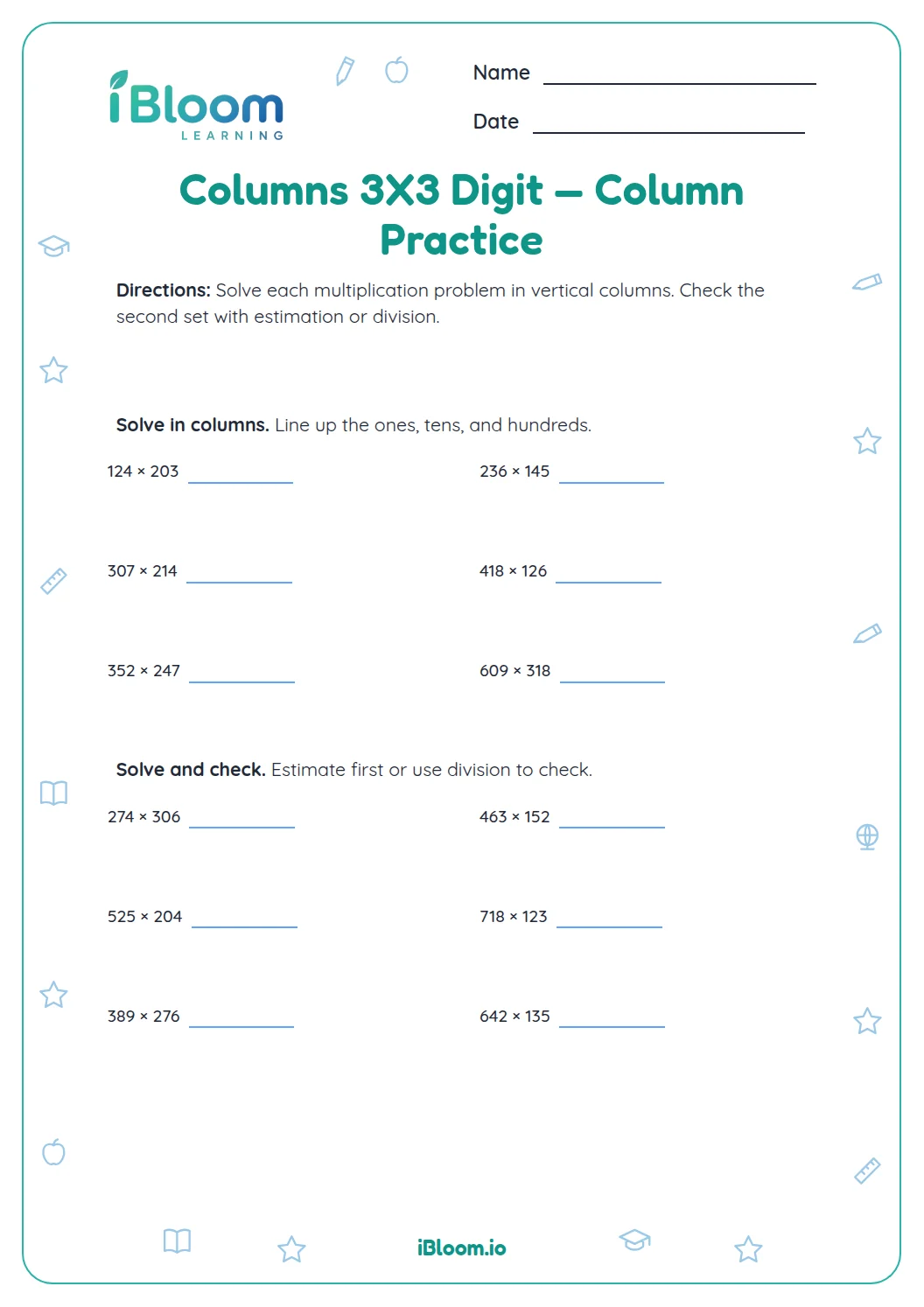
This printable gives Grade 5 learners 14 three-digit by three-digit multiplication problems in horizontal form. Children rewrite each expression in columns, multiply one place at a time, and combine partial products. The practice targets CCSS 5.NBT.B.5 and includes a separate answer key. Problems use varied factors, including zeros in different places, so students must attend to place value.
Aligned to 5.NBT.B.5
What does this page practice?
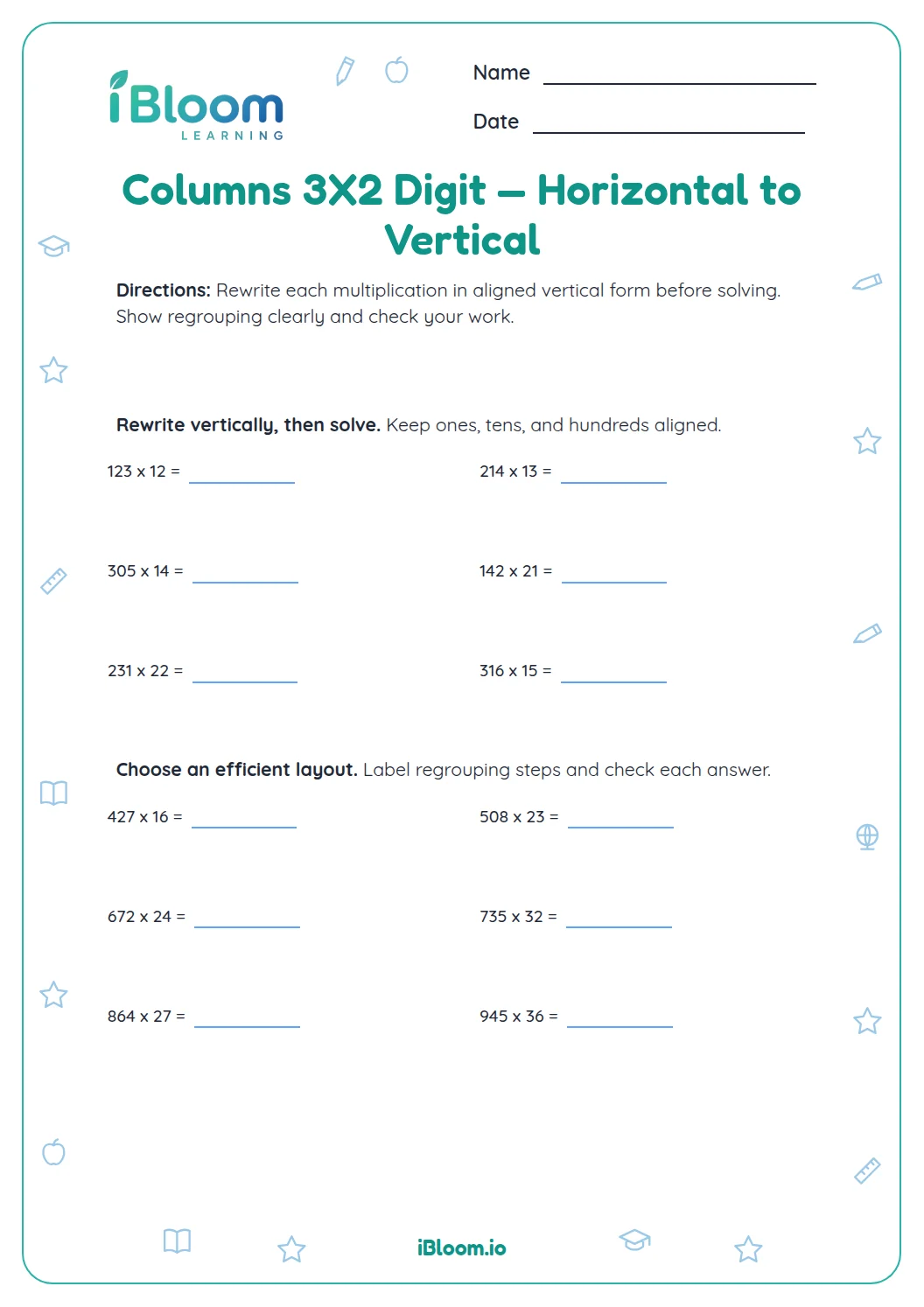
Each problem starts as a horizontal multiplication sentence. Rewrite the factors so the ones digits line up, then multiply by each place-value digit and combine the partial products.
Fourteen problems give repeated practice with regrouping and zeros in different places. The answer key lists each product.
How do I set up the factors?
Put the second factor beneath the first, lining up ones with ones, tens with tens, and hundreds with hundreds. Begin with the ones digit in the bottom factor.
- 1124 × 213
- 2Write 124 over 213 with place values aligned.
- 3124 × 3 = 372; 124 × 10 = 1,240; 124 × 200 = 24,800.
- 4Add the partial products: 372 + 1,240 + 24,800 = 26,412.
How can I check a product?
Estimate first: 124 is near 100 and 213 is near 200, so a product near 20,000 is reasonable. Then multiply the factors in reverse order or add the partial products again.
How to use this worksheet
- 1Read the horizontal multiplication sentence before writing.
- 2Copy both factors into a vertical setup, aligning the rightmost digits.
- 3Multiply by the ones digit and record any regrouping carefully.
- 4Use the tens and hundreds digits for the next partial products.
- 5Add the partial products and check that the size is reasonable.
Common mistakes and quick fixes
The mistake
Starting with digits that do not line up by place value.
The fix
Line up the ones digits at the right edge before multiplying.
The mistake
Forgetting that a tens-row partial product is ten times the ones-row product.
The fix
Leave a zero in the ones place or shift the tens partial product one column left.
The mistake
Dropping a carried digit during a partial product.
The fix
Write each regrouped digit above its place and include it in the next multiplication.
Common Core alignment
This page practices the multi-digit multiplication method used in Grade 5.
Multiply multi-digit whole numbers with the standard algorithm.
On this sheet: The three-digit by three-digit items are set up and solved with the standard algorithm.
Show the official wordingHide the official wording
Fluently multiply multi-digit whole numbers using the standard algorithm.
What to practice next
Make more practice
Further reading
Questions parents and teachers ask
What does column multiplication mean?
column multiplication means line up digits by place value, find partial products, and add them. This sheet gives children 14 chances to practice, moving from a clear starting point to mixed examples. The separate answer key makes it easy to check each response and talk through a missed step.
What grade is this column multiplication worksheet for?
This printable is written for Grade 5. The directions use short, direct language, and the problems build within the named skill. An adult can read directions aloud or work through the first example before the learner continues independently.
What is on the worksheet?
The worksheet has 14 questions in two parts. Part A begins with setting up a three-digit multiplication problem; later questions ask children to apply the same idea in fresh examples. The answer key is a separate page, so you can print it only when you are ready to check the work.
How should I check a missed answer?
Ask the learner to explain the step that led to the answer, then compare it with the answer key. For this skill, line up digits by place value, find partial products, and add them. A quick spoken explanation can reveal whether the issue was reading the prompt, choosing a strategy, or carrying out a step.
Does this printable include an answer key?
Yes. The answer key is included after the worksheet pages and lists a correct response for every item. For any open response, it gives a model answer or the feature to look for, so an adult can check the idea without expecting identical wording.