


About this worksheet
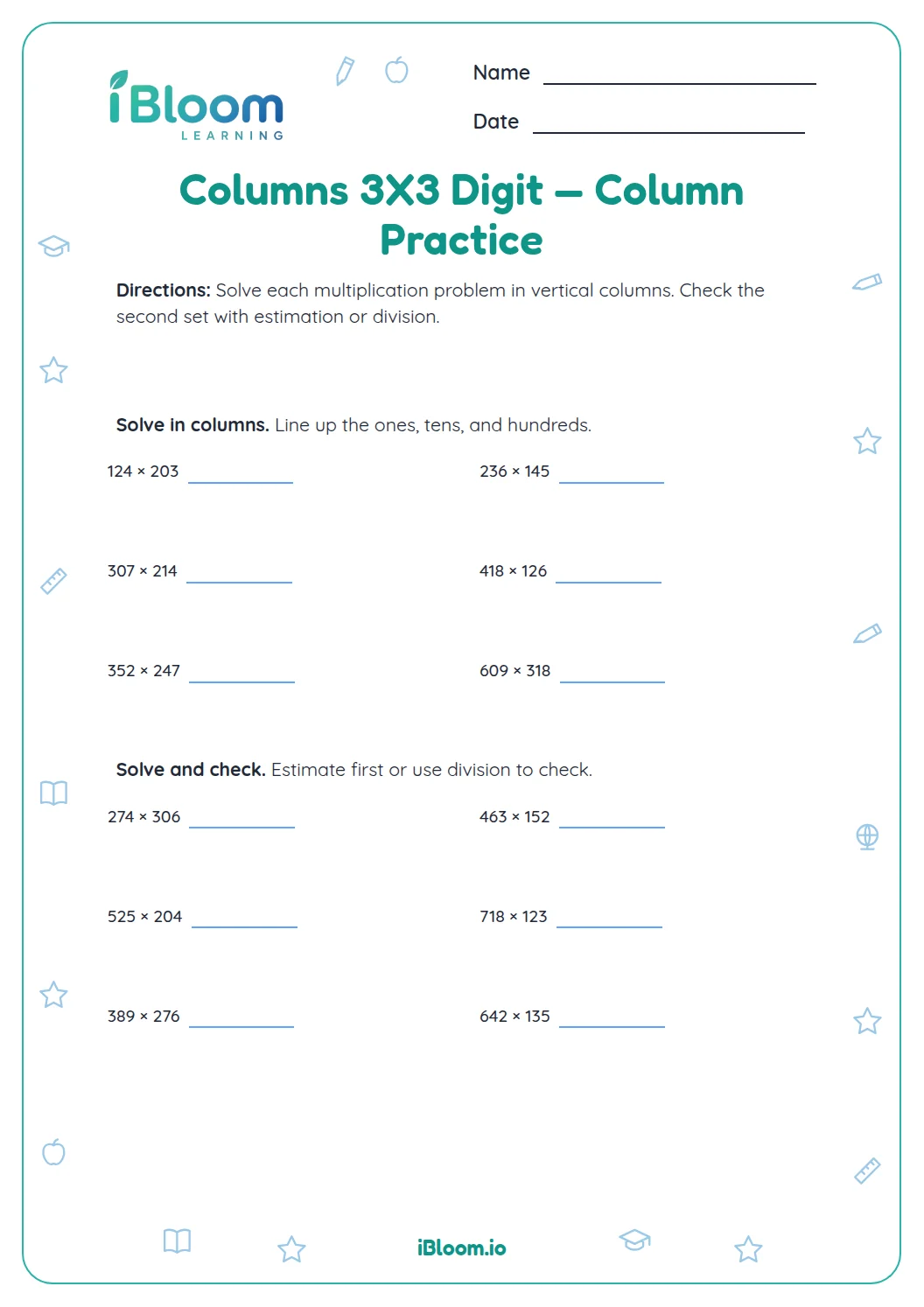
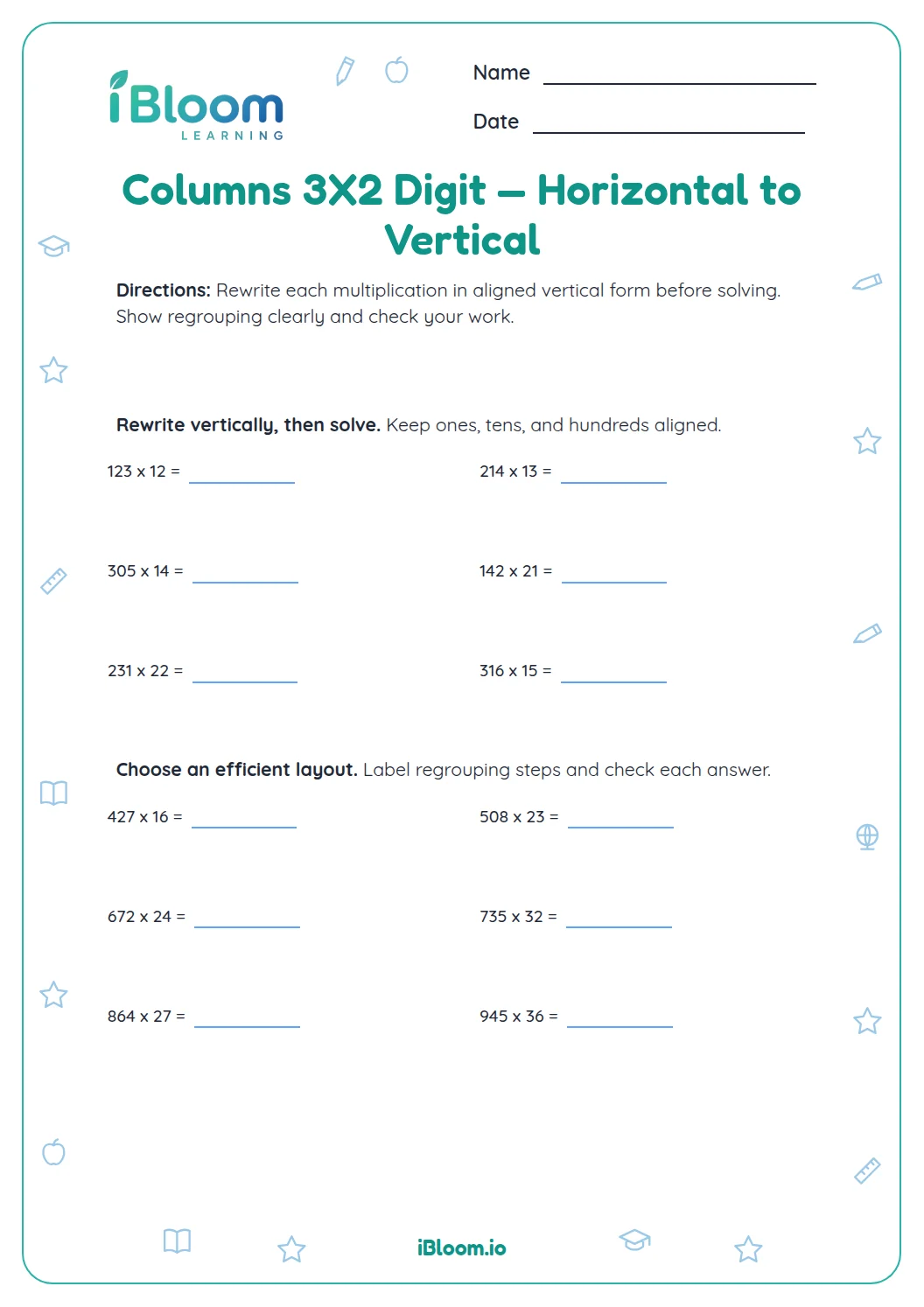
This Grade 5 multiplication worksheet gives students 16 three-digit by three-digit multiplication problems. Some equations hide a digit in a factor, some hide a full factor, and others ask for the product. Students use column work, place value, and inverse division to check answers. Two final questions apply multiplication in a school supply context and ask students to correct a product error. A separate answer key is included. The practice aligns with Common Core 5.NBT.B.5.
Aligned to 5.NBT.B.5
How do you find a missing digit?
Use the known digits and place value to test a possible factor. For question 1, 324 × 201 = 65,124, so the missing digit in 3_4 is 2. Multiply the completed factor to verify it.
- 13_4 × 201 = 65,124
- 265,124 ÷ 201 = 324
- 3So the missing digit is 2.
How can division check a missing factor?
When a whole factor is missing, divide the product by the known factor. For question 7, 88,560 ÷ 205 = 432. Multiply 432 × 205 to check.
What should column work show?
Keep hundreds, tens, and ones aligned, and include all partial products. Estimating before multiplying helps show whether the result is in the right range.
How to use this worksheet
- 1Read the full equation and mark the unknown digit or factor.
- 2Estimate the product when possible.
- 3Use place value and aligned columns to multiply.
- 4Use division to find a missing whole factor.
- 5Multiply again to check the completed equation.
Common mistakes and quick fixes
The mistake
Leaving out a place-value zero in a partial product.
The fix
Write the tens and hundreds partial products in their correct columns.
The mistake
Guessing a missing digit without checking the full product.
The fix
Multiply the completed factor by the other factor.
The mistake
Dividing by the unknown factor instead of the known one.
The fix
Divide the product by the factor already given.
Common Core alignment
The drill uses place value strategies for multiplication and related fact checks.
Multiply multi-digit whole numbers using place value and properties of operations.
On this sheet: Students multiply three-digit factors and use place value and the standard algorithm.
Show the official wordingHide the official wording
Fluently multiply multi-digit whole numbers using the standard algorithm.
What to practice next
Make more practice
Further reading
Questions parents and teachers ask
How does this worksheet practice three-digit multiplication?
All 16 problems involve three-digit factors or products. Questions 1–4 hide one factor digit, questions 5–6 and 13–14 ask for products, questions 7–12 hide a full factor, and questions 15–16 apply or check a product. Column work reinforces place value throughout.
How can I solve an equation with one missing digit?
Use the known digits and place value to narrow the possibilities, then multiply to check. In question 1, 3_4 × 201 = 65,124; dividing 65,124 by 201 gives 324, so the missing digit is 2. The multiplication check confirms the completed equation.
What should students do if they are unsure of a product?
Estimate first, then multiply with hundreds, tens, and ones aligned. For question 5, 328 × 215 is close to 300 × 200, or 60,000, so 70,520 is plausible. The partial products or a division check can confirm the exact result.
Does the key show the missing digits?
Yes. For questions 1–4, it gives the missing digit. For questions 7–12, it gives the complete missing factor, and the remaining questions show the product or corrected product. Students can verify each factor by multiplying and compare every result with the printed key.