


About this worksheet
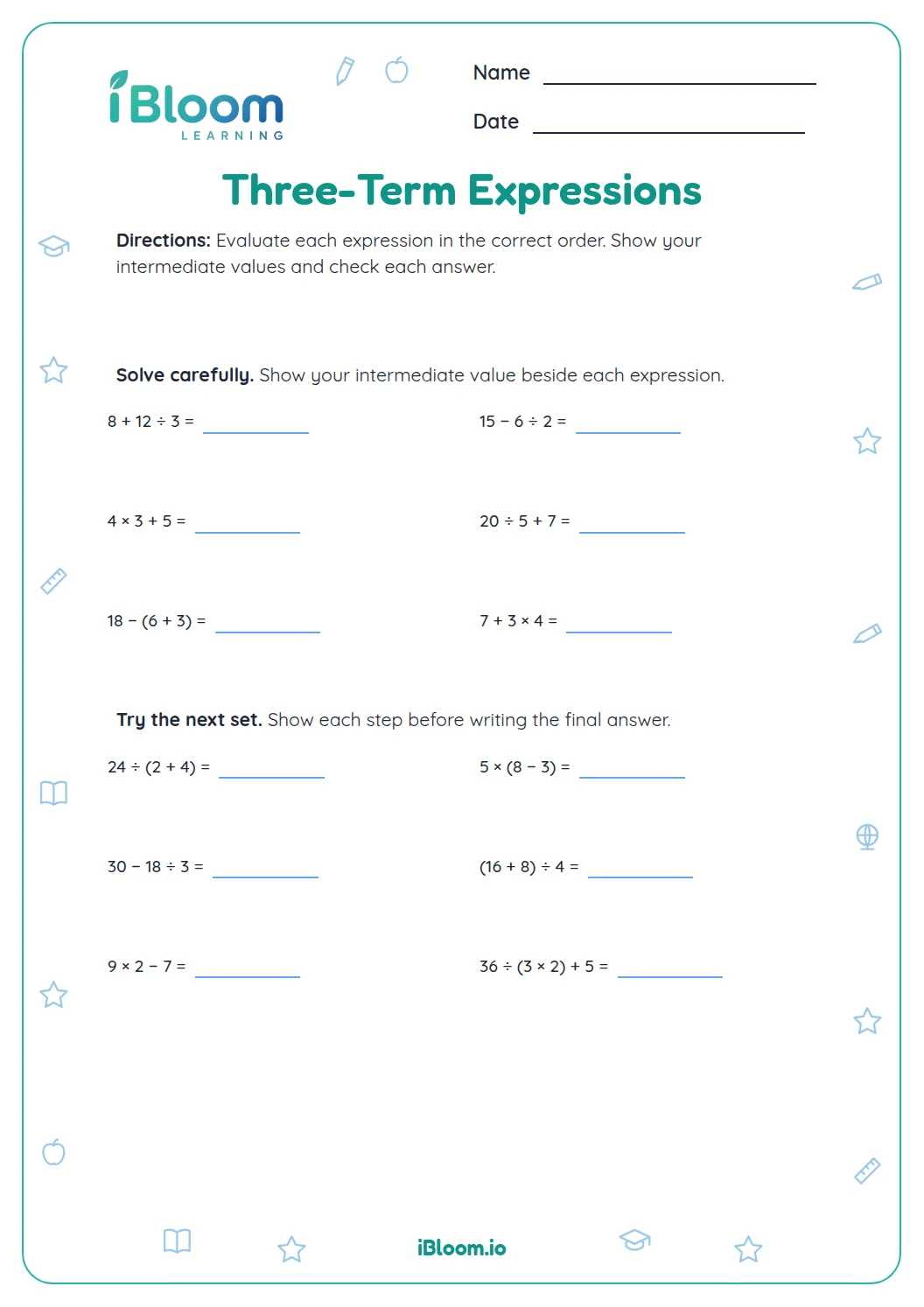
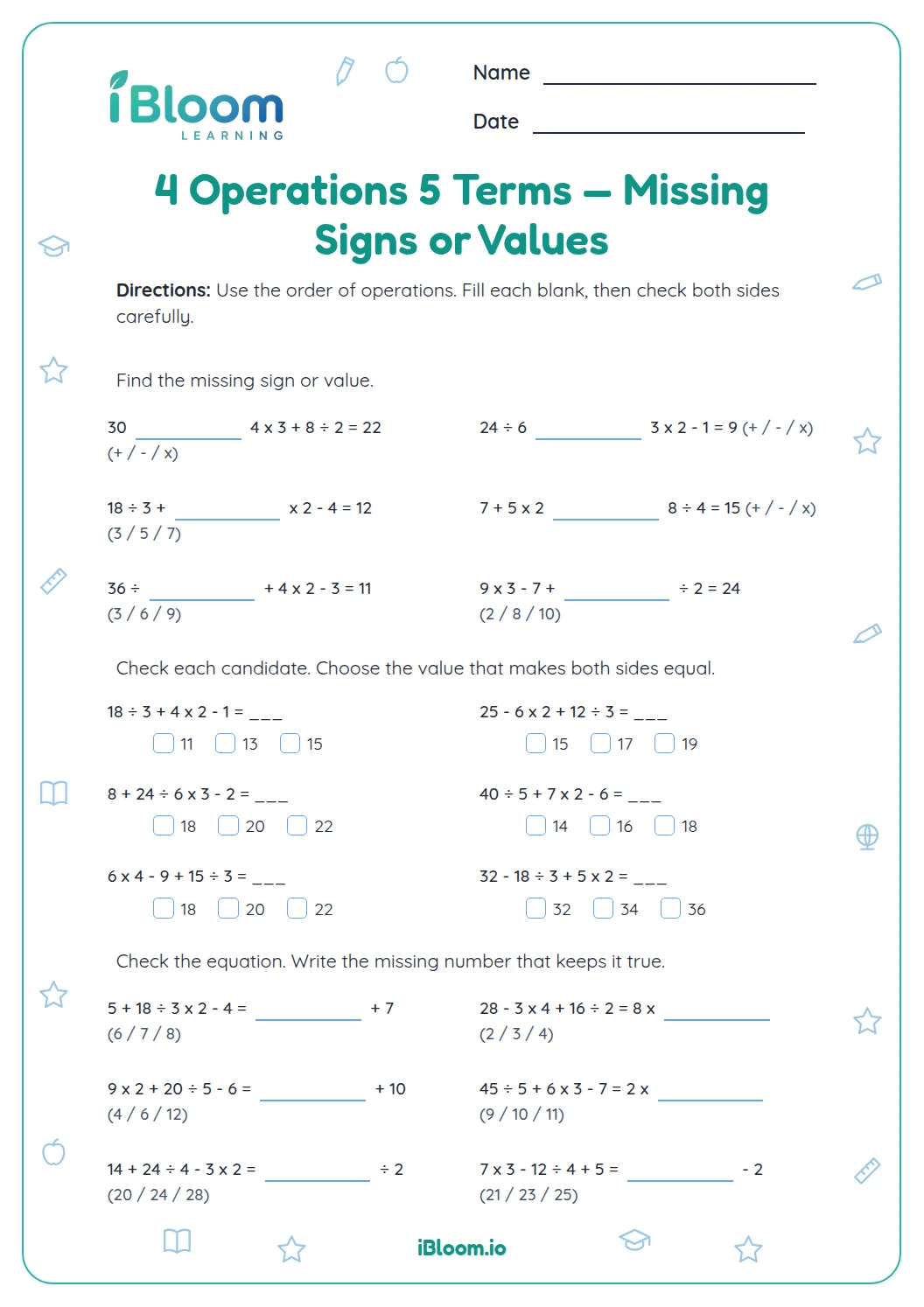
This two-page order-of-operations warm-up has 16 distinct five-term expressions using parentheses and all four operations. Learners evaluate grouped parts first, then multiply and divide from left to right, followed by addition and subtraction from left to right. The separate answer key shows the final values.
Aligned to CCSS 5.OA.A.1
Which operations come first?
Evaluate any parentheses first. Then multiply and divide before adding and subtracting. Multiplication and division have equal priority, so work left to right; addition and subtraction also share a level and go left to right.
How do the rules work in one expression?
Start inside the parentheses, then continue with the remaining operations in priority order.
- 18 + 3 × (4 − 2) ÷ 2
- 2Parentheses: 4 − 2 = 2
- 3Multiply and divide left to right: 3 × 2 ÷ 2 = 3
- 4Add: 8 + 3 = 11
What does this warm-up include?
Each item has five number terms, and the set uses addition, subtraction, multiplication, and division. Parentheses appear in every expression so learners practice evaluating grouped parts before the remaining operations.
- Sixteen unique expressions.
- Parentheses, multiplication, division, addition, and subtraction.
- Whole-number results.
How to use this worksheet
- 1Read the directions and complete Part A before moving on.
- 2Read each sentence or expression fully before choosing or calculating.
- 3Mark the clue, factor, or operation that supports your answer.
- 4For written work, reread the response and check that it answers the prompt.
- 5Use the separate answer key to check each response and revisit any missed step.
Common mistakes and quick fixes
The mistake
Answering from one familiar word or number without reading the full prompt.
The fix
Read the whole item and identify the clue or operation it asks you to use.
The mistake
Stopping after a first step when the item needs more reasoning.
The fix
Check whether the prompt asks for a meaning, a greatest value, or a final result.
The mistake
Copying an answer without checking that it fits the sentence or calculation.
The fix
Read the completed response again and compare it with the original question.
Curriculum alignment
This worksheet practices the following Common Core standard.
Evaluate numerical expressions that use parentheses and operation priority.
On this sheet: Every expression includes parentheses, and the directions and items practice evaluating grouped parts and the remaining operations in order.
Show the official wordingHide the official wording
Use parentheses, brackets, or braces in numerical expressions, and evaluate expressions with these symbols.
What to practice next
Make more practice
Further reading
Questions parents and teachers ask
Do multiplication and division have different priority?
No. Multiplication and division have equal priority. When both appear, evaluate them from left to right after completing parentheses and before addition or subtraction. This keeps the expression value consistent with the standard order rules. The expressions on this worksheet use parentheses, so grouped calculations are handled before either level.
What should you do after multiplication and division?
Complete addition and subtraction from left to right after multiplication and division. Keep the current value of the expression after each step so the next operation uses the correct result. Evaluate all grouped parts first, before applying these later steps.
Why evaluate parentheses first?
Parentheses group part of an expression and show which calculation to complete first. In 8 + 3 × (4 − 2) ÷ 2, subtract inside the parentheses before multiplying or dividing. The remaining operations then follow their usual priority.
How can you check an order-of-operations answer?
Write the result of each operation in order. Check that parentheses came first, multiplication and division went left to right, and addition and subtraction came afterward from left to right. Comparing each written step with the original expression can reveal a skipped operation.
What is included in this warm-up?
The printable contains 16 five-term expressions across two worksheet pages, followed by two answer-key pages. The expressions include parentheses and use all four basic operations. The key lists each final value for checking the completed calculations. Learners can use the printed directions to review the order before starting the first problem.