


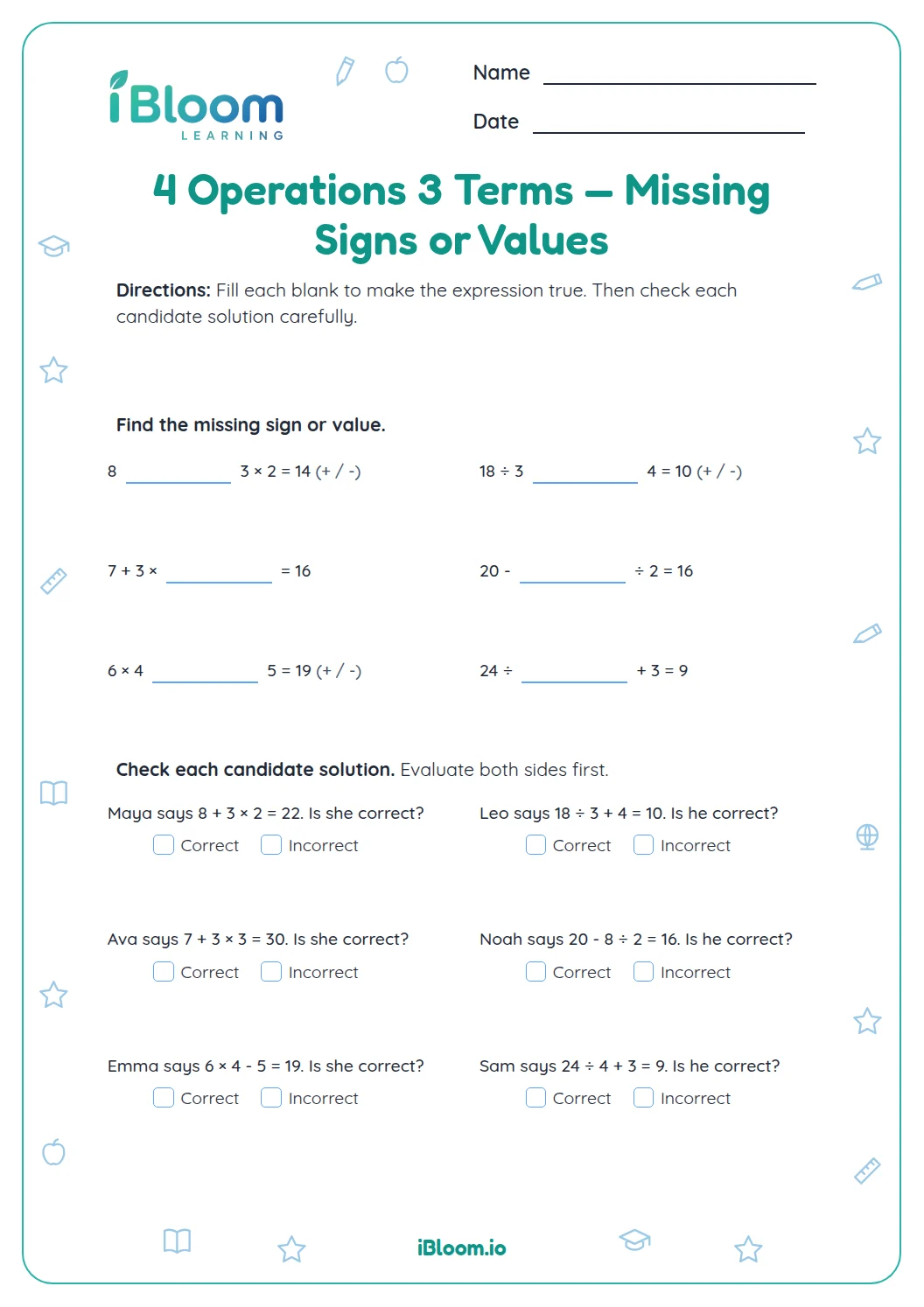
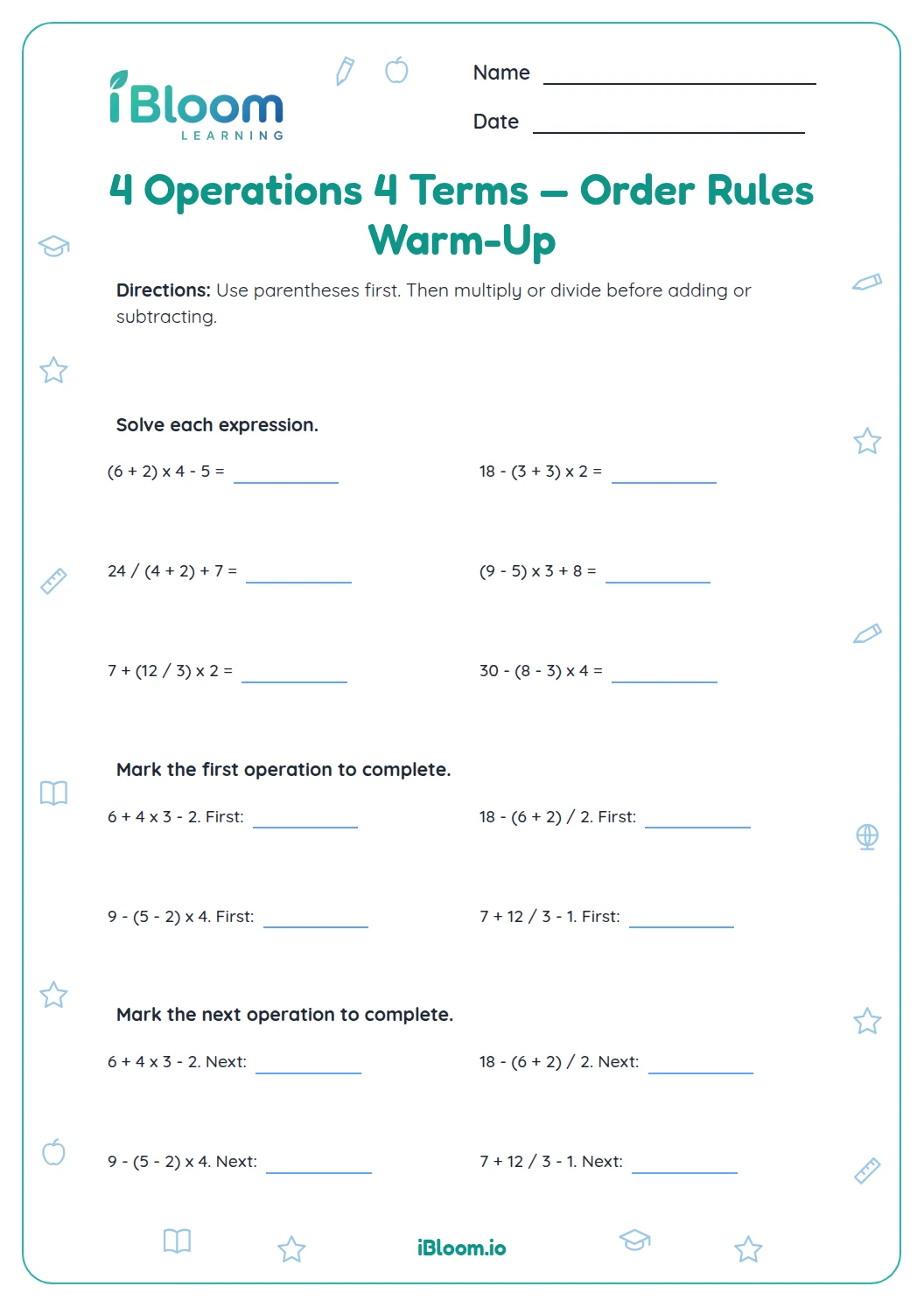

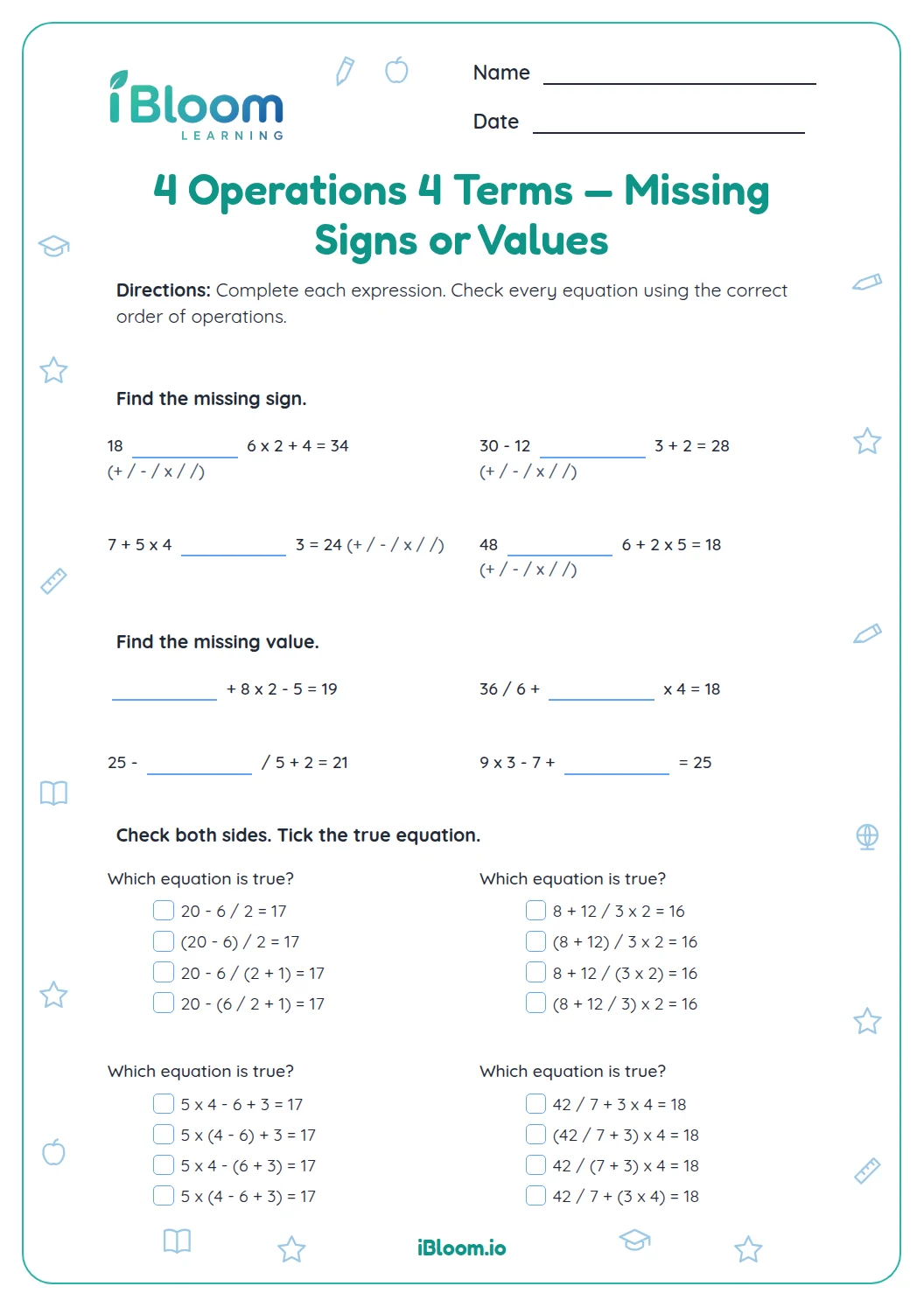

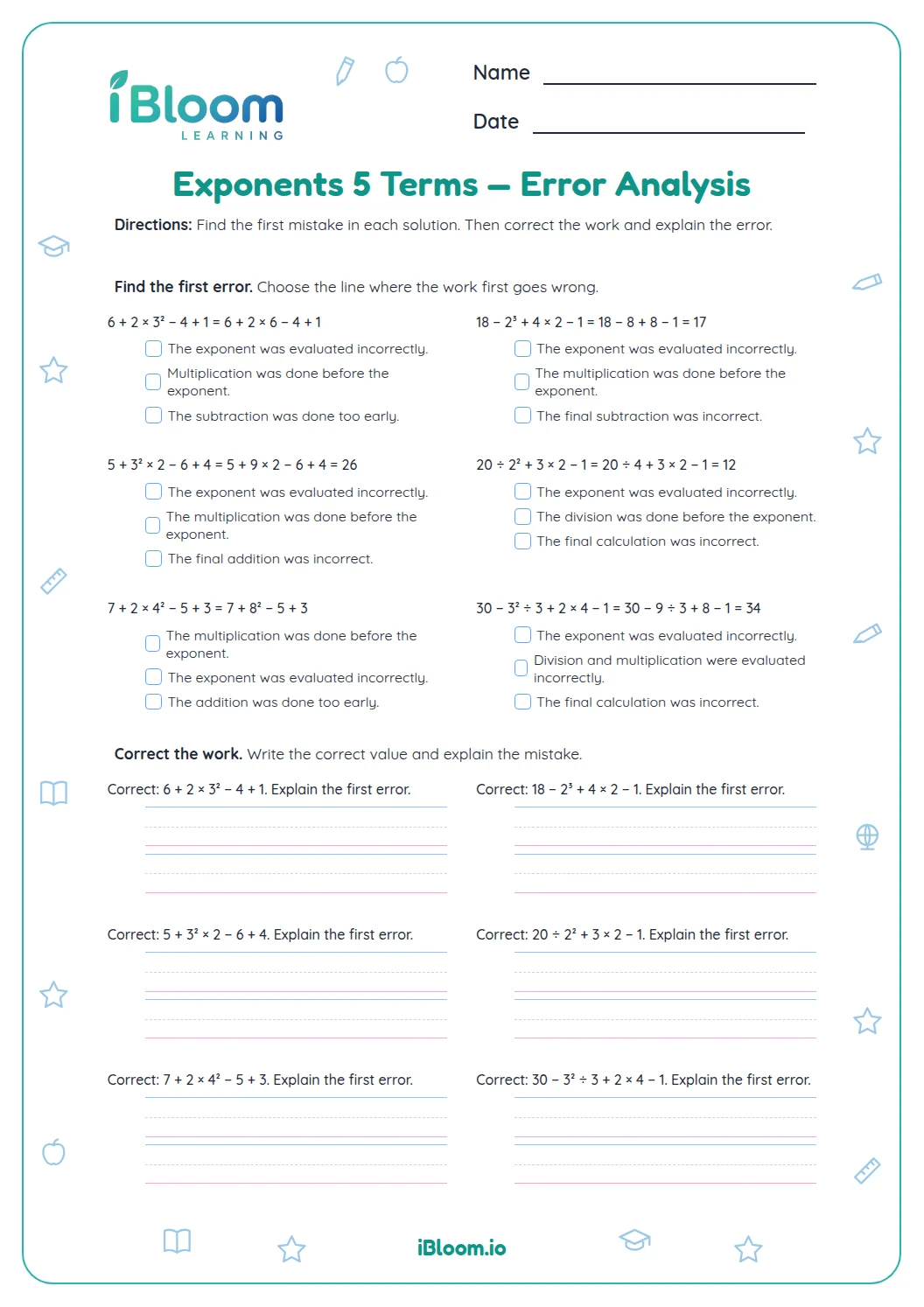
About this worksheet
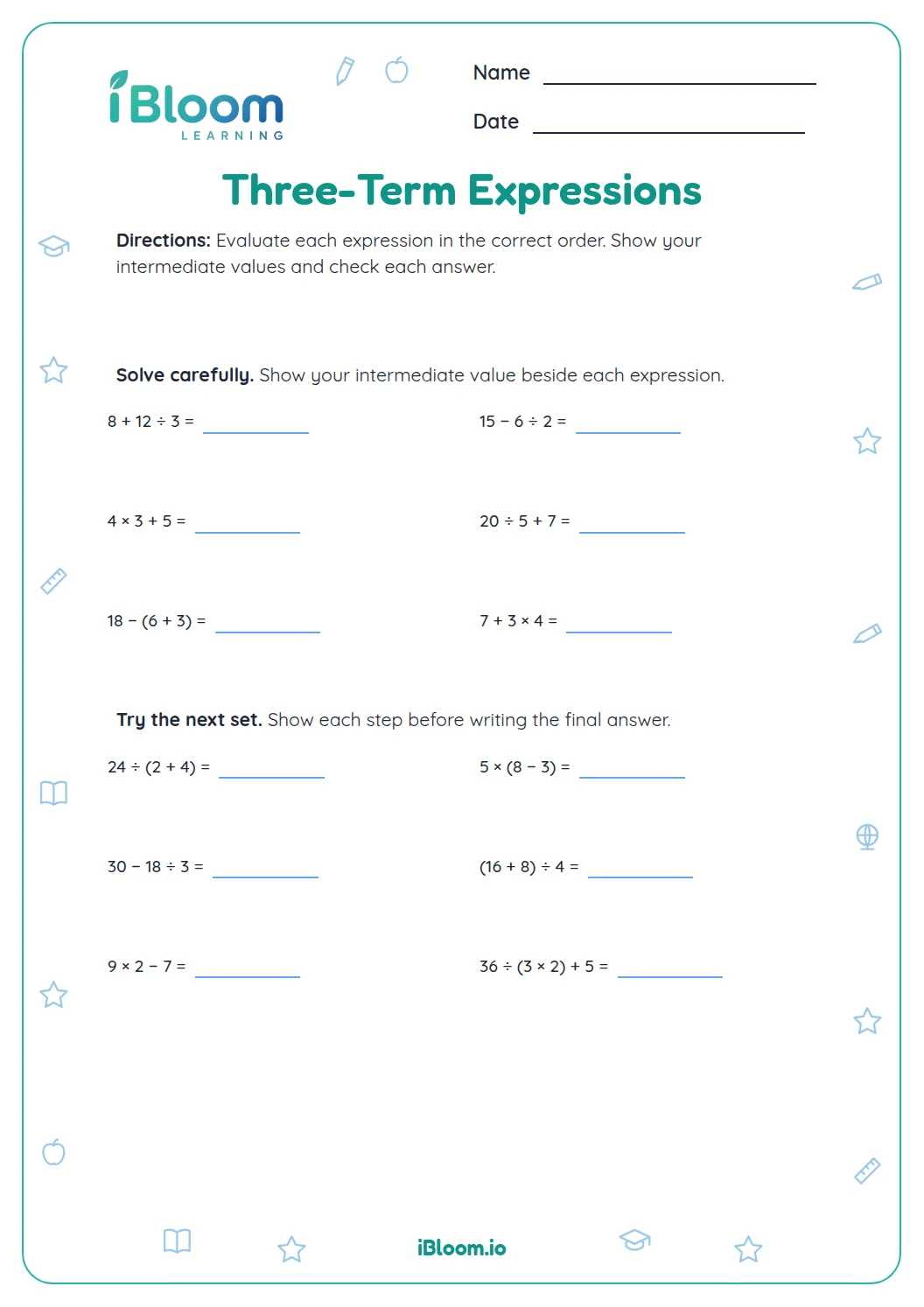
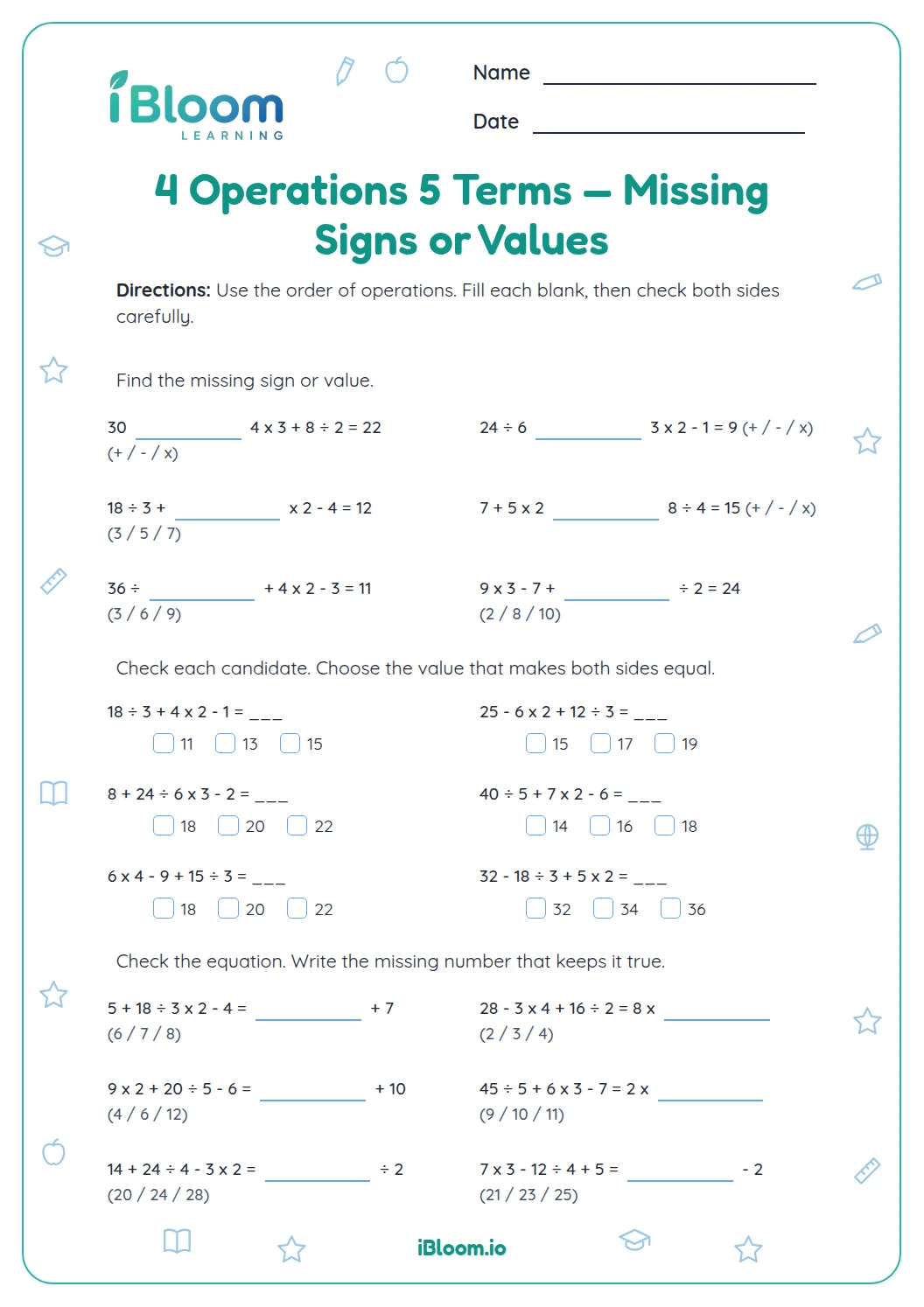
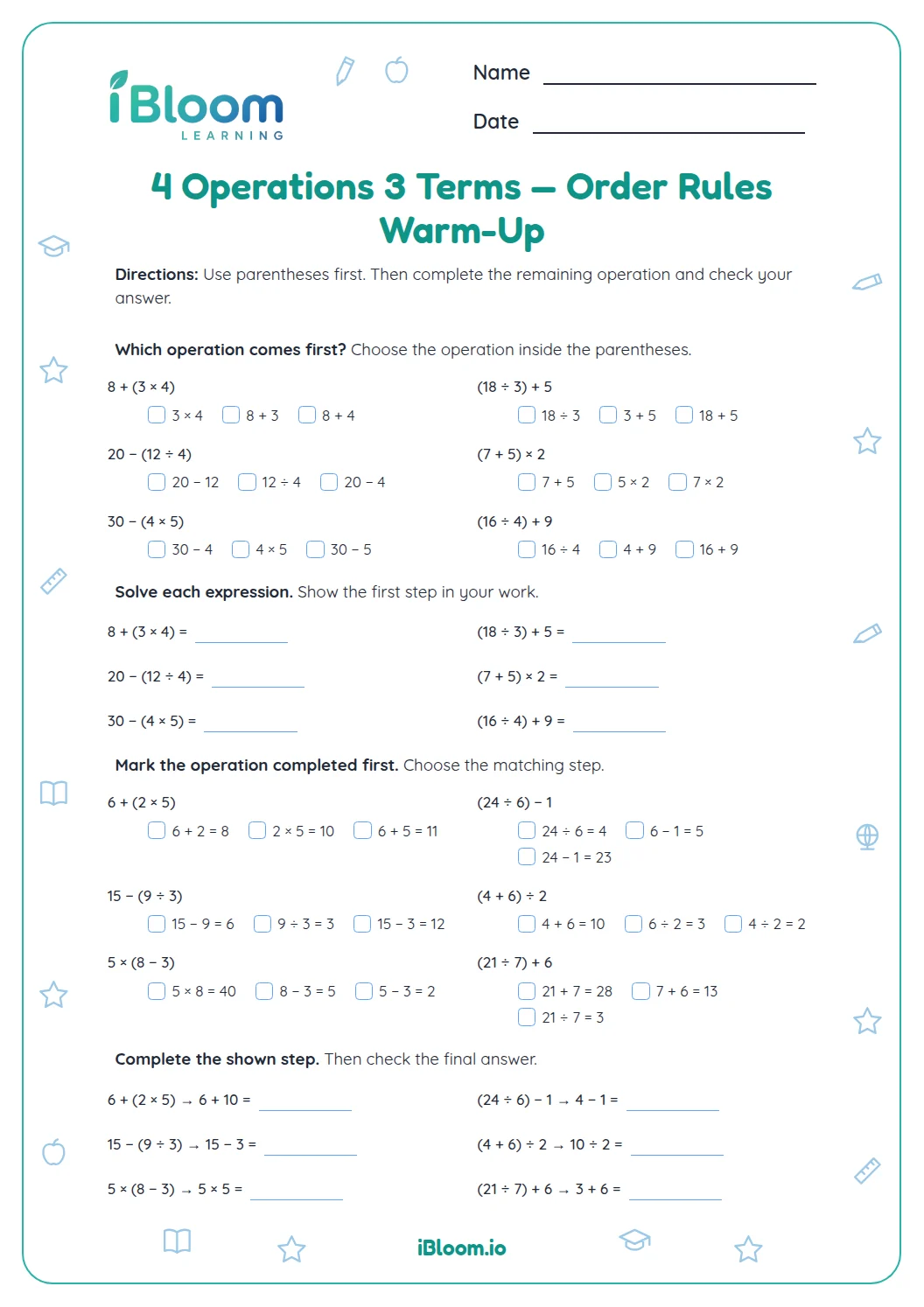
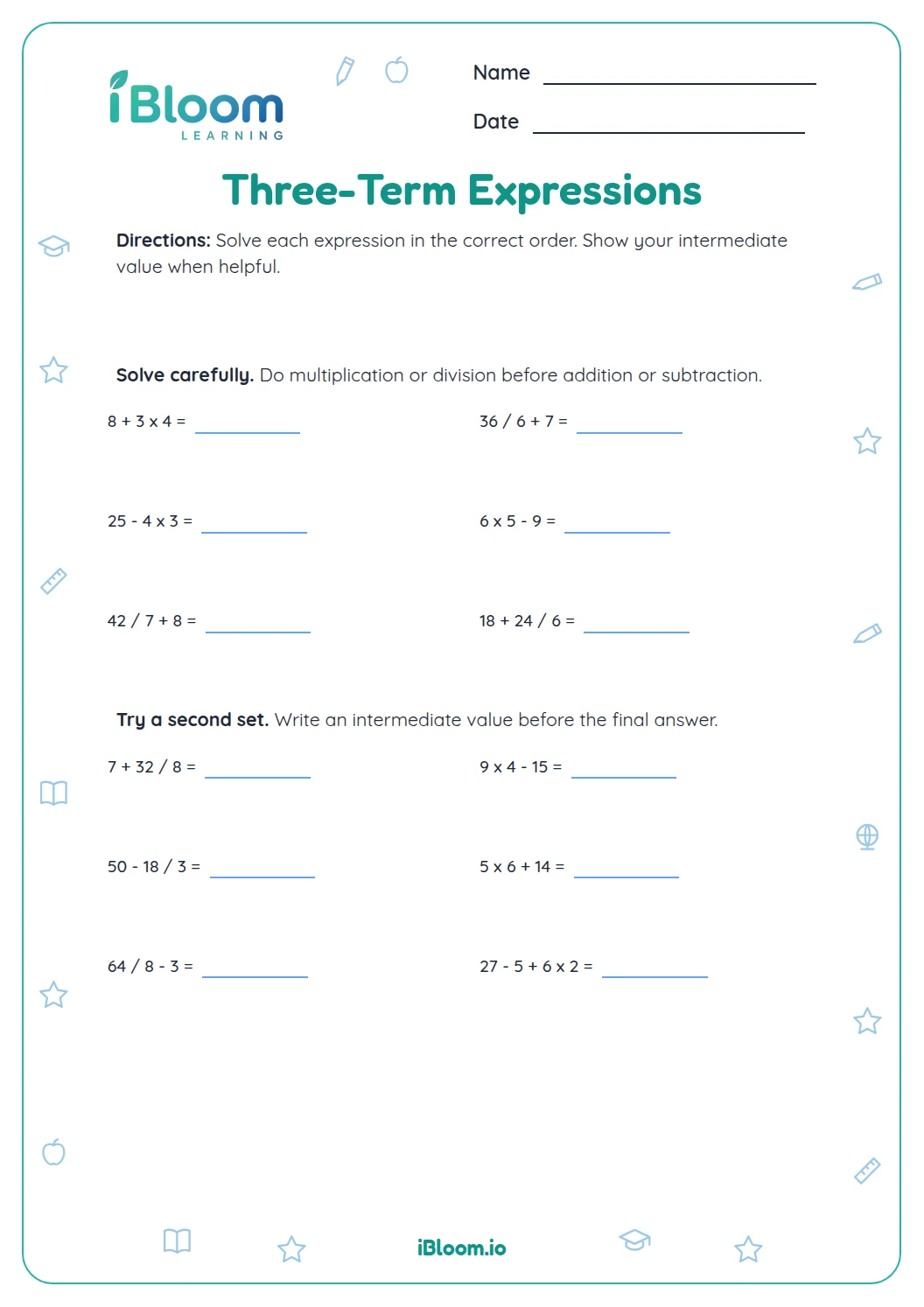
This printable gives Grade 5–6 learners 14 order-of-operations questions using five-number expressions. They evaluate expressions with and without parentheses, check a common left-to-right error, and apply the rules to two short situations. It practices Common Core 5.OA.A.1 by evaluating numerical expressions with grouping symbols. A separate answer key covers every question.
Aligned to 5.OA.A.1
Which operations should be calculated first?
Five numbers can make a long expression, but the rule stays steady. Work inside parentheses first. Next, sweep from left to right for every × and ÷. Last, move left to right for + and −.
Rewriting the expression after each step keeps the numbers from getting lost. Multiplication and division share a priority, as do addition and subtraction.
- 1(8 − 4) × 2 + 6 ÷ 3
- 24 × 2 + 2
- 38 + 2 = 10
How can a learner catch an order mistake?
Circle the multiplication and division signs first. Resolve those operations across the expression, then return to addition and subtraction. This makes it easier to spot a tempting but incorrect left-to-right calculation across all four operations.
What practice does the mastery sheet include?
The 14 items include five-number calculations, answer checks, and two applied situations. Some expressions include parentheses, as in the earlier practice, and learners use the same priority rules in each case.
How to use this worksheet
- 1Look for parentheses and simplify inside them first.
- 2Work multiplication and division from left to right.
- 3Then work addition and subtraction from left to right.
- 4Write intermediate values so each step is easy to follow.
- 5Substitute your result or estimate to check whether it is reasonable.
Common mistakes and quick fixes
The mistake
Working every operation strictly left to right.
The fix
Do multiplication and division first, while keeping their order left to right.
The mistake
Doing all multiplication before division.
The fix
Multiplication and division tie; follow the expression from left to right.
The mistake
Adding before completing a division later in the expression.
The fix
Finish multiplication and division before starting addition or subtraction.
Common Core alignment
This practice applies grouping and operation priority to numerical expressions.
Evaluate expressions with parentheses while following operation priority.
On this sheet: Learners evaluate five-number expressions that include parentheses and the four operations.
Show the official wordingHide the official wording
Use parentheses, brackets, or braces in numerical expressions, and evaluate expressions with these symbols.
What to practice next
Make more practice
Further reading
Questions parents and teachers ask
Which operation comes first in a five-number expression?
If parentheses appear, evaluate inside them first. Then do multiplication and division in the order they appear from left to right. Finish with addition and subtraction, also moving from left to right. Question 3 shows these steps with parentheses. This order still applies when the five numbers make an expression look busy.
Does multiplication always come before division?
No. Multiplication and division have the same priority. In 30 ÷ 5 × 2, divide first because that operation appears farther left: 30 ÷ 5 = 6, then 6 × 2 = 12. Keep the same left-to-right rule when both appear.
How should children handle addition and subtraction?
After multiplication and division are complete, addition and subtraction share a priority too. Work them from left to right. Writing an intermediate result helps prevent a learner from subtracting before an earlier addition. A written intermediate answer makes the next step easier to check.
What is one common mistake on this worksheet?
A common slip is to multiply before a division that appears earlier. In 30 ÷ 5 × 2, divide 30 by 5 first, then multiply the result by 2. The worksheet includes a check question about that left-to-right decision. That left-to-right step is the key idea in question 13.
What does the worksheet include?
The 14 questions include five-number calculations, checks of operation order, and two short situations to model. Parentheses appear in some expressions, and the separate key lists numerical results plus units for the applied questions. Work one example together to model each step.
Is an answer key included?
Yes. The answer key is separate from the practice pages. It lists each value and gives short responses for the applied items, so an adult can check both the calculation and the learner’s reasoning. The key also shows the result for each expression.