



About this worksheet
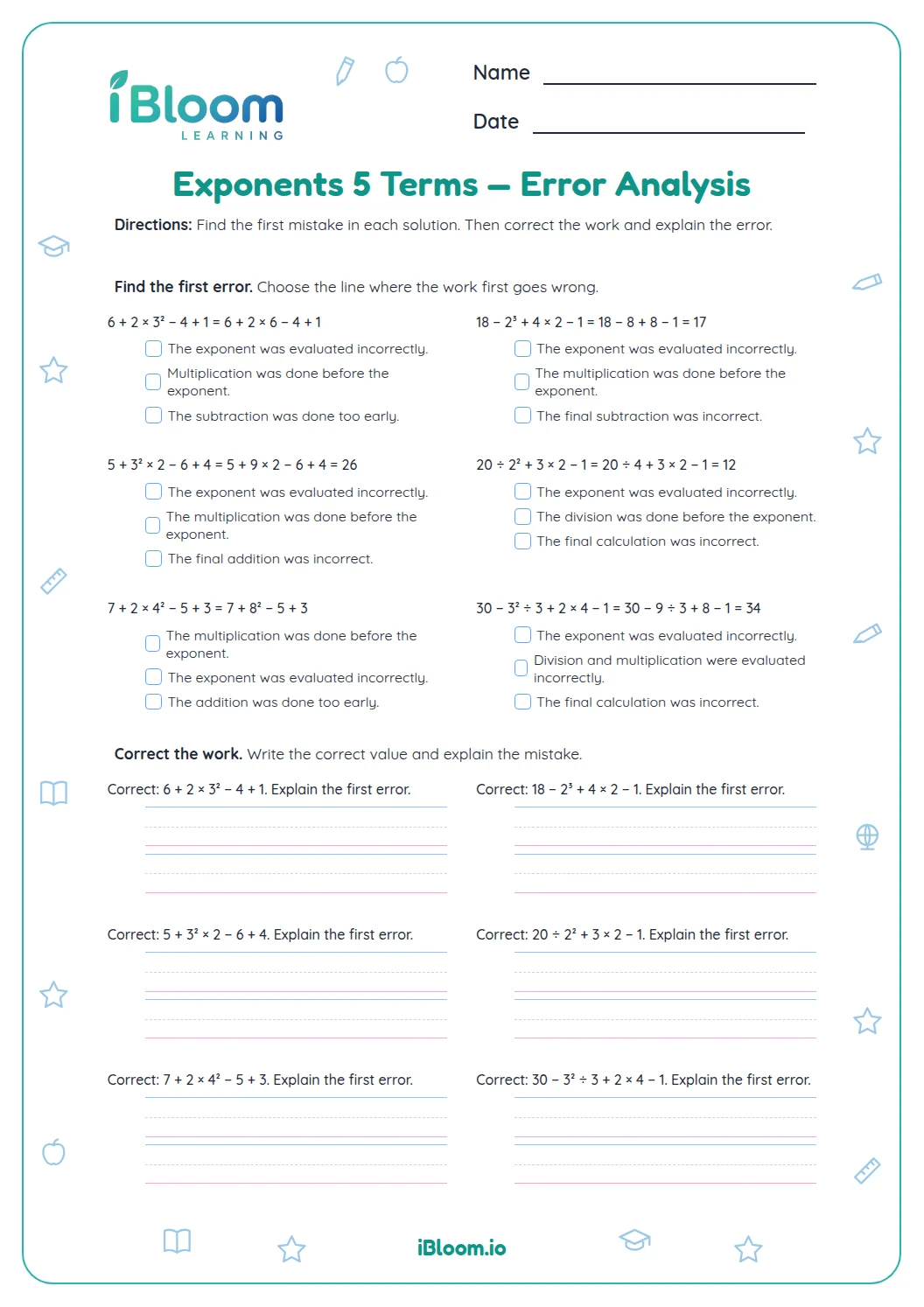
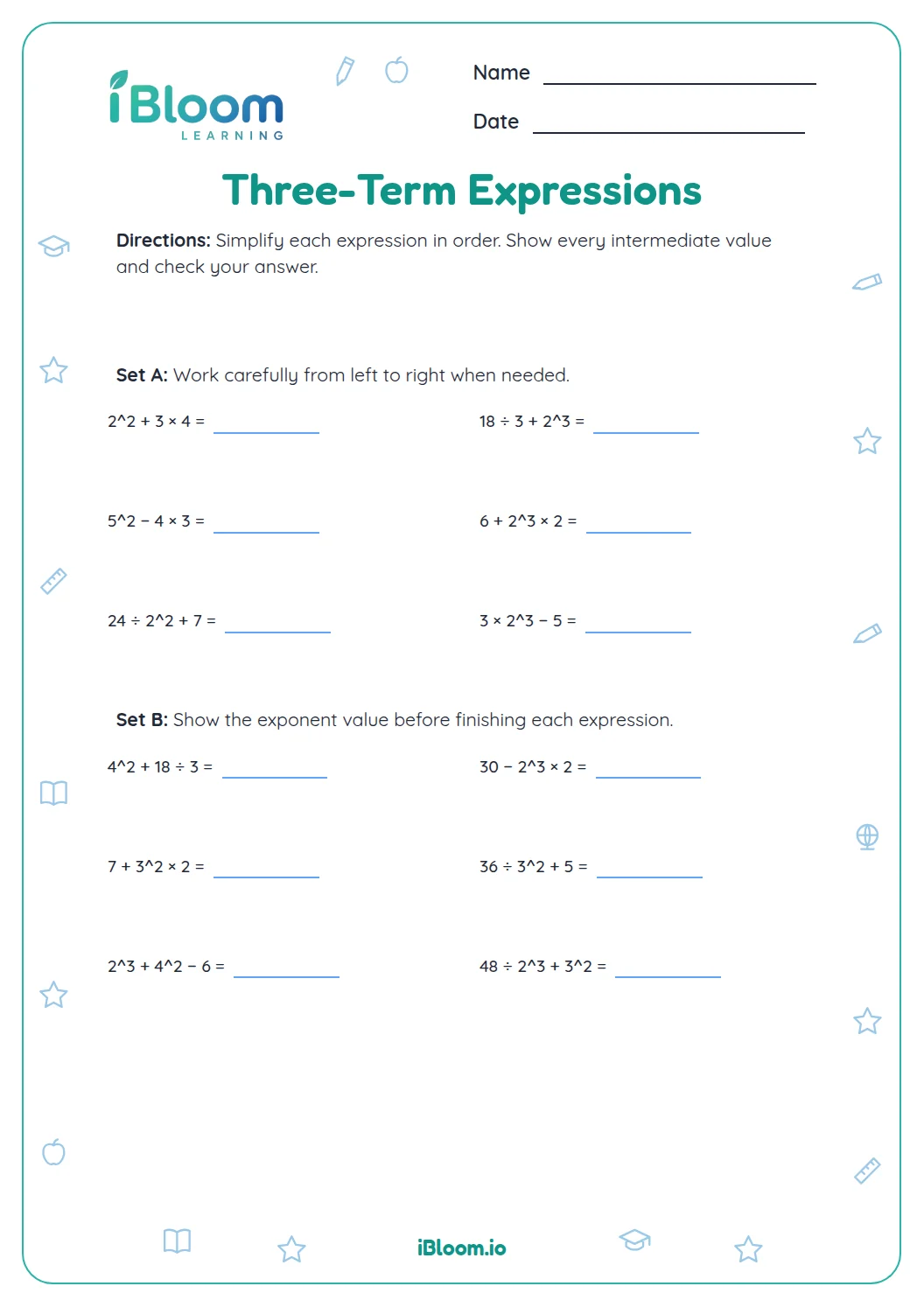
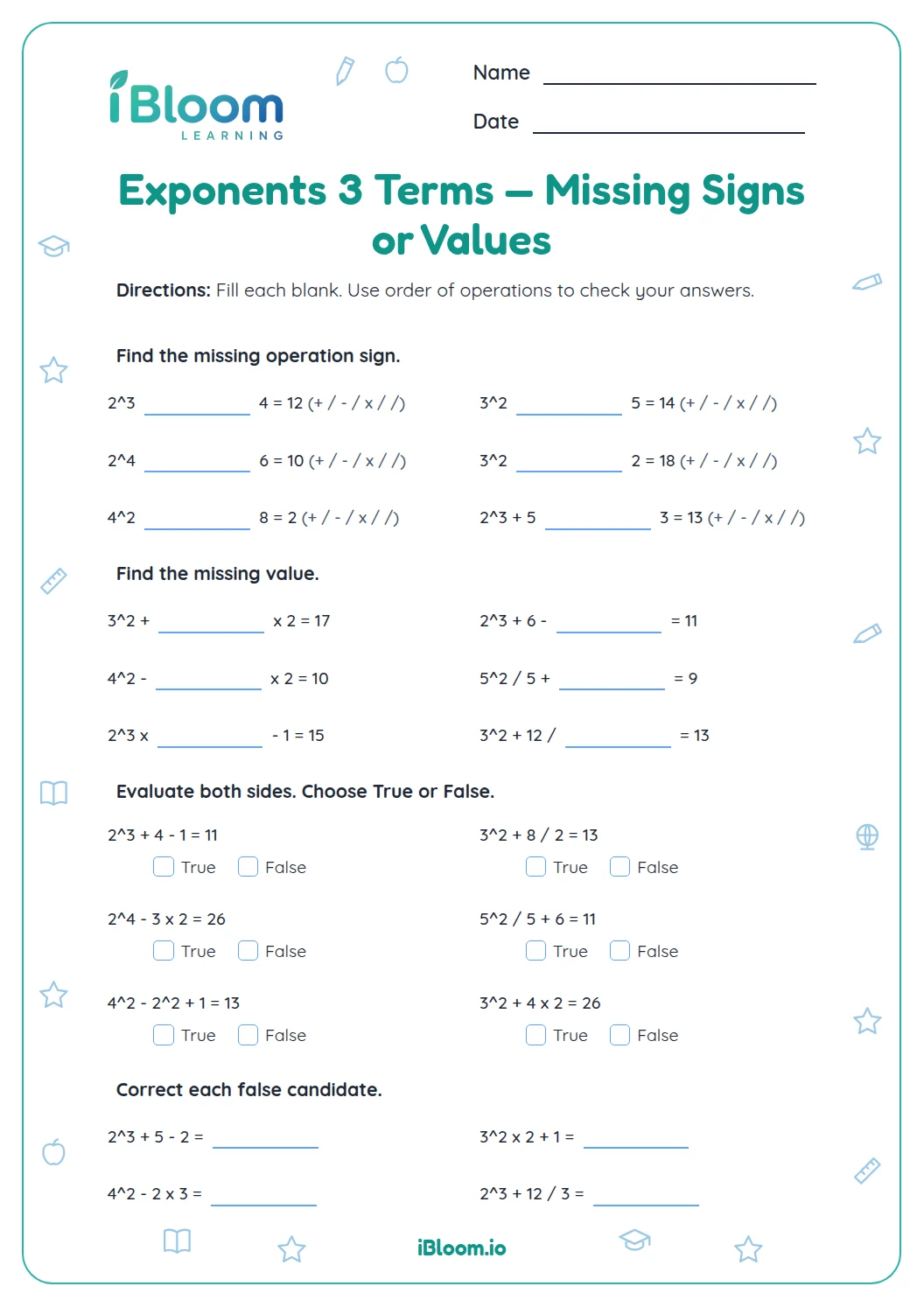
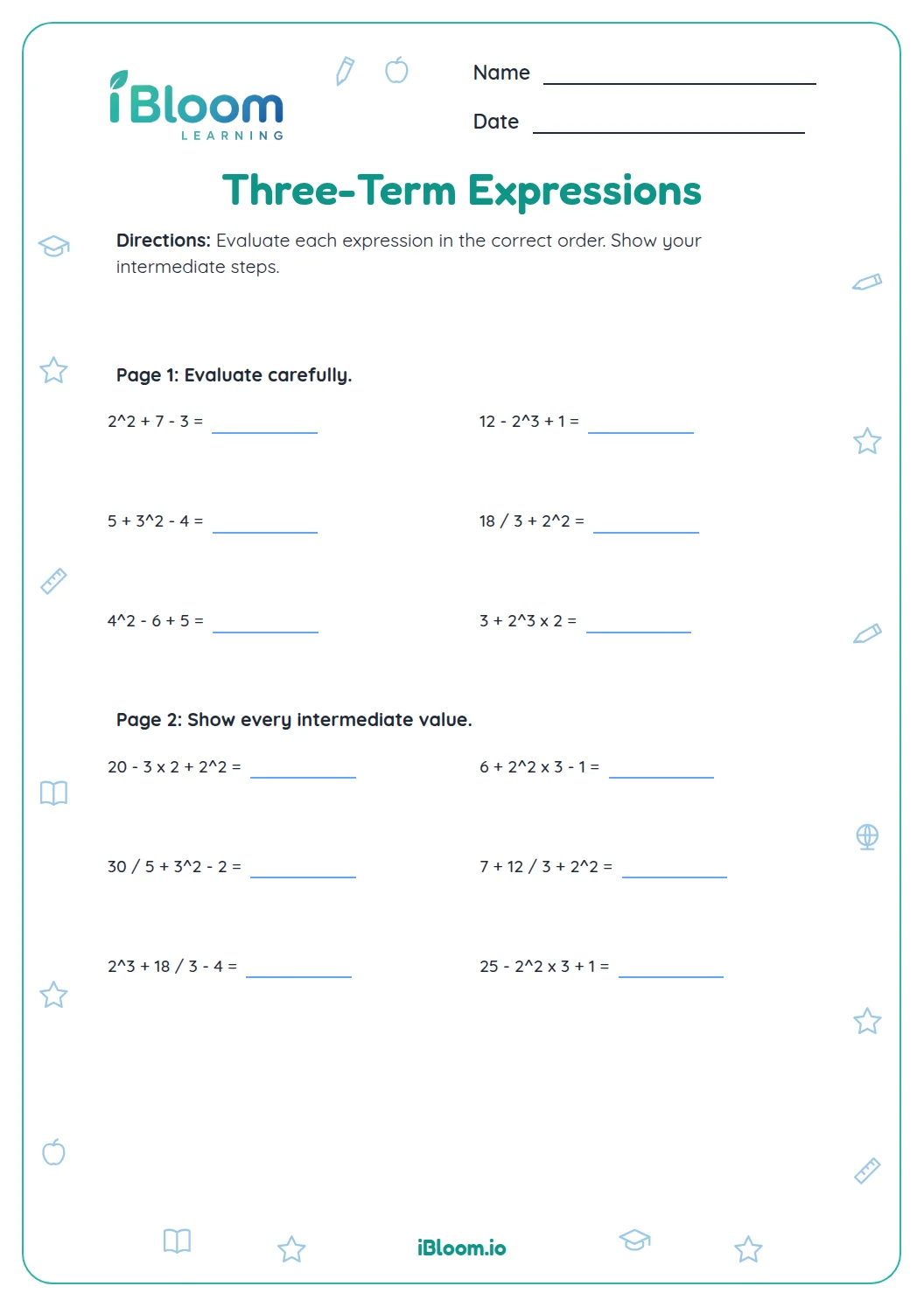
This printable math drill gives students 16 three-term expressions to evaluate using exponents and order of operations. Each expression includes one power and two operations, so the practice focuses on deciding what to compute first and then working left to right when operations share priority. The answer key lists each result. The sheet aligns with Common Core 6.EE.A.1, which calls for writing and evaluating numerical expressions involving whole-number exponents.
Aligned to 6.EE.A.1
What should be evaluated first?
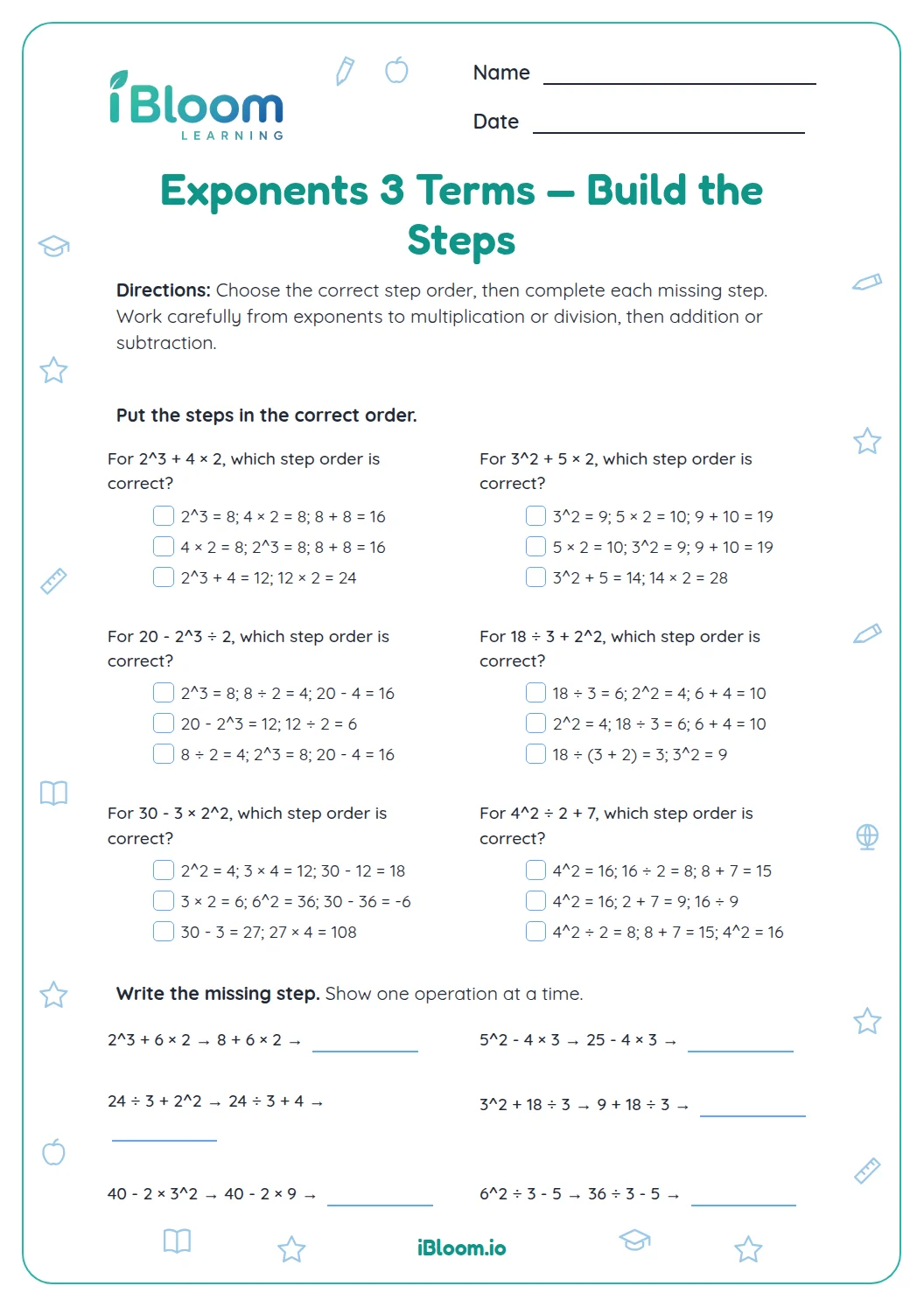
Evaluate the exponent before the other operations. Next, complete multiplication or division from left to right. Finish with addition or subtraction from left to right. A compact expression can still contain several steps, so writing each intermediate value helps prevent skipped operations.
- 12² + 3 × 4
- 24 + 12 = 16
How can you check an expression?
Rewrite the expression one step at a time, changing only the operation you evaluate. For example, first replace 2² with 4. Then do the multiplication. Compare the final result with a second calculation in which you follow the same priority rules.
How to use this worksheet
- 1Scan the expression and mark the exponent.
- 2Evaluate the power first; for example, 2² = 4.
- 3Complete multiplication and division from left to right.
- 4Complete addition and subtraction from left to right.
- 5Reread the original expression and check each step.
Common mistakes and quick fixes
The mistake
Reading 2³ as 2 × 3.
The fix
The exponent tells how many factors of the base: 2³ = 2 × 2 × 2.
The mistake
Adding before multiplying because addition appears first.
The fix
Multiplication and division come before addition and subtraction.
The mistake
Multiplying before evaluating the exponent.
The fix
Replace the power with its value before continuing.
Common Core alignment
These expressions practice evaluating numerical expressions with whole-number exponents.
Evaluate numerical expressions that include whole-number exponents.
On this sheet: Students evaluate three-term expressions by applying exponent and operation order.
Show the official wordingHide the official wording
Write and evaluate numerical expressions involving whole-number exponents.
What to practice next
Make more practice
Further reading
Questions parents and teachers ask
What order should students use for these expressions?
Evaluate the exponent first. Next do multiplication and division from left to right, then addition and subtraction from left to right. For example, in 2² + 3 × 4, replace 2² with 4, multiply 3 × 4, and add 4 + 12.
What does an exponent mean?
An exponent tells how many times to use the base as a factor. In 2³, the base 2 appears three times: 2 × 2 × 2, which equals 8. It does not mean 2 × 3. Each expression on this page uses a whole-number exponent.
Are parentheses included?
No parentheses are printed in these expressions, so students can focus on exponents and the priority of multiplication or division before addition or subtraction. They should still work carefully in stages, since treating the expression as a simple left-to-right calculation can change the result.
How many problems are included?
There are 16 short-answer expressions across two worksheet pages. Each includes three terms, with one exponent and two operations. The separate answer key spans two pages and lists the final value for every expression. The short layout keeps attention on each step.
Should students show their steps?
Writing intermediate values is useful even when the answer space asks for a final value. For 2² + 3 × 4, a student can write 4 + 12 and then 16. This makes it easier to find whether an exponent, multiplication or addition step needs another look.
What practice comes after this page?
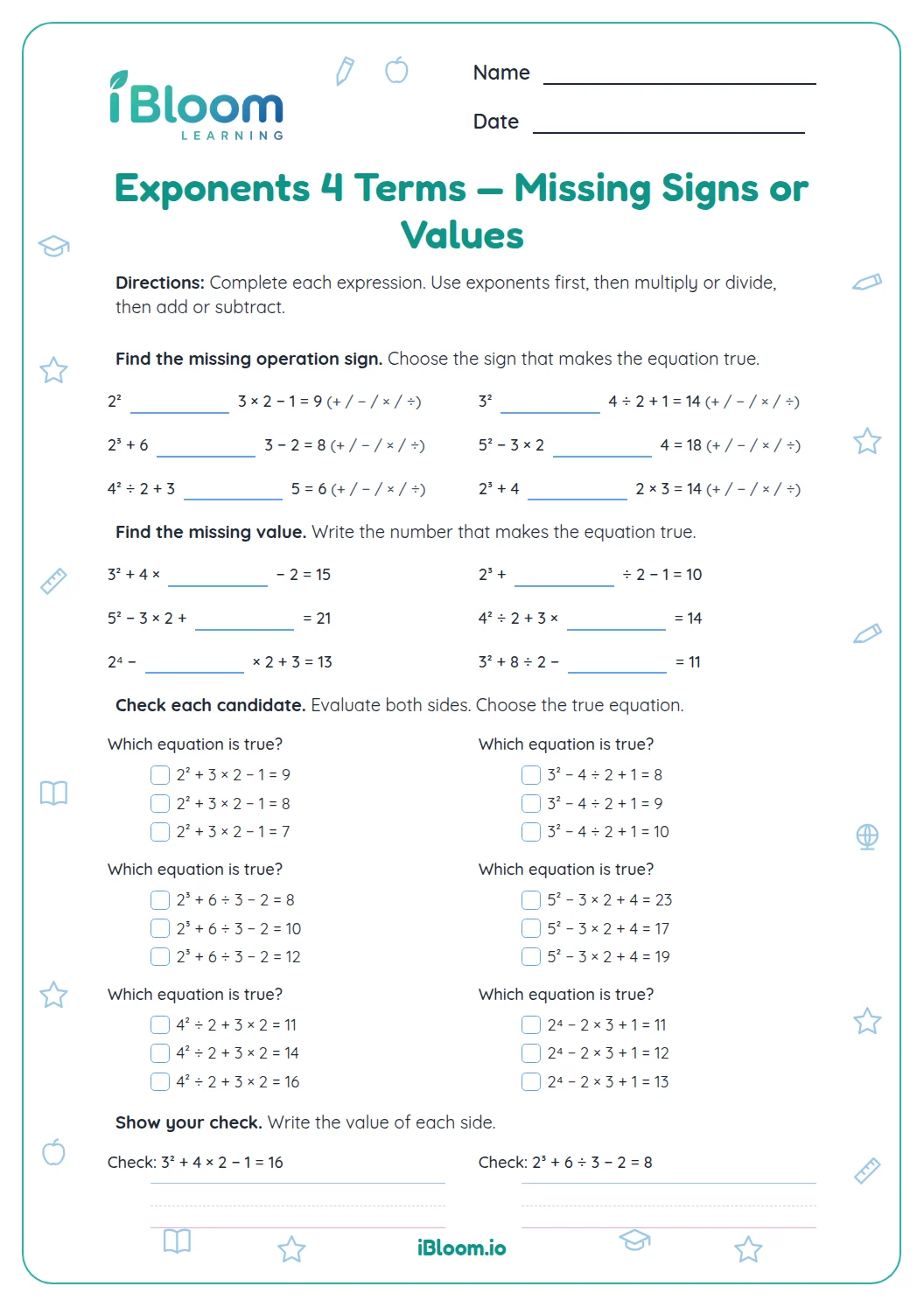
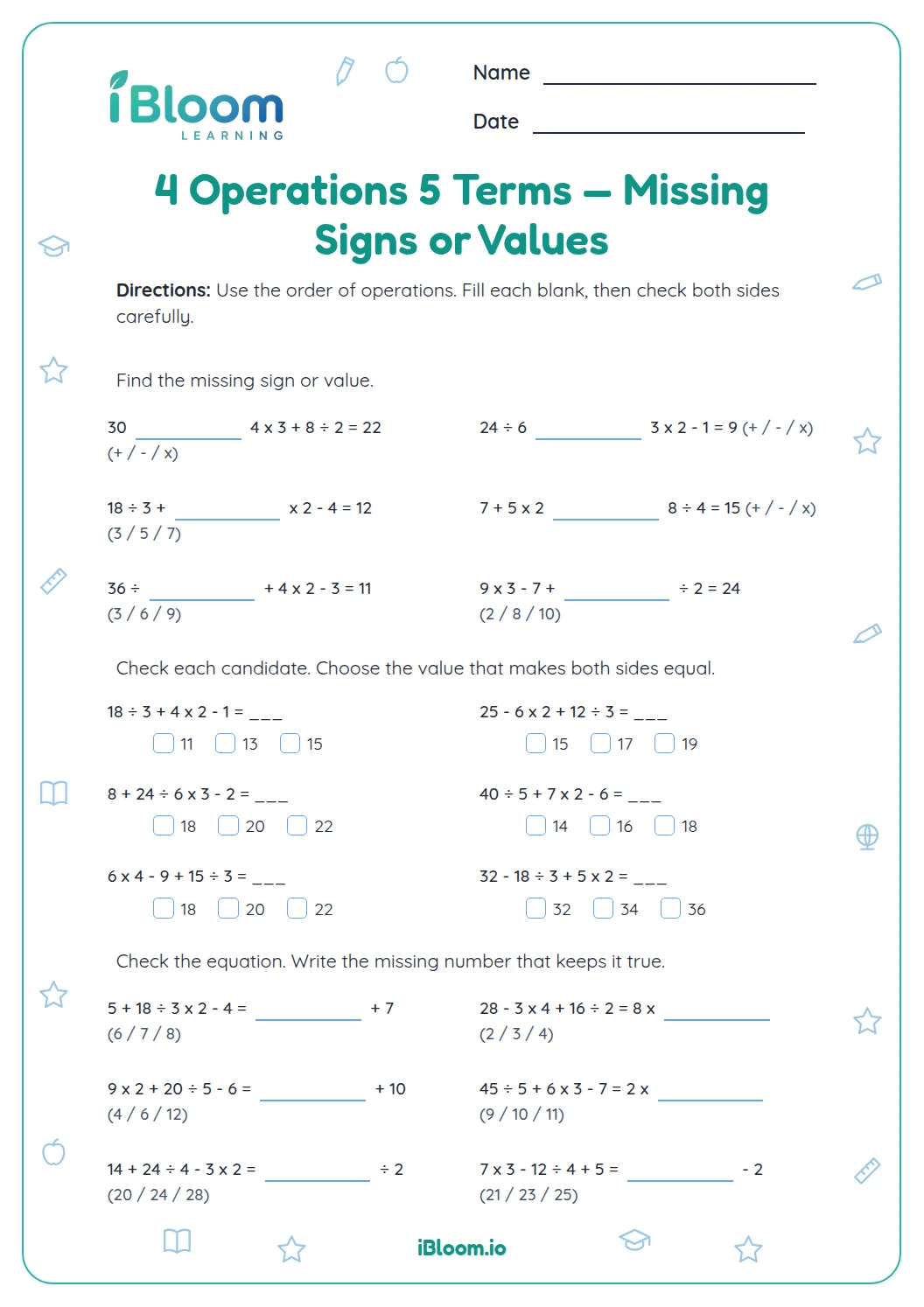
The linked three-term exponent sheet gives shorter expressions, while the four-term exponent sheet adds another term. Students can then try a five-term expression set with all four operations to practice keeping track of several steps and checking the order.