

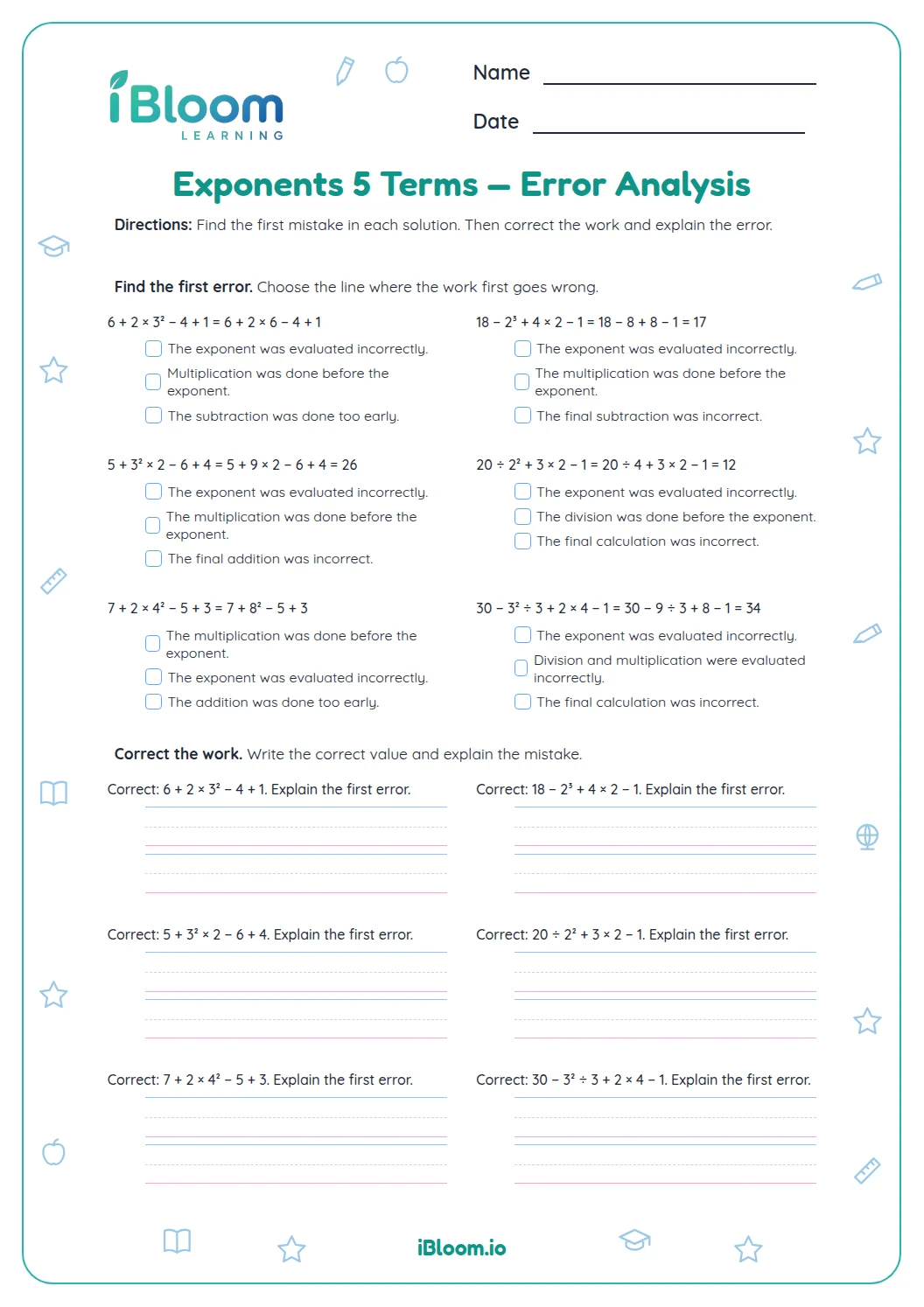
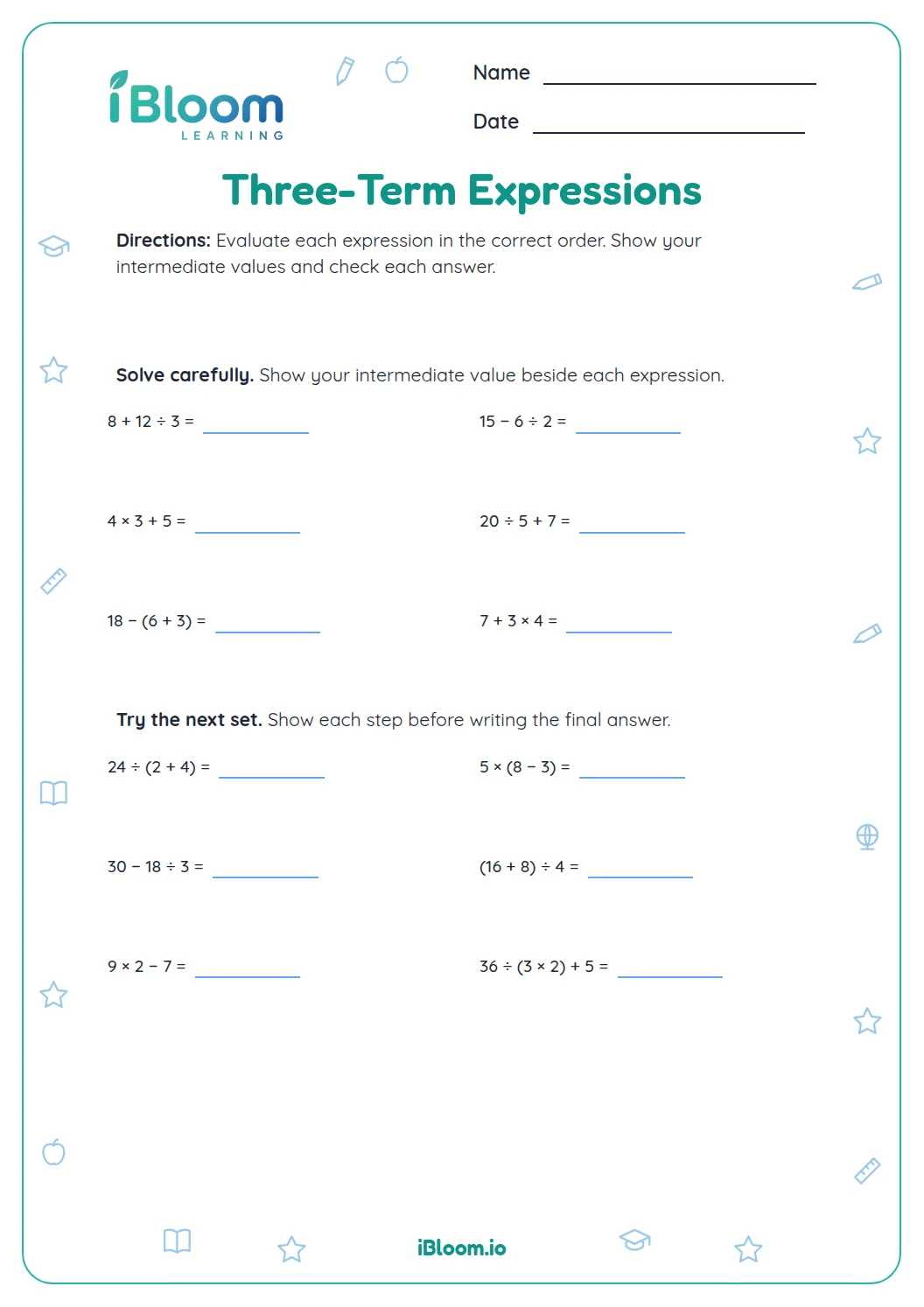

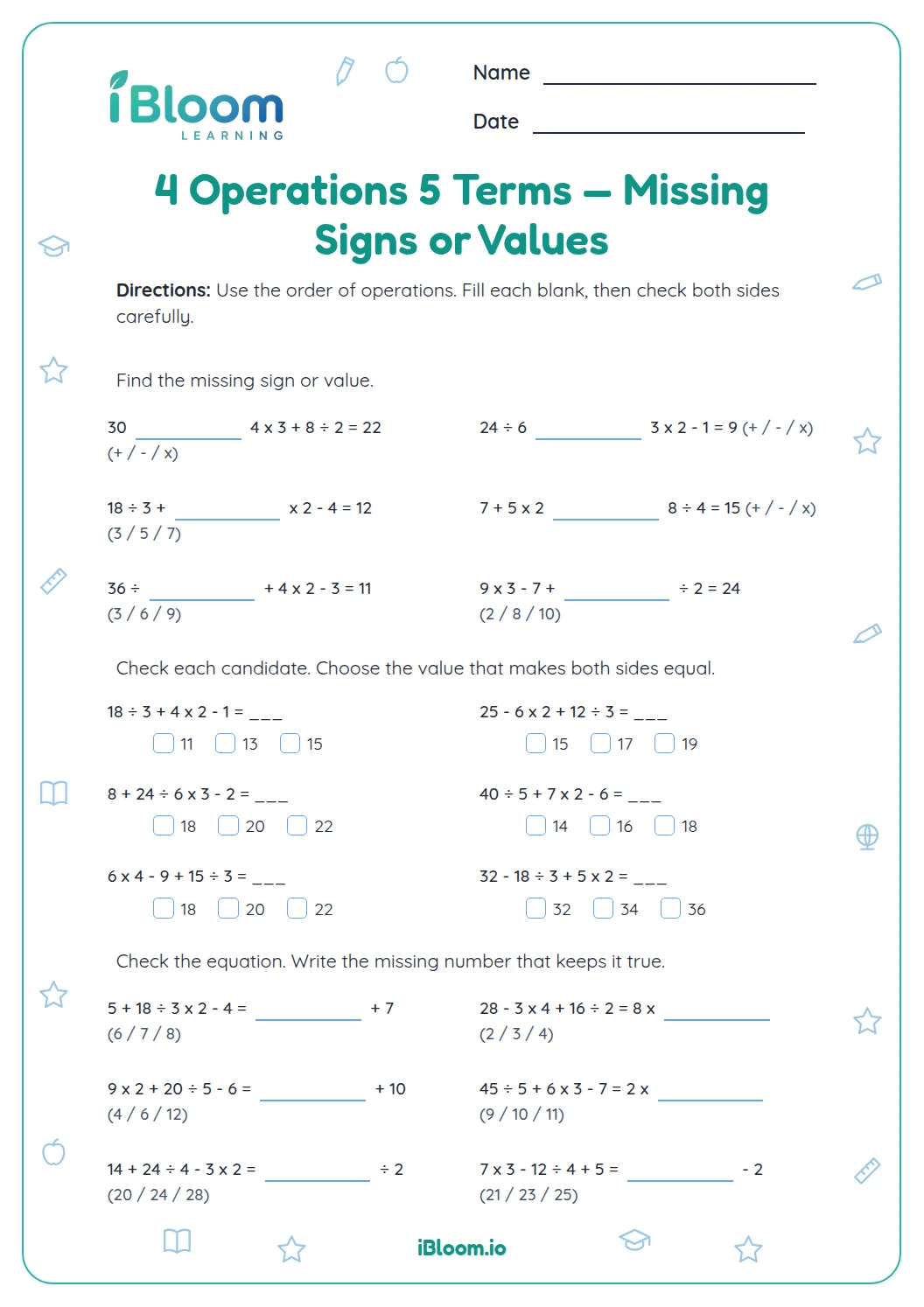
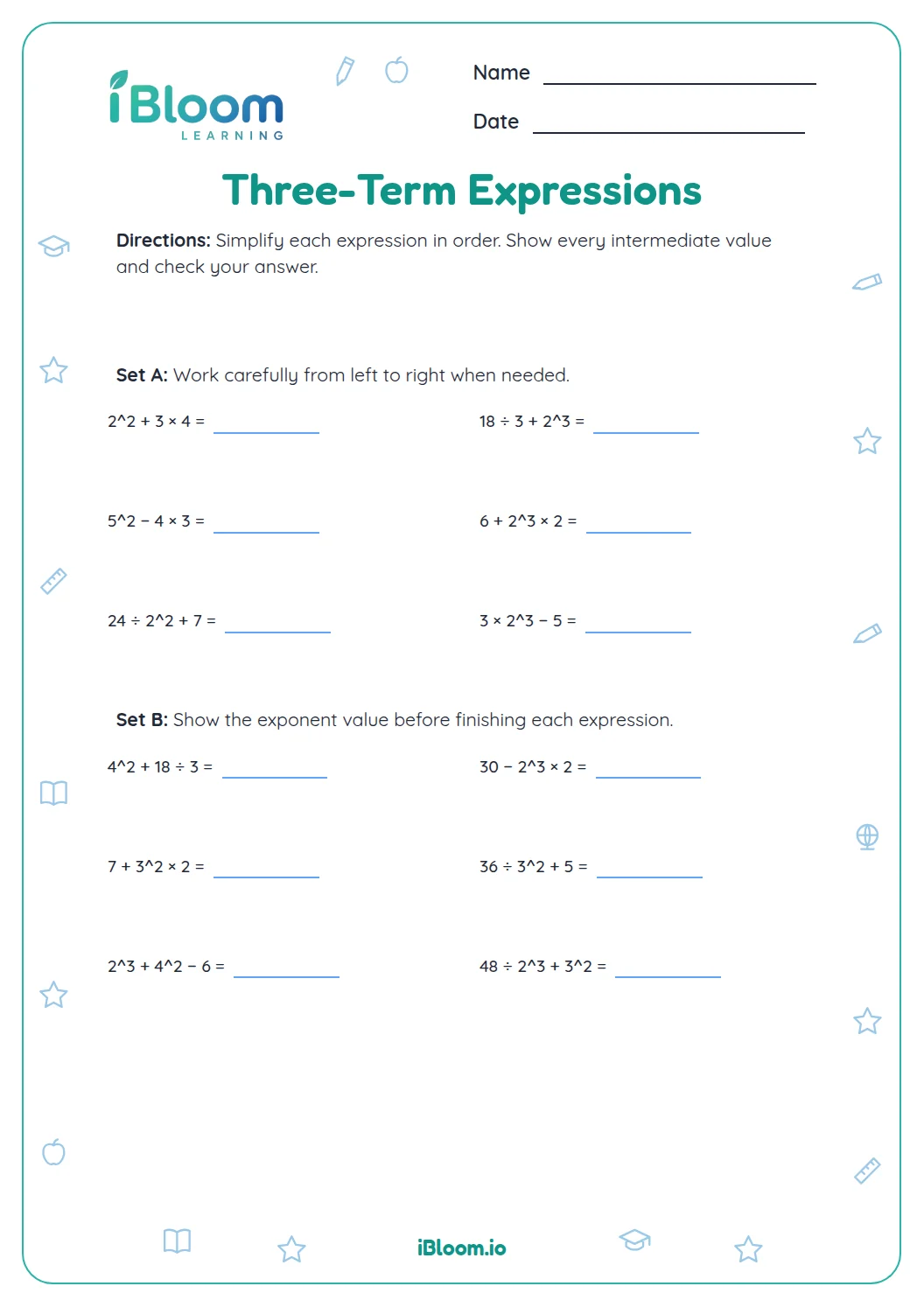

About this worksheet
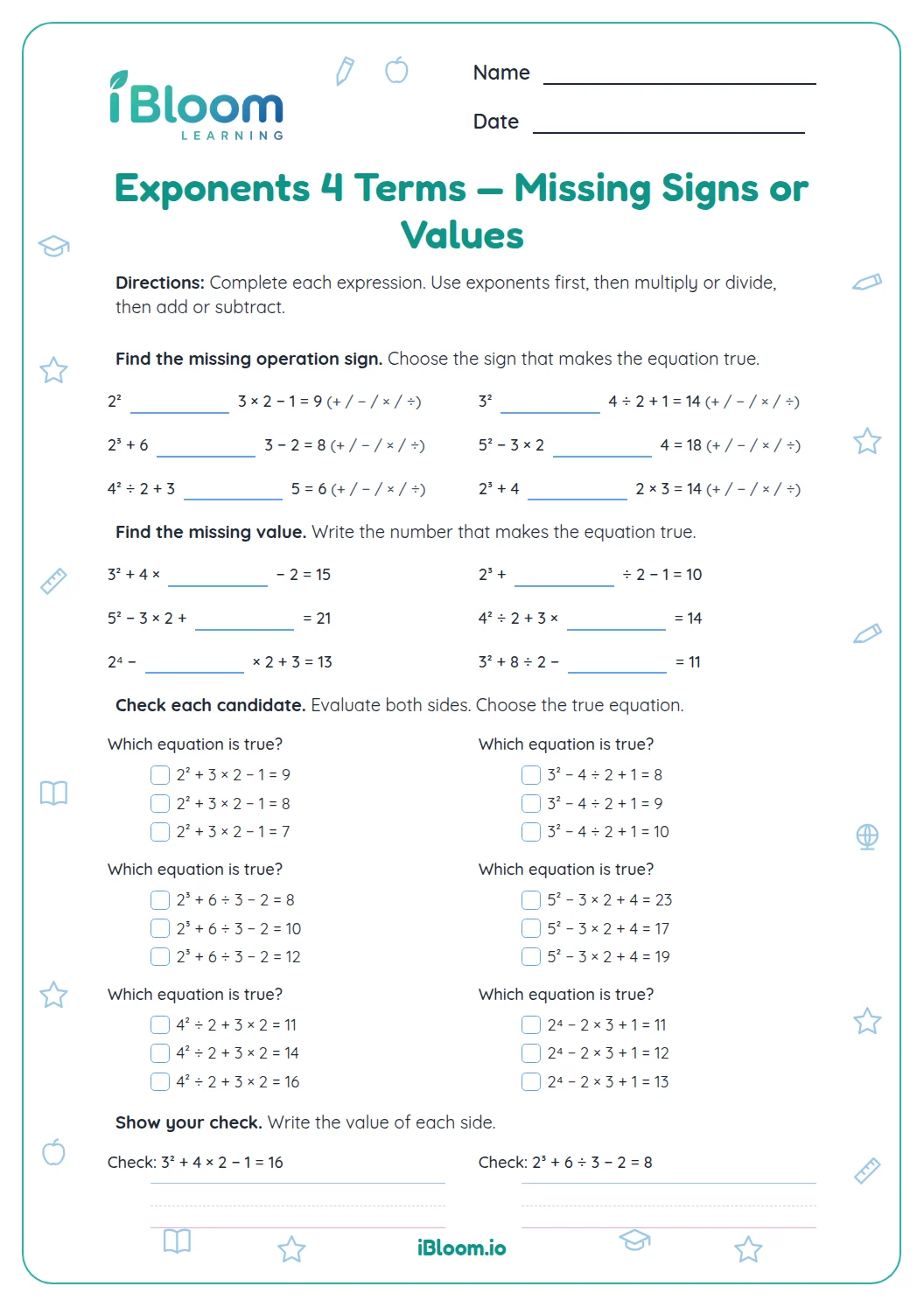
This free two-page worksheet for Grades 5–6 asks students to complete eighteen equations containing exponents. Part A has six missing operation signs, Part B has six missing values, and Part C has six missing values in parentheses. Each expression has five number entries, counting a power or a missing number as one entry. Students make each equation true using the order of operations, practicing Common Core 6.EE.A.1. The separate two-page key lists every missing sign and value. Students check by substituting their answers into the original expressions.
Aligned to 6.EE.A.1
What does five-term mean on this worksheet?
Each left-hand expression contains five number entries, counting a power such as 2³ as one entry and a missing value as one entry. In question 1, the entries are 2³, 6, 2, 3, and 1.
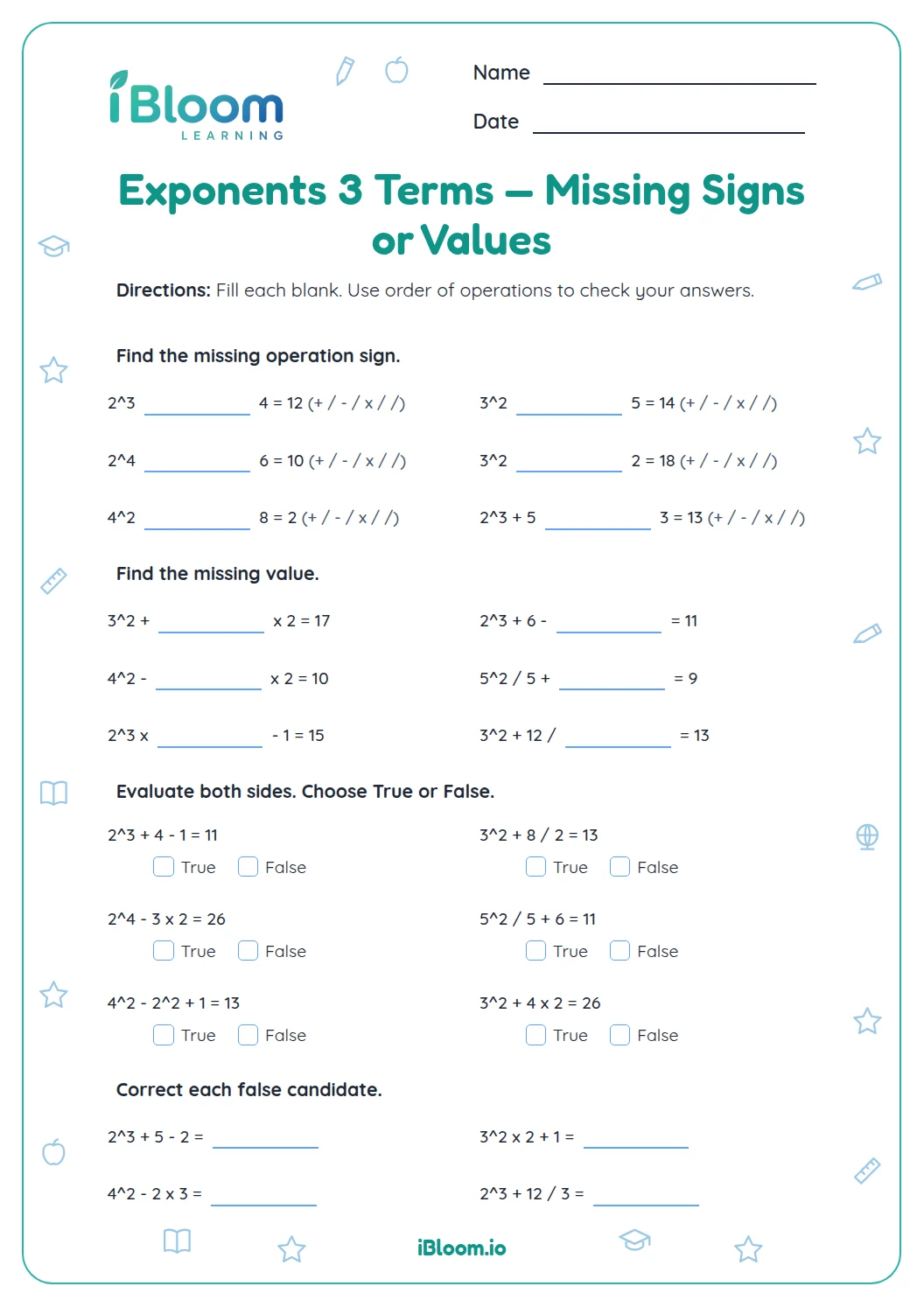
A blank in Part A stands for an operation sign. A blank in Parts B and C stands for a whole number. Check the part’s instruction before filling it.
How can students test a missing operation sign?
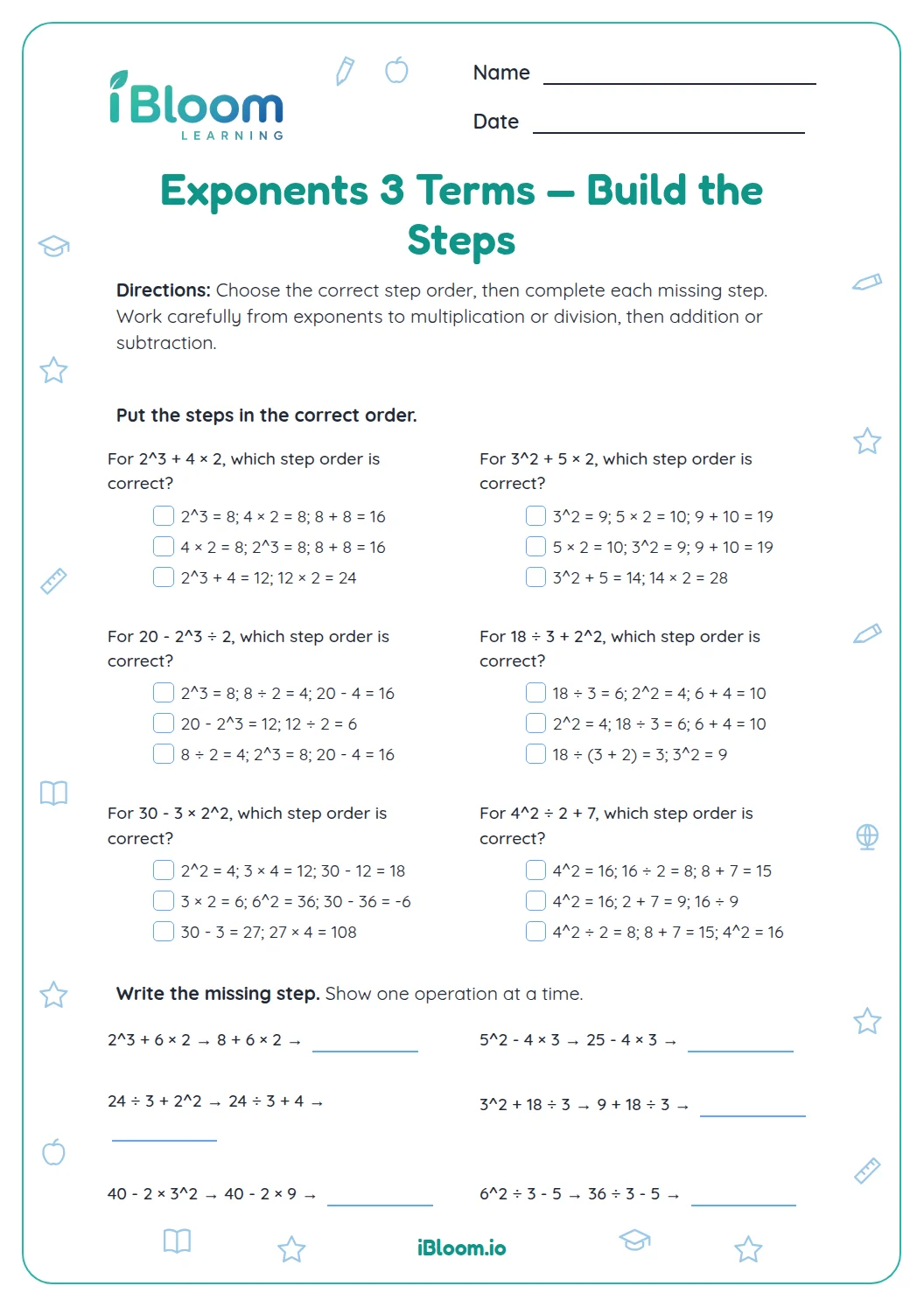
Evaluate each power first. Then try the allowed operation signs and follow the order of operations for each trial. Multiplication and division share a level, and addition and subtraction share a level; work from left to right within either pair.
- 1Question 1: 2³ + 6 ___ 2 − 3 + 1 = 18
- 22³ = 8. Try × in the blank.
- 38 + 6 × 2 − 3 + 1 = 8 + 12 − 3 + 1
- 4The result is 18, so write ×.
How do students find and check a missing value?
Simplify the known parts, then reason about the missing number. In question 7, 3² − 4 + 1 contributes 6. To reach 18, the missing number times 2 must contribute 12, so the missing number is 6.
In Part C, parentheses group an operation that must be completed before the outside operations. After finding a candidate value, substitute it into the original equation and calculate again. The check should end at the printed result.
How to use this worksheet
- 1Identify whether the blank needs a sign or a whole number.
- 2Evaluate whole-number powers, remembering that 3² means 3 × 3.
- 3Simplify any parentheses, then multiplication and division from left to right.
- 4Finish addition and subtraction from left to right.
- 5Put your answer back into the original equation and check both sides.
Mistakes to catch and correct
The mistake
Treating 2³ as 2 × 3 = 6.
The fix
Write 2 × 2 × 2 = 8 before continuing.
The mistake
Adding 8 + 6 before multiplying in question 1.
The fix
Complete 6 × 2 first after choosing ×.
The mistake
Ignoring the parentheses in question 13.
The fix
With 3 in the blank, calculate (4 + 3) × 3 − 8 + 2 = 15.
Common Core alignment
Complete five-number expressions by evaluating powers and finding a missing sign or value.
On this sheet: Students evaluate expressions with whole-number exponents to make each equation true.
Show the official wordingHide the official wording
Write and evaluate numerical expressions involving whole-number exponents.
What to practice next
Make more practice
Further reading
Questions parents and teachers ask
Which signs can go in Part A?
Choose from addition, subtraction, multiplication, and division: +, −, ×, or ÷. Each of the six questions has one correct sign from that set. Students should test the resulting expression with the normal order of operations instead of calculating every operation strictly from left to right.
What does the exponent tell my child to do?
The exponent tells how many equal factors to multiply. For example, 2³ means 2 × 2 × 2, which equals 8, and 3² means 3 × 3, which equals 9. Evaluate each power as a single value before completing the surrounding operations in these equations.
Are the missing values whole numbers?
Yes, every missing value in Parts B and C is a whole number. Students can simplify the known parts and work backward from the printed result. Once they have a candidate, substituting it into the original expression provides a direct check that all the operations give the required total.
Why does Part C include parentheses?
The parentheses make students track which quantities belong together before applying the outside operations. In question 13, the power and missing number form a sum that is multiplied by three. Using 3 in the blank gives (4 + 3) × 3 − 8 + 2 = 15, confirming the answer.
How should students use the answer key?
Students should finish a question and verify their substitution before comparing it with the key. If the sign or value differs, rewrite the expression one step at a time and locate the first mismatch. Keep timing optional so the practice emphasizes correct powers, grouping, and operation order.