


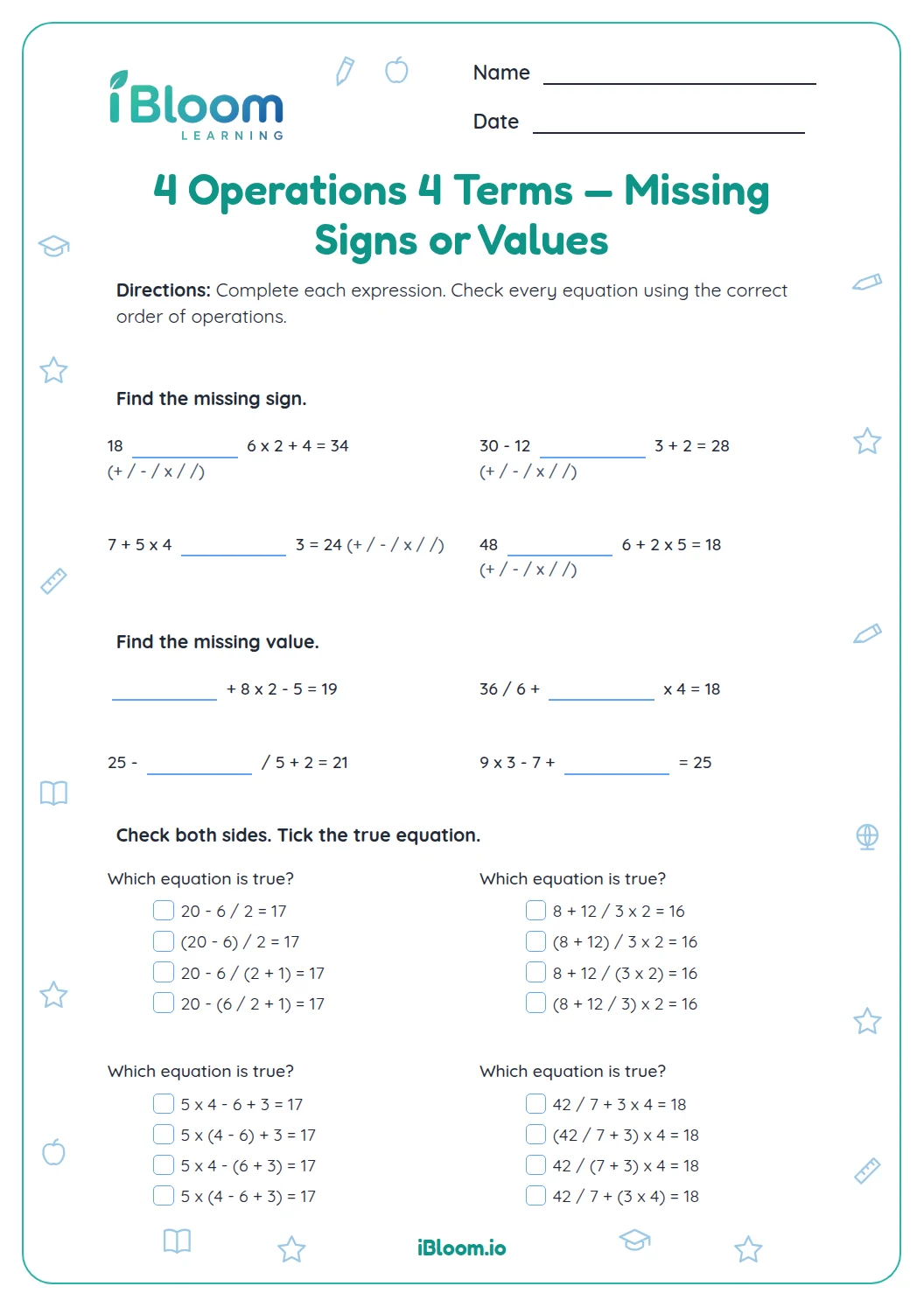

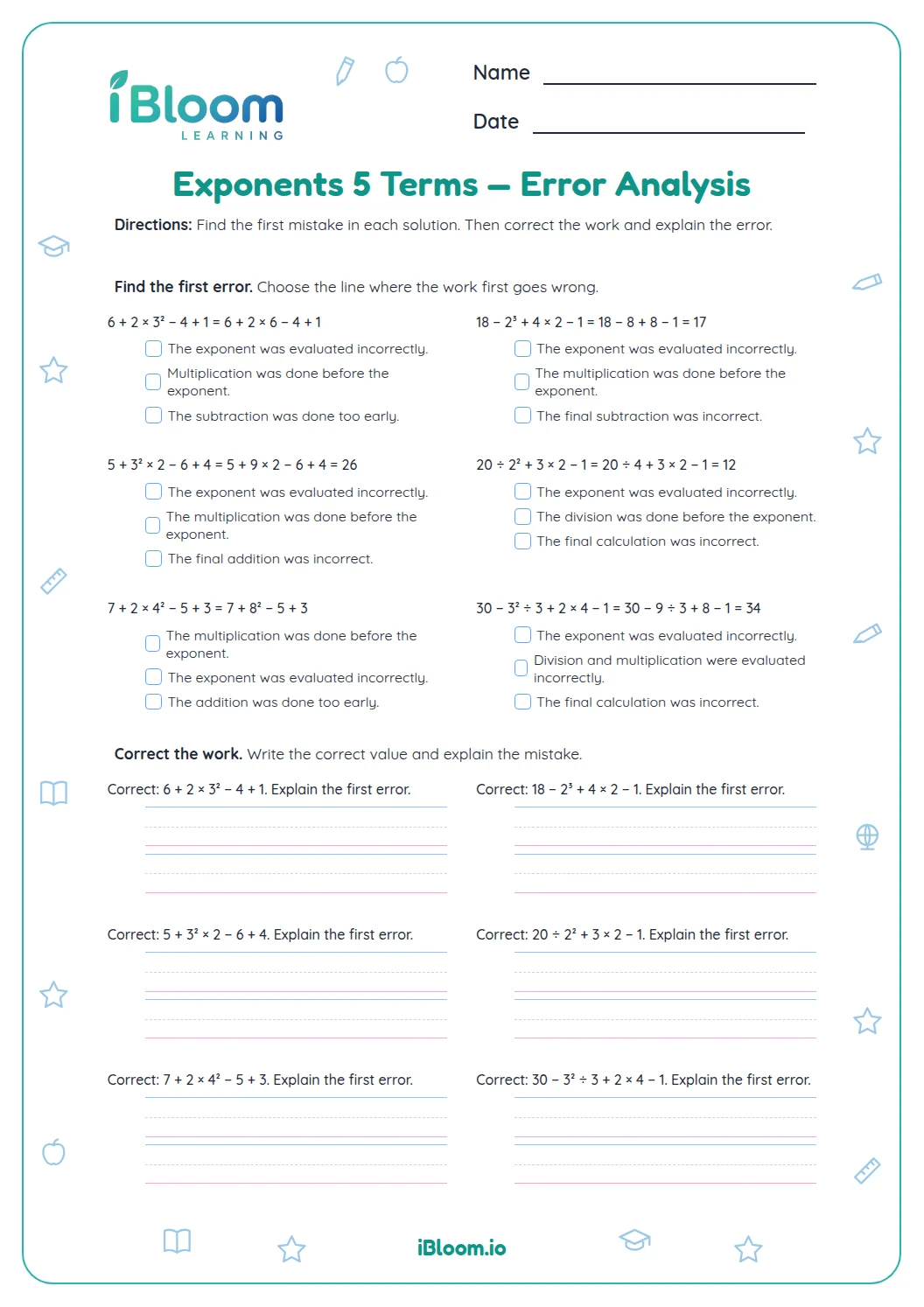
About this worksheet
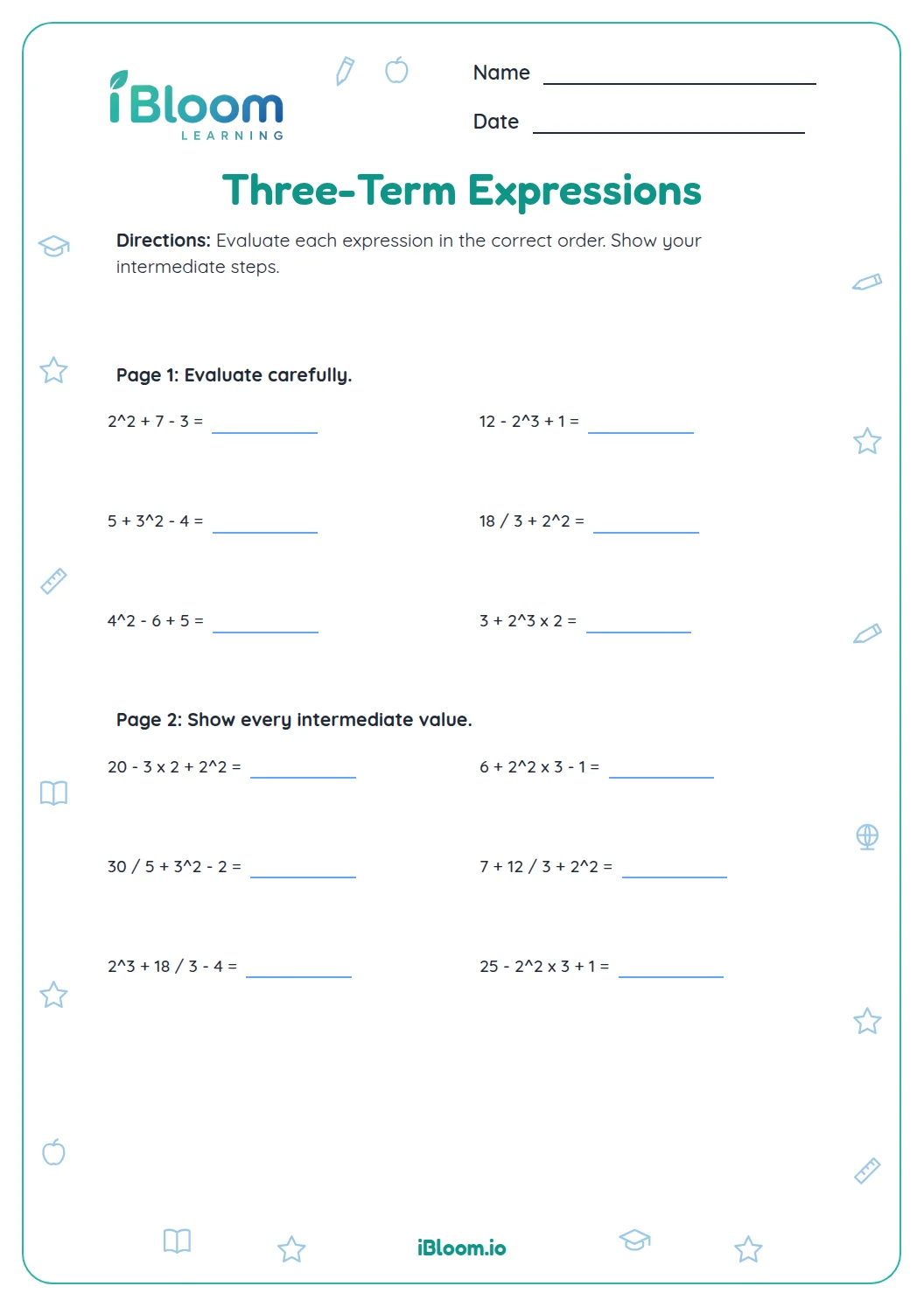
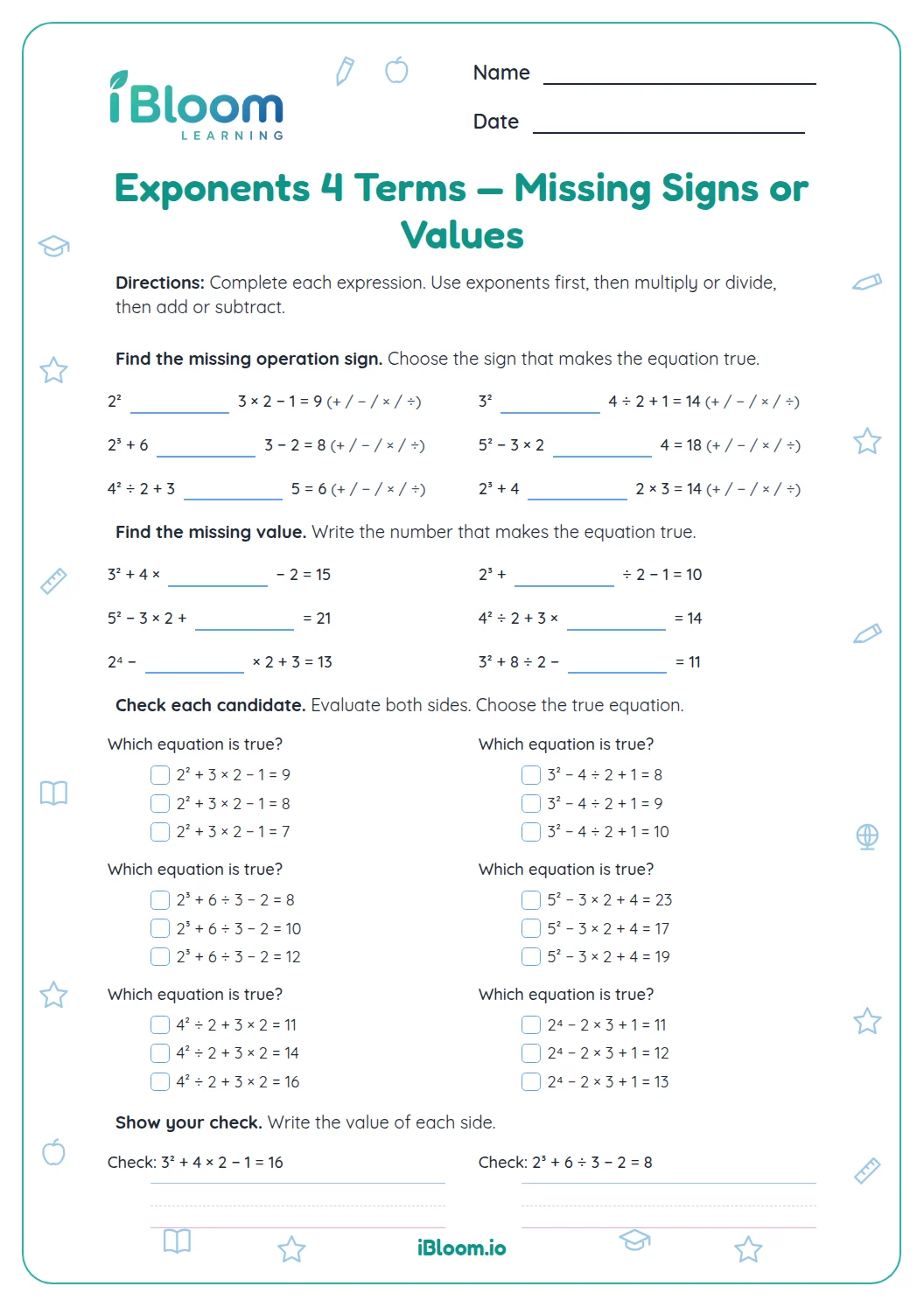
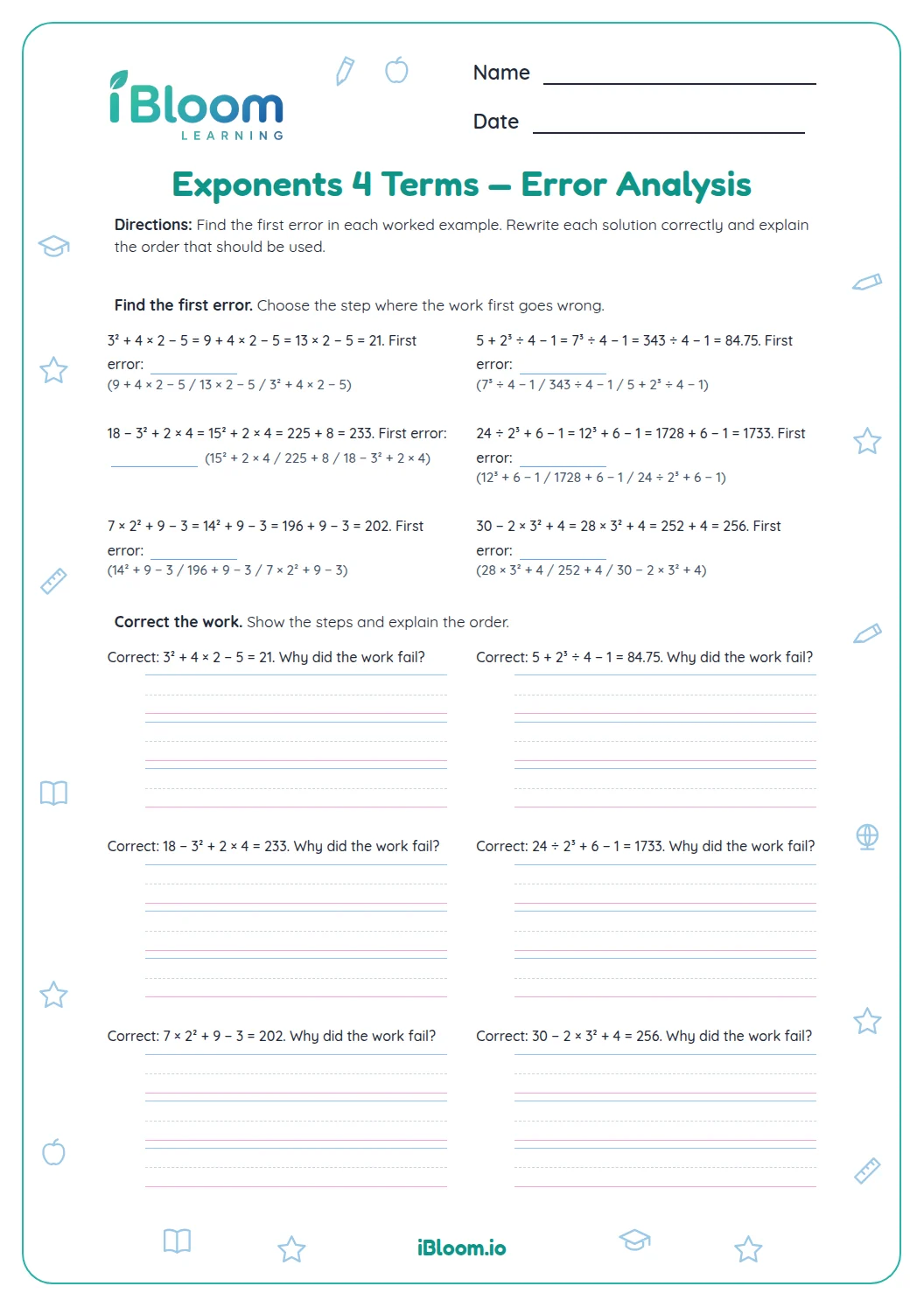
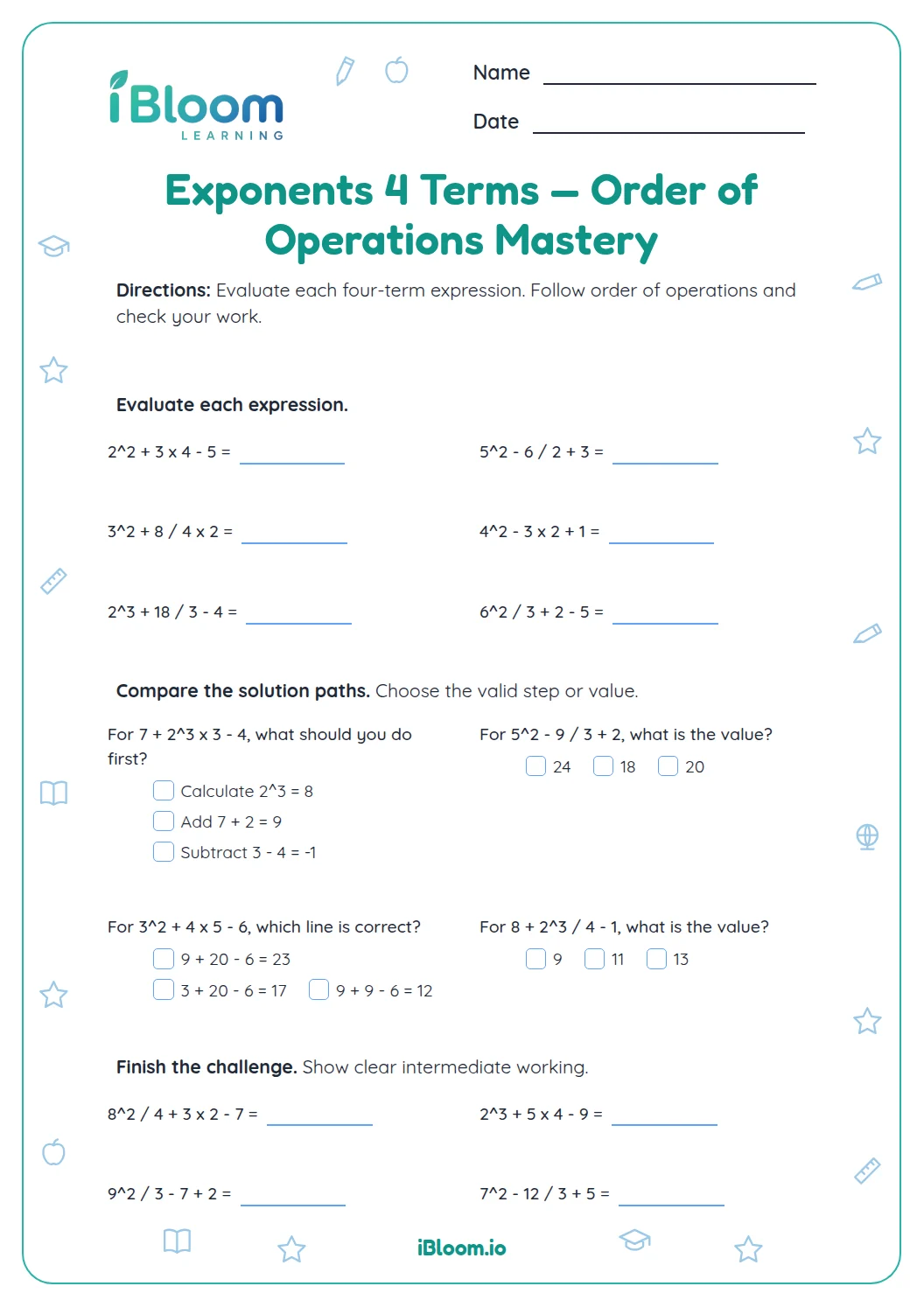
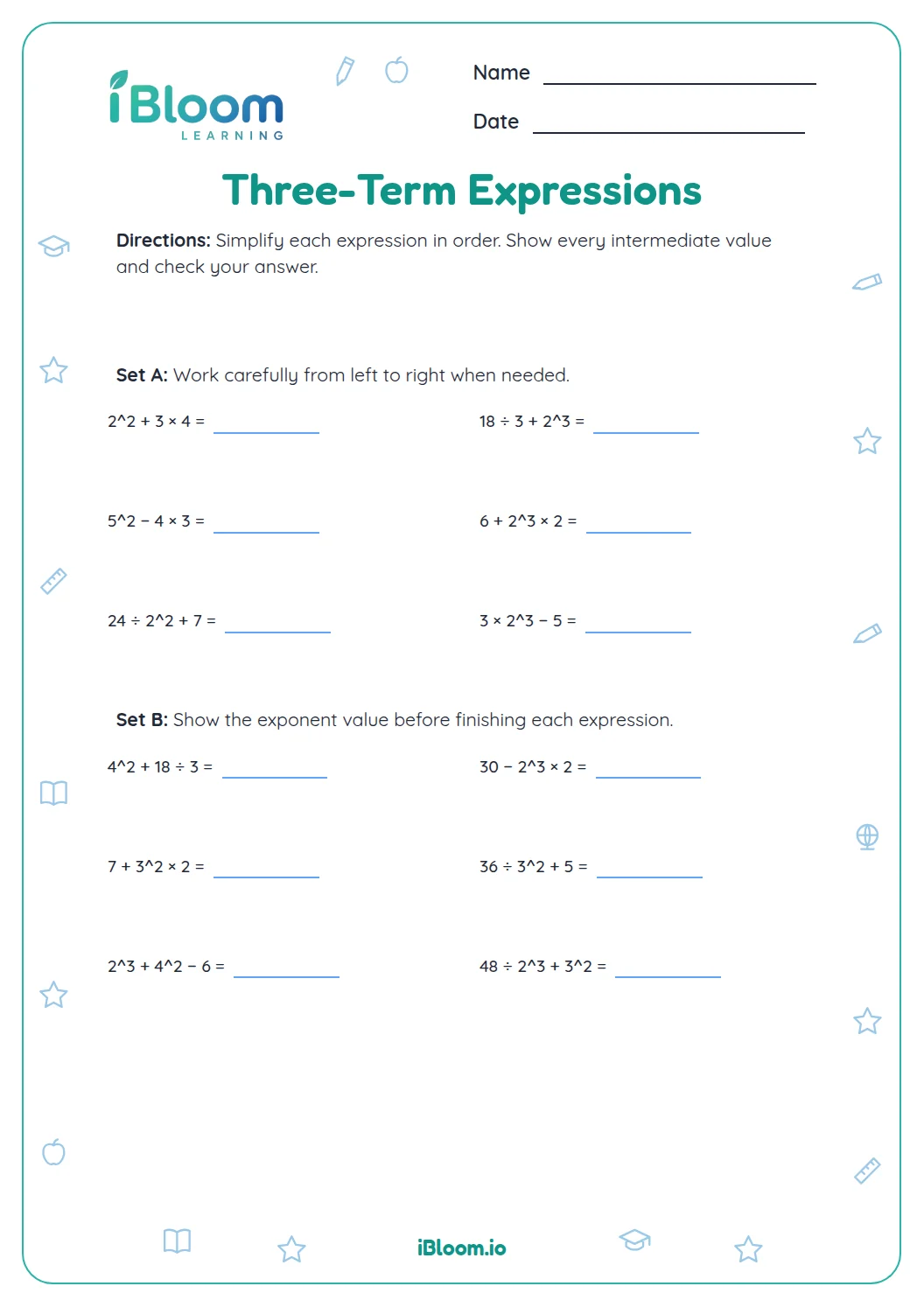
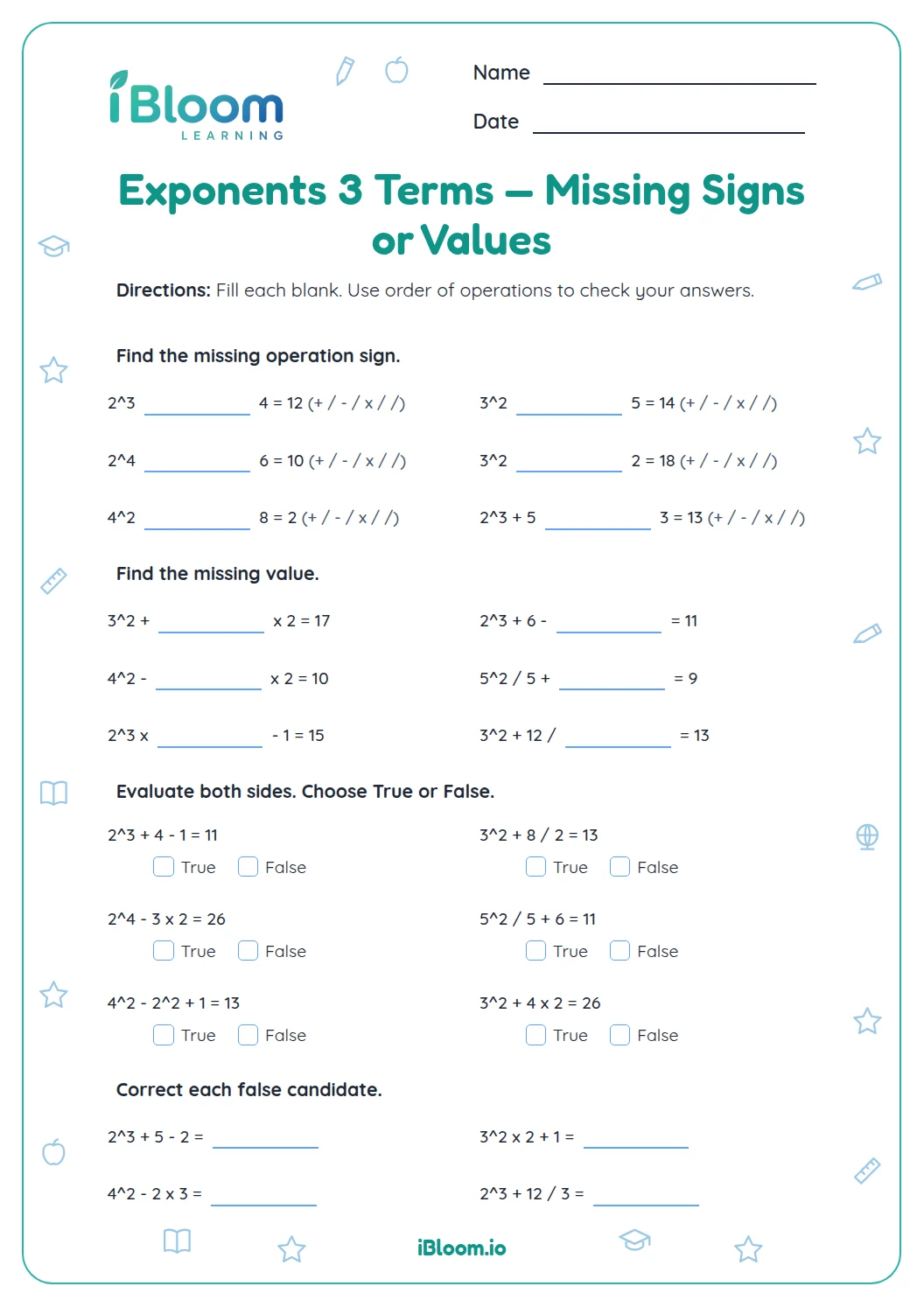
This free printable Grades 5–6 worksheet practices evaluating numerical expressions with whole-number exponents. In 22 questions, students choose the first operation, fill in the next step for six expressions, and then evaluate ten mixed expressions. The sequence keeps the work visible before students solve independently. It aligns with 6.EE.A.1, writing and evaluating numerical expressions involving whole-number exponents. A separate answer key gives each step and final value.
Aligned to 6.EE.A.1
What does each part ask students to do?
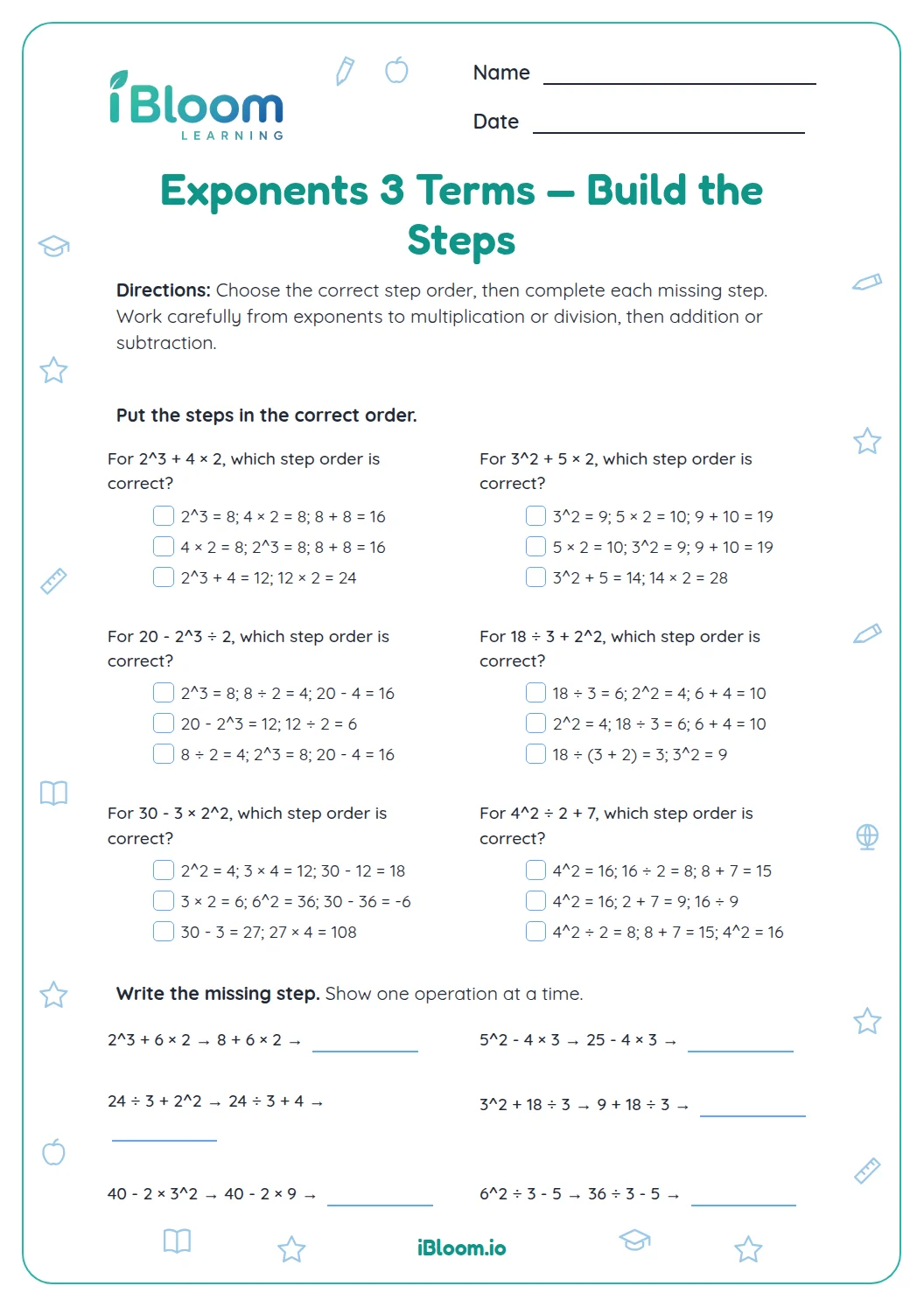
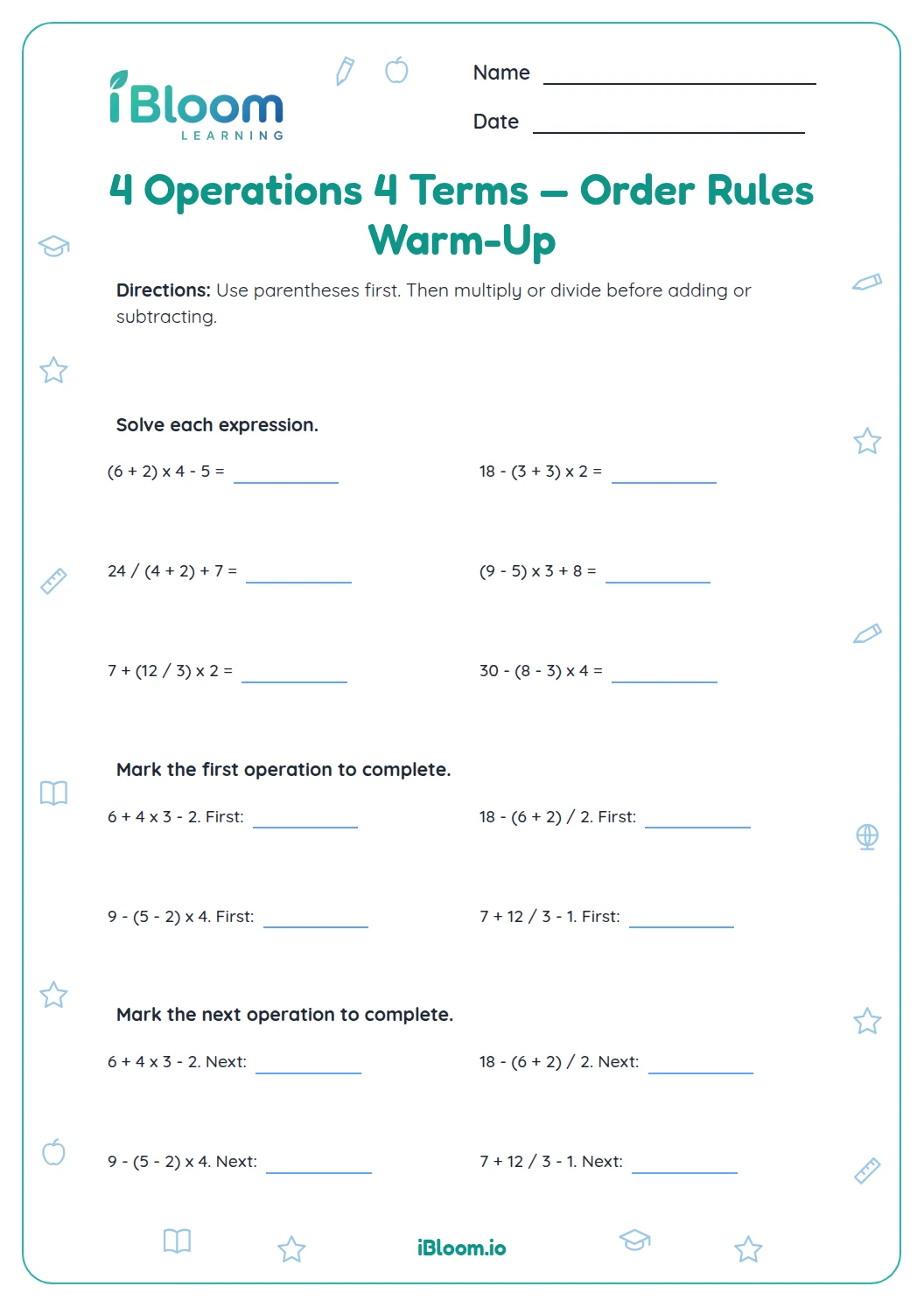
Part A asks which operation or grouping to handle first and shows the rewritten expression. Part B continues each of six expressions one step further. Part C gives ten mixed expressions to evaluate fully.
- Part A: Choose the first step
- Part B: Write the next step
- Part C: Evaluate mixed expressions
What is the first step in an expression with a power?
Evaluate the exponent before multiplying, dividing, adding, or subtracting. For question 1, 2³ becomes 8, so the expression is rewritten as 8 + 4 × 2. Multiplication still comes before addition.
- 12³ + 4 × 2
- 2First step: 8 + 4 × 2
How do students write the next step?
Part B shows the expression after the exponent has been evaluated. In question 7, continue by multiplying 4 × 2, so the next line is 8 + 8 − 5. Then finish the addition and subtraction from left to right.
- 18 + 4 × 2 − 5 → 8 + 8 − 5
- 2Multiply before adding or subtracting.
How can students check the final value?
In Part C, write one intermediate expression at a time. For question 15, calculate 2³ × 3 before subtracting: 30 − 24 + 4 = 10. Multiplication and division are handled left to right, as are addition and subtraction.
How to evaluate each expression
- 1Copy the expression and mark parentheses.
- 2Evaluate powers, including powers inside parentheses.
- 3Multiply and divide from left to right.
- 4Add and subtract from left to right.
- 5Substitute each intermediate value and check the final result.
Common order-of-operations errors
The mistake
Adding or subtracting before multiplying.
The fix
Finish multiplication and division from left to right first.
The mistake
Treating an exponent as multiplication by its base.
The fix
For 2³, multiply 2 × 2 × 2 to get 8.
The mistake
Ignoring parentheses or stopping after the first step.
The fix
Simplify the group, then continue through every remaining operation.
Common Core alignment
Students write intermediate forms and evaluate numerical expressions with whole-number exponents.
Write and evaluate numerical expressions involving whole-number exponents.
On this sheet: Students rewrite expressions after evaluating powers and find each expression’s value.
Show the official wordingHide the official wording
Write and evaluate numerical expressions involving whole-number exponents.
What to practice next
Make more practice
Further reading
Questions parents and teachers ask
How many expressions are included?
There are 22 questions in three parts: six first-step choices, six missing-next-step expressions, and ten problems to evaluate. The answer key lists the correct rewrite for each first-step question, the missing value for each next-step line, and the final value for every evaluation problem.
What should be done first in 2³ + 4 × 2?
Evaluate the exponent first: 2³ is 8, so the expression becomes 8 + 4 × 2. Multiplication comes before addition, giving 16. The first-step questions ask students to show the rewrite, not the final value, so they can focus on the order of operations.
How do parentheses affect the steps?
Evaluate the expression inside parentheses before continuing outside them. If a power is inside the group, evaluate it as part of that group. In question 8, 20 ÷ (1 + 2²) + 3 becomes 20 ÷ 5 + 3, which equals 7. Keep the grouping visible until it is simplified.
What does the answer key include?
The answer key gives all six selected first-step expressions and the final values for the remaining 16 questions. Students can compare their intermediate work too: if the final answer differs, find the first line where an operation was handled out of order.
How long should this worksheet take?
Plan for about 20 minutes. The first-step choices are short, but the grouped and mixed expressions have several operations. Students should show intermediate values so they can spot whether a power, multiplication, division, or addition was handled at the right time.