



About this worksheet
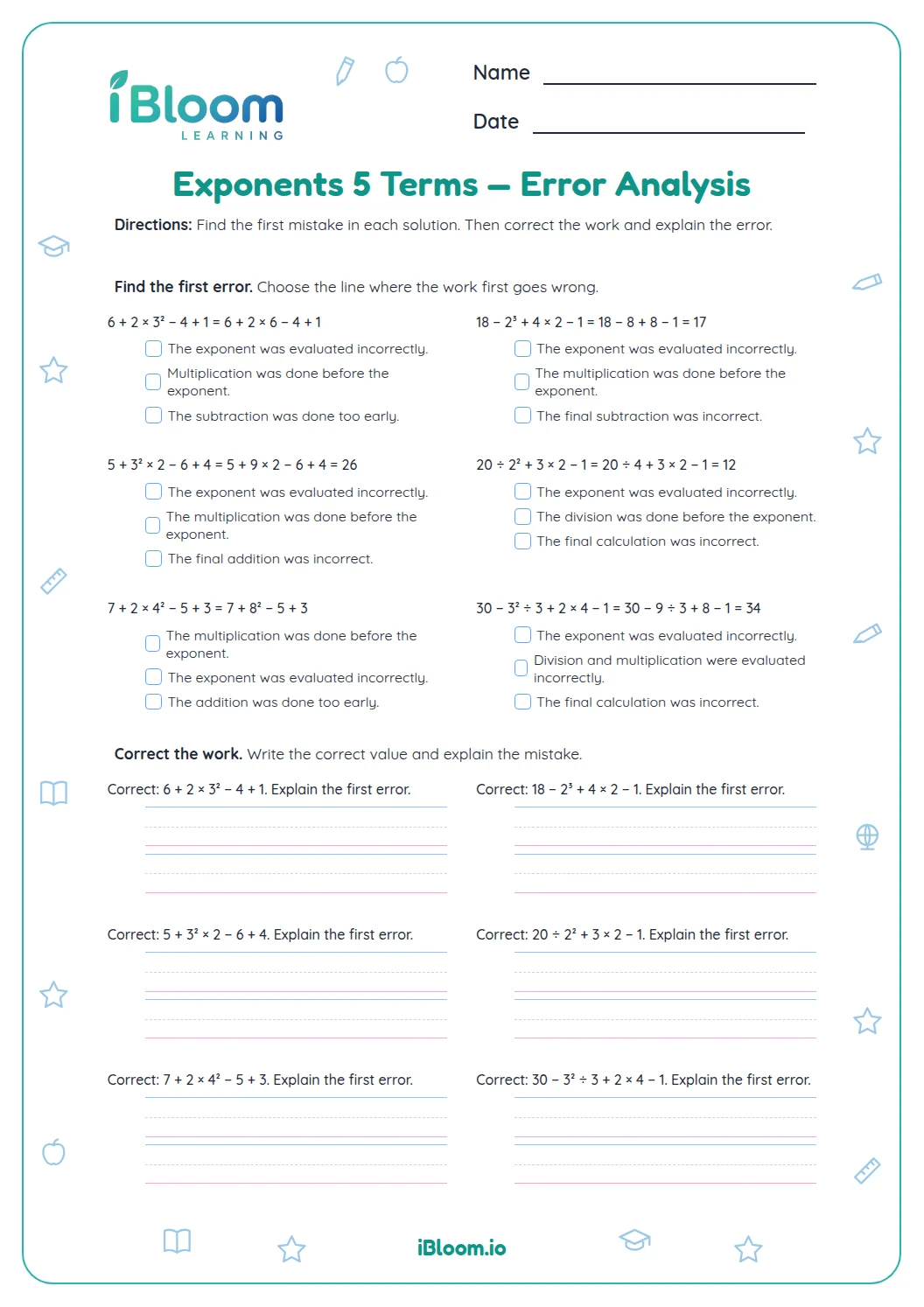
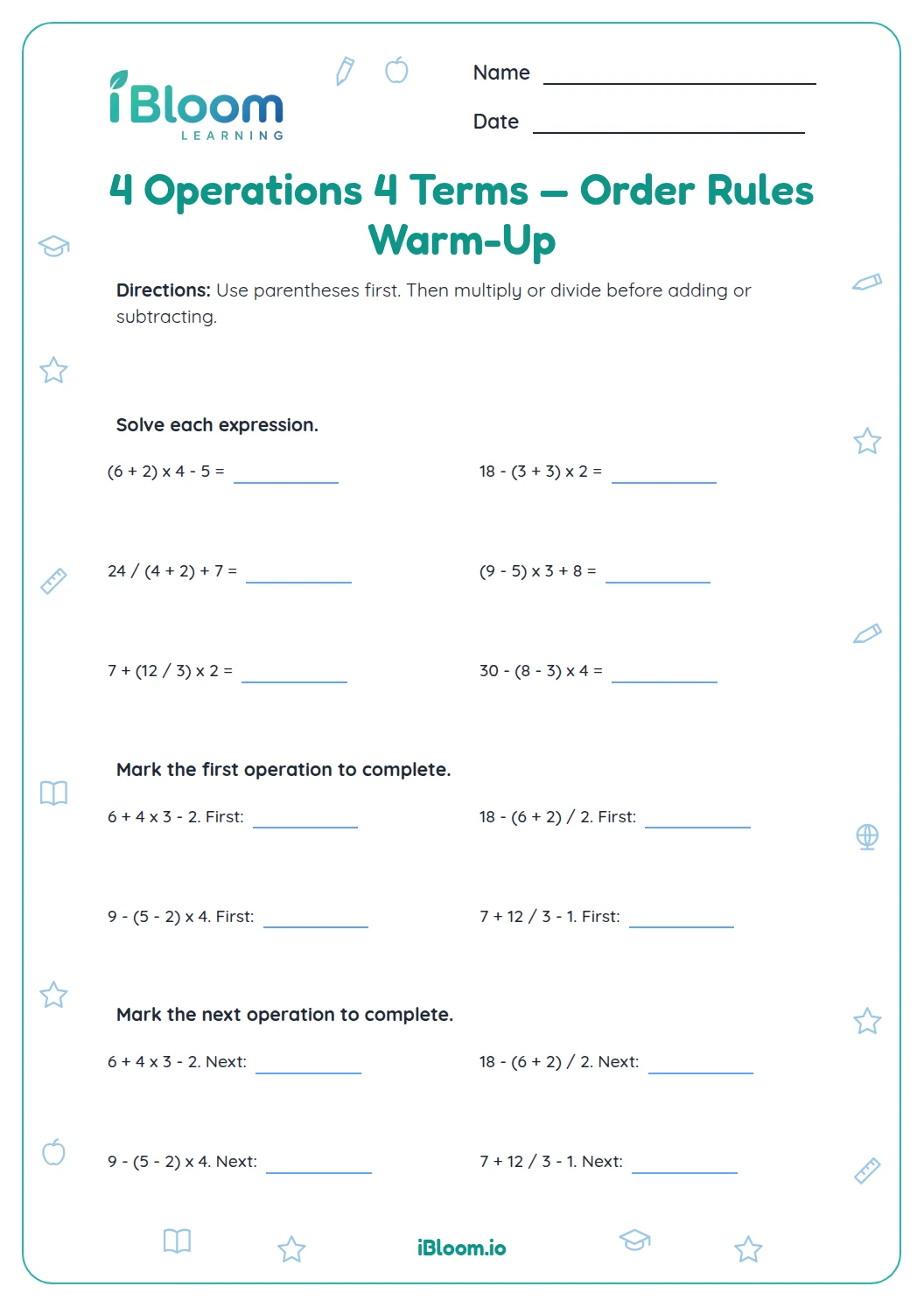
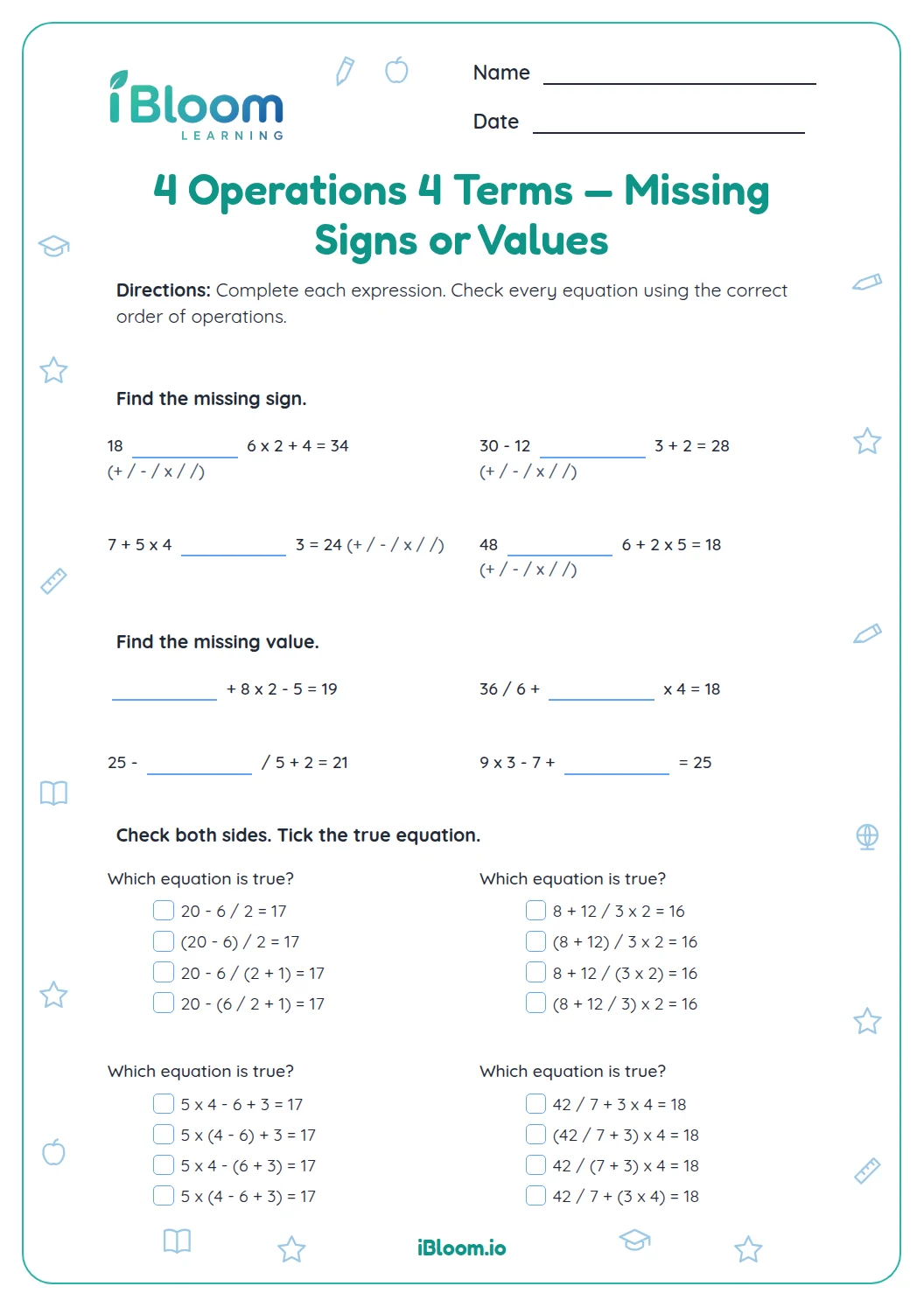
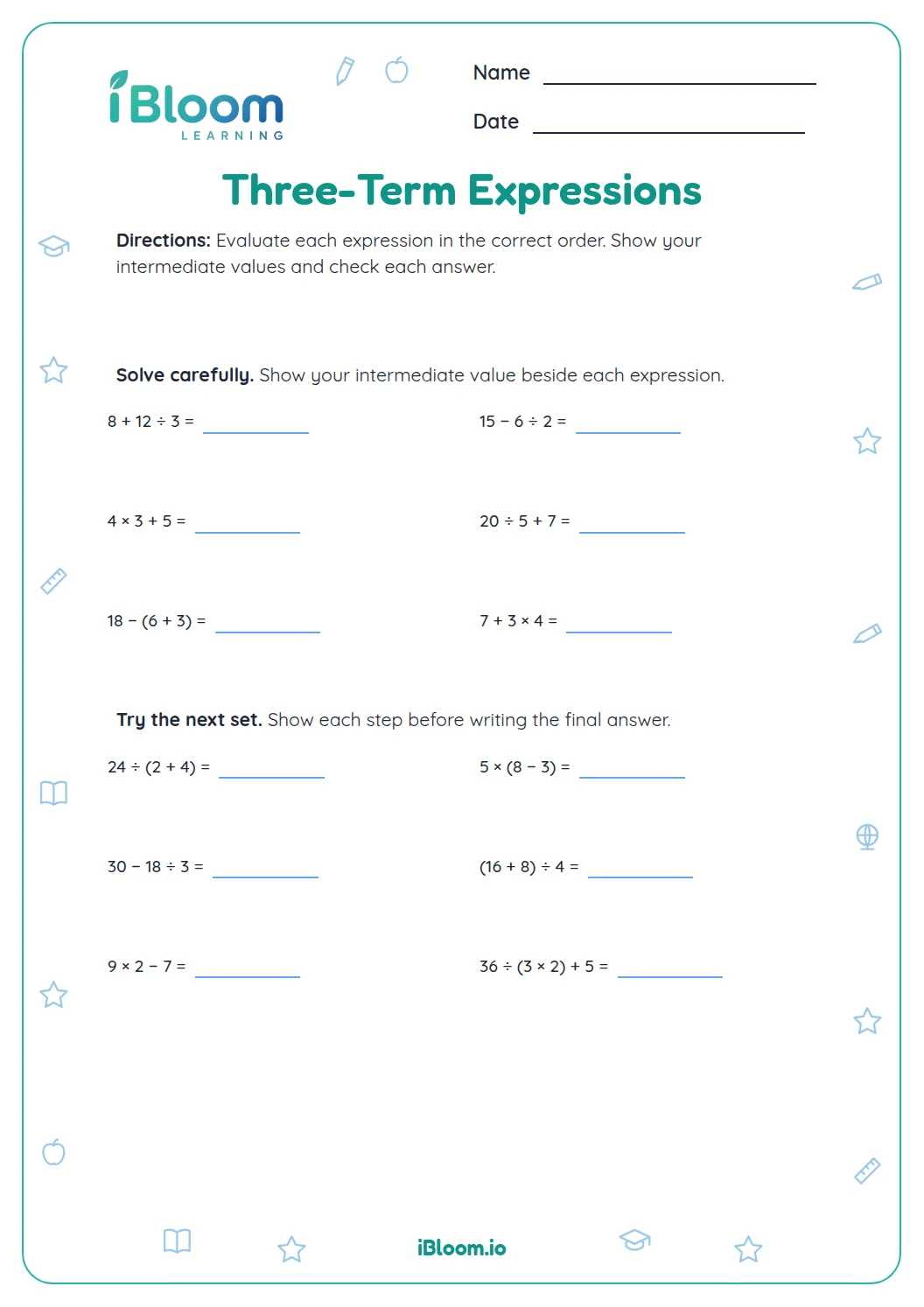
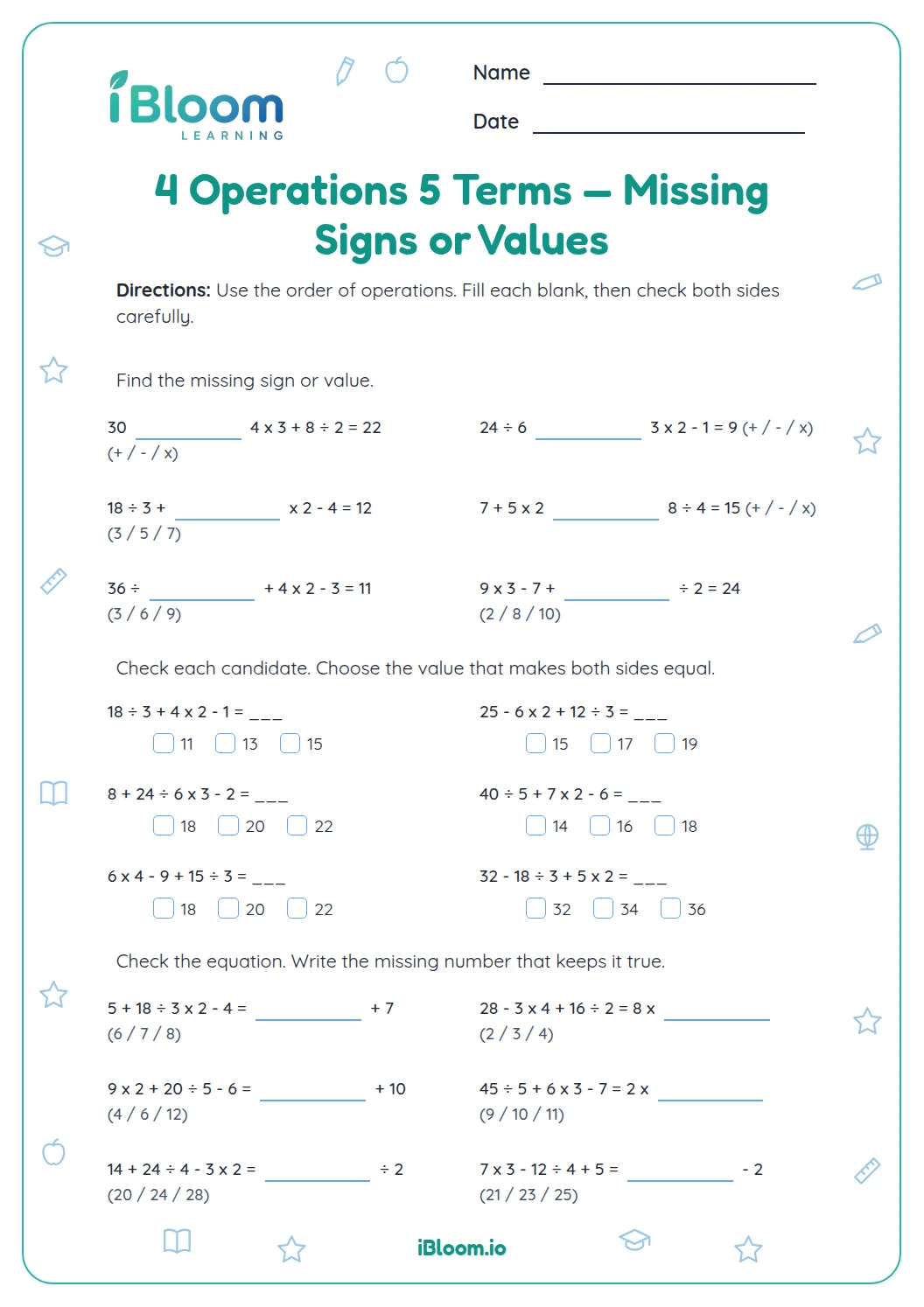
Practice the same sequence on 16 five-term expressions: evaluate exponents, multiply or divide from left to right, then add or subtract from left to right. The separate key lists each result. CCSS 6.EE.A.1.
Aligned to 6.EE.A.1
What is the main move in exponents and order of operations?
Evaluate each power first. Then work multiplication and division from left to right, followed by addition and subtraction from left to right. The 16 expressions apply that sequence with five terms.
How does one problem work from start to finish?
For 2² + 3 × 4, evaluate 2² as 4 and 3 × 4 as 12 before adding: 4 + 12 = 16.
- 12² + 3 × 4
- 24 + 12 = 16
How can students check each result?
Rewrite each exponent as repeated multiplication or its value. Complete multiplication and division from left to right. Review the answer key only after completing the calculation.
How to use this worksheet
- 1Rewrite each exponent as repeated multiplication or its value.
- 2Complete multiplication and division from left to right.
- 3Complete addition and subtraction from left to right.
- 4Keep each intermediate value on a new line.
- 5Substitute the final value back into the original expression to check.
Common mistakes and quick fixes
The mistake
Adding before multiplying: 2² + 3 × 4 becomes 7 × 4.
The fix
Fix: Mark the multiplication and exponent before doing the addition.
The mistake
Reading 2³ as 2 × 3.
The fix
Fix: Write 2 × 2 × 2 = 8 beside the power.
The mistake
Doing all multiplication before division even when division appears first.
The fix
Fix: Work multiplication and division from left to right.
Common Core alignment
This page connects the printed practice to the following Common Core standard.
Evaluate numerical expressions containing whole-number exponents.
On this sheet:
Show the official wordingHide the official wording
Write and evaluate numerical expressions involving whole-number exponents.
What to practice next
Make more practice
Further reading
Questions parents and teachers ask
What does 2³ mean?
It means multiply three 2s: 2 × 2 × 2 = 8. The raised 3 tells how many factors of 2 to use; it does not mean 2 × 3. In this drill, evaluate that power before moving to multiplication, division, addition, or subtraction.
Do students multiply before dividing?
Multiplication and division have equal priority, so work from left to right after evaluating powers. In q11, 8 + 16 ÷ 4 × 3 − 5, divide 16 by 4, then multiply by 3 before completing the addition and subtraction.
How many problems are on the drill?
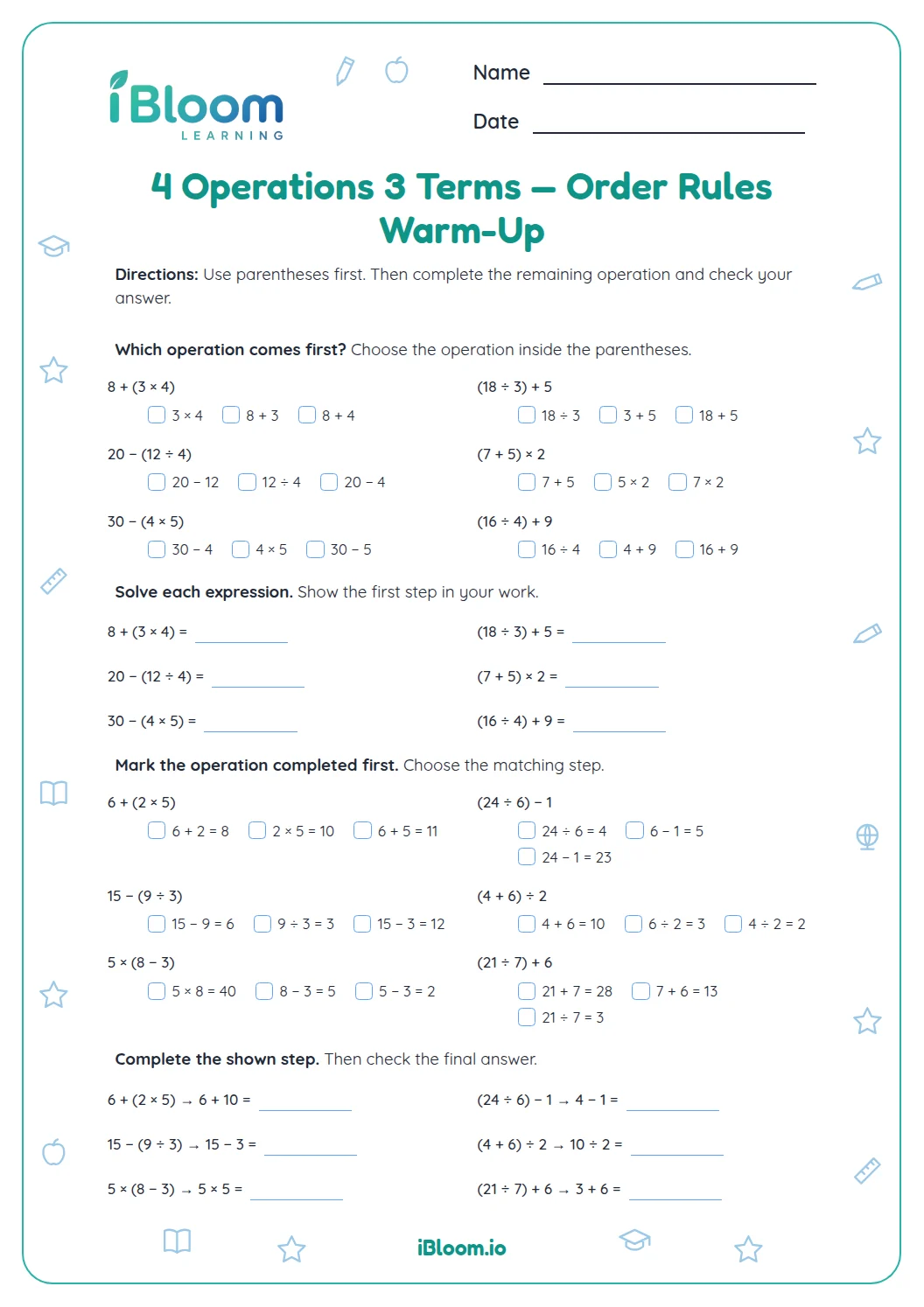
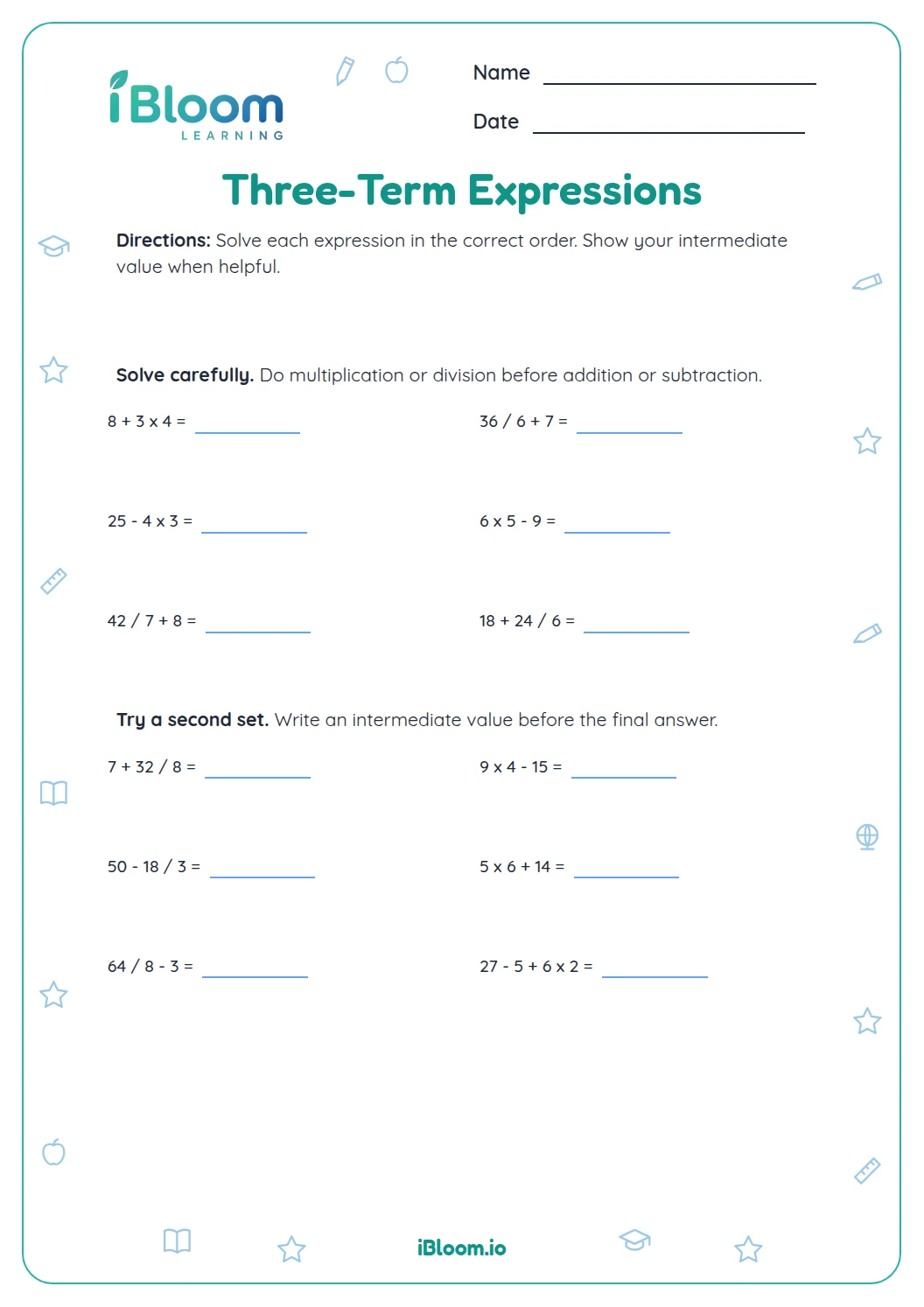
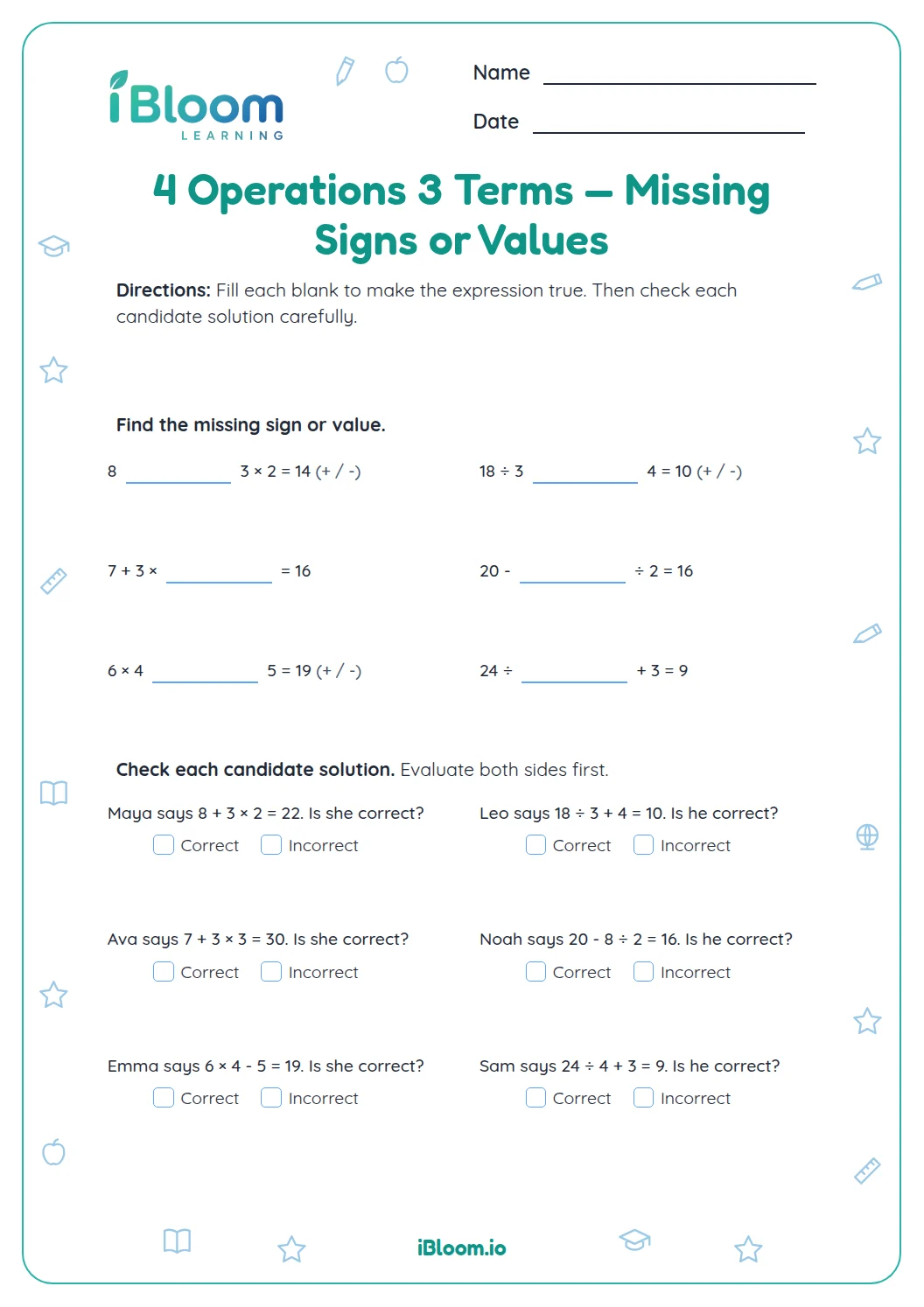
There are 16 expressions across two worksheet pages, followed by two answer-key pages. Each expression has five terms and includes a whole-number exponent. The later questions combine powers with multiplication, division, addition, and subtraction in the same calculation.
What should students write for each problem?
Write one operation step at a time, keeping the original order visible. The worksheet provides room to show work under each expression, and the separate key lists the final value. Comparing intermediate steps can help locate an arithmetic slip.
How can a student check an answer?
Recheck the exponent value first, then the multiplication or division steps from left to right. Finish by checking addition and subtraction in order. For q1, the power is 8, the product is 32, and the quotient is 3, so 6 + 32 − 3 = 35.