



About this worksheet
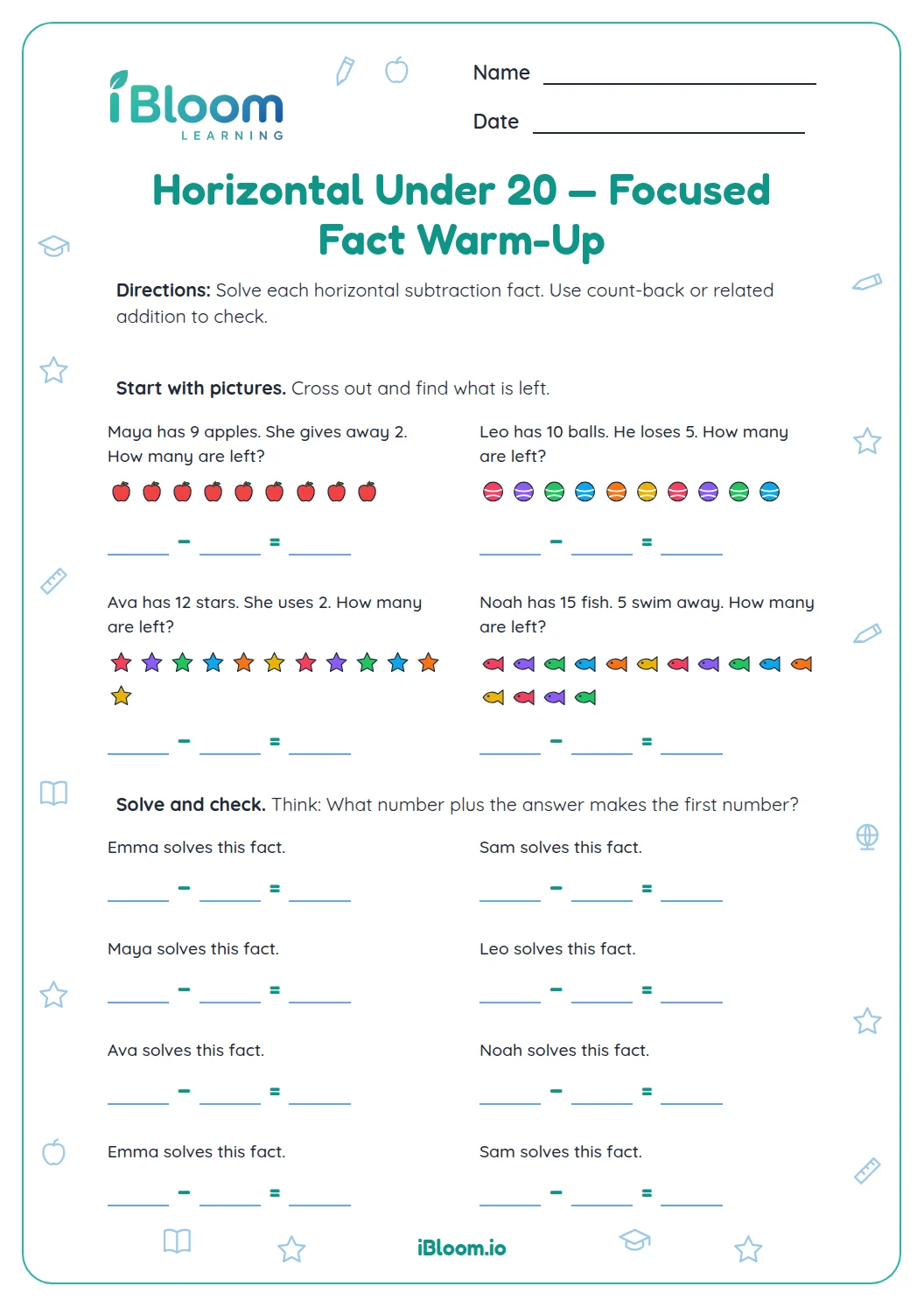
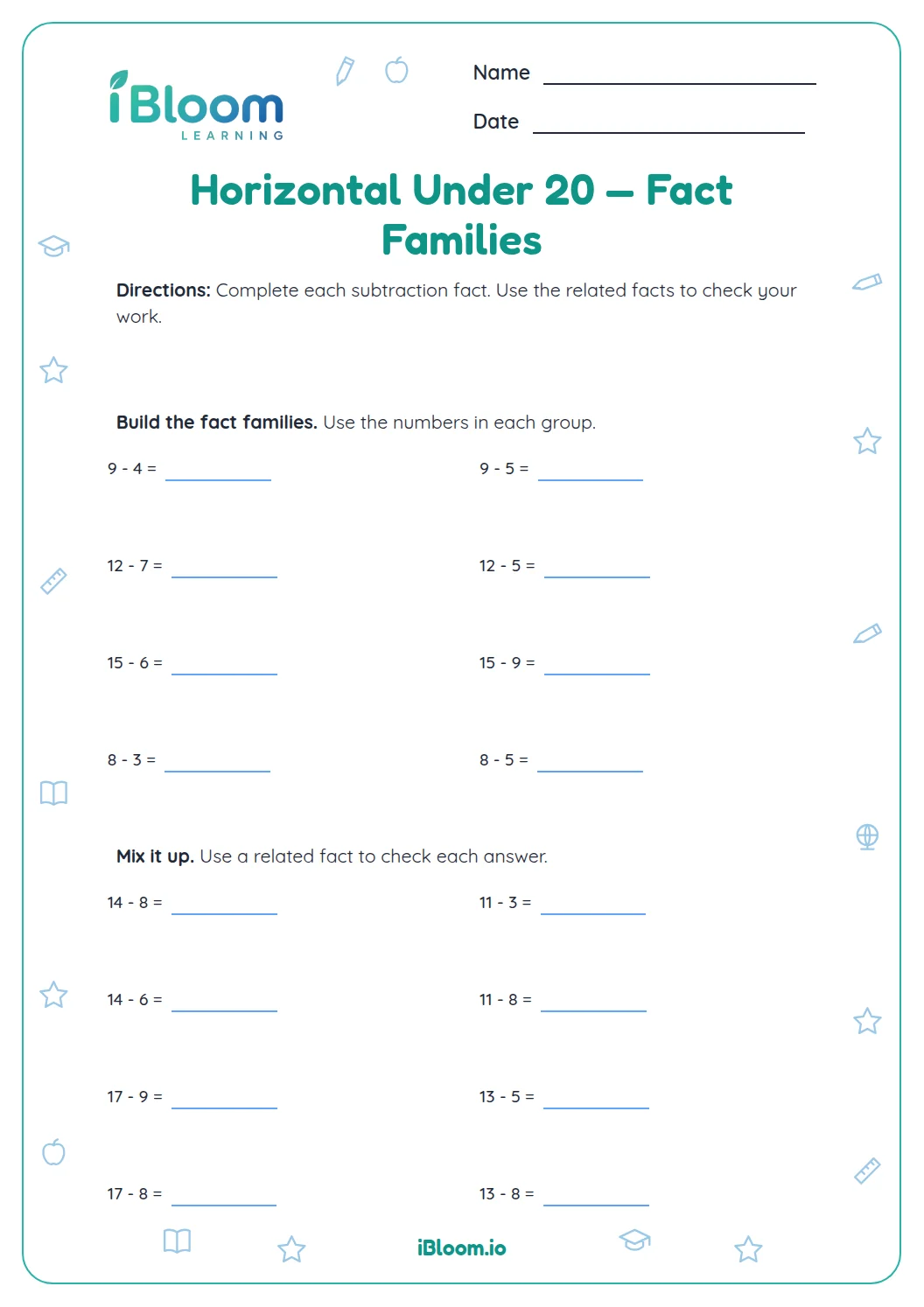
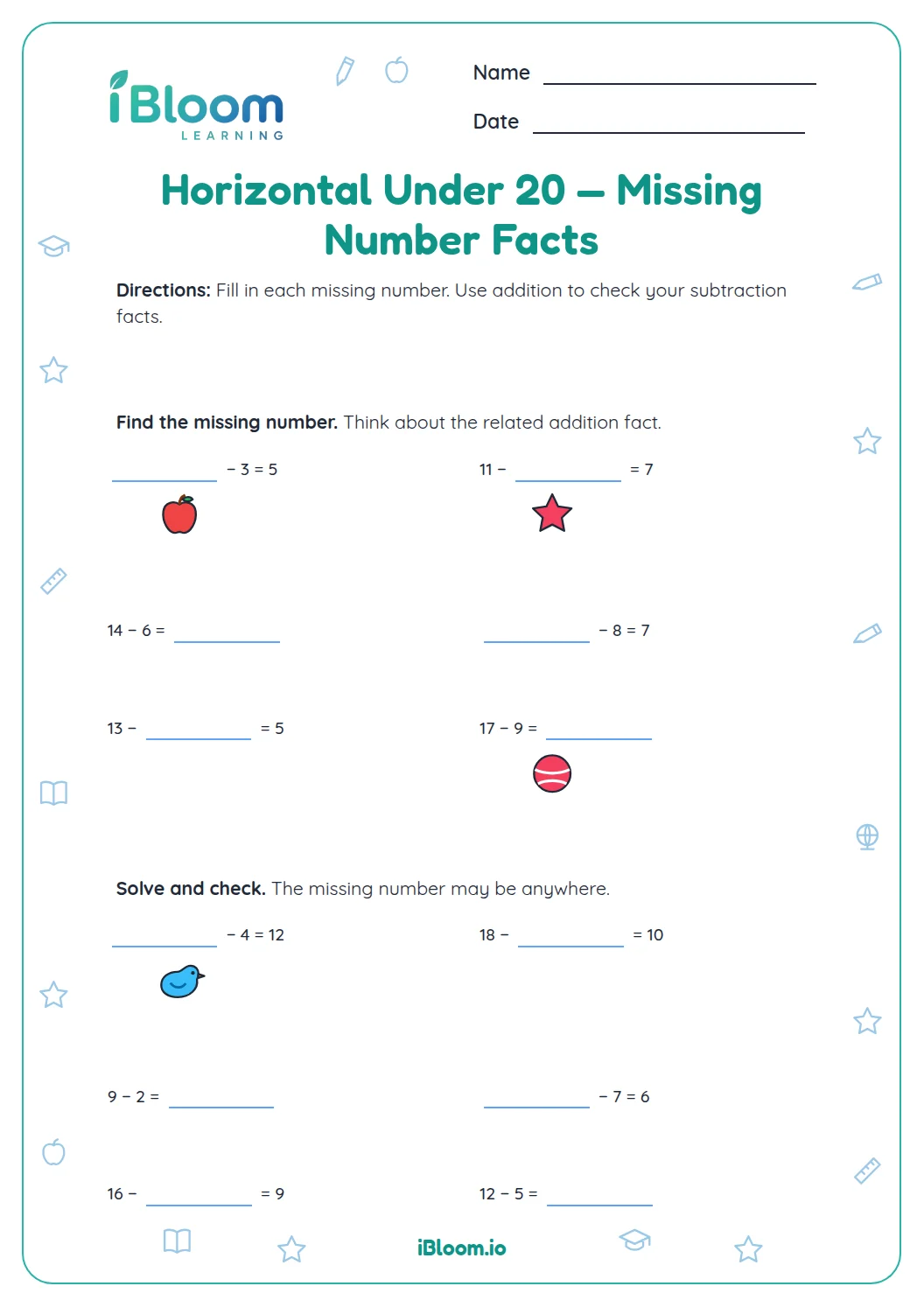
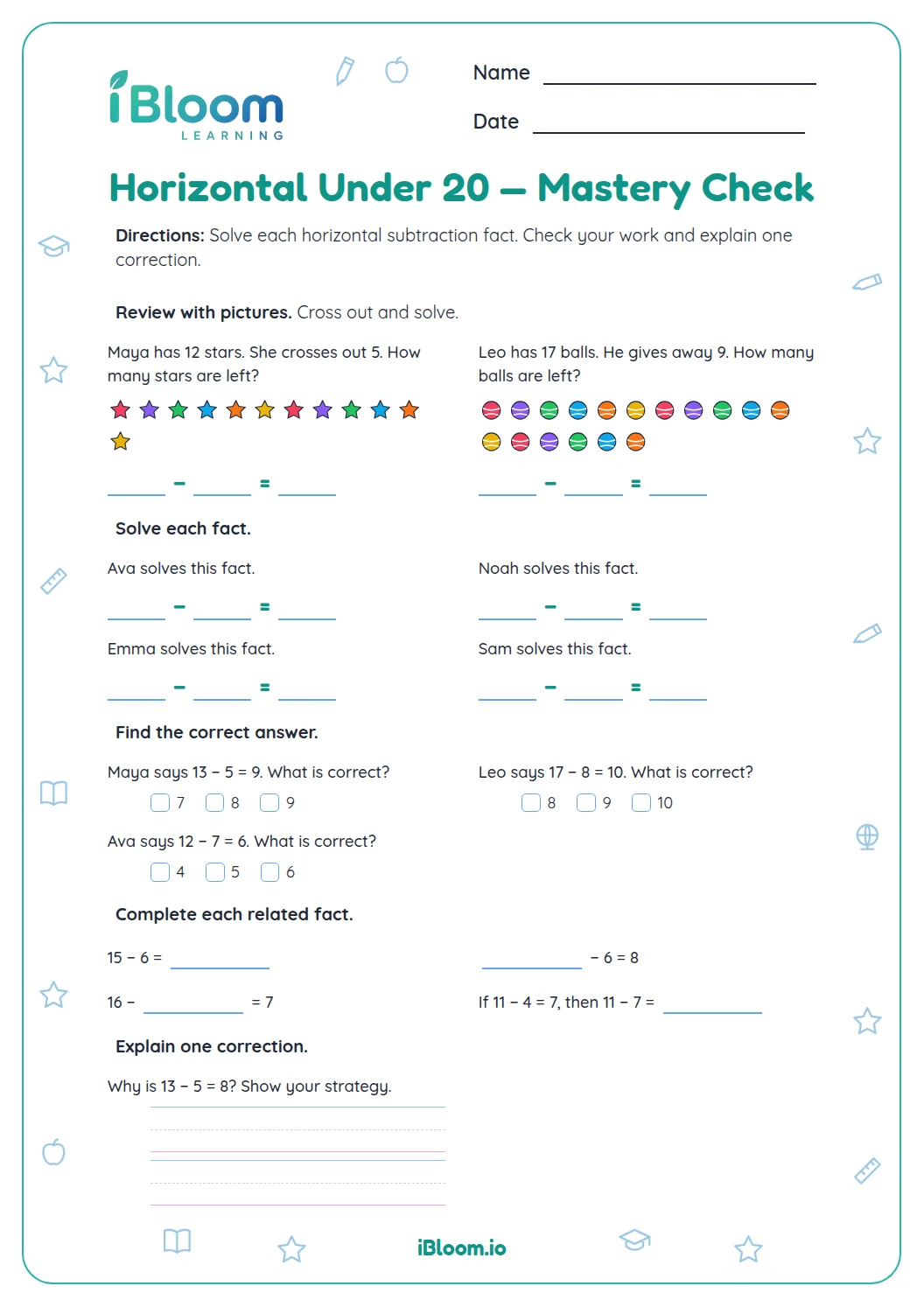
This mixed-order subtraction drill gives Grades 1–2 students 18 horizontal facts with minuends through 20. The set mixes familiar small differences, teen numbers, zero, and facts that can be checked with addition. Students write each missing difference, then use the answer key to review accuracy. The practice supports CCSS 2.OA.B.2: fluently add and subtract within 20 using mental strategies.
Aligned to 2.OA.B.2
How do you find a subtraction difference?
Think of subtraction as taking away or as finding the number that completes an addition fact. In 14 − 6, ask what number added to 6 makes 14.
- 114 − 6 = ___
- 26 + 8 = 14, so 14 − 6 = 8
How can addition check subtraction?
Add the difference to the number being subtracted. If the sum is the starting number, the subtraction fact checks: 14 − 6 = 8 because 8 + 6 = 14.
Why solve facts in mixed order?
A mixed set asks students to read the operation sign and choose a strategy for each fact, rather than repeat one pattern. Pause at each minus sign and keep the starting number in view.
How to use this worksheet
- 1Read the minuend and subtrahend in each equation.
- 2Choose a strategy: count back, use a known fact, or find the missing addend.
- 3Write only the difference in the blank.
- 4Check by adding the difference to the subtrahend.
- 5Review missed facts and solve them again without rushing.
Common mistakes and quick fixes
The mistake
Subtracting the larger number from the smaller because both are visible.
The fix
Start with the number before the minus sign and take away the second number.
The mistake
Writing the subtrahend as the answer.
The fix
Check whether the difference plus the subtrahend equals the minuend.
The mistake
Reading a minus sign as a plus sign in a fast drill.
The fix
Point to the operation sign before solving each fact.
Build fluency with addition and subtraction facts within 20.
On this sheet: The sheet practices subtraction facts with differences within 20.
Show the official wordingHide the official wording
Fluently add and subtract within 20 using mental strategies. By end of Grade 2, know from memory all sums of two one-digit numbers.
What to practice next
Make more practice
Further reading
Questions parents and teachers ask
What numbers appear in the facts?
The worksheet mixes minuends from 7 through 20, including zero and teen-number subtraction. Each problem uses a horizontal equation with one missing difference, so students can scan the mixed facts on the page. The mixed order encourages students to read each sign and choose a strategy for that fact.
How can a student check an answer?
Add the difference to the number being subtracted. The total should match the starting number, as in 14 − 6 = 8 and 8 + 6 = 14. This inverse operation makes a quick check for every answer.
Should students try to finish as fast as possible?
Accuracy comes first. Students can solve at a comfortable pace, check their work, and repeat the facts that need more practice. Timing is optional; there is no need to rush through unfamiliar facts. It is fine to pause between facts and check a challenging answer before continuing.
What can a child do when a fact feels hard?
Count back from the starting number or turn the subtraction into a missing-addend question. For 14 − 6, ask what number added to 6 makes 14. Thinking about the related addition fact can make the subtraction easier. This also provides a way to check the difference after solving.
How many subtraction facts are on the page?
There are 20 horizontal subtraction facts in mixed order. Nine ask students to write a missing difference, and 11 ask them to choose the difference from three options. Students can use the answer key after completing the page, or check each fact with addition.
What does “under 20” mean here?
Each starting number is 20 or less, and the facts use nonnegative whole-number differences. Students can solve each equation by counting back, using a related addition fact, or recalling a known subtraction fact. For example, 14 − 6 = 8 checks because 8 + 6 returns to 14.