






About this worksheet
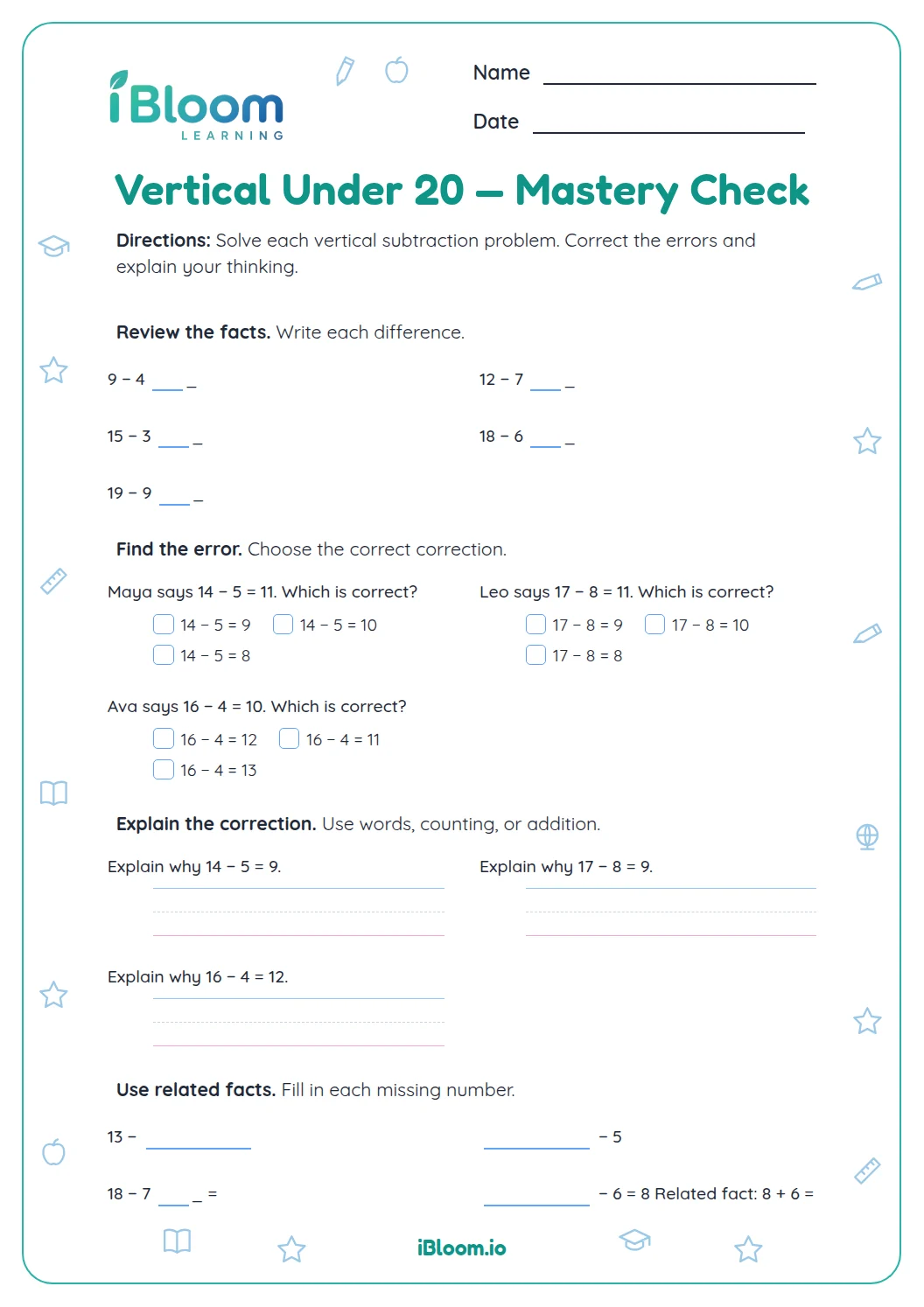
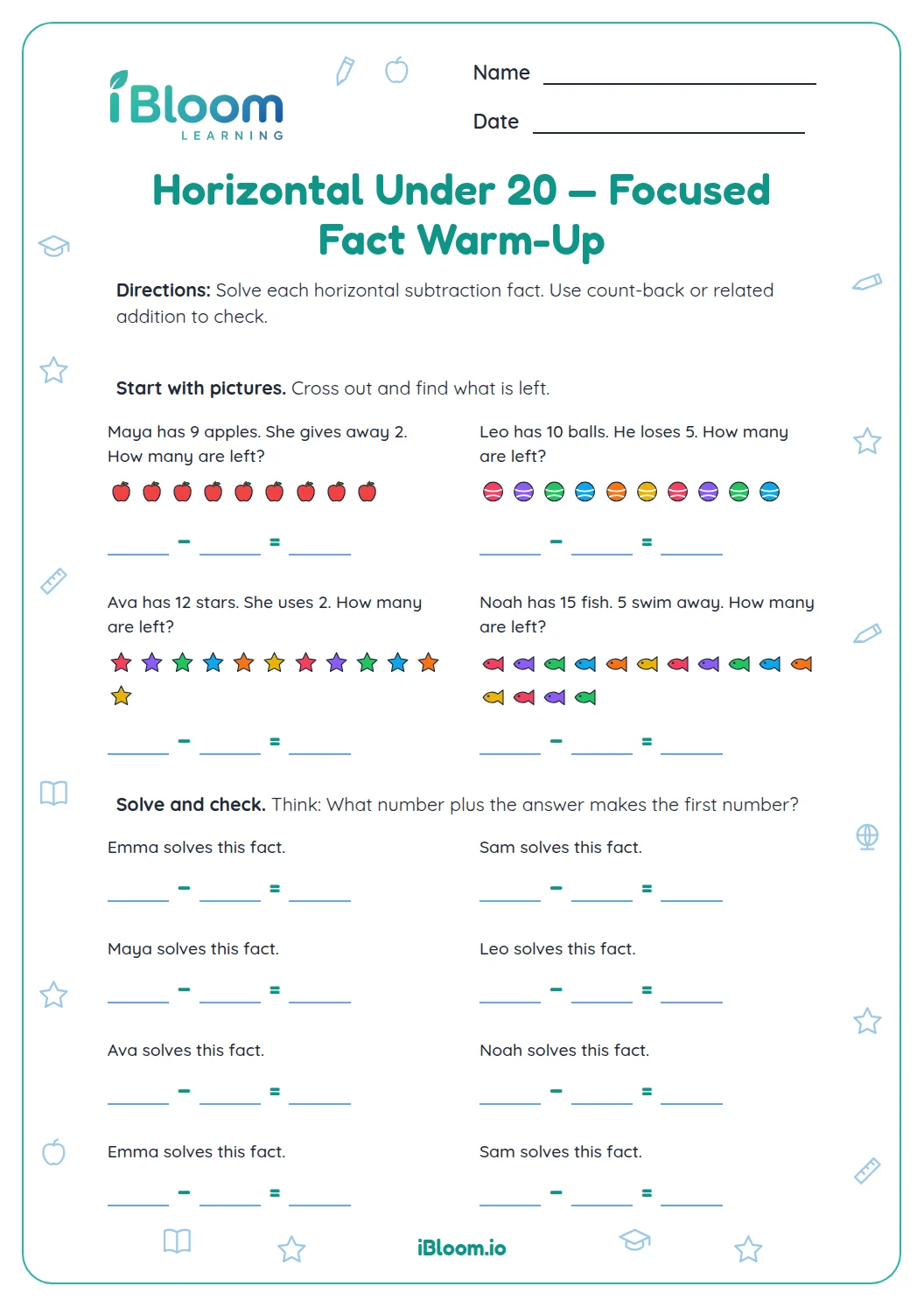
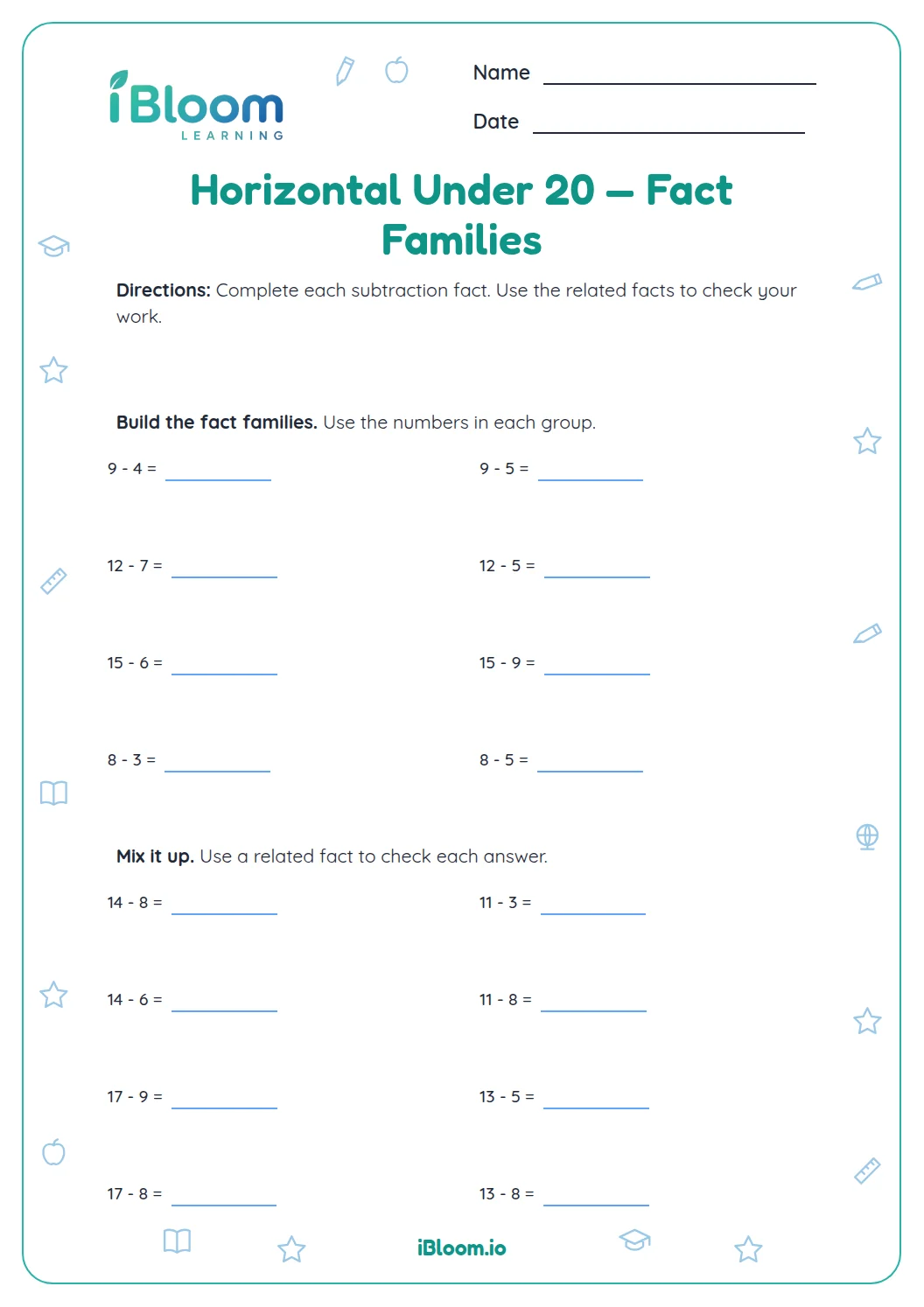
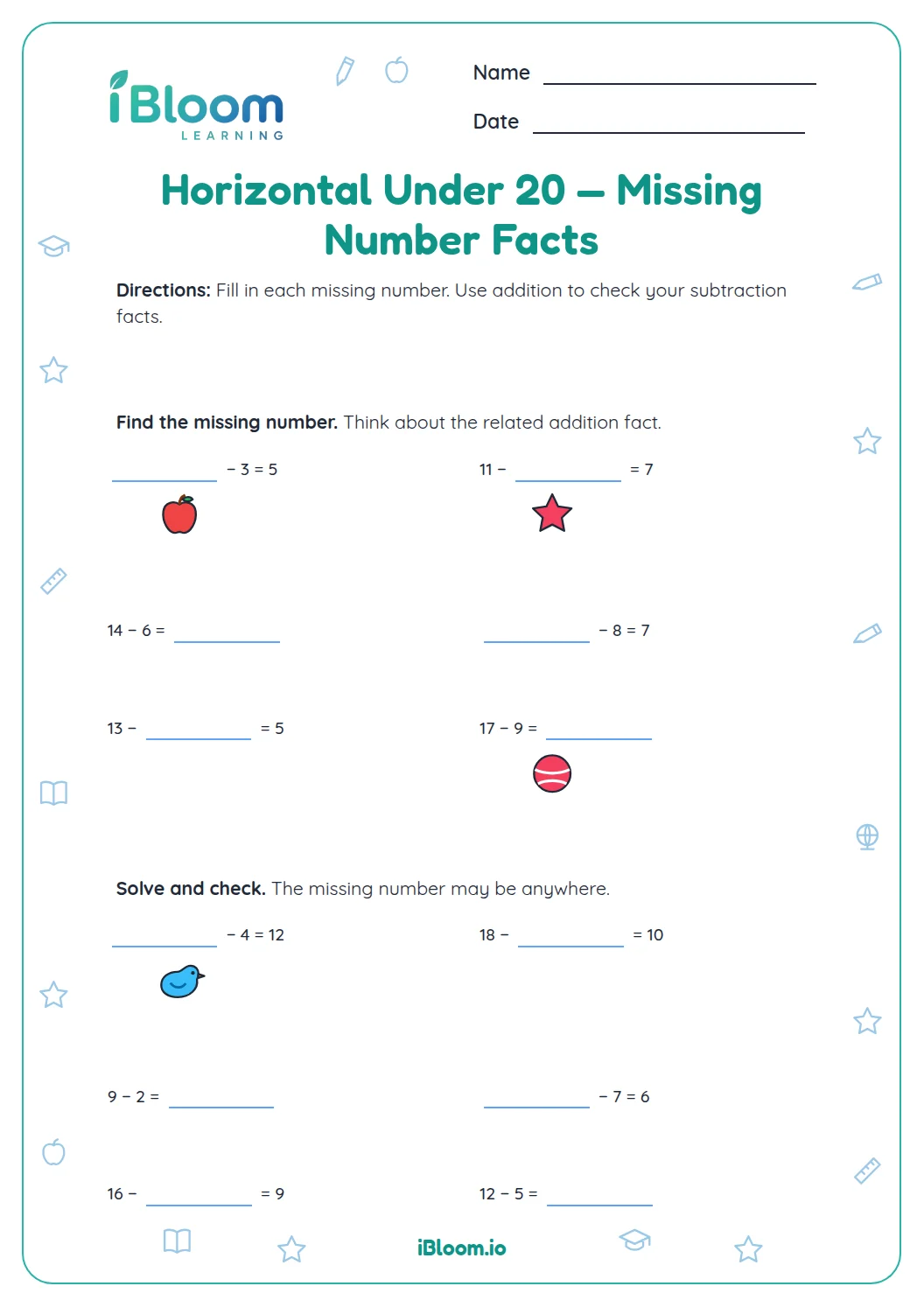
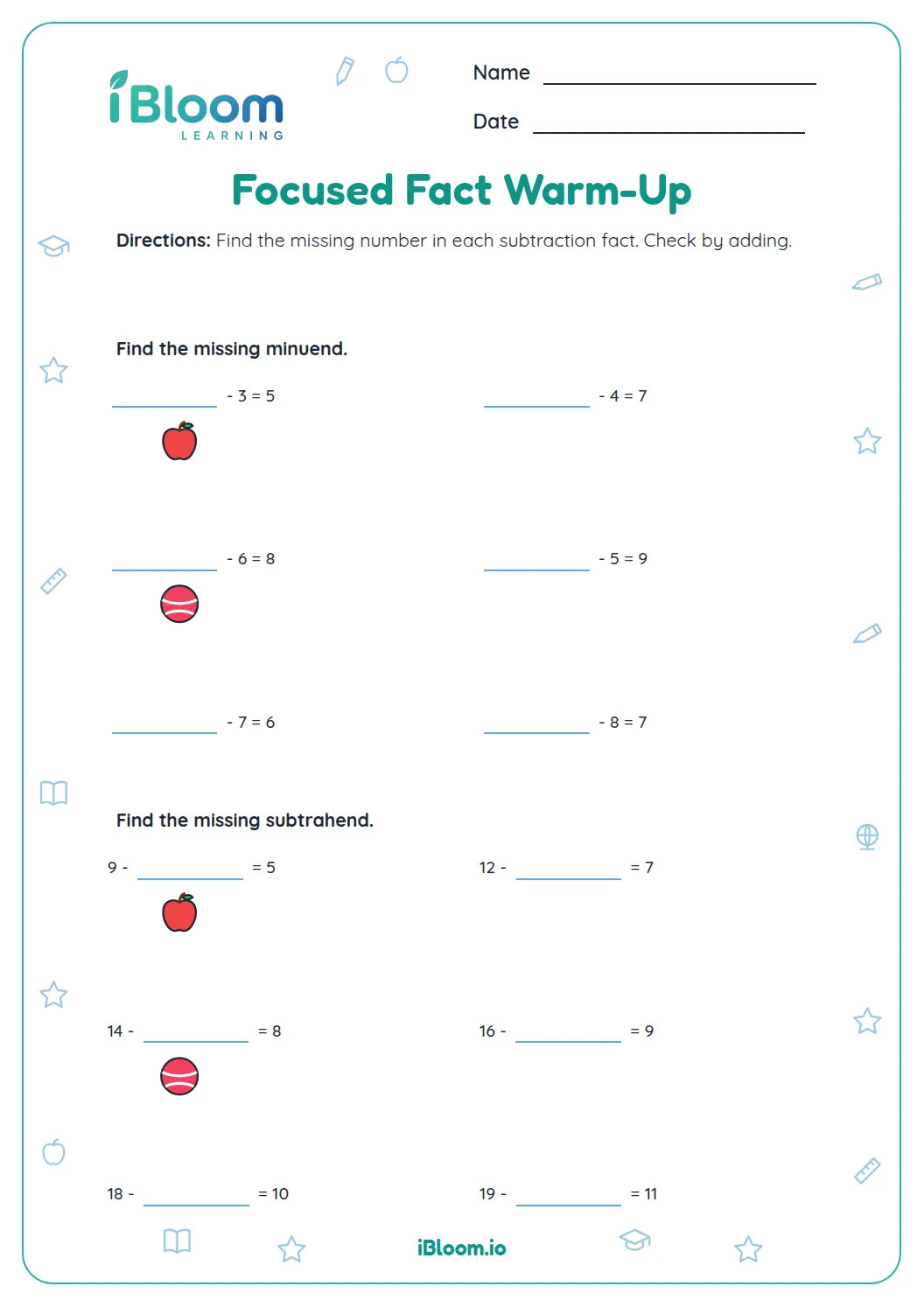
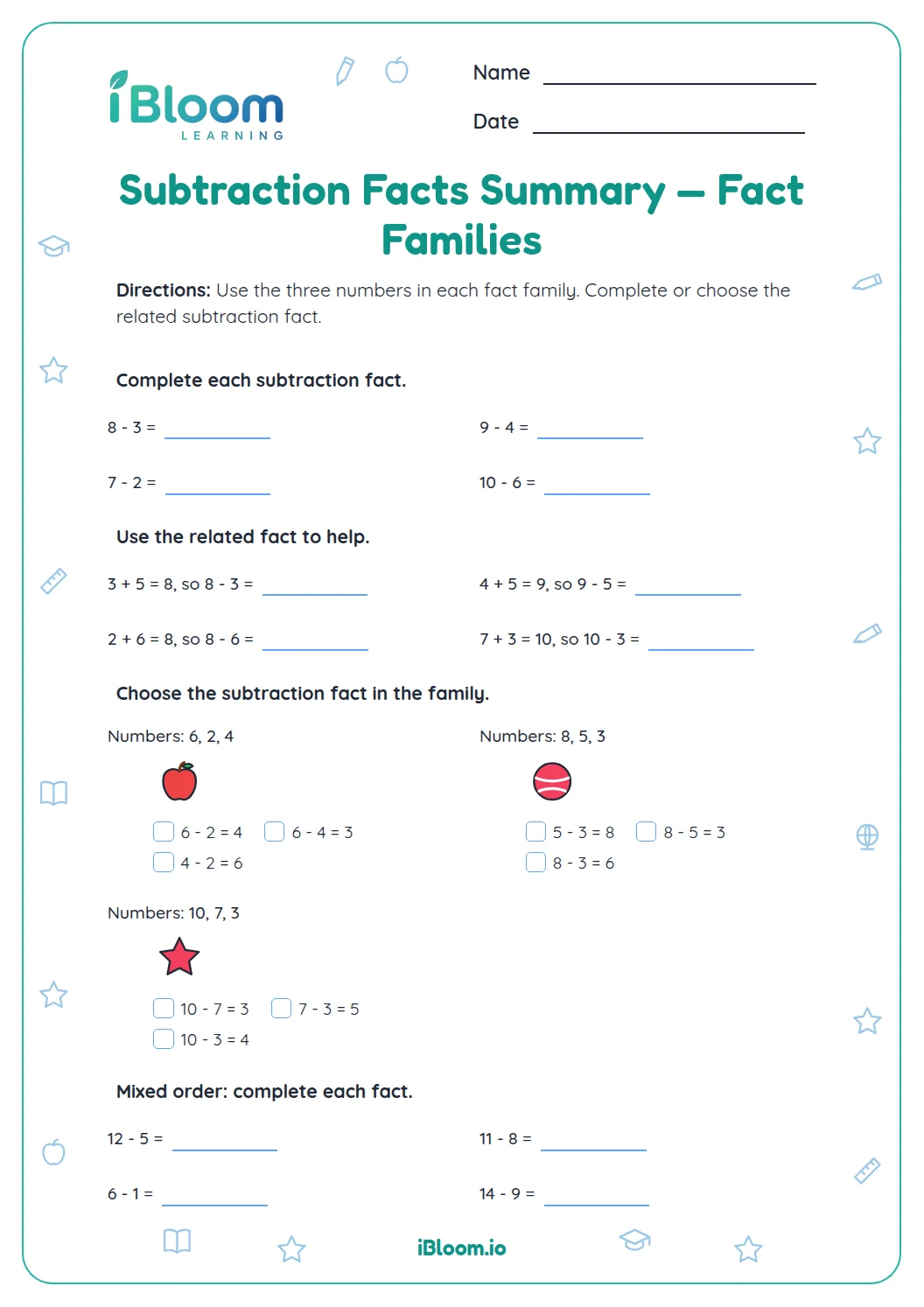
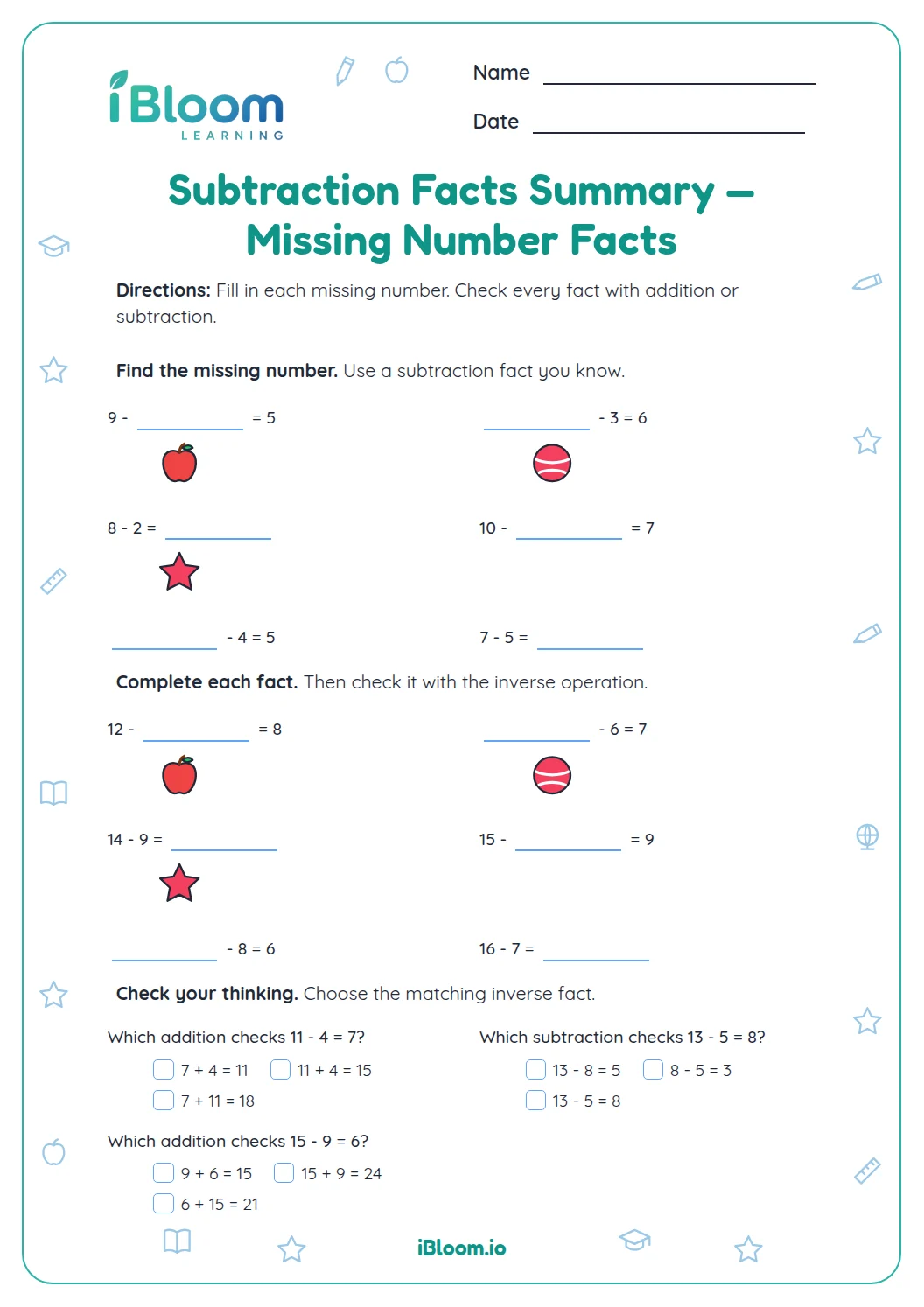
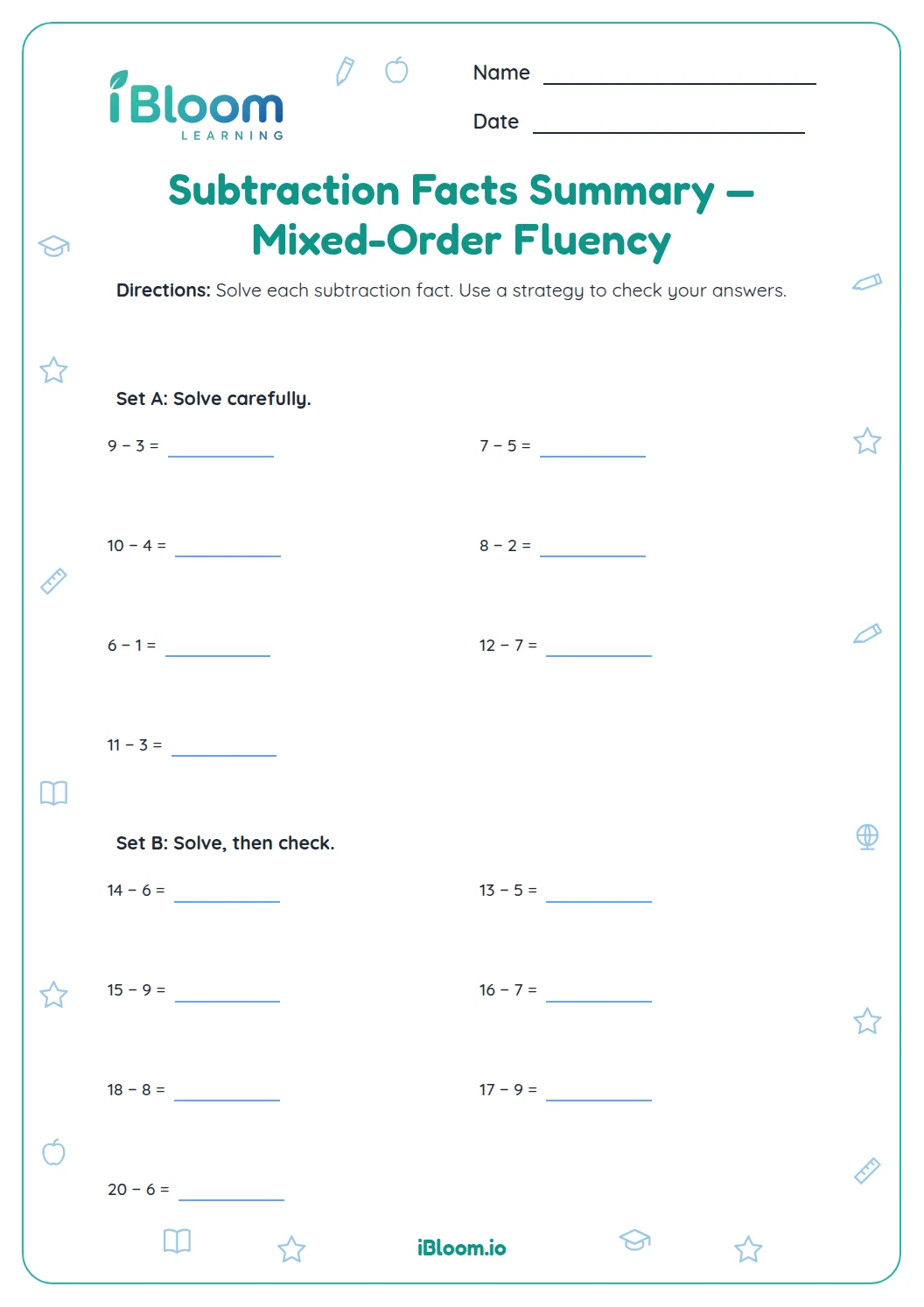
This free printable subtraction worksheet practices fact families with numbers up to 20. Each prompt gives a fact family and a vertical subtraction sentence with a missing difference. Students use the relationship between addition and subtraction to see how the three numbers fit together and can check each result by adding the parts. The separate answer key lists all 16 differences.
How does a fact family show subtraction?
The whole is made from two parts. If the family is 9, 4, and 5, then 9 − 4 = 5 because 4 and 5 make 9. The vertical format lines up the numbers for subtraction.
- 1Fact family: 9, 4, 5
- 2 9
- 3− 4
- 4___
- 54 + 5 = 9, so the missing number is 5
How can addition check a difference?
Add the number being subtracted and the difference. If their sum is the stated whole, the subtraction fact is correct. For example, 4 + 5 = 9 checks 9 − 4 = 5.
What number range does this page use?
All 16 prompts use whole numbers under 20. The order of the two parts varies, so students must use the family relationship instead of relying on a repeated pattern.
How can I use this worksheet?
- 1Read the three numbers in the fact family.
- 2Identify the whole and the part already subtracted.
- 3Find the other part that completes the whole.
- 4Write the missing difference.
- 5Add the two parts to check that they equal the whole.
Common mistakes and quick fixes
The mistake
Subtracting the smaller part from the wrong number.
The fix
Use the largest number in the family as the whole.
The mistake
Repeating the given part as the answer.
The fix
Add both parts and check that together they make the whole.
The mistake
Forgetting that subtraction can be checked with addition.
The fix
Add the subtracted part and your difference to see whether they equal the whole.
What to practice next
Make more practice
Further reading
Questions parents and teachers ask
What is a subtraction fact family?
A fact family is a group of three numbers connected by addition and subtraction. For 9, 4, and 5, the parts 4 and 5 make the whole 9, so 9 − 4 = 5. The worksheet uses that relationship to find missing differences.
How do I find the missing difference?
Treat the largest number as the whole, then identify the part already being subtracted. The difference is the other part. In 12 − 7, the missing part is 5 because 7 + 5 = 12; addition checks the family.
Are all the facts under 20?
Yes. Every prompt uses a whole number from 6 through 20 and asks for a subtraction difference using numbers under 20. The answer key lists each missing number, and each fact can be checked by adding its two parts.
Why check subtraction with addition?
Addition checks whether the two parts rebuild the whole. If the subtracted number plus the difference equals the starting whole, the subtraction answer fits the fact family. For example, 7 + 5 = 12 checks 12 − 7 = 5.
Is the worksheet arranged vertically?
Yes. Each prompt prints a subtraction fact vertically, alongside its three-number fact family. Students find the missing difference and check it by adding the two parts to recover the whole. The format keeps place values aligned for clear subtraction practice.
Does the page include a key?
Yes. A separate answer-key page gives all 16 missing differences. Students can also check each response by adding the given part and the answer to see whether they make the whole. This provides a quick, reliable check for each family.