




About this worksheet
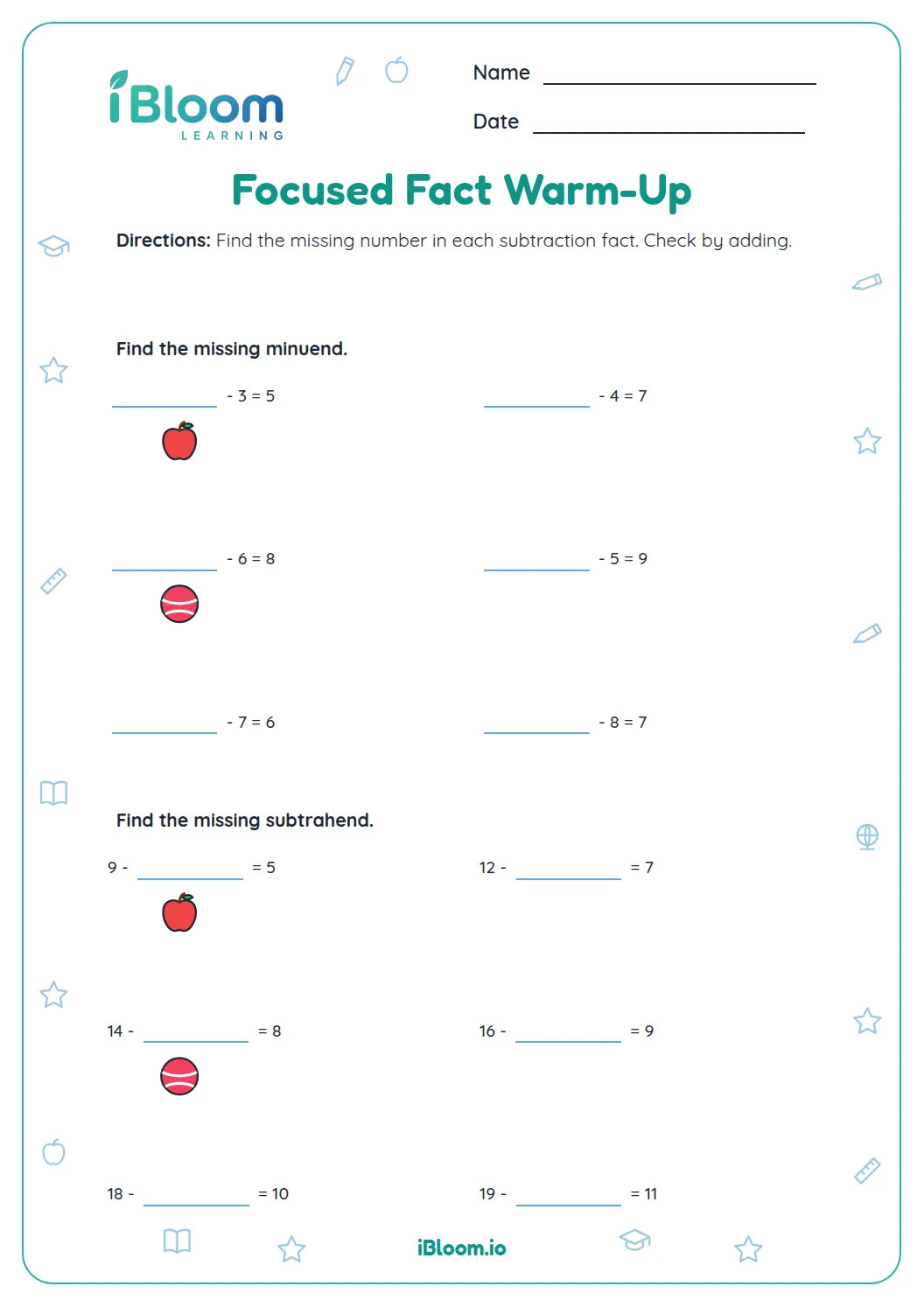
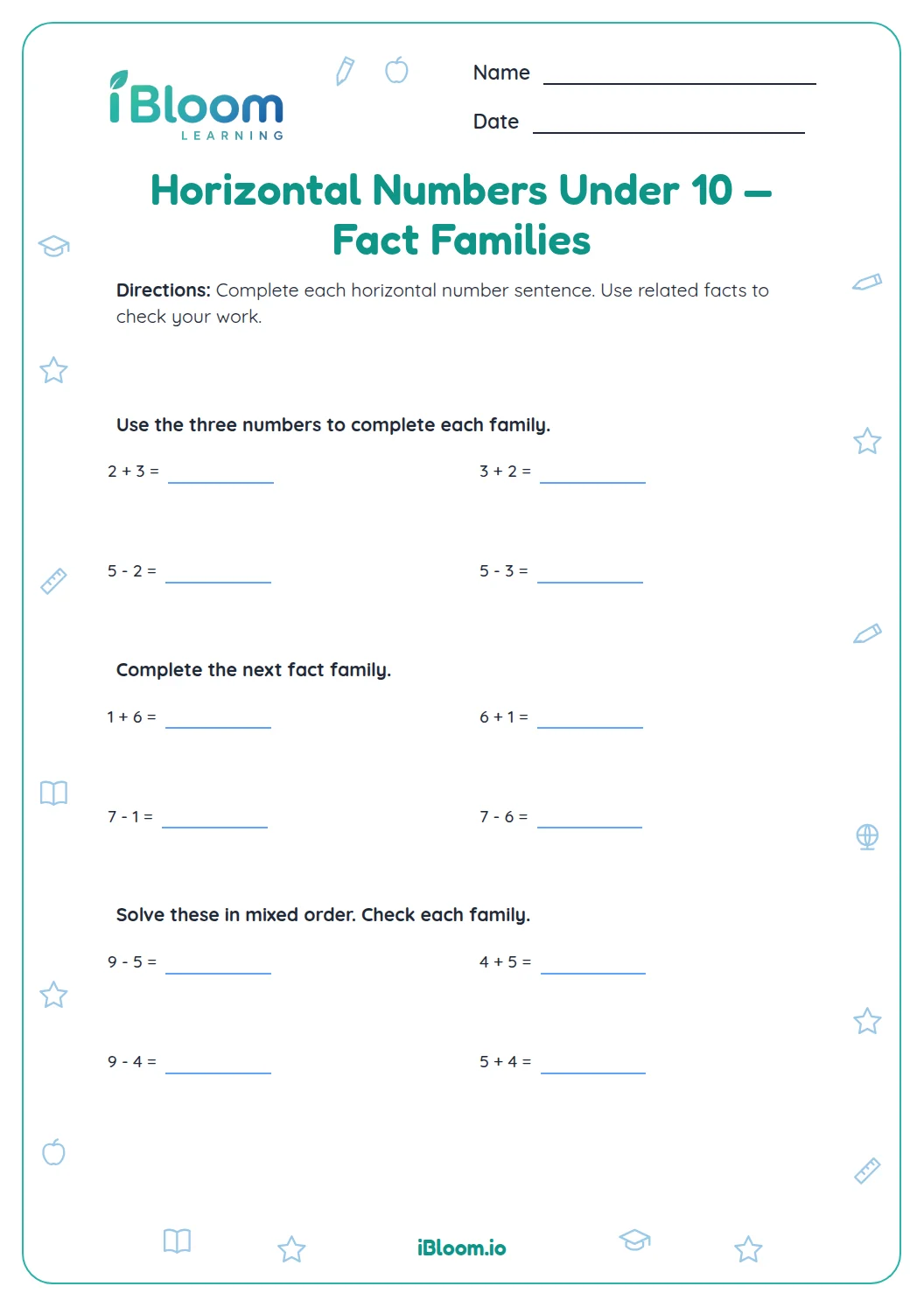
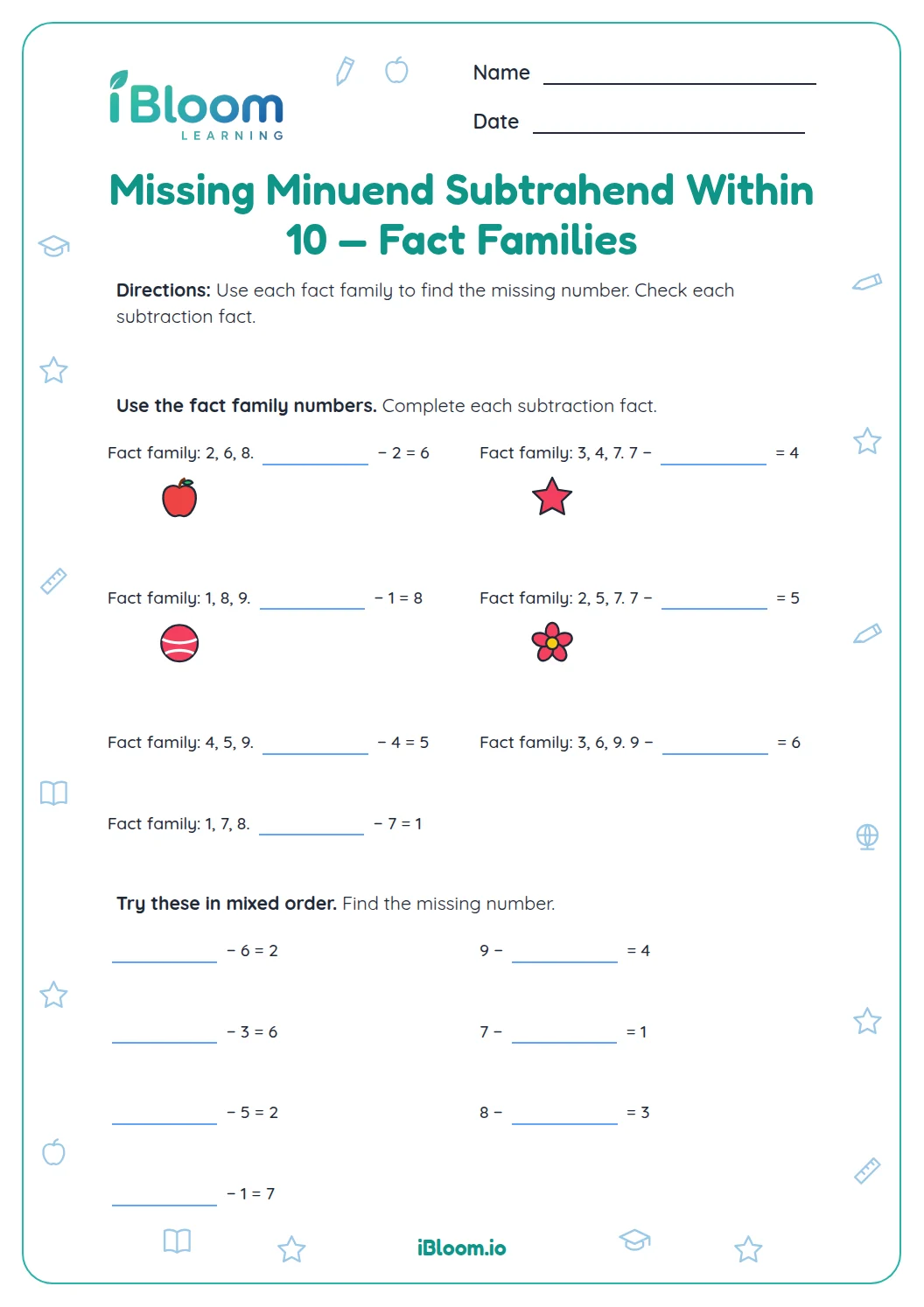
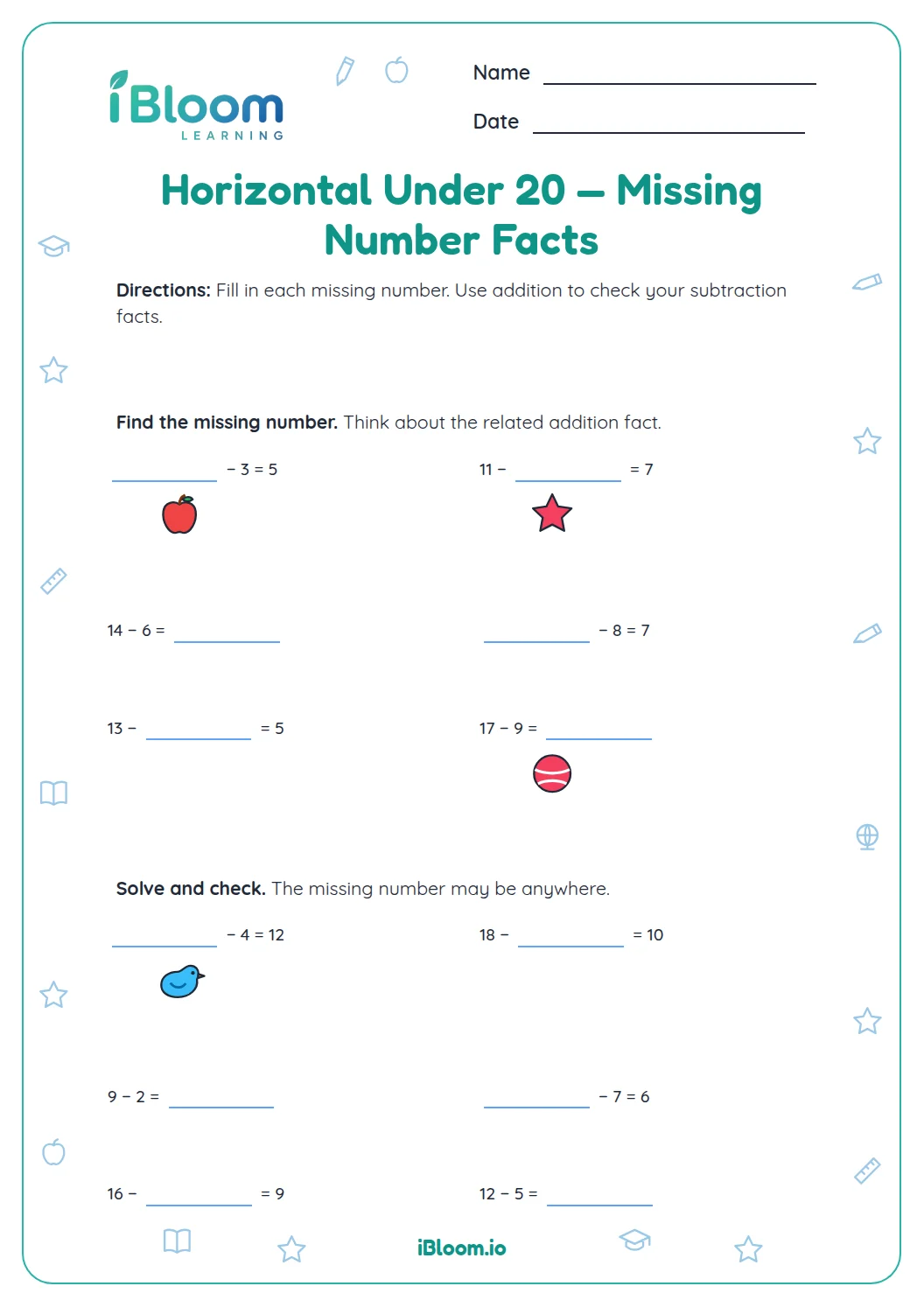
This free printable drill gives children in Grades 1–2 twenty-four subtraction facts with the blank in two different positions. Part A hides the starting number, Part B hides the amount taken away, and Part C mixes both forms. All numbers stay from 0 through 19. The sheet practices Common Core 1.OA.D.8 by asking children to determine the unknown number that makes an equation true. A separate answer key supplies every missing number. Use the first two parts to establish a strategy, then let the mixed section show whether the child checks the blank’s position.
Aligned to 1.OA.D.8
What do minuend and subtrahend mean?
The minuend is the starting number. The subtrahend is the number taken away. In 14 − 6 = 8, 14 is the minuend and 6 is the subtrahend. Children can use the simpler phrases “start” and “take away” as they work.
Part A has six missing starts. Part B has six missing take-away amounts. Part C has eight mixed items, including subtracting zero, subtracting equal numbers, and finding a missing start when zero is taken away.
How do you find a missing starting number?
Join the amount taken away to the amount left. That reconstructs the original total. In question 1, five are taken away and four remain, so the starting amount must contain both groups.
- 1Question 1: ___ − 5 = 4
- 25 + 4 = 9
- 3Write 9 in the blank.
- 4Check: 9 − 5 = 4.
How do you find a missing amount taken away?
Use the starting number and the amount left to find the difference between them. For 10 − ___ = 3 in question 7, 10 − 3 = 7 tells how many were removed. Check by adding 7 and 3 to get 10.
In Part C, avoid settling into one operation for every blank. Ask what the blank stands for each time, then substitute the answer into the original subtraction sentence.
How to use this worksheet
- 1Name the start, take-away amount, and result in a complete subtraction fact.
- 2Solve question 1 by adding the known parts.
- 3Complete Part A, checking each answer in its subtraction sentence.
- 4For Part B, subtract the result from the starting number.
- 5In Part C, name the missing part before solving, then check all answers with the key.
Mistakes to discuss and fix
The mistake
Subtracting 5 − 4 for ___ − 5 = 4.
The fix
The blank is the start: combine 5 taken away and 4 left to get 9.
The mistake
Adding 10 + 3 for 10 − ___ = 3.
The fix
The start is already 10. Find the removed part with 10 − 3 = 7.
The mistake
Avoiding zero as an answer in 18 − ___ = 18.
The fix
Taking away zero leaves the starting amount unchanged.
Common Core alignment
Find an unknown starting number or amount taken away in subtraction facts.
On this sheet: Each of the twenty equations has one missing whole number within 19.
Show the official wordingHide the official wording
Determine the unknown whole number in an addition or subtraction equation relating three whole numbers. For example, determine the unknown number that makes the equation true in each of the equations 8 + ? = 11, 5 = _ - 3, 6 + 6 = _.
What to practice next
Make more practice
Further reading
Questions parents and teachers ask
Which numbers stay within 19?
Every starting number, amount taken away, result, and missing answer is a whole number from 0 through 19. The problems include smaller facts first and larger facts later. This keeps the number range consistent while changing which part of the subtraction sentence children must find.
Why are there two separate parts before the mixed facts?
The first two parts isolate the two blank positions so children can establish a useful strategy for each. Part A rebuilds the starting total, and Part B finds the removed amount. Part C then asks children to notice the blank’s position without relying on the section heading.
Can children use counters to solve these facts?
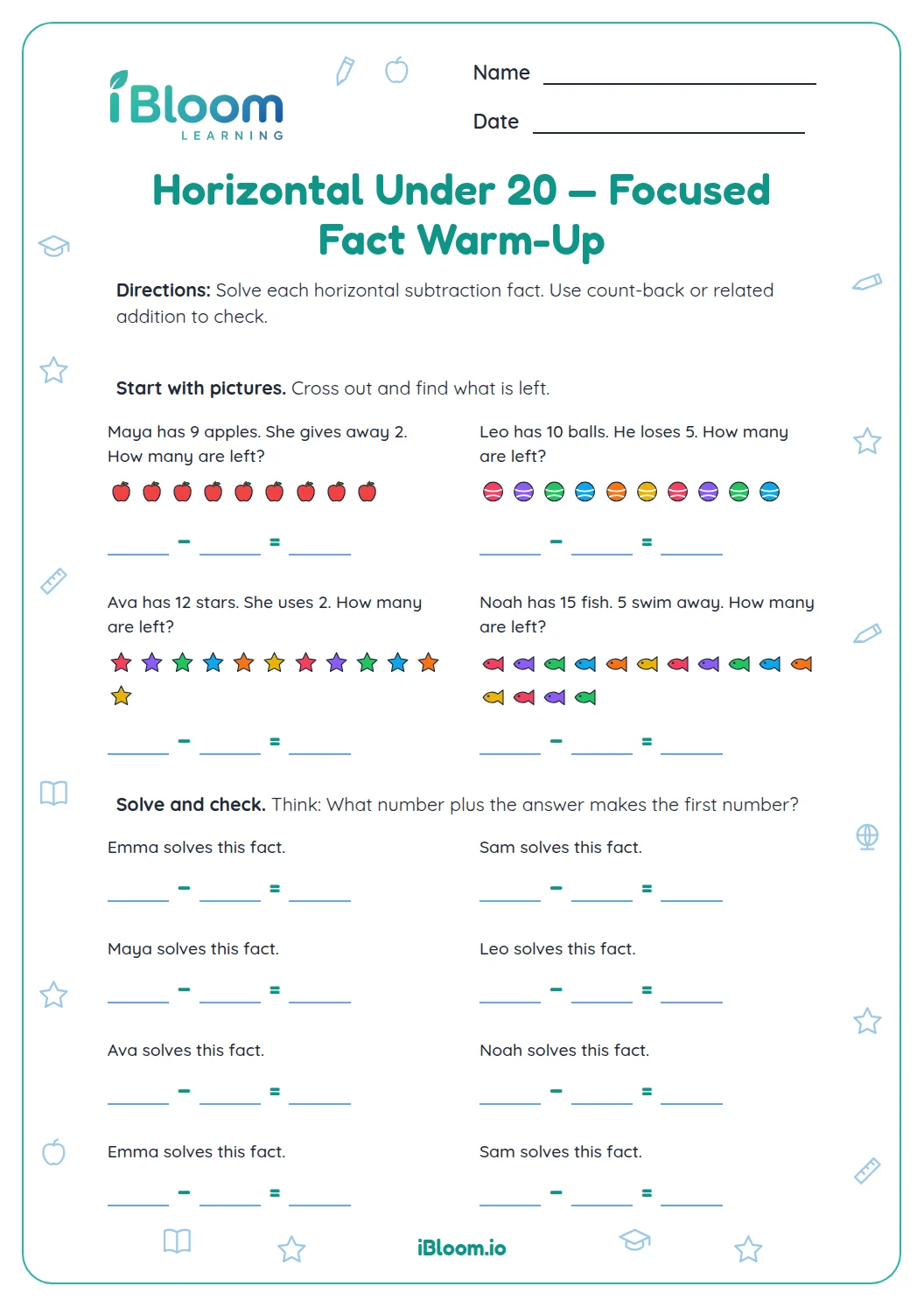
Yes, counters can make the missing part concrete. For a missing start, put together counters for the removed amount and the amount left. For a missing takeaway, begin with the given total and remove counters until the stated result remains. Then connect that action to the written equation.
Does this worksheet need a timer?
No, children can complete the twenty facts without a timer. Begin by watching how they identify the missing part and check a solution. When the answers are accurate, another short practice session can focus on smoother recall. The suggested time is a planning estimate, not a score target.
What does the answer key show?
The key fills in the missing number for every equation. To review a mismatch, read the completed subtraction sentence aloud and check whether it is true. Ask the child to explain the blank’s role before trying again, especially when moving from one section to the mixed facts.