





About this worksheet
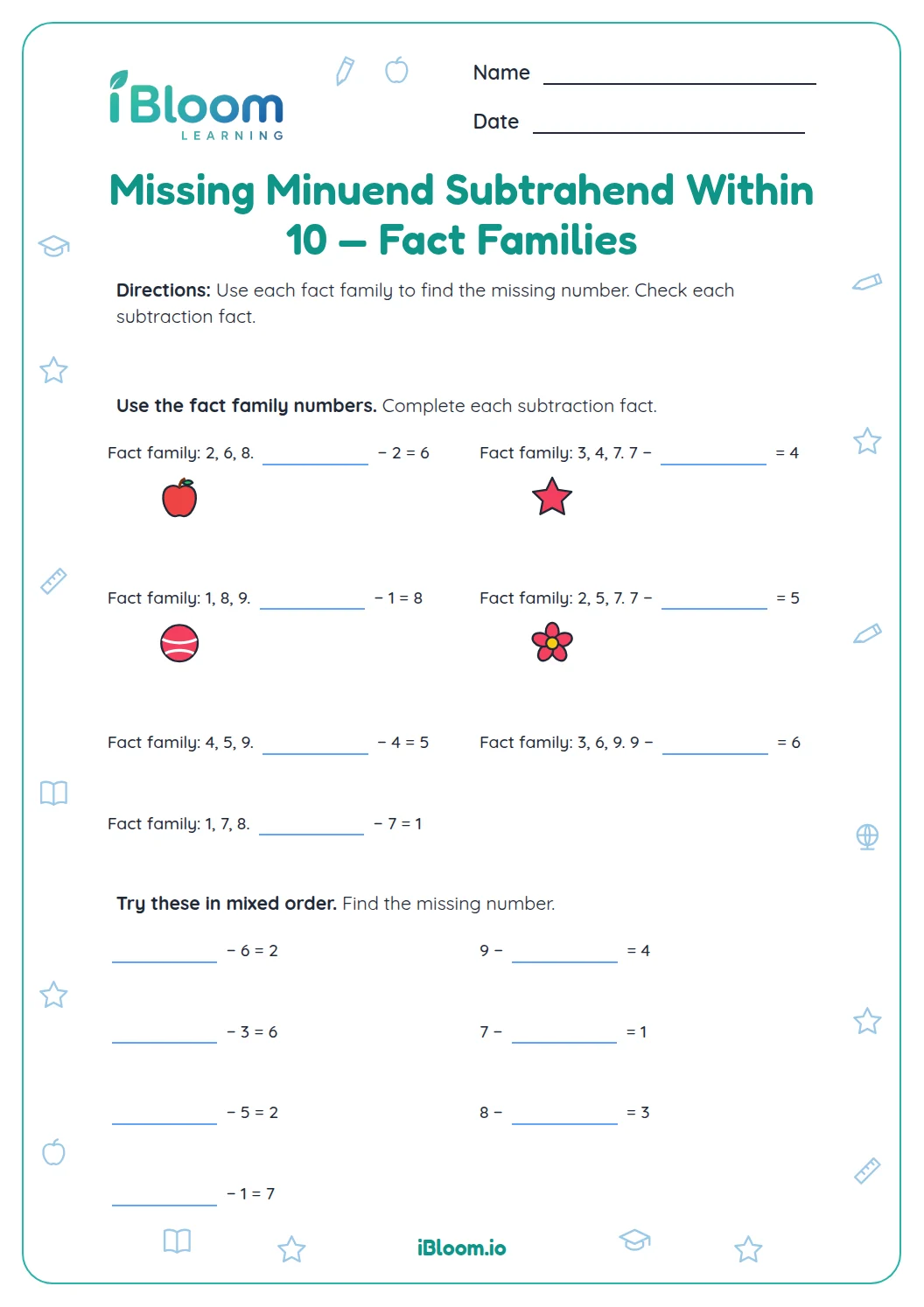
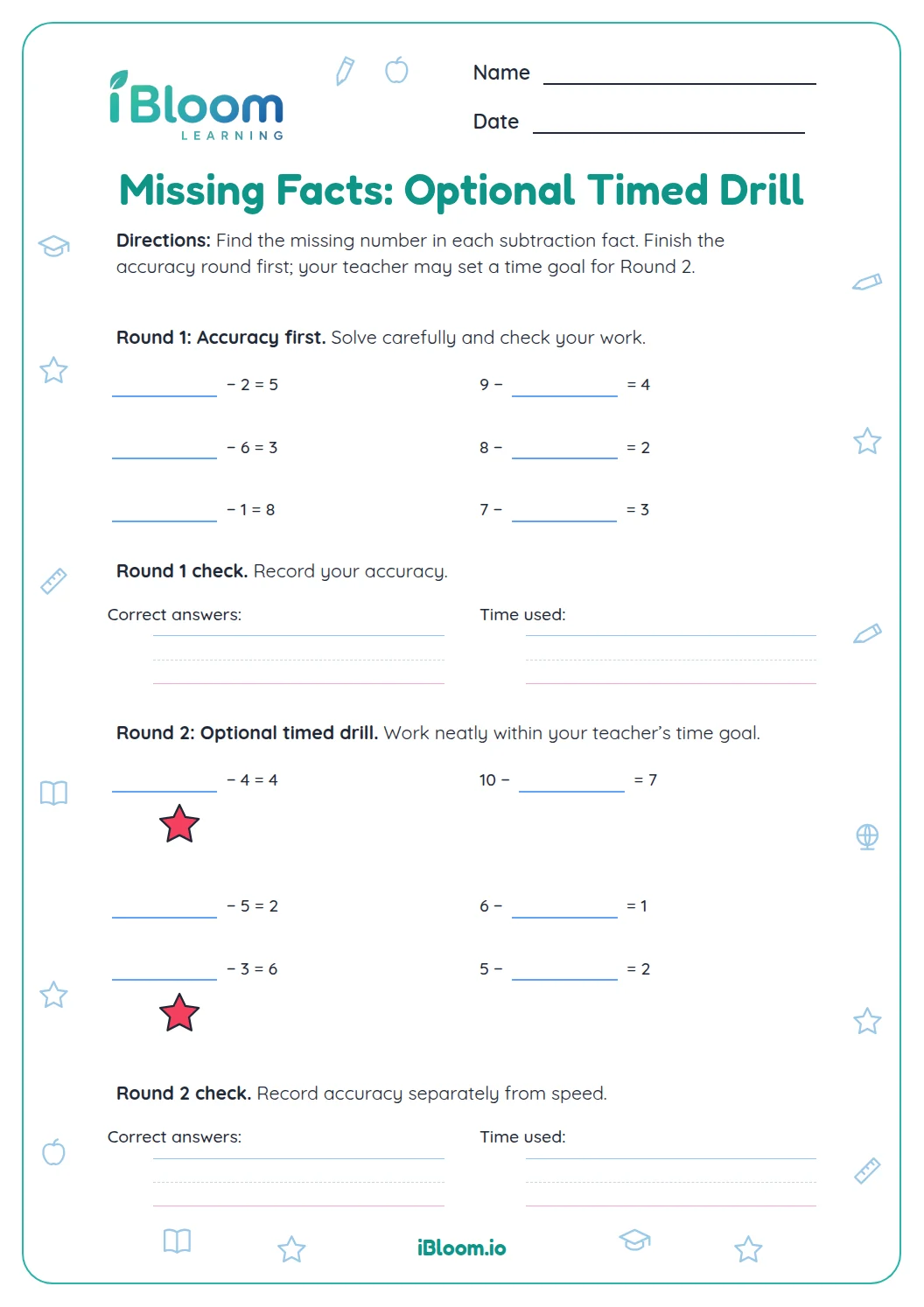
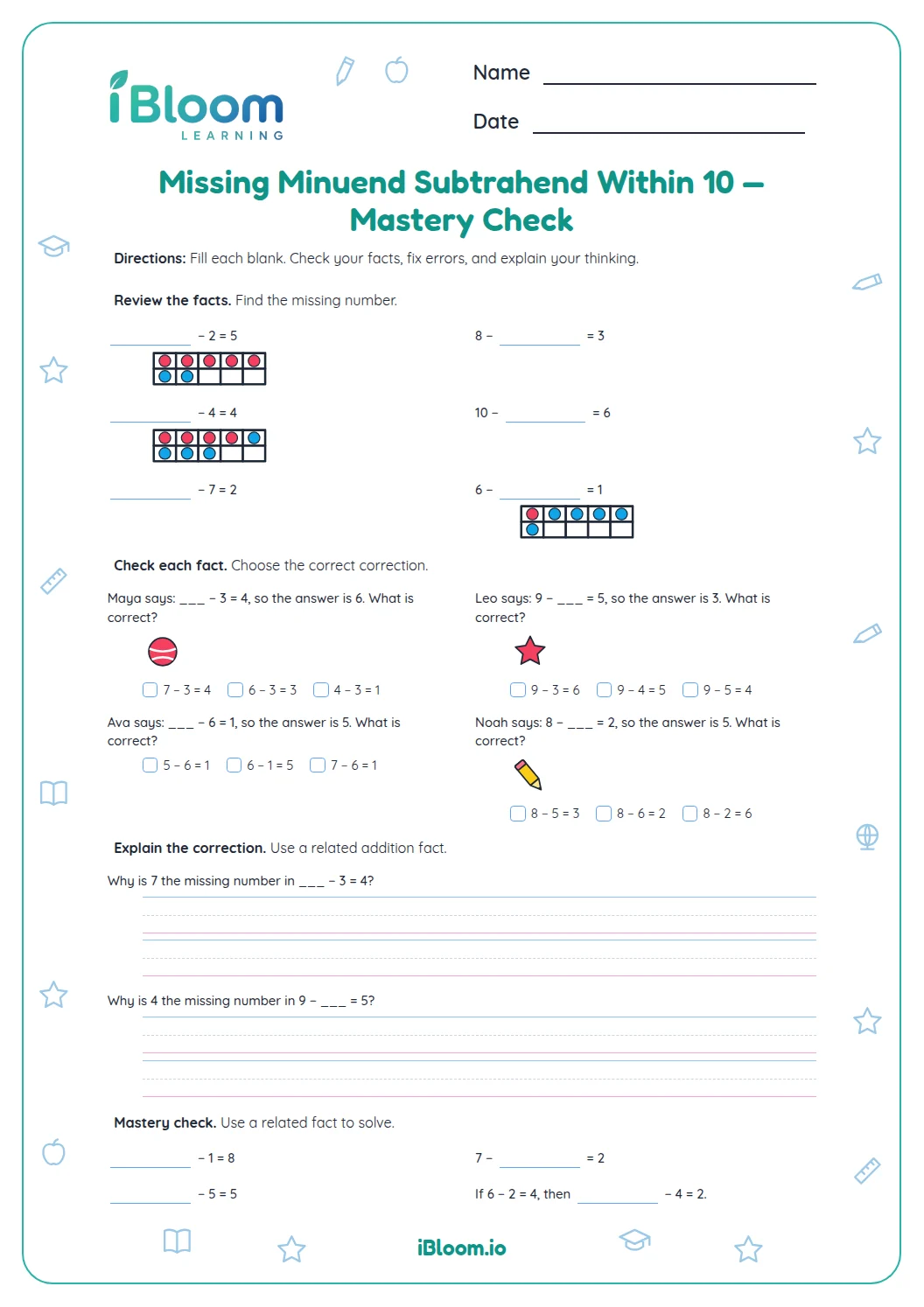
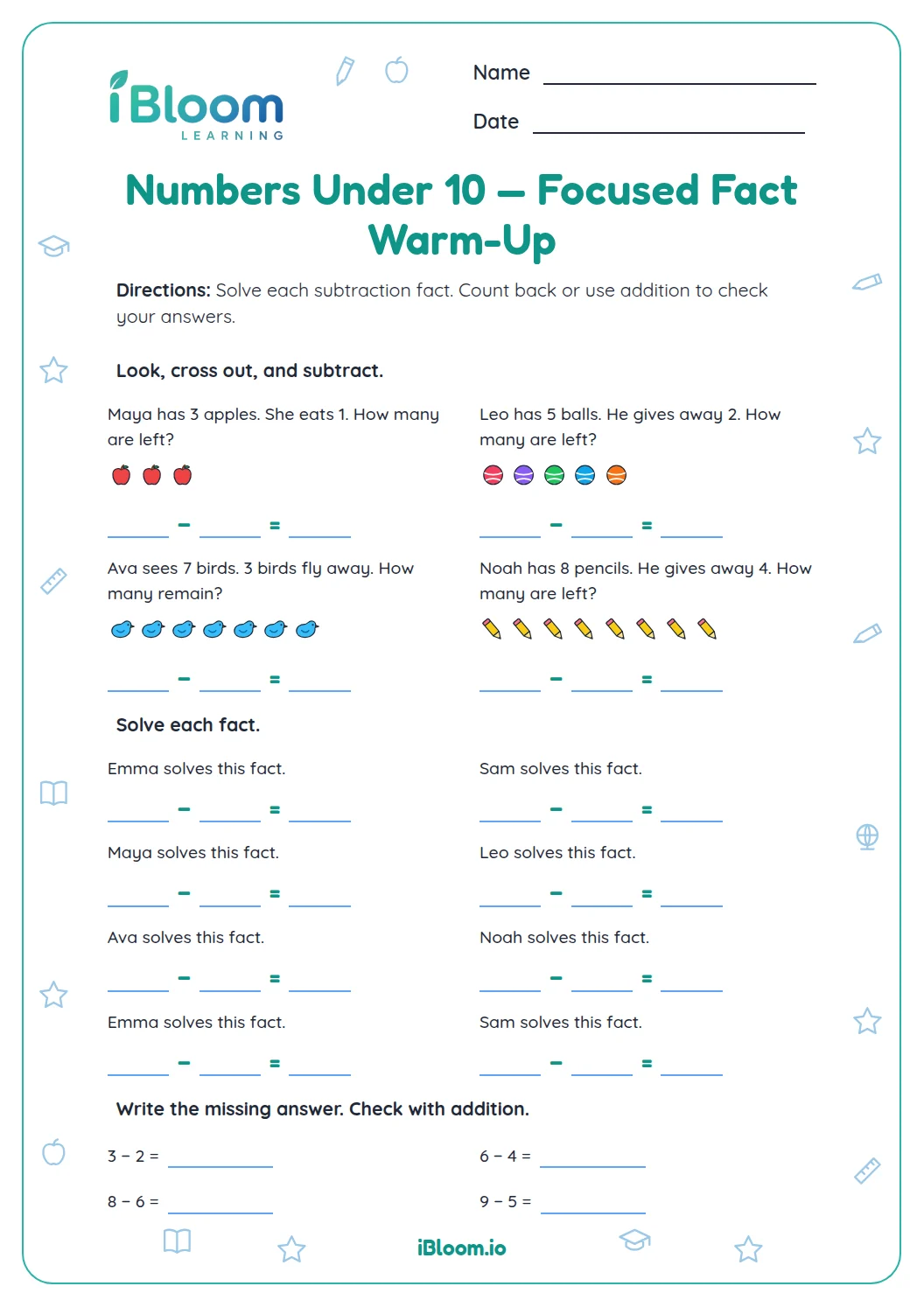
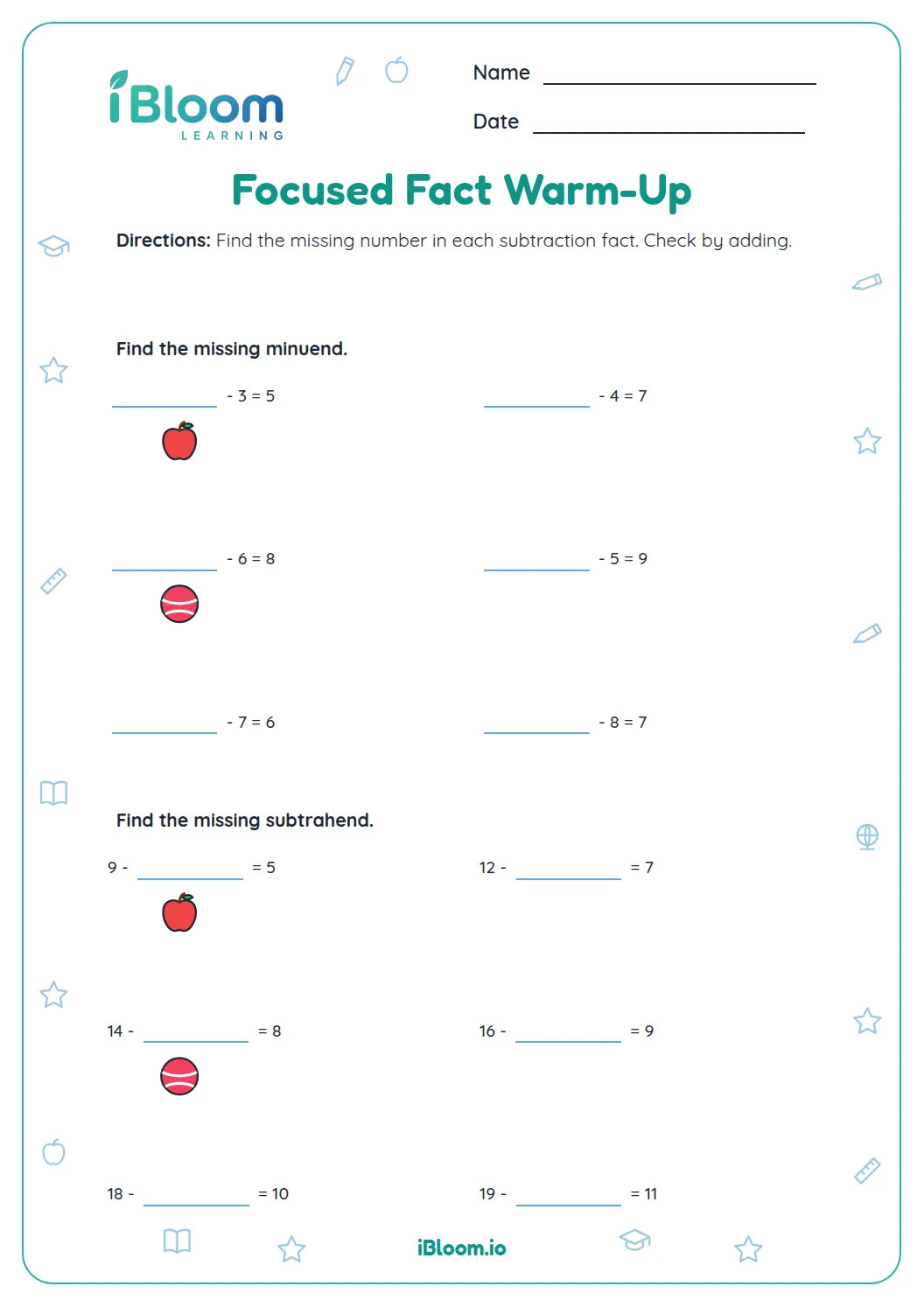
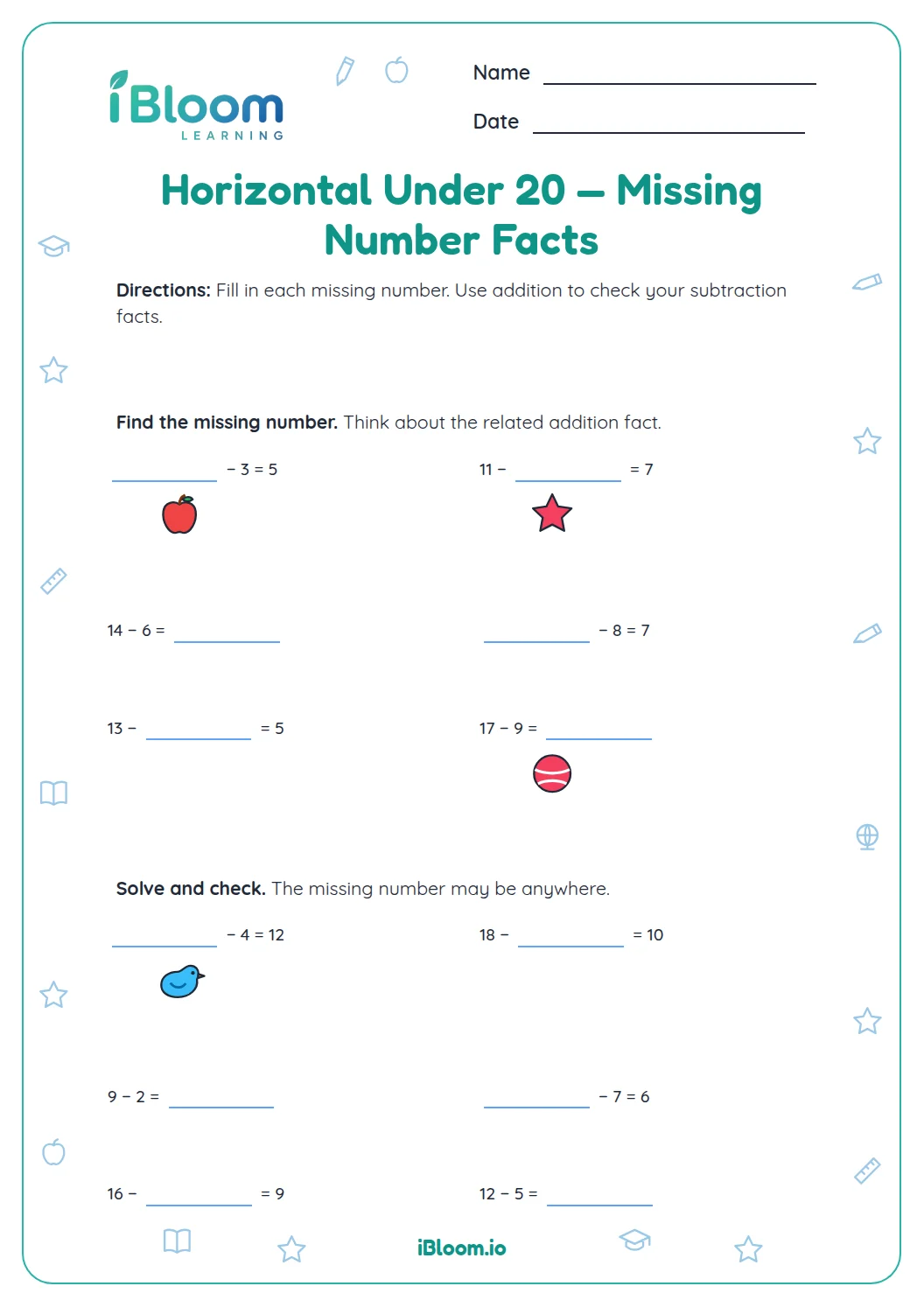
This Grade 1 subtraction worksheet has 20 questions about missing numbers in subtraction equations. The first eight find a missing minuend, the next eight find a missing subtrahend, and the last four apply the same unknown-number thinking to short stories. Students can check each answer with addition. An answer key is included, and the equation work practices CCSS 1.OA.D.8.
Aligned to 1.OA.D.8
How do you find a missing minuend?
The minuend is the number being subtracted from. If it is missing, add the subtrahend and the difference to find it. For ___ − 2 = 3, add 2 + 3 to get 5.
Question 1 is 5 − 2 = 3. Check by adding 3 + 2; the sum matches the missing starting number.
- 1___ − 2 = 3
- 23 + 2 = 5, so the missing minuend is 5.
How do you find a missing subtrahend?
The subtrahend is the number taken away. When it is missing, subtract the difference from the starting number. For 7 − ___ = 5, compute 7 − 5 to find 2.
Check by placing 2 in the blank: 7 − 2 = 5.
How do story problems use missing numbers?
Find the starting amount, amount taken away, and amount left in the story. Then write or imagine a subtraction equation with the unknown in the right place.
In question 17, Nia gave away 3 shells and had 5 left. Add 3 + 5 to find that she started with 8 shells.
How to solve each fact
- 1Read the equation and identify the empty place.
- 2For a missing minuend, add the subtrahend and the difference.
- 3For a missing subtrahend, ask what added to the difference makes the minuend.
- 4Write the missing number in the blank.
- 5Check by adding the difference and the missing number in the correct order.
Common mix-ups
The mistake
Subtracting the two visible numbers when the minuend is missing.
The fix
Use addition: the difference plus the subtrahend makes the minuend.
The mistake
Writing the difference as the missing subtrahend.
The fix
Find what was taken away by subtracting the difference from the minuend.
The mistake
Checking with the original subtraction but repeating the same mistaken step.
The fix
Use the inverse addition fact to check the missing value.
Common Core alignment
This page practices finding unknown whole numbers in subtraction equations and checking with addition.
Find the unknown whole number that makes a subtraction equation true.
On this sheet: All 20 questions contain one unknown in a subtraction equation with whole numbers within 10.
Show the official wordingHide the official wording
Determine the unknown whole number in an addition or subtraction equation relating three whole numbers. For example, determine the unknown number that makes the equation true in each of the equations 8 + ? = 11, 5 = _ − 3, 6 + 6 = _.
What to practice next
Make more practice
Further reading
Questions parents and teachers ask
How many questions are on this worksheet?
There are 20 questions: eight missing-minuend equations, eight missing-subtrahend equations, and four short story problems. All answers are within 10. The key shows the missing number or story answer for each item. The 16 equation items build familiarity before the final four stories ask students to interpret the same unknown-number relationships.
What is a missing minuend?
The minuend is the starting number in a subtraction equation. In ___ − 2 = 3, add the amount taken away and the amount left: 2 + 3 = 5. So the missing minuend is 5, and 5 − 2 = 3 checks it.
How can a student find a missing subtrahend?
Subtract the difference from the starting number. In 7 − ___ = 5, calculate 7 − 5 = 2. Put 2 in the blank and check that 7 − 2 equals 5. For 7 − ___ = 5, the missing amount is 2 because 7 − 2 = 5; the key includes this checkable result.
Why does addition help check subtraction?
Addition can reverse the subtraction. For a missing minuend, add the subtrahend and difference to find the start. For a missing subtrahend, add the amount taken away to the amount left and check that the sum is the starting amount.
What do the story problems ask students to find?
The last four questions describe amounts that were taken away or left. Students identify the missing starting amount or amount removed, then use the story details to find the unknown. For example, 3 shells given away and 5 left means 8 shells at the start.
What can students practice next?
After these equations, students can try related Grade 1 subtraction facts or subtraction word problems from the linked pages. Encourage them to say what each number represents, solve for the unknown, and use addition to check that the story or equation makes sense.