






About this worksheet
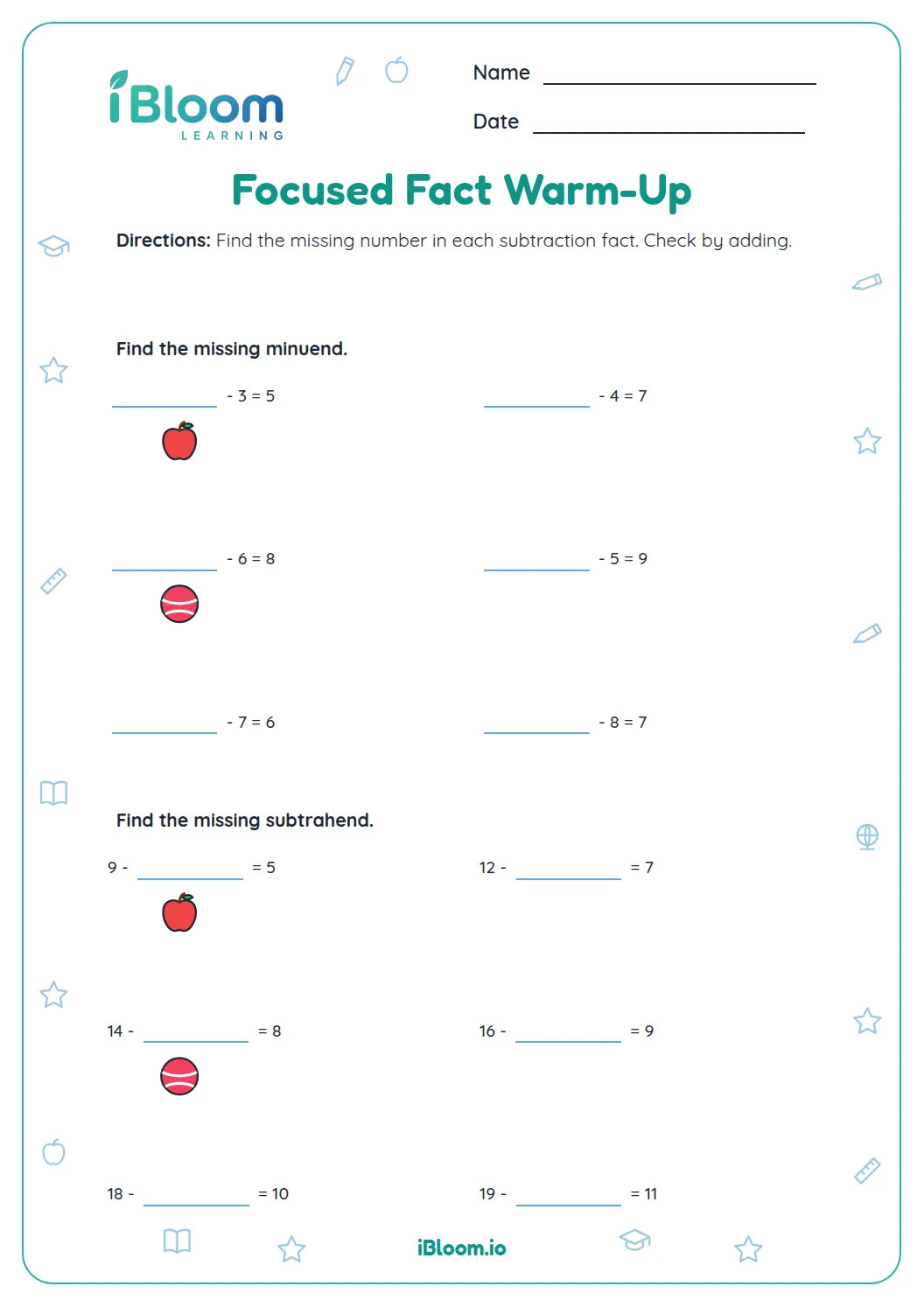
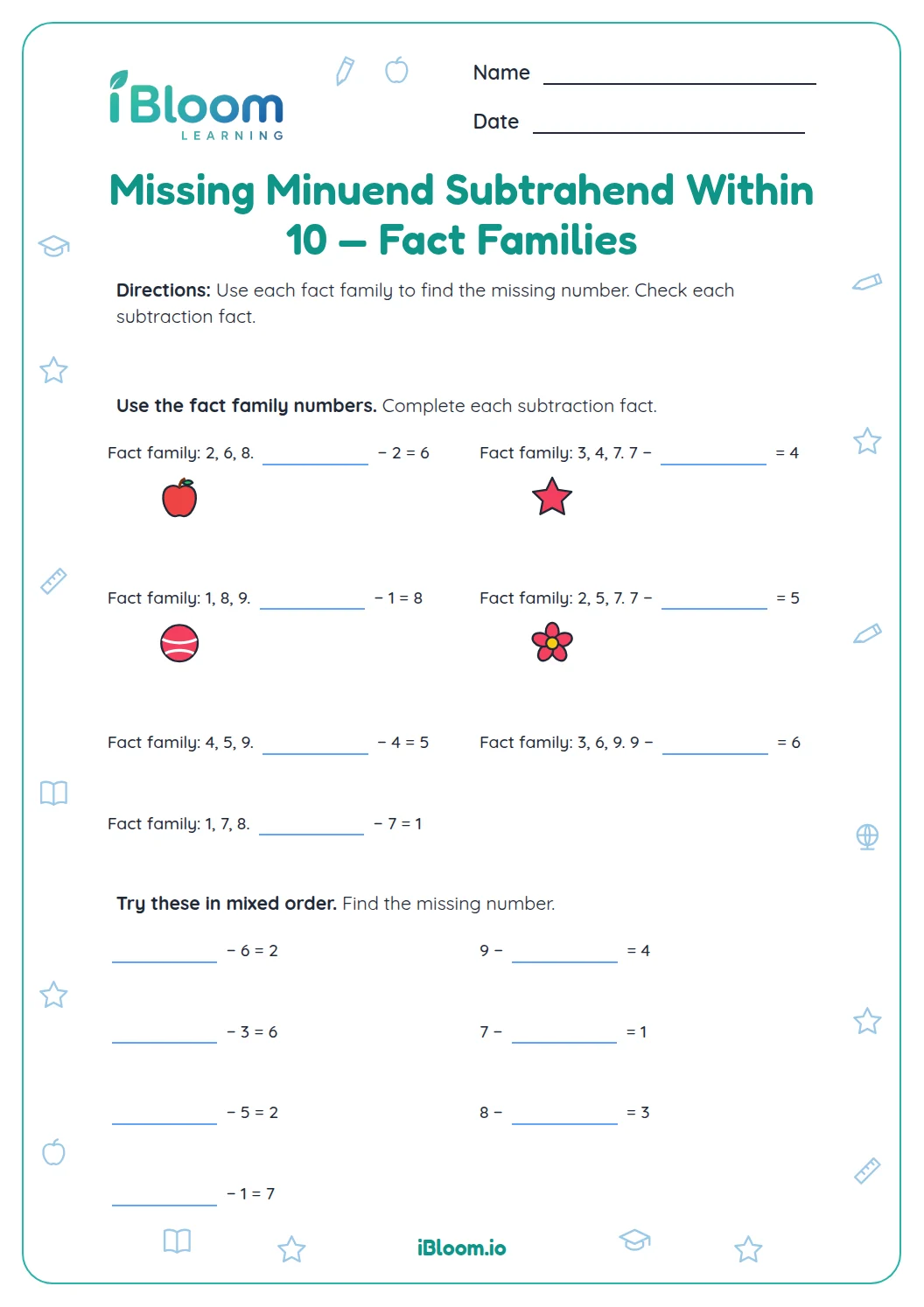
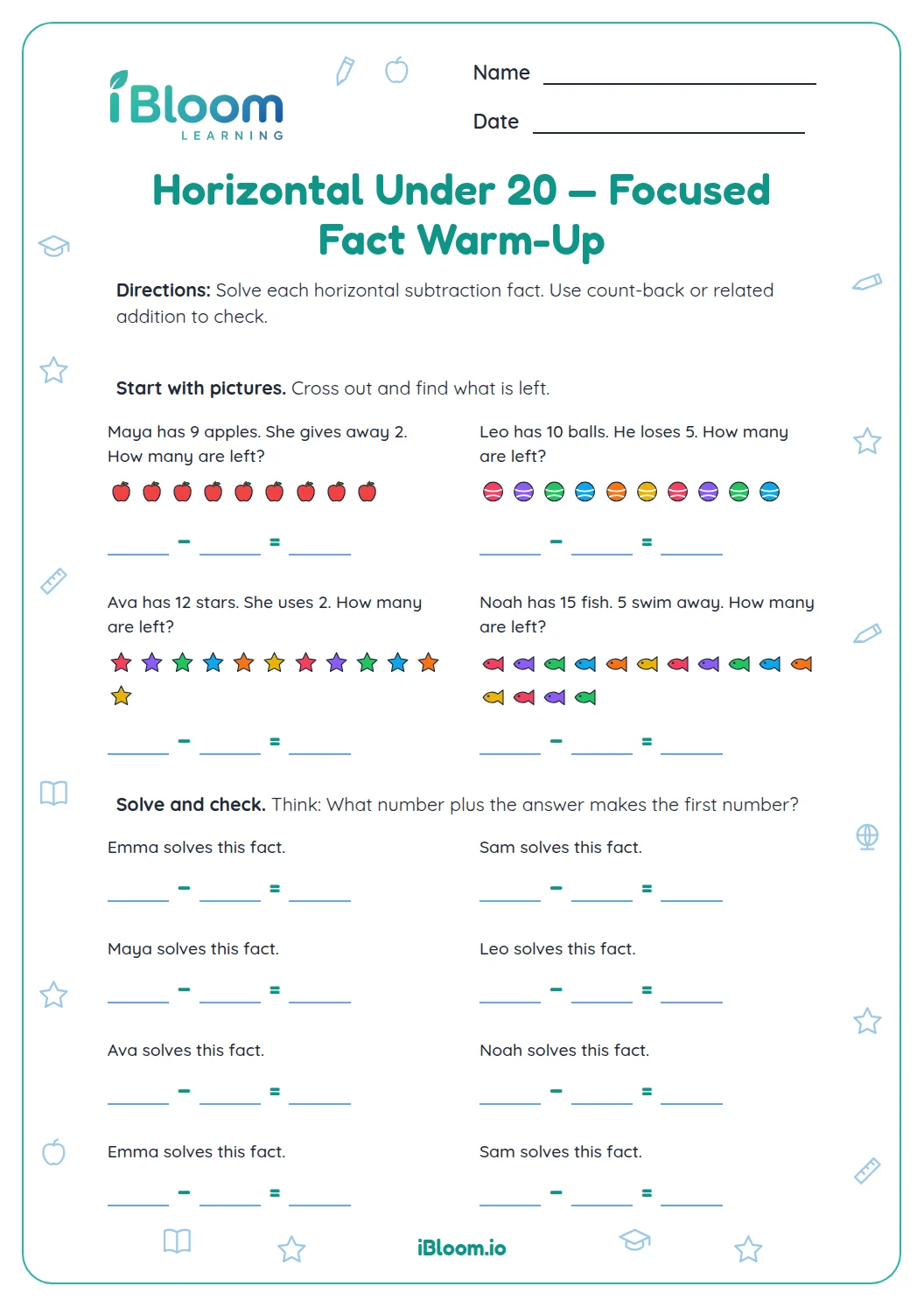
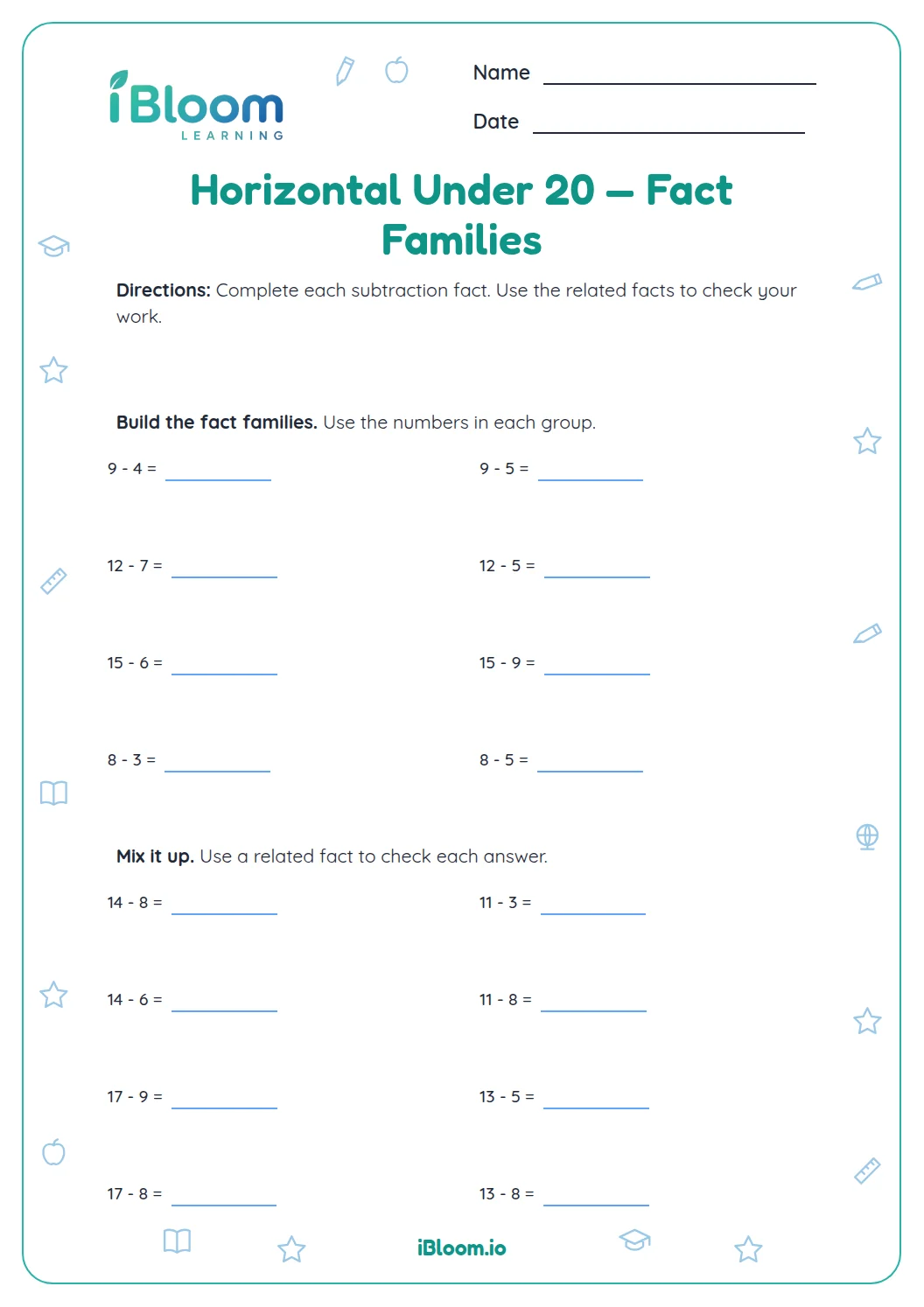
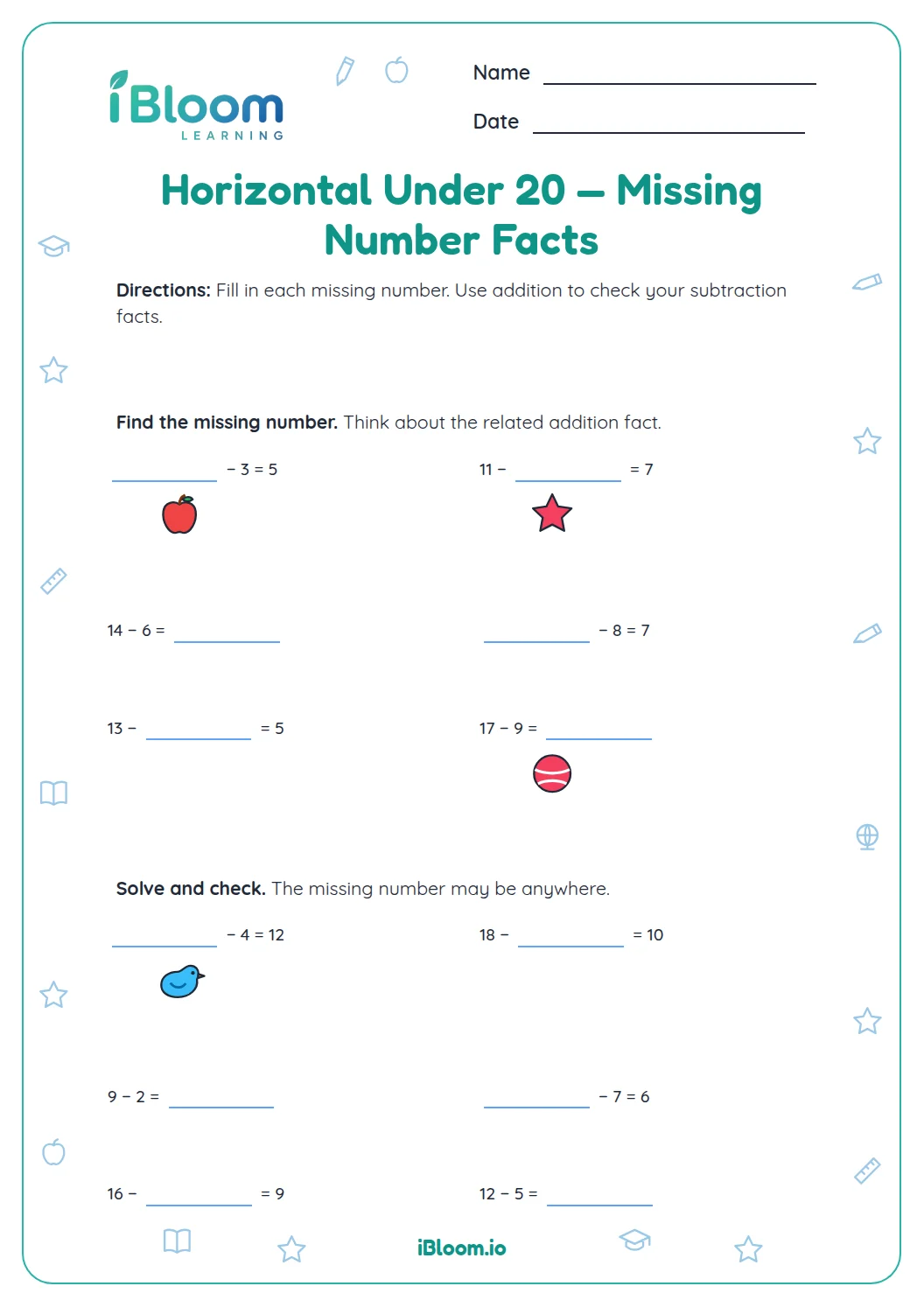
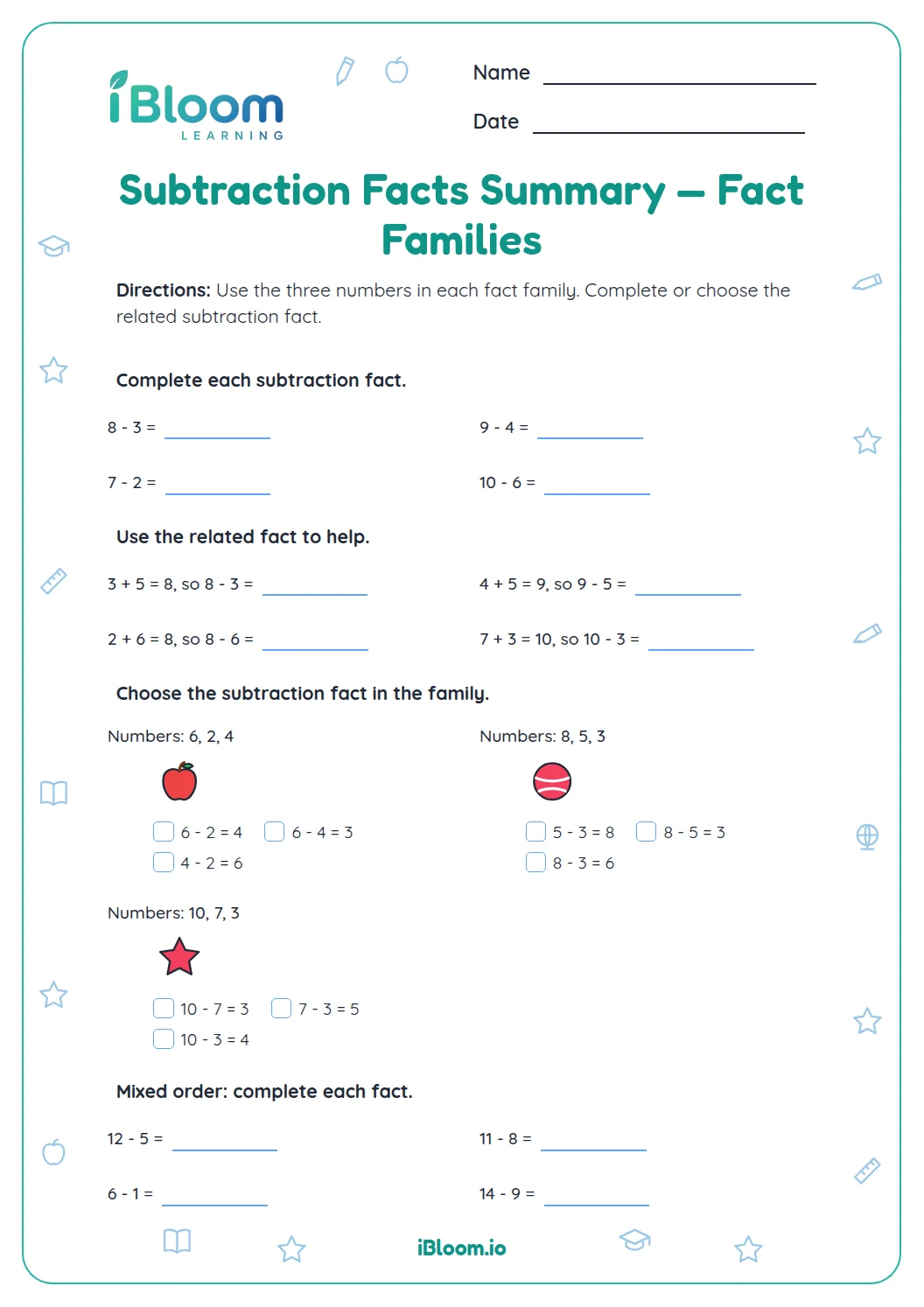
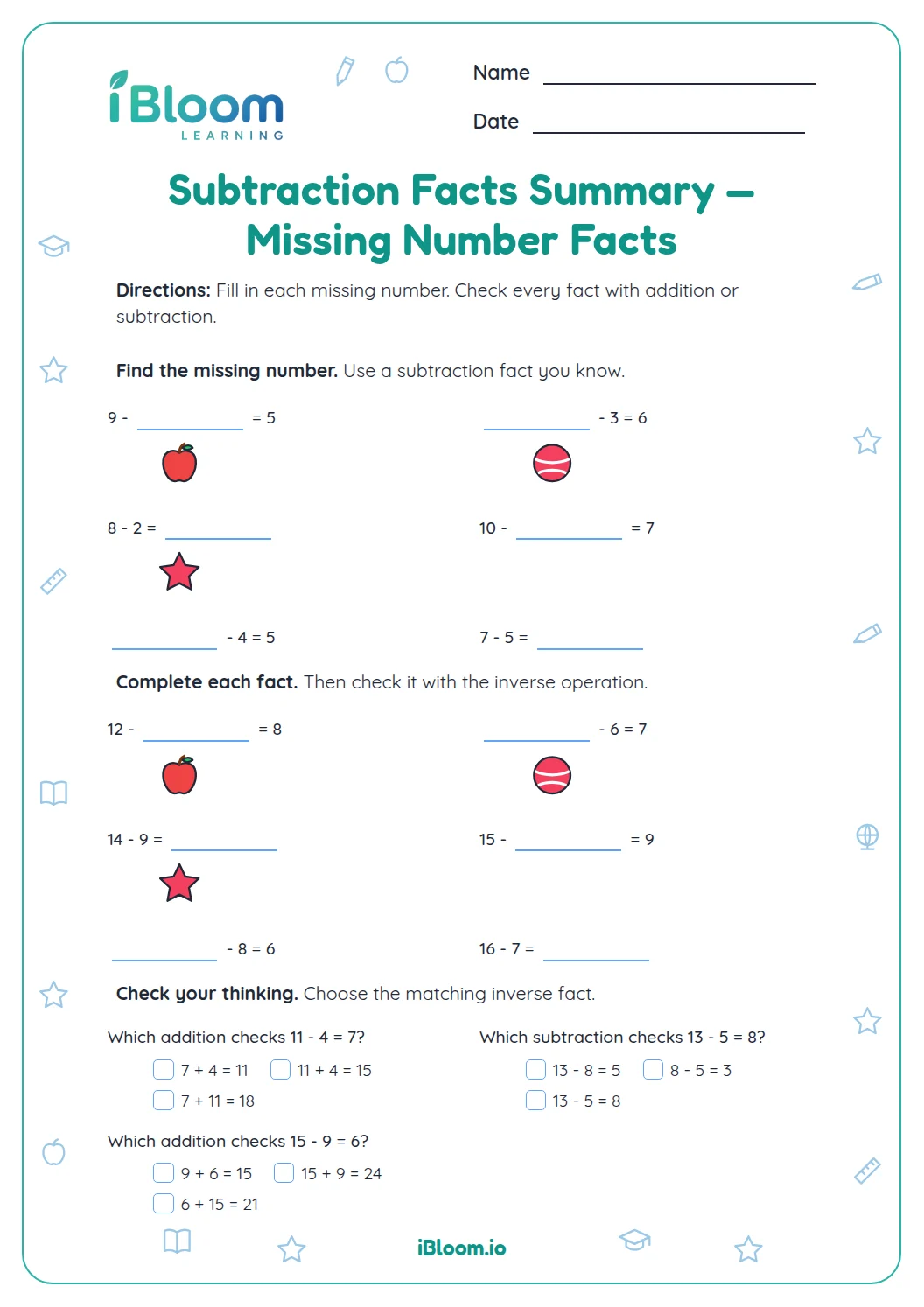
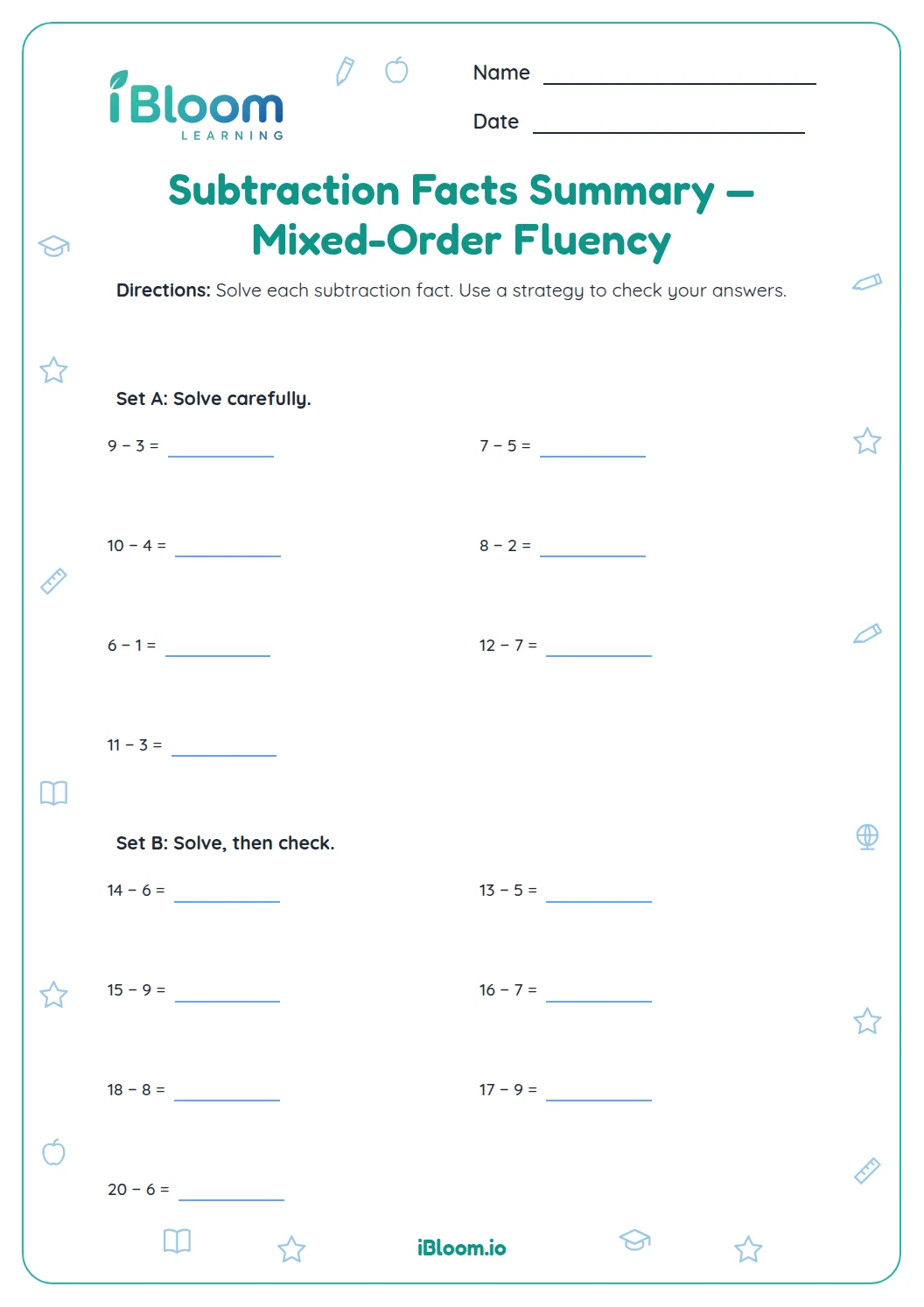
This printable gives Grades 1–2 practice finding either missing number in a subtraction fact within 19. Students solve missing starts such as ___ − 6 = 8, missing parts such as 15 − ___ = 8, and related fact-family equations. The 16 questions progress from single blanks to connected facts, and a separate answer key supports quick checking.
How do you find a missing minuend?
The minuend is the starting number. In ___ − 6 = 8, ask what number is 8 more than 6. Since 8 + 6 = 14, the missing start is 14.
How do you find a missing subtrahend?
The subtrahend is the number being taken away. For 15 − ___ = 8, compare 15 and 8: the amount between them is 7. Check by subtracting 7 from 15.
- 115 − ___ = 8
- 28 + 7 = 15, so the missing number is 7.
How does a fact family check the answer?
If 13 − 5 = 8, then 8 + 5 = 13. Addition puts the two parts back together and confirms the whole. The last two parts ask students to use those relationships in mixed equations.
How to use this worksheet
- 1Identify which position is blank: the starting whole or the part removed.
- 2For a missing start, add the difference and the part removed.
- 3For a missing subtrahend, find the amount between the start and difference.
- 4Use the related addition fact to check the subtraction.
- 5Keep the same three numbers together when completing a family.
Common mistakes and quick fixes
The mistake
Treating the difference as the missing start.
The fix
Add the subtrahend to the difference to rebuild the starting number.
The mistake
Subtracting in the wrong order to find the missing part.
The fix
Compare the starting number with the difference: start minus difference is the part removed.
The mistake
Changing a number while writing the related fact.
The fix
Copy the same three numbers and identify the whole and two parts first.
What to practice next
Make more practice
Questions parents and teachers ask
What is a minuend?
The minuend is the number a subtraction problem starts with. In 14 − 6 = 8, the minuend is 14. The first part of the worksheet leaves that starting number blank, so students use the difference and the number removed to find it.
What is a subtrahend?
The subtrahend is the number being subtracted. In 15 − 7 = 8, the subtrahend is 7. Part B leaves that number blank and asks students to determine which part was removed to leave the stated difference. They can check by subtracting.
How many questions are included?
The worksheet has 16 number sentences in four parts. Four leave the starting number blank, four leave the number removed blank, and eight ask students to connect subtraction with addition in a fact family. A separate answer key gives the result for every item.
How can addition check a subtraction answer?
Add the difference and the number removed. For example, if 15 − 7 is 8, check that 8 + 7 returns to 15. The fact-family questions make this relationship explicit so students can verify their subtraction rather than guess.
Are all answers less than 20?
Yes. The minuends, subtrahends, differences, and missing numbers on this sheet are all whole numbers below 20. For example, 15 − 7 = 8 uses numbers within 19. Students can check every completed equation with subtraction or its related addition fact.
Should students solve these mentally?
Many children can solve these facts mentally, while others may use counters, a number line, or a related addition fact. The worksheet asks for the missing number in each equation, and the key supports checking. Accuracy comes first; show a strategy when helpful.