





About this worksheet
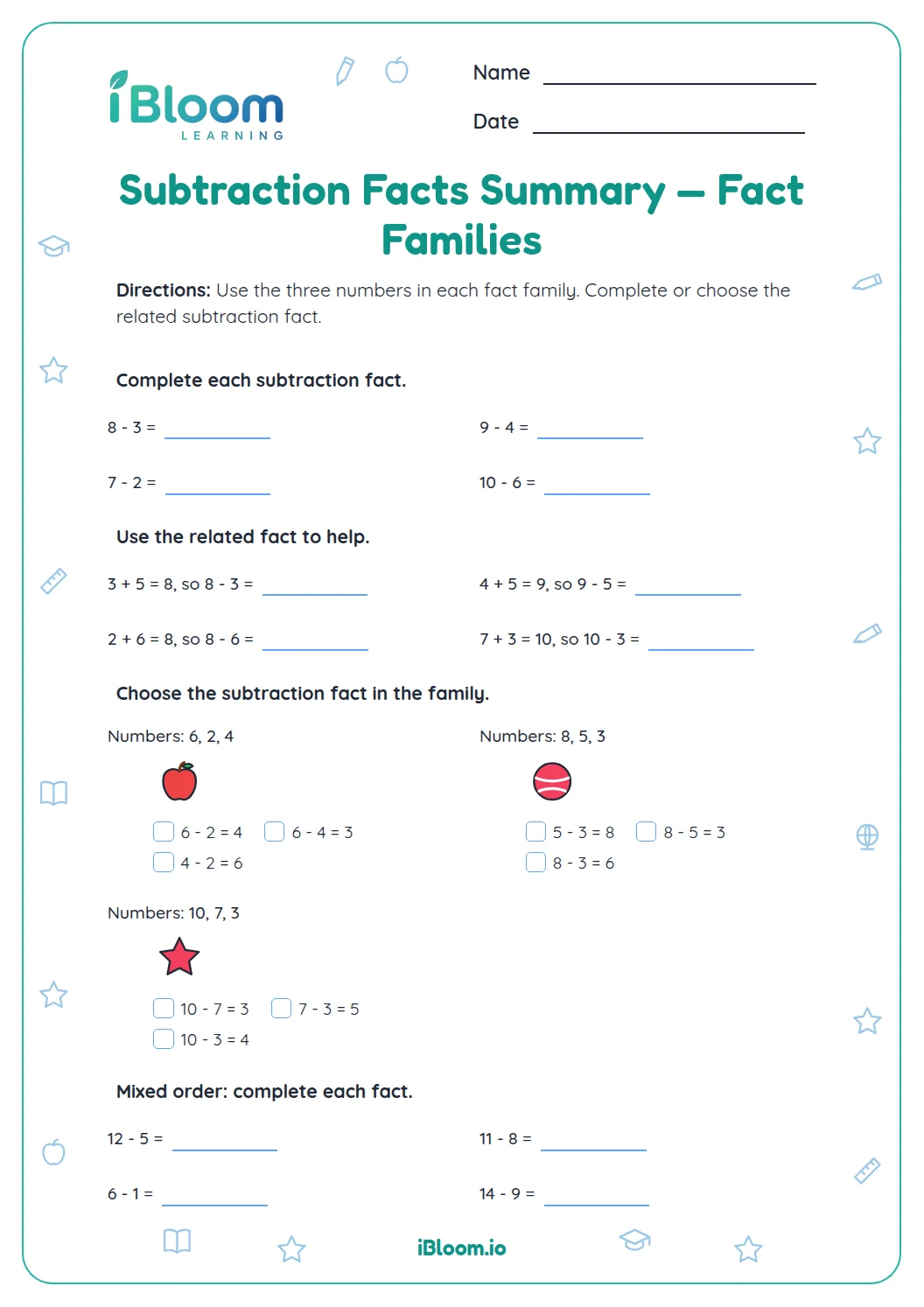
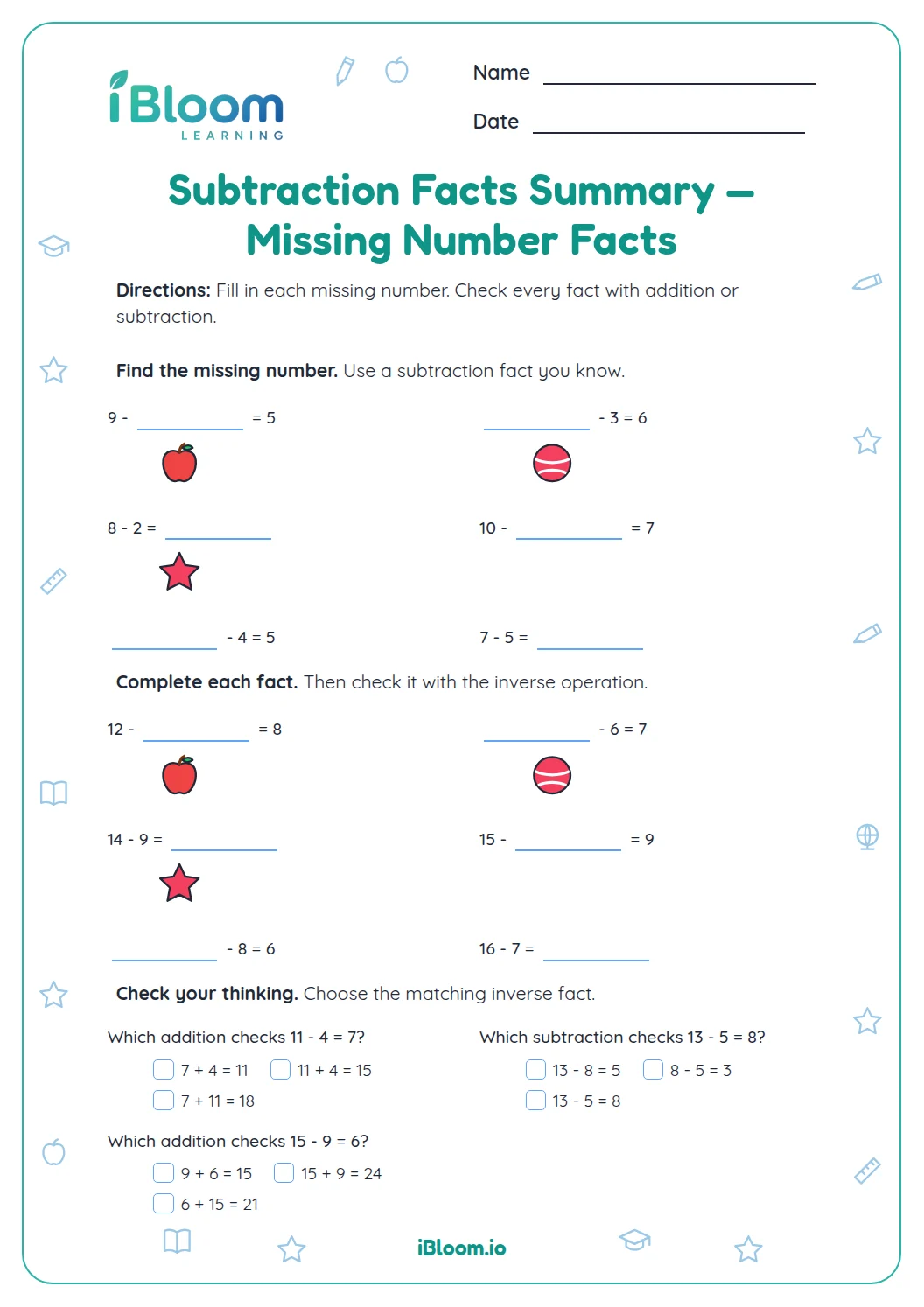
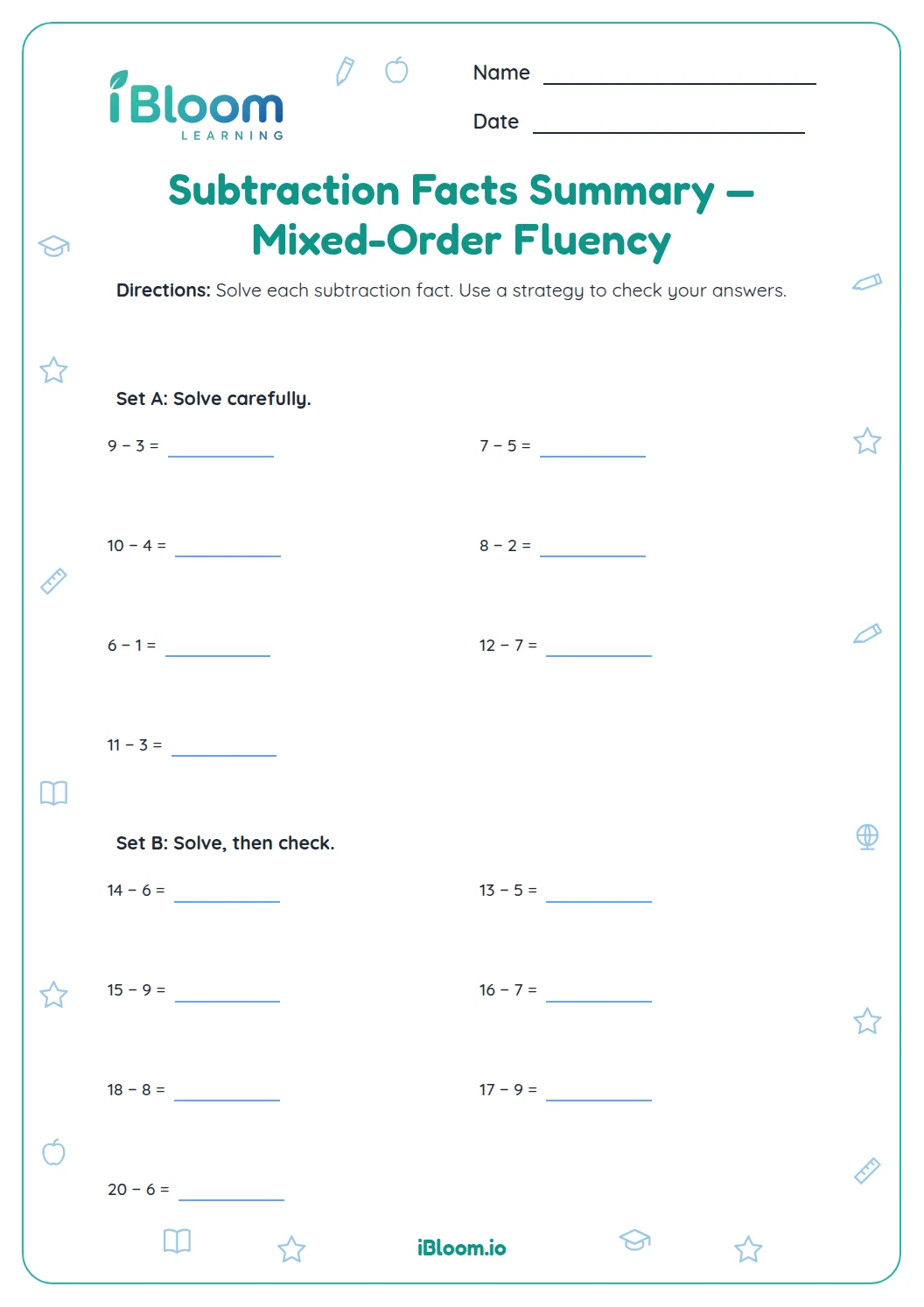
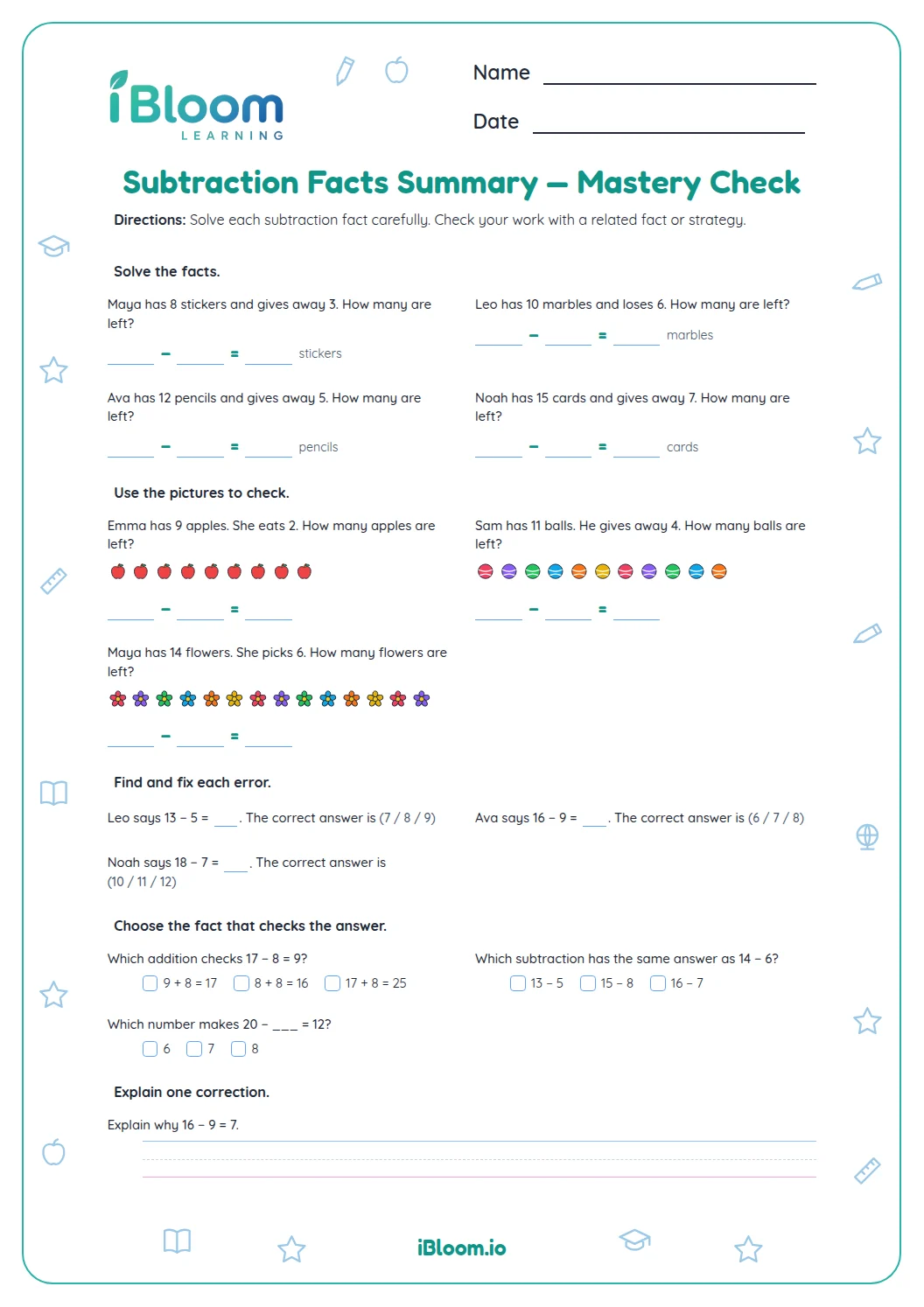
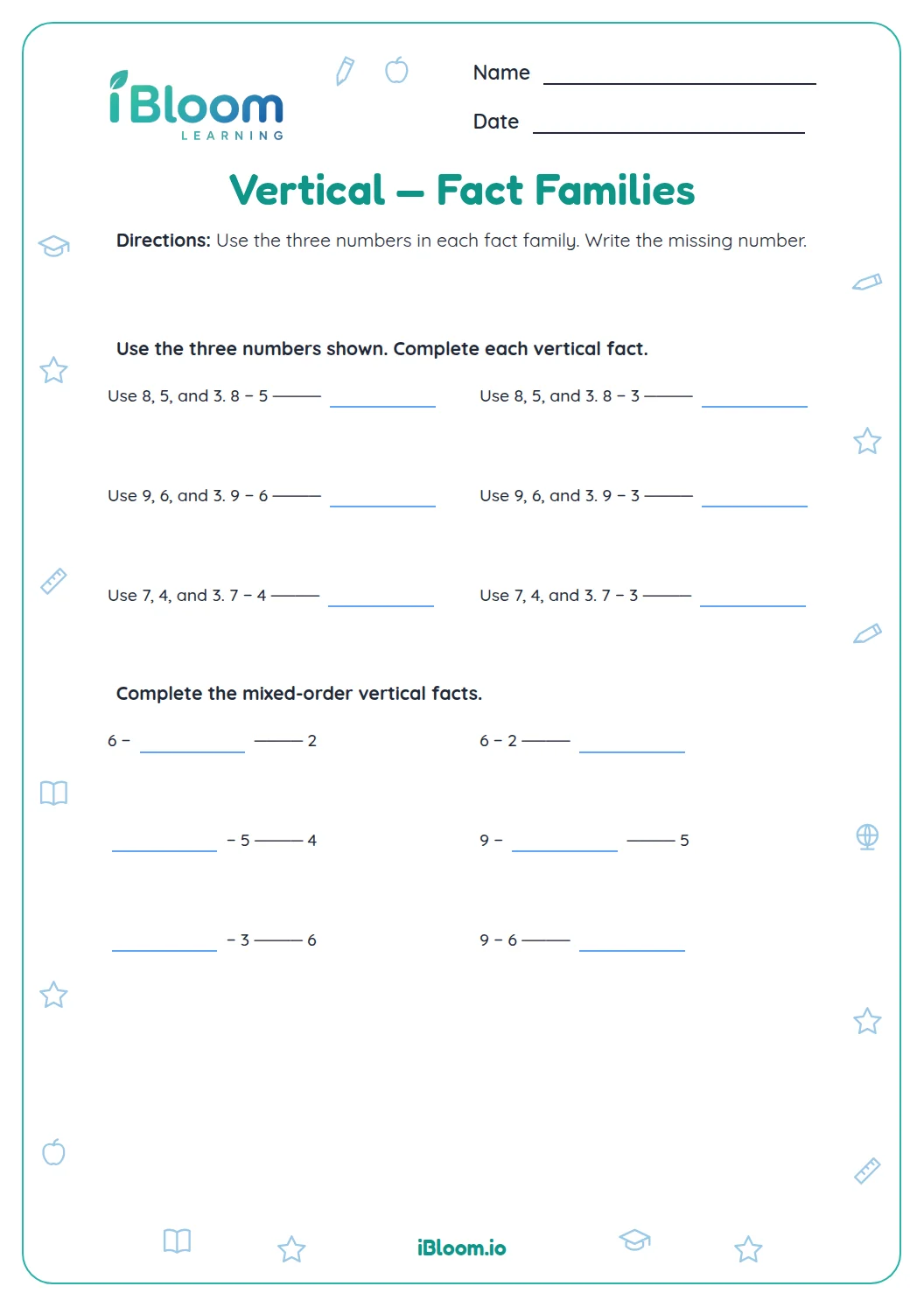
This printable subtraction worksheet gives Grades 1–2 practice in three steps: cross out objects that go away, solve subtraction facts within 20, and find a missing subtrahend. Four picture activities bring back the old sheet’s cross-out method, followed by eight facts and four missing-number equations. A separate answer key supports checking. The questions practice CCSS 1.OA.C.6 through subtraction and the relationship between subtraction and addition.
Aligned to 1.OA.C.6
How can pictures model subtraction?
A subtraction story starts with a group, takes some away, and asks how many remain. Cross out the objects that leave, then count the uncrossed pictures. For example, crossing out 2 of 6 apples leaves 4 apples.
How can a subtraction fact be checked?
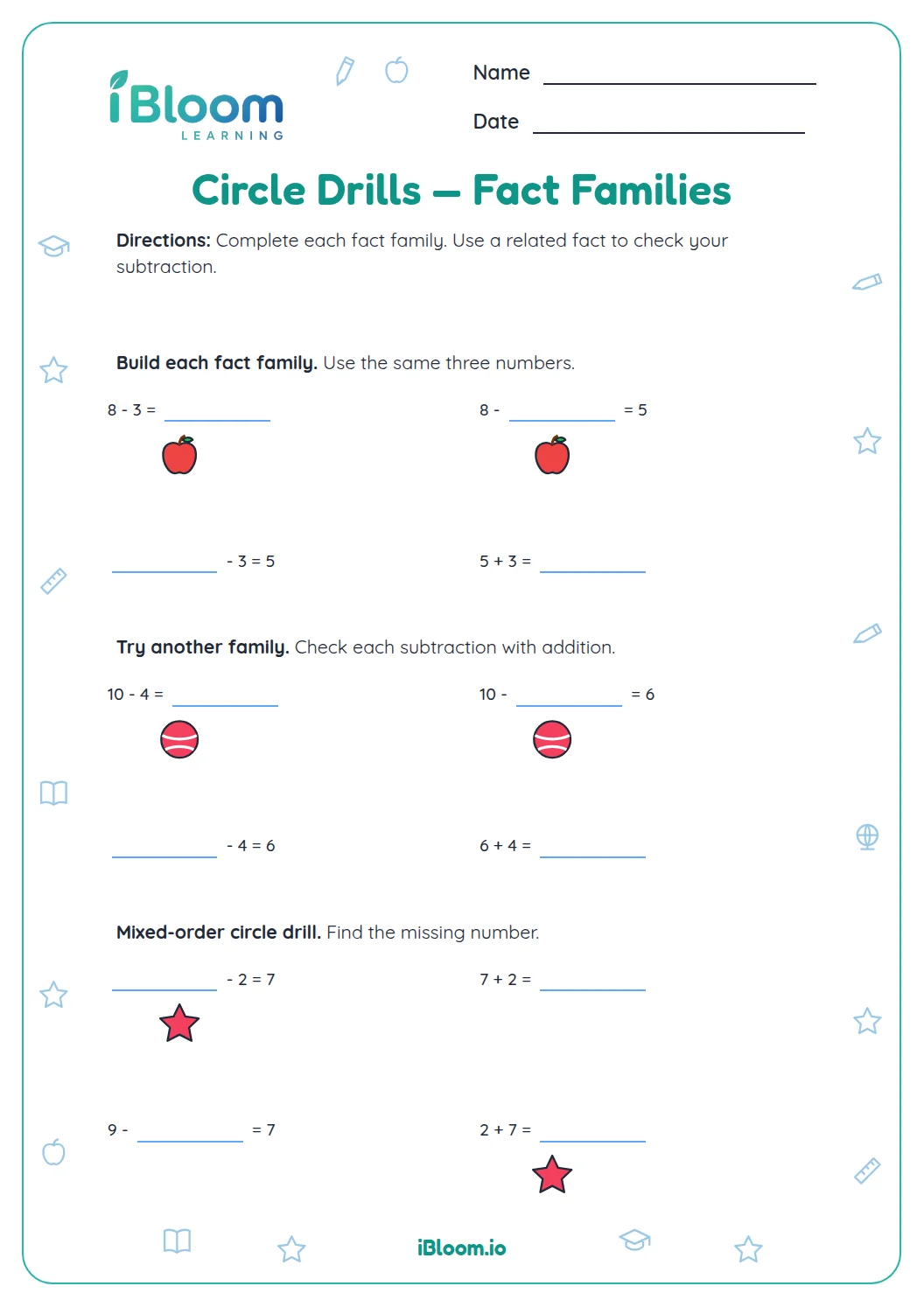
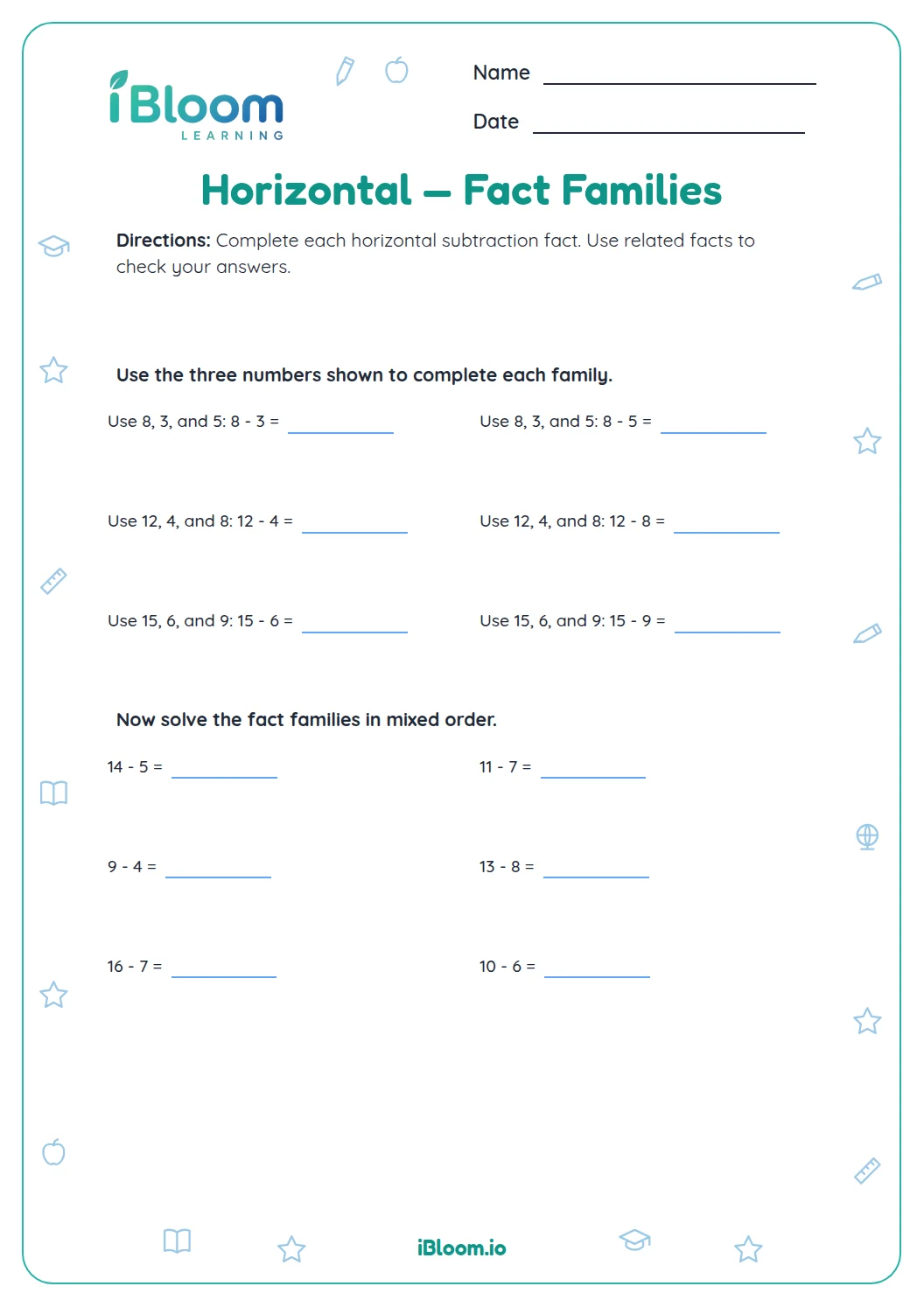
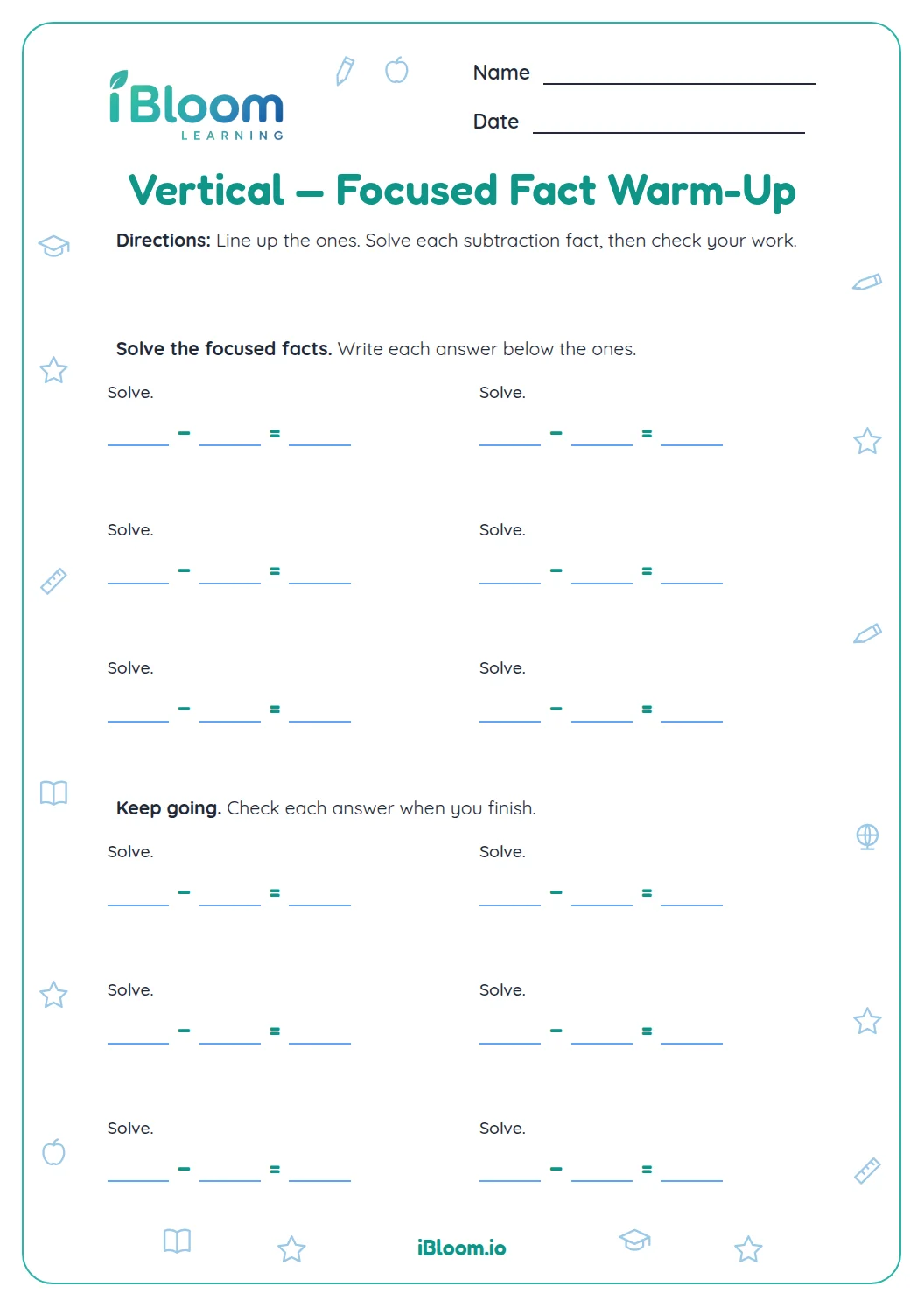
Find the difference, then add it to the number taken away. For 12 − 5 = 7, check that 7 + 5 equals 12. Part B has eight facts with answers within 20.
How do you find a missing subtrahend?
In 15 − ___ = 8, ask what you add to 8 to make 15. Since 8 + 7 = 15, the missing number is 7. Part C uses the same relationship between addition and subtraction.
How to use this worksheet
- 1Read the picture activity and find the starting group.
- 2Cross out the objects named in the prompt.
- 3Count the uncrossed pictures and compare your work with the key.
- 4Solve each number fact, then check by adding the difference and the amount subtracted.
- 5For a missing subtrahend, add the difference and missing number to reach the starting amount.
- 6Use the separate answer key to check all 16 responses.
Common mistakes and quick fixes
The mistake
Counting the crossed-out pictures as objects that remain.
The fix
Count only the pictures that have not been crossed out.
The mistake
Subtracting the starting amount from the amount taken away.
The fix
Start with the full group and take away the smaller group.
The mistake
Putting the difference in a missing-subtrahend blank.
The fix
Add the difference and the blank number; their sum must equal the starting number.
Common Core alignment
This practice connects each question to a specific grade-level reading or math skill.
Subtraction facts.
On this sheet: Subtraction facts is practiced throughout the worksheet.
Show the official wordingHide the official wording
Add and subtract within 20, demonstrating fluency for addition and subtraction within 10. Use strategies such as counting on; making ten (e.g., 8 + 6 = 8 + 2 + 4 = 10 + 4 = 14); decomposing a number leading to a ten (e.g., 13 − 4 = 13 − 3 − 1 = 10 − 1 = 9); using the relationship between addition and subtraction (e.g., knowing that 8 + 4 = 12, one knows 12 − 8 = 4); and creating equivalent but easier or known sums (e.g., adding 6 + 7 by creating the known equivalent 6 + 6 + 1 = 12 + 1 = 13).
What to practice next
Make more practice
Further reading
Questions parents and teachers ask
How many questions are included?
There are 16 questions in three parts. Part A has four picture activities, Part B has eight subtraction facts, and Part C has four missing-subtrahend equations. The answer key is separate and lists each result so a child can check the work.
How do the picture activities work?
Each picture group shows the starting amount. Children cross out the pictures described as given away, then count the uncrossed pictures to see what remains. For example, crossing out two of six apples leaves four apples. The key reminds adults what to check.
What is a missing subtrahend?
It is the number being subtracted when that number is blank. In 15 − ___ = 8, the missing number is 7 because 15 − 7 equals 8. Children can also check by adding 8 and 7 to get 15.
Which strategies can children use?
Children can cross out pictures, count back, use a known fact, or check with addition. The picture activities give a visible starting group; the later equations let children practice the number relationship without a picture model. Adults can invite the child to explain one strategy aloud.
Is this a timed test?
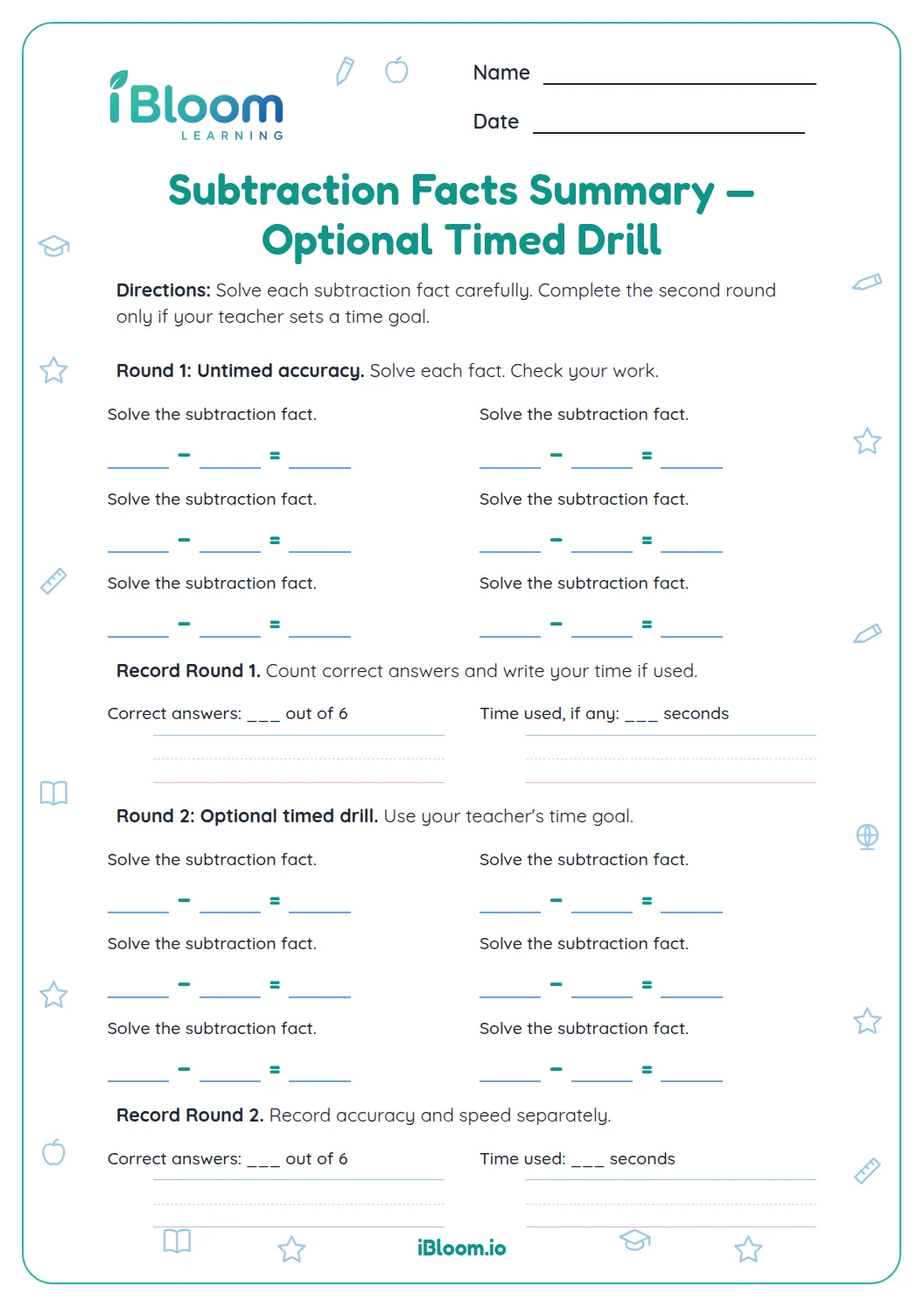
No timing goal is printed on the worksheet. Children can work carefully, explain how they counted what remained, and check each fact with addition. A parent or teacher can use it as a warm-up at a comfortable pace.
Does it include an answer key?
Yes. A separate answer key gives all 16 responses, including the picture activity notes and missing numbers in Part C. The picture activity answers describe the expected cross-out action. For a number problem, the key provides the result so children can check their equation.