






About this worksheet
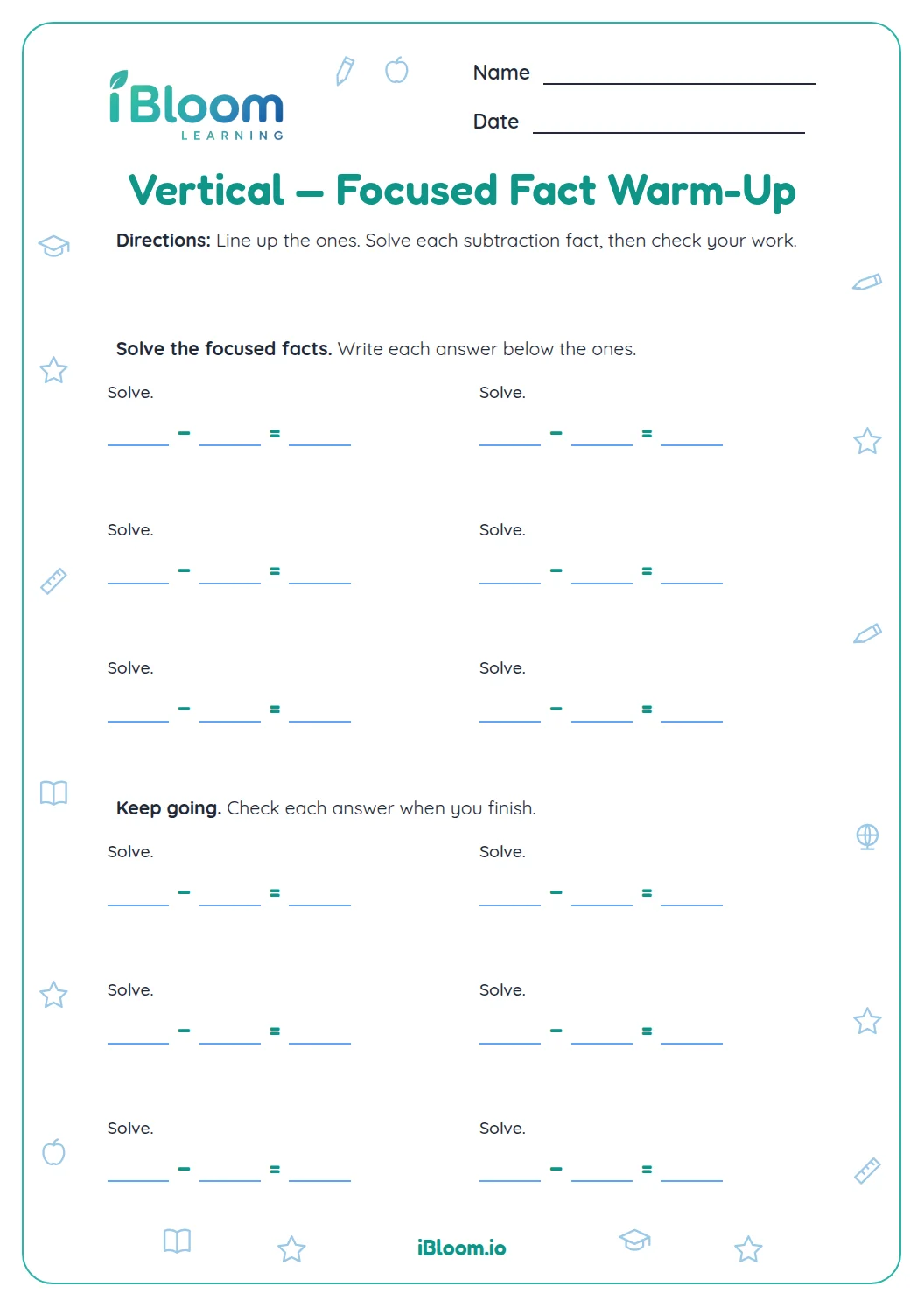
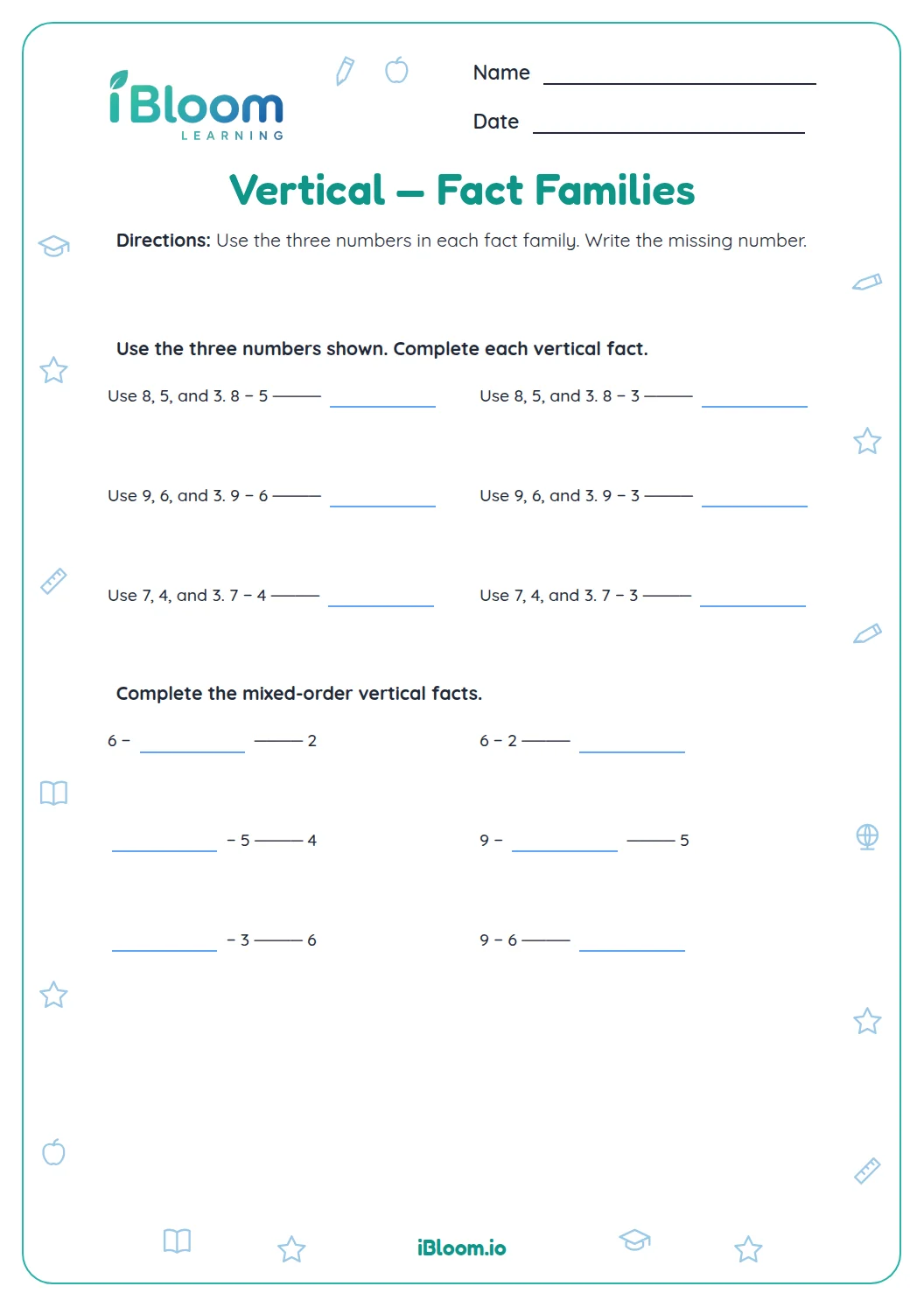
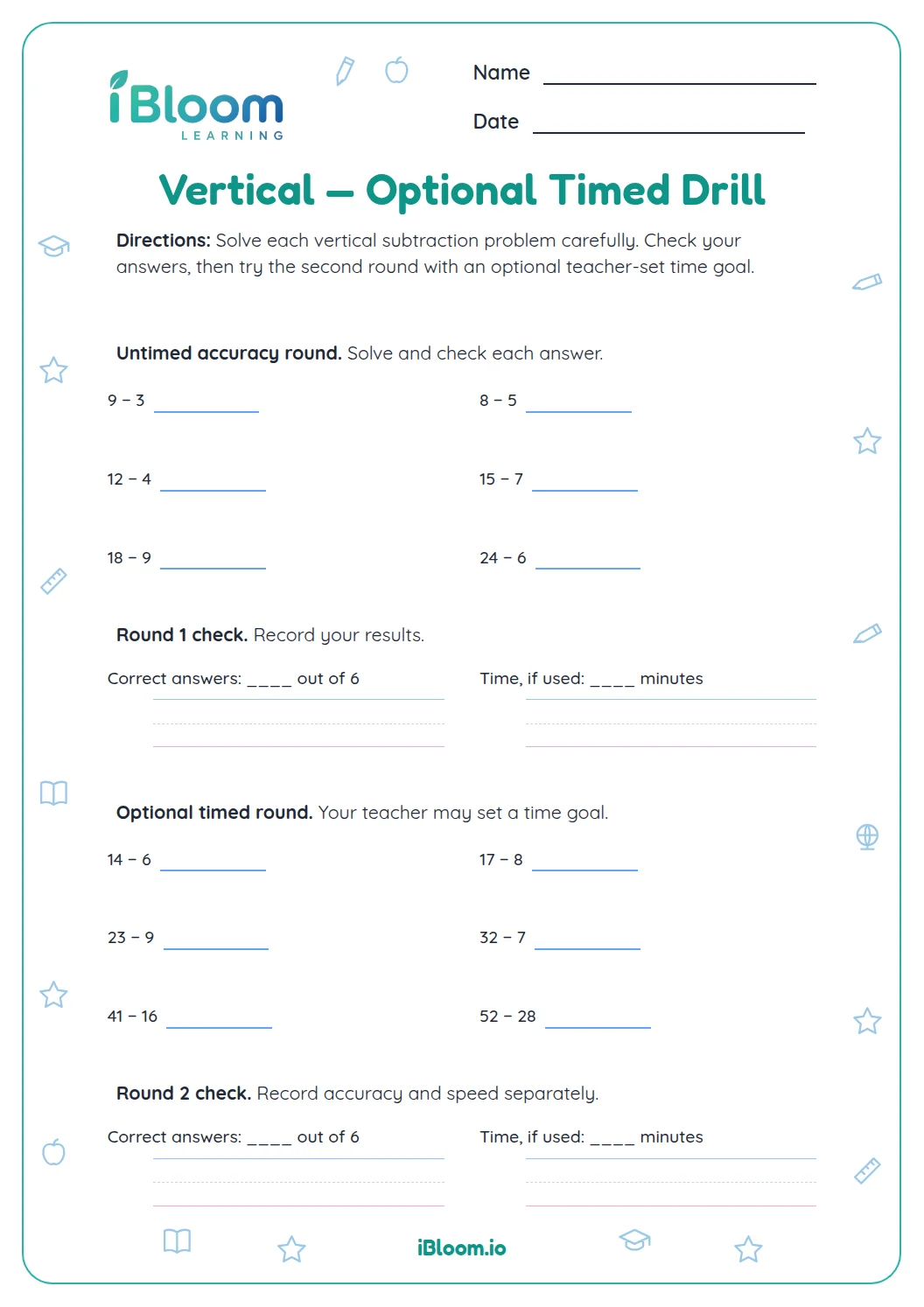
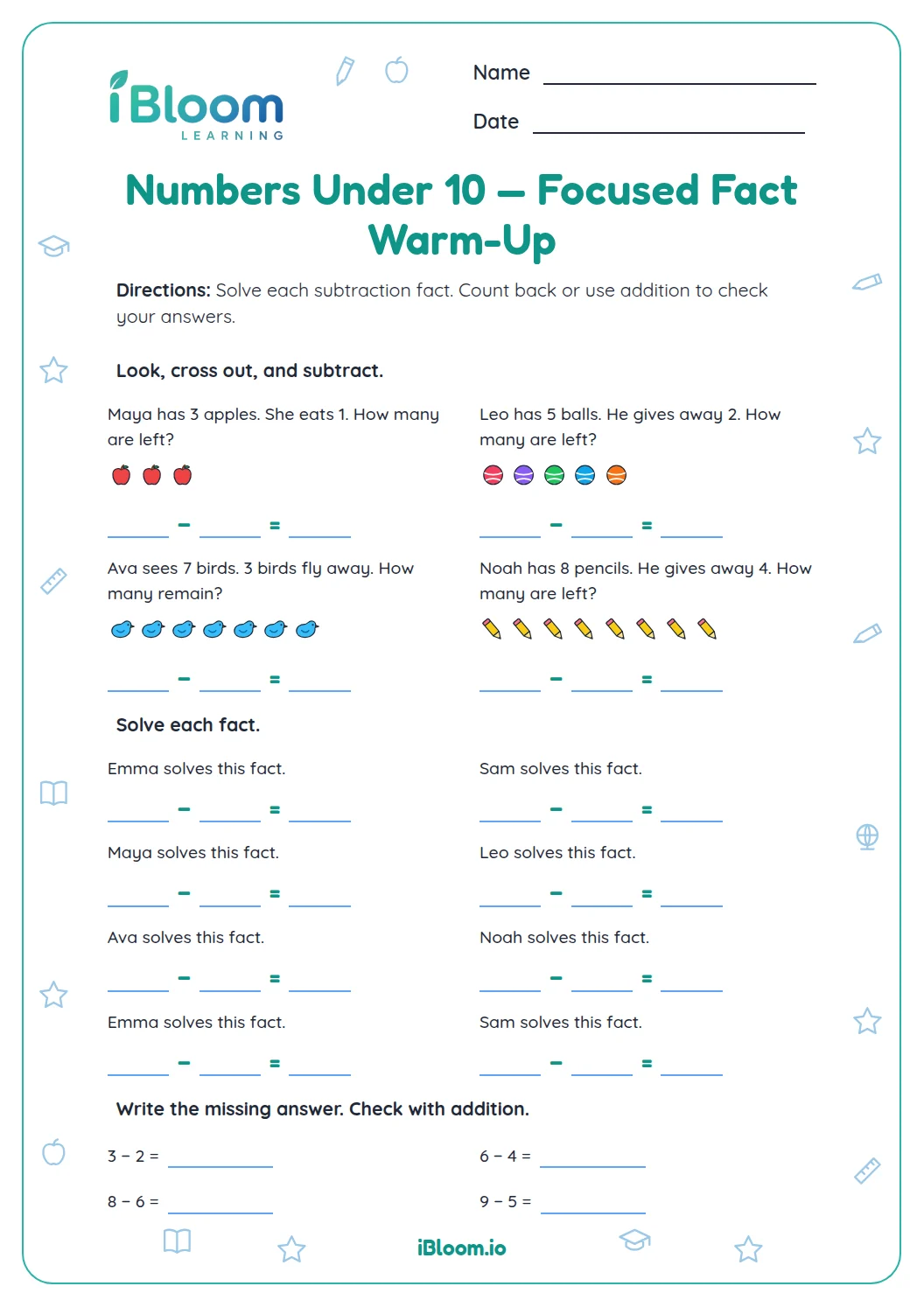
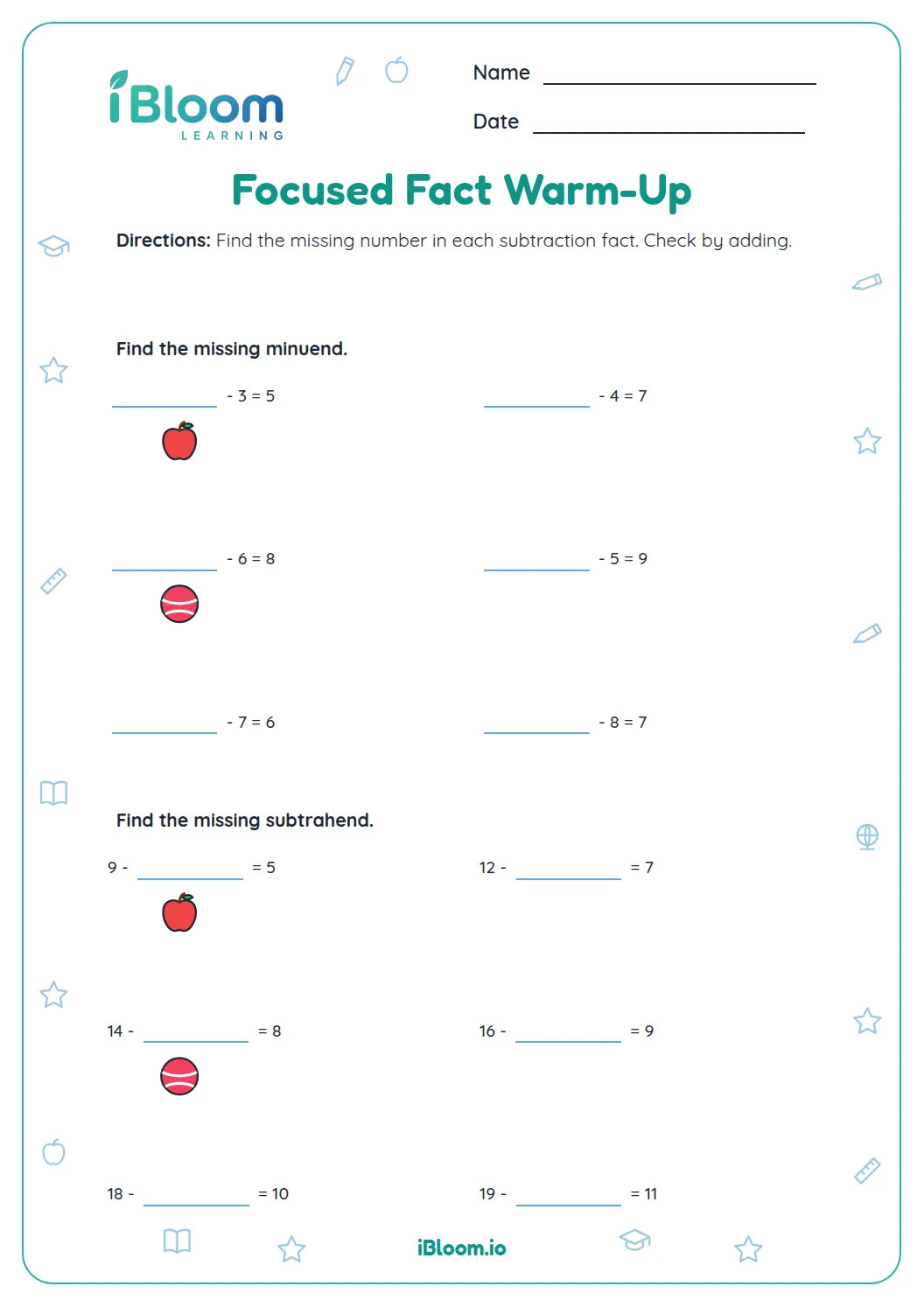
This Grade 1 printable gives learners 16 subtraction facts with the missing number in different positions. Every equation stays within 20, and two number bond drawings connect the whole and its parts to selected facts. The template prints equations horizontally, so the original vertical layout is rebuilt as clear missing-number equations. A separate answer key is included. It practices CCSS 1.OA.D.8.
Aligned to 1.OA.D.8
How can addition help find a missing subtraction number?
For 12 − ___ = 5, ask what number added to 5 makes 12. Since 5 + 7 = 12, the missing number is 7.
- 1For 12 − ___ = 5, ask what number added to 5 makes 12. Since 5 + 7 = 12, the missing number is 7.
How is the practice organized?
Part A finds missing numbers in subtraction equations. Two items also include a number bond, linking a whole and its parts to the equation.
How can the answer key support review?
After finishing, compare each response with the key. For a missed item, reread the prompt and use the relevant relationship or text detail to correct it.
How to use this worksheet
- 1Read the directions and look over the parts.
- 2Try the first item in each part slowly.
- 3Use the key idea to solve the remaining items.
- 4Check each result against the prompt.
- 5Use the answer key to review any missed items.
Common mistakes and quick fixes
The mistake
Subtracting the visible numbers in the order they appear.
The fix
Use addition to find the missing part: add the known part to the blank.
The mistake
Putting the difference in the missing-minuend position.
The fix
Ask what starting number would leave the shown difference after subtracting.
The mistake
Changing the subtraction sign while checking.
The fix
Check with addition: subtrahend + difference = minuend.
Common Core alignment
This worksheet gives focused practice with the standards below.
Determine an unknown number in an addition or subtraction equation.
On this sheet: Each item asks learners to determine an unknown number in a subtraction equation.
Show the official wordingHide the official wording
Determine the unknown whole number in an addition or subtraction equation relating three whole numbers. For example, determine the unknown number that makes the equation true in each of the equations 8 + ? = 11, 5 = _ - 3, 6 + 6 = _.
What to practice next
Make more practice
Further reading
Questions parents and teachers ask
What kinds of missing numbers appear?
The blank appears in the starting number, the number being subtracted, or the difference. Each fact stays within 20. Finding the unknown in different places helps learners connect subtraction with the related addition fact. Check the related addition fact after solving to confirm the missing number.
Why are there number bonds?
Two questions include a number bond alongside a subtraction fact. The bond shows the whole and a known part, making the missing part visible as the number needed to complete the whole. The other items keep the practice focused on equations.
Why are the facts printed horizontally?
The template prints number sentences horizontally. This revised page keeps the missing-number skill and pairs two equations with number bonds. The equation layout makes it easy to see whether the unknown is the starting number, subtrahend, or difference. Check the related addition fact after solving to confirm the missing number.
How should children check their answers?
Use addition to check the subtraction fact. For 12 − 7 = 5, add the parts: 7 + 5 = 12. When a different number is missing, place the known numbers in the related addition equation and find the value that makes it true.
Is this for Grade 1 or Grade 2?
It is labeled Grade 1 and uses subtraction facts within 20. A learner can use it for practice finding an unknown number in an equation, whether the blank is before or after the subtraction sign or in the answer position.