



About this worksheet
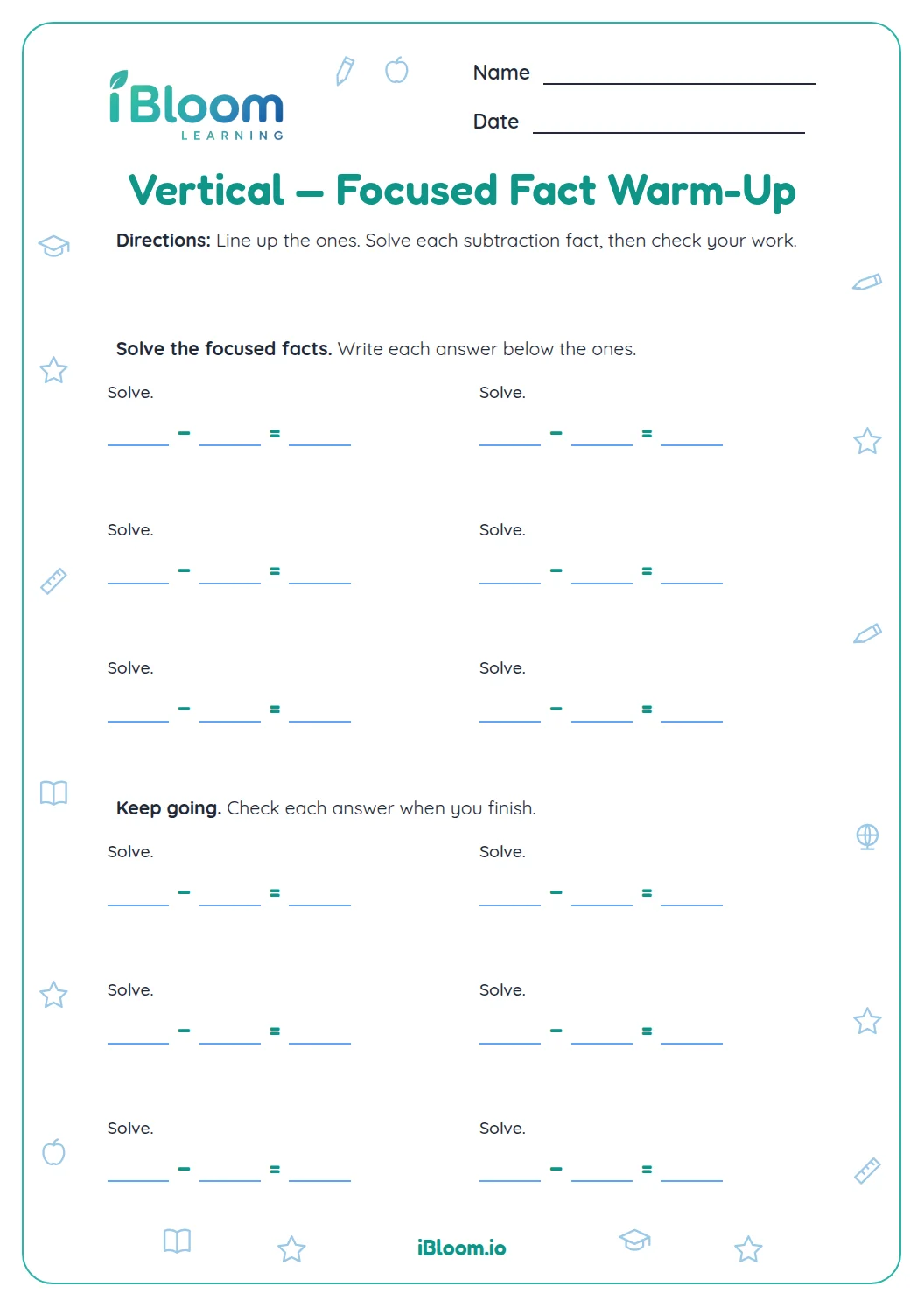
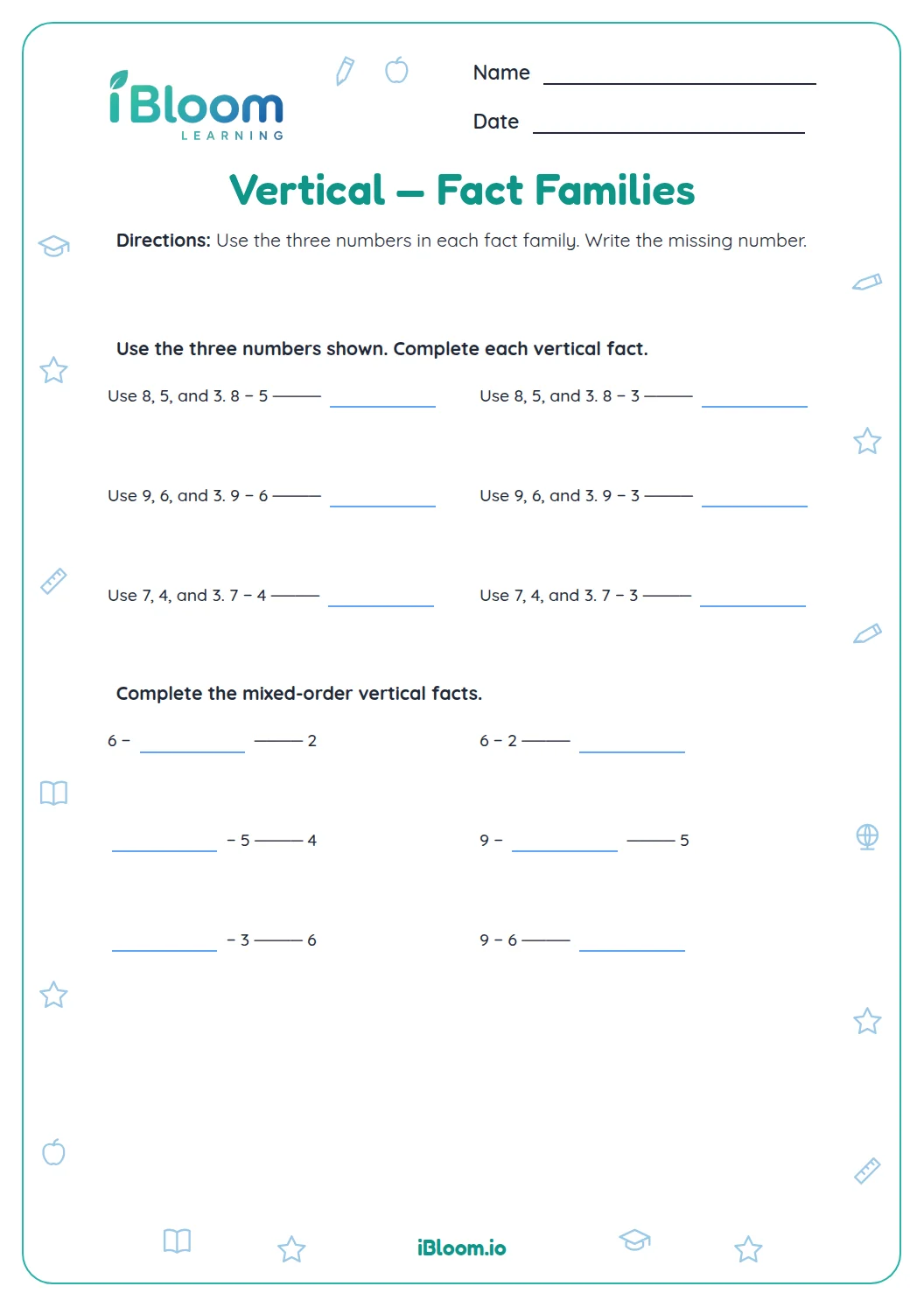
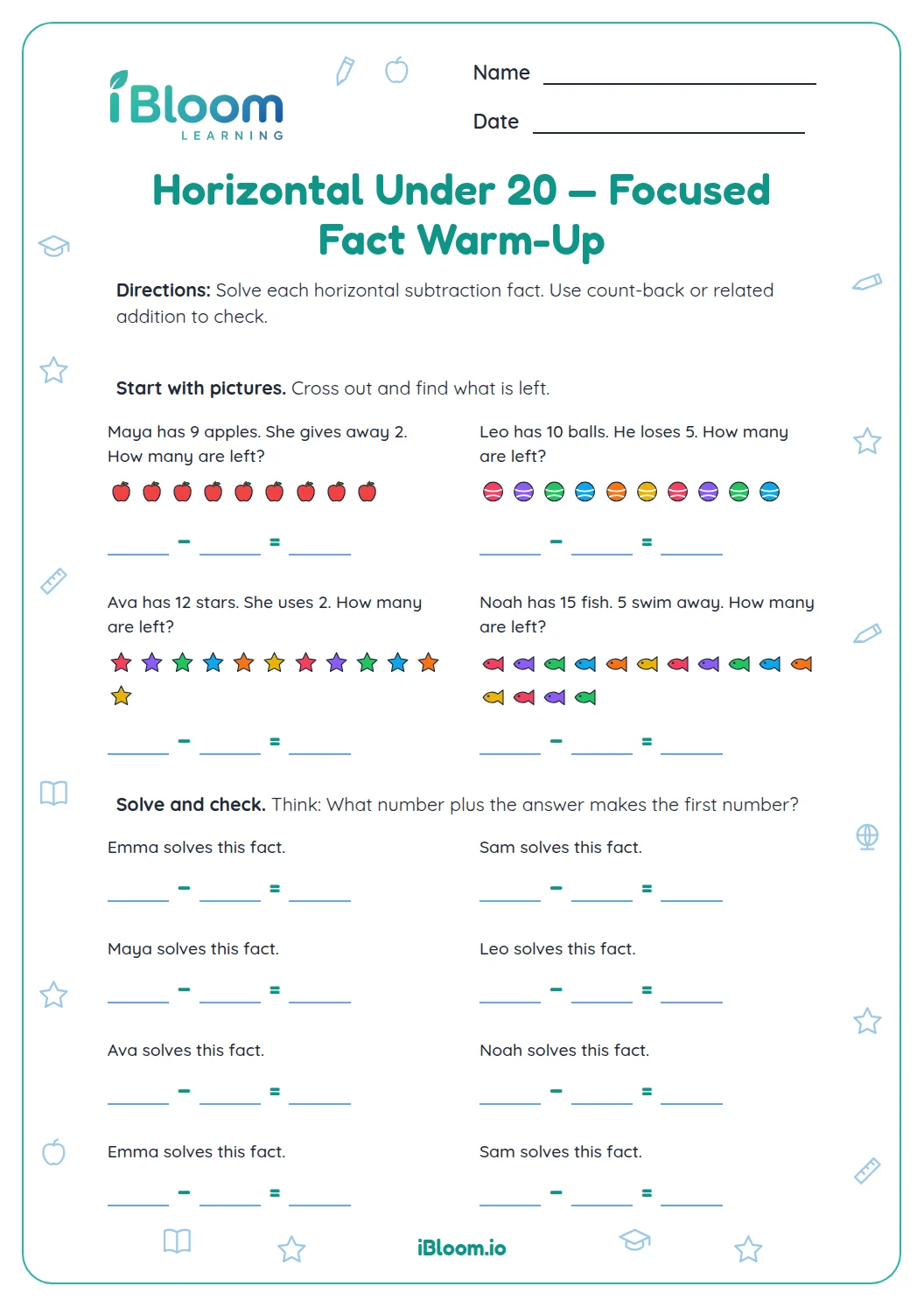
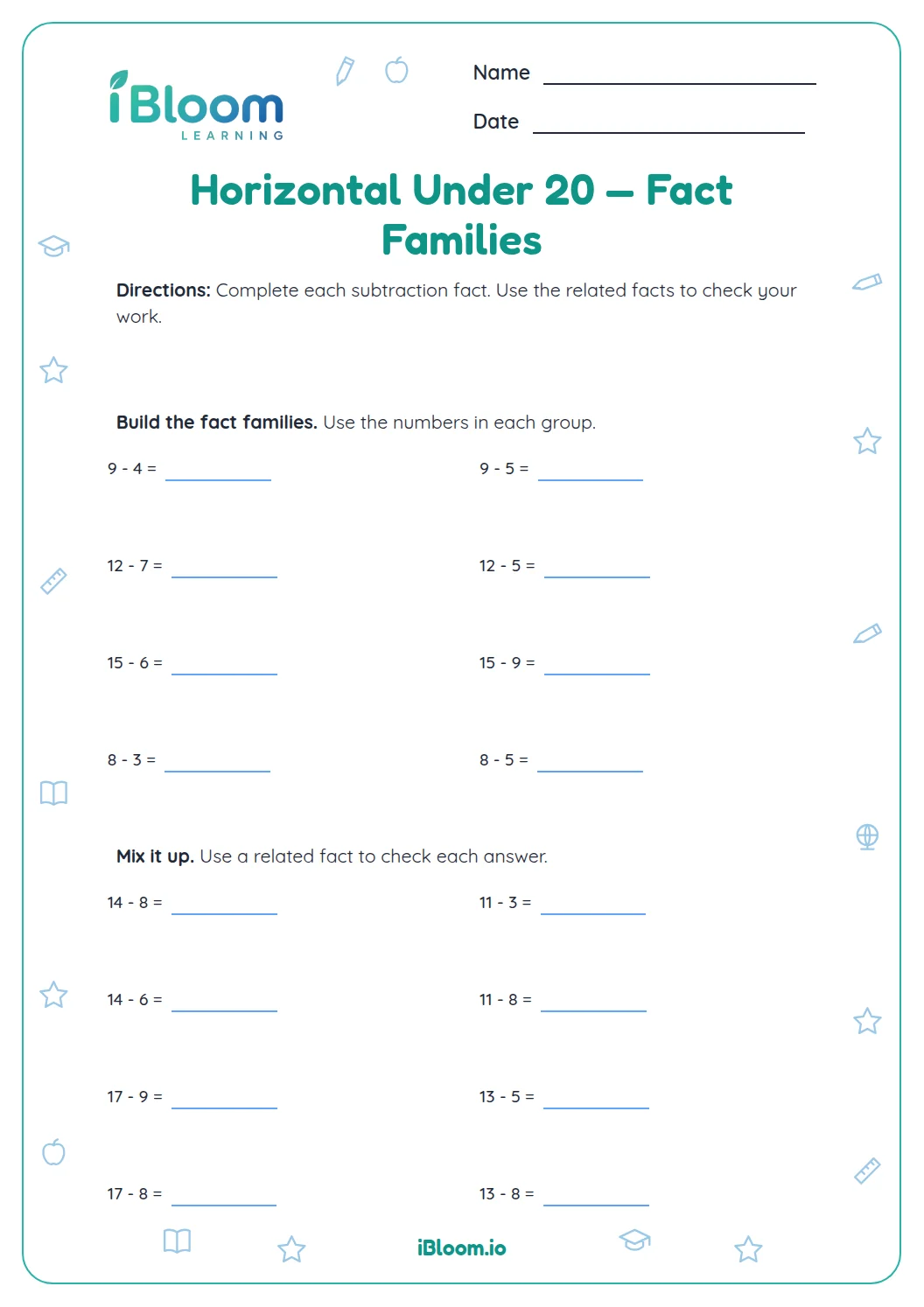
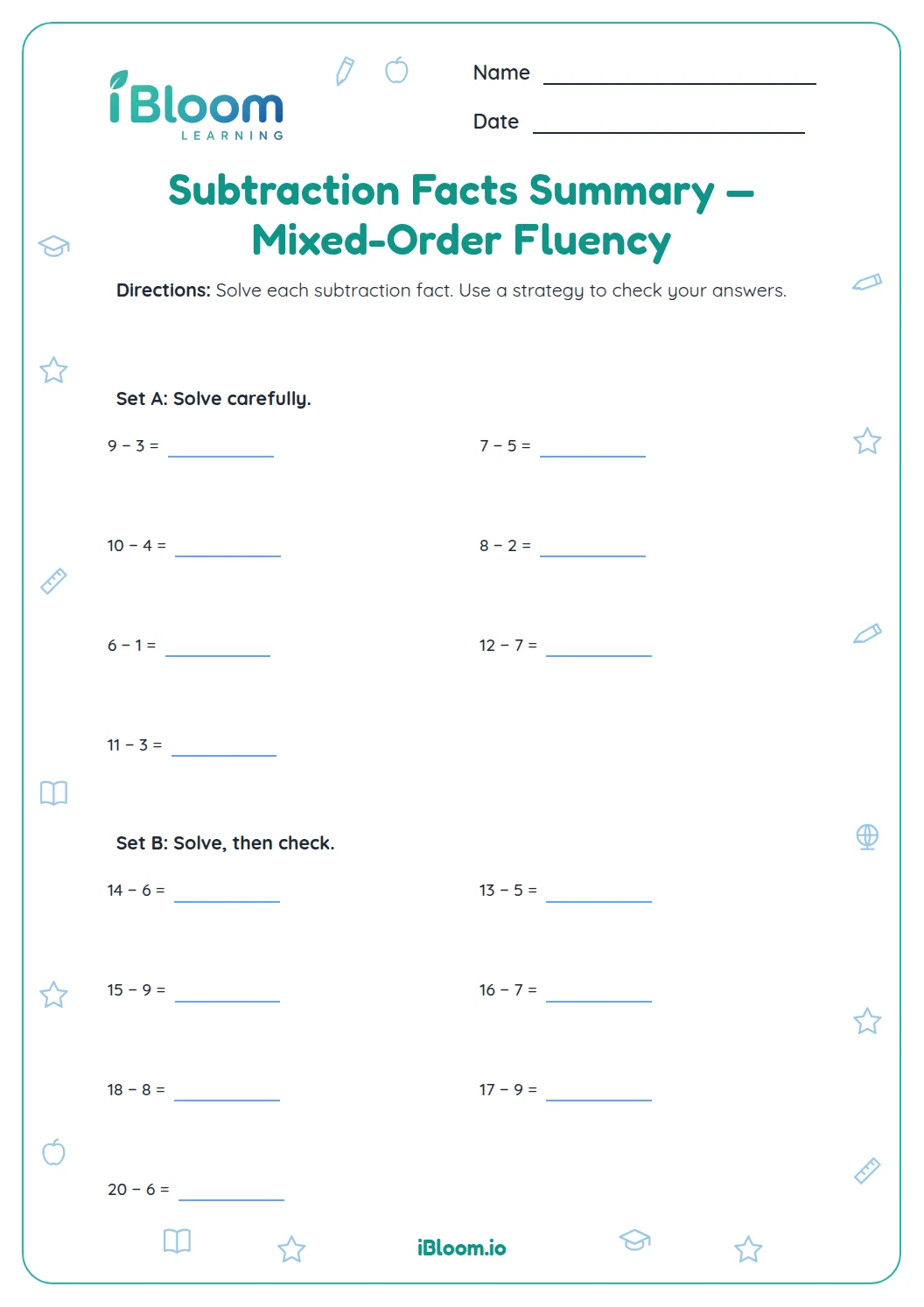
This printable subtraction drill is for students working with Grades 1–2 facts within 20. It presents 16 mixed-order equations with space to solve each fact, then asks students to check differences with addition. The answer key lists each result. The facts connect to CCSS 1.OA.C.6, which includes subtraction within 20 and strategies such as using the relationship between addition and subtraction.
Aligned to 1.OA.C.6
How do you solve a vertical subtraction fact?
A subtraction fact names a starting amount, the amount taken away, and the difference. Solve each equation, then add the difference to the subtrahend to check that you return to the starting number.
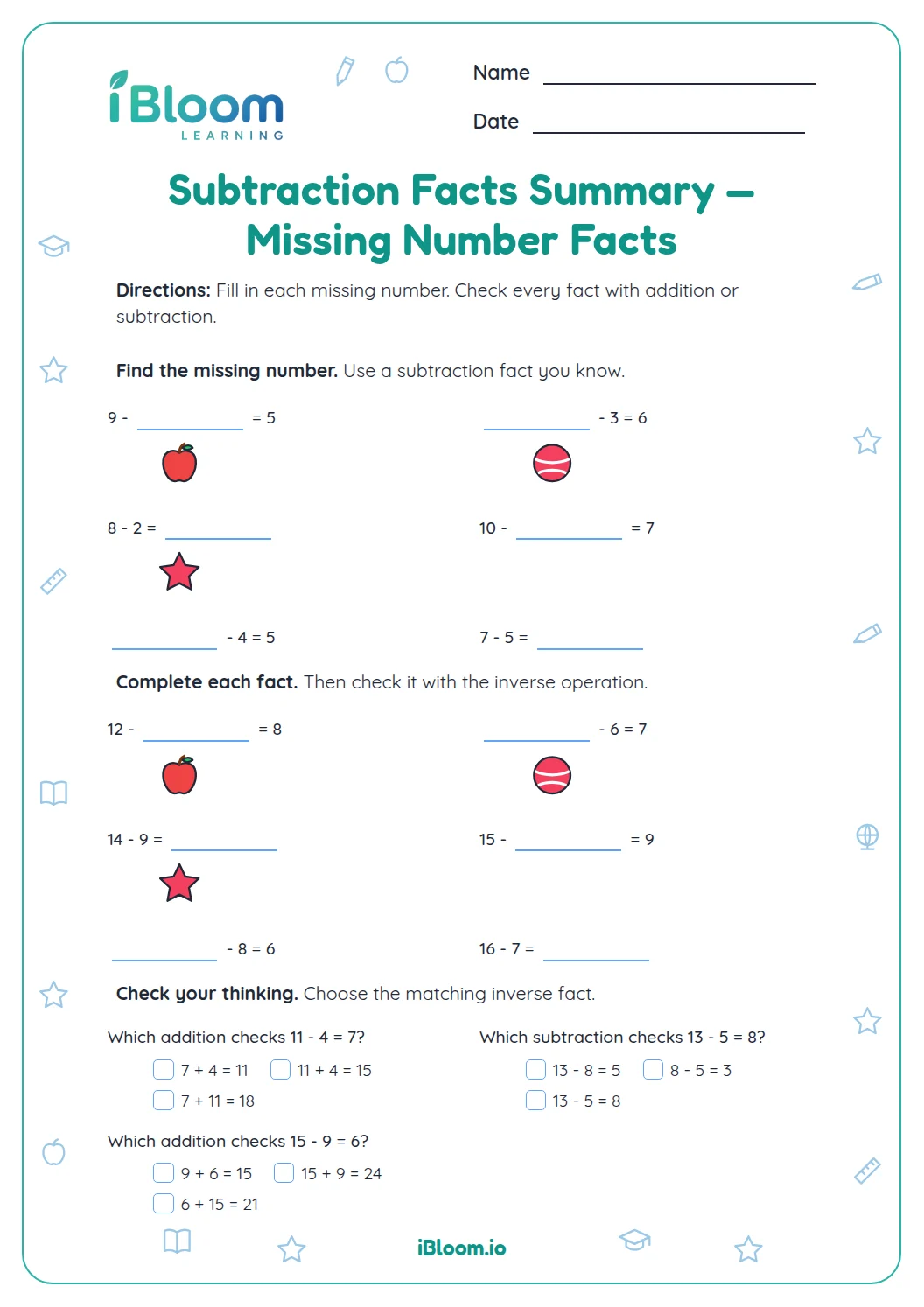
This mixed set includes facts within 10 and facts within 20. Addition can check a subtraction answer: add the difference to the number being subtracted and see whether it returns to the starting number.
- 1 13 − 6 ____ → 7, because 6 + 7 = 13.
How can addition check a difference?
Use the relationship between subtraction and addition. For 15 − 8 = 7, check that 8 + 7 = 15. If the sum does not match the starting number, revisit the subtraction.
How to use this worksheet
- 1Read the top number and the number being subtracted.
- 2Subtract the lower ones digit from the top number.
- 3Write the difference in the answer space.
- 4Check by adding the difference to the number subtracted.
- 5Use the key to review any fact that needs another try.
Common mistakes and quick fixes
The mistake
Subtracting the larger digit from the smaller one
The fix
The top number is the starting amount. Ask how many remain after taking away the lower number.
The mistake
Forgetting to check the operation sign
The fix
Read the minus sign before solving each fact; addition checks the result but is not the operation to perform.
The mistake
Rushing teen facts
The fix
Think of the missing addend: for 17 − 9, ask what goes with 9 to make 17.
Common Core alignment
The facts build fluency with subtraction within 20 and use addition to check differences.
Build fluency with subtraction facts and use strategies within 20.
On this sheet: The fact practice builds subtraction fluency within 20, including several facts within 10.
Show the official wordingHide the official wording
Add and subtract within 20, demonstrating fluency for addition and subtraction within 10. Use strategies such as counting on; making ten (e.g., 8 + 6 = 8 + 2 + 4 = 10 + 4 = 14); decomposing a number leading to a ten (e.g., 13 - 4 = 13 - 3 - 1 = 10 - 1 = 9); using the relationship between addition and subtraction (e.g., knowing that 8 + 4 = 12, one knows 12 - 8 = 4); and creating equivalent but easier or known sums (e.g., adding 6 + 7 by creating the known equivalent 6 + 6 + 1 = 12 + 1 = 13).
What to practice next
Make more practice
Further reading
Questions parents and teachers ask
What number range do the facts use?
Every subtraction fact stays within 20. The page includes a mix of facts with starting numbers from 10 through 19, including facts within 10 as well as teen-number facts. Students practice solving the difference rather than filling a missing number.
How many problems are on the drill?
There are 16 subtraction questions on the practice sheet. Each is an equation with room to work, and the separate answer key gives one difference for every item. Students can work at a comfortable pace, then check results and retry any facts that were difficult.
How can a student check a subtraction answer?
Add the difference to the number being subtracted. For example, if 15 − 8 is 7, check 8 + 7 = 15. If the addition returns to the starting number, the difference is consistent with the subtraction fact.
Are the subtraction facts in a pattern?
The facts appear in mixed order, so each equation must be read on its own. Starting numbers vary from 10 through 19, and the subtrahends vary as well. This gives practice recalling the fact, noticing the minus sign, and checking with the related addition fact.
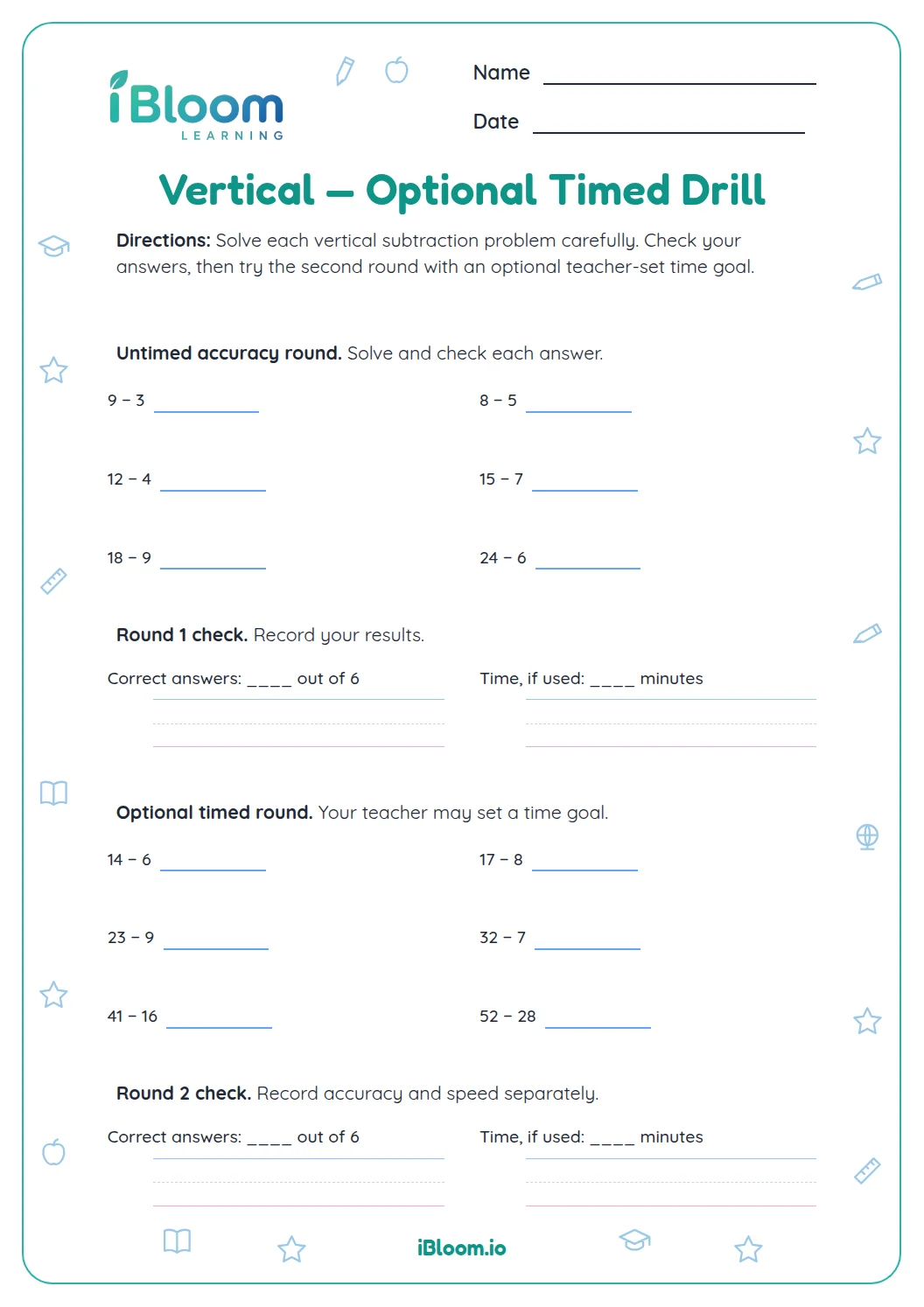
Should this be a timed drill?
Students can complete the page without a timer. If a teacher or caregiver chooses to time a repeat attempt, the goal can be steady, accurate work rather than speed alone. The printed directions focus on solving and checking each fact.