






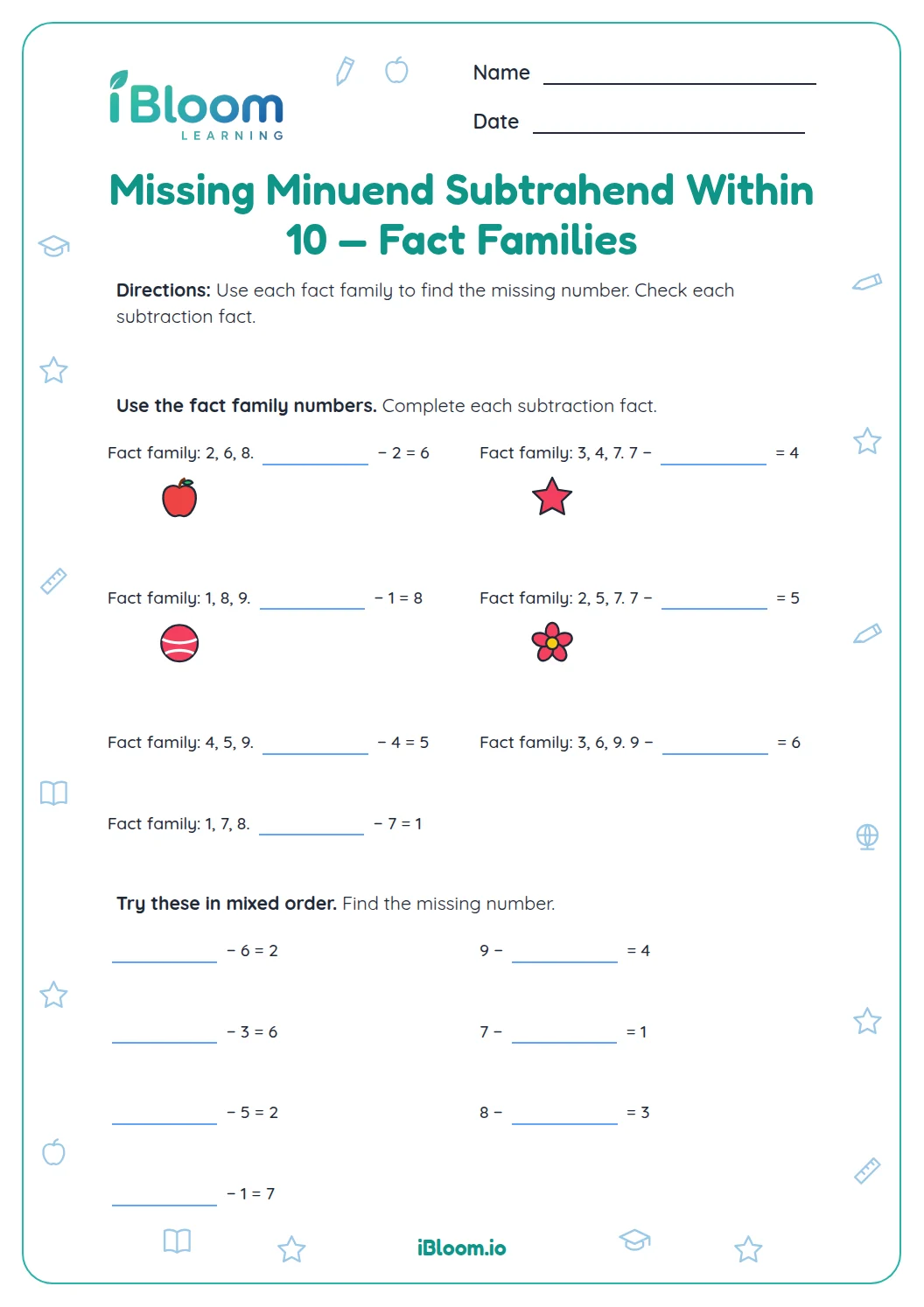
About this worksheet
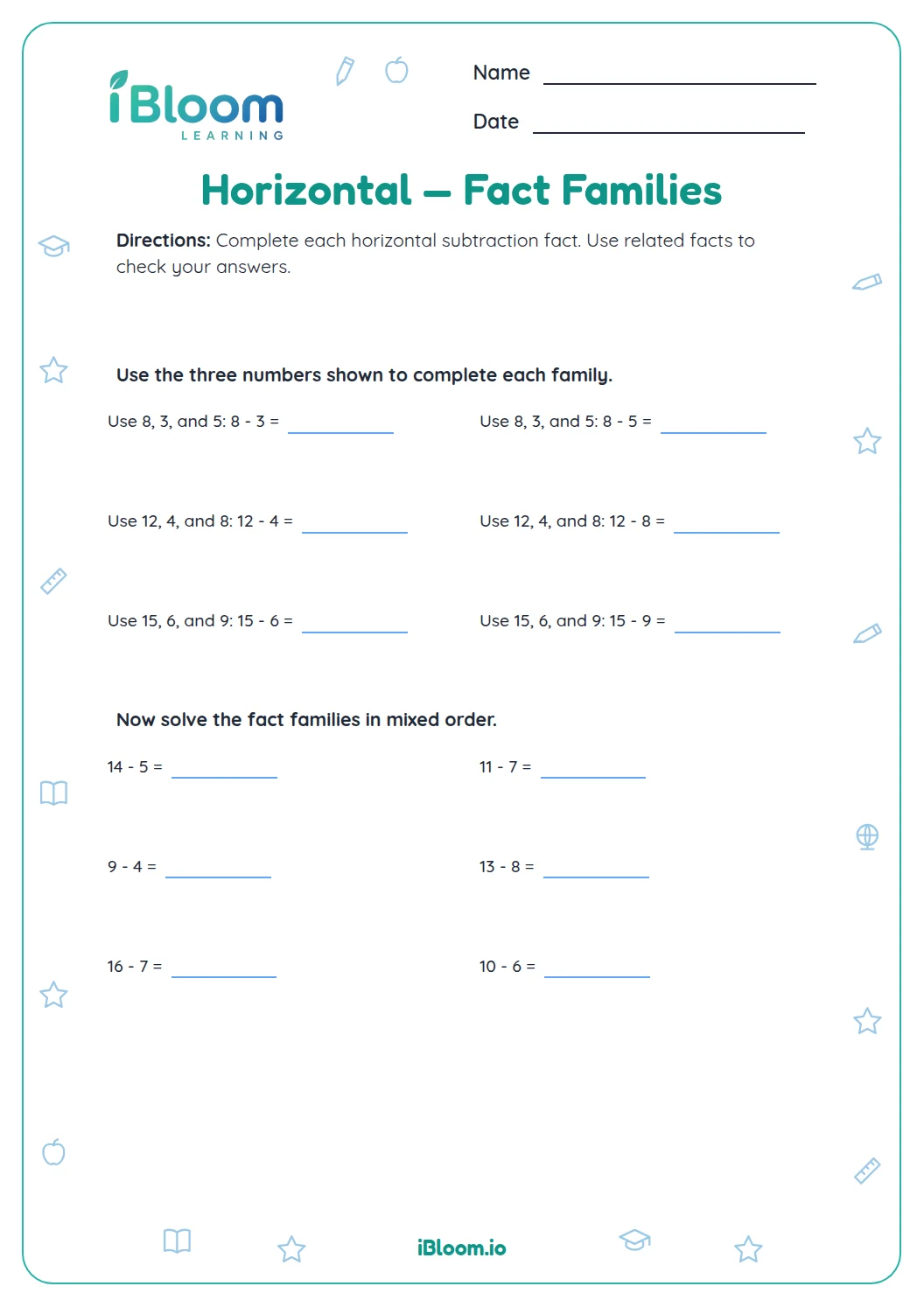
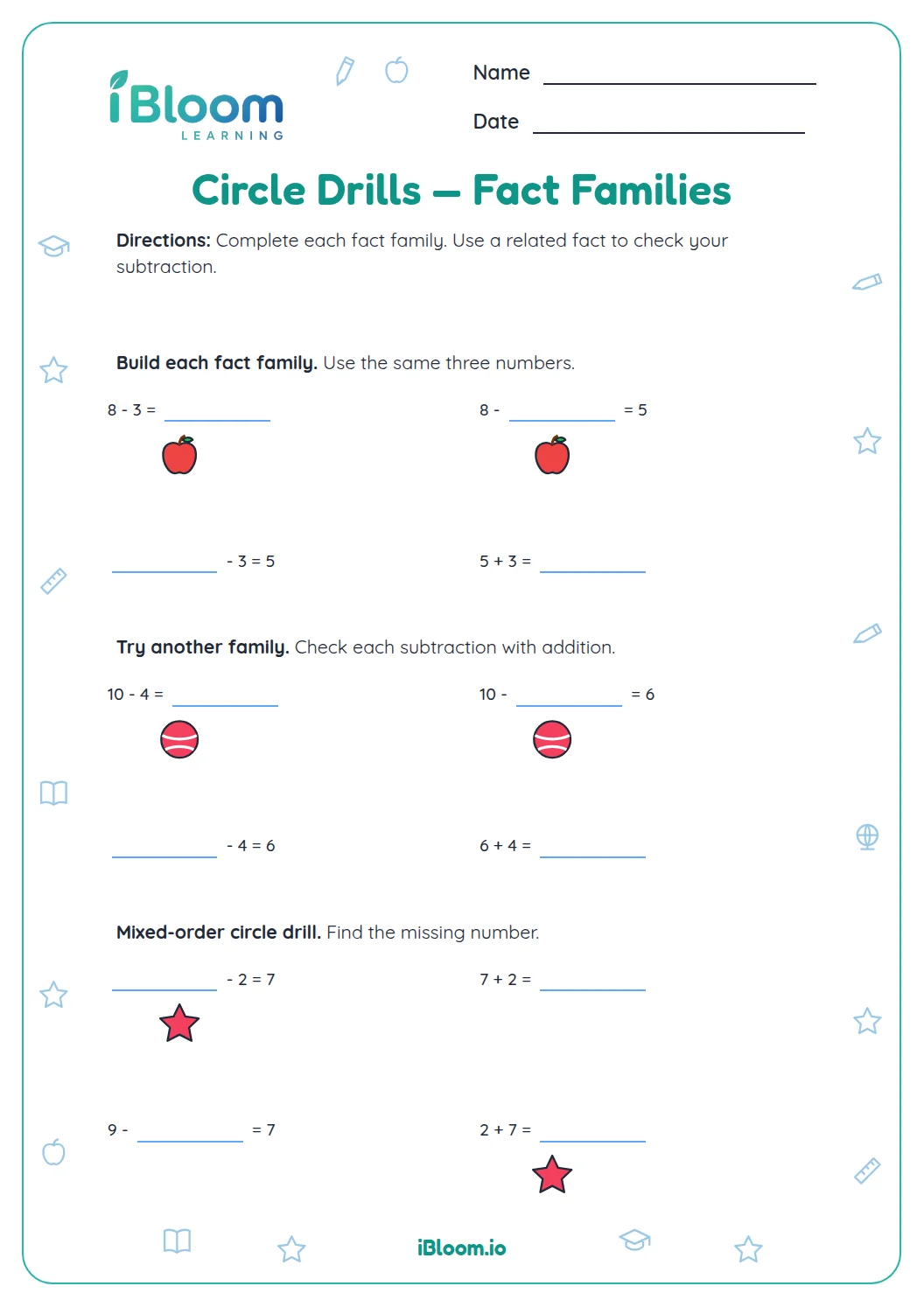
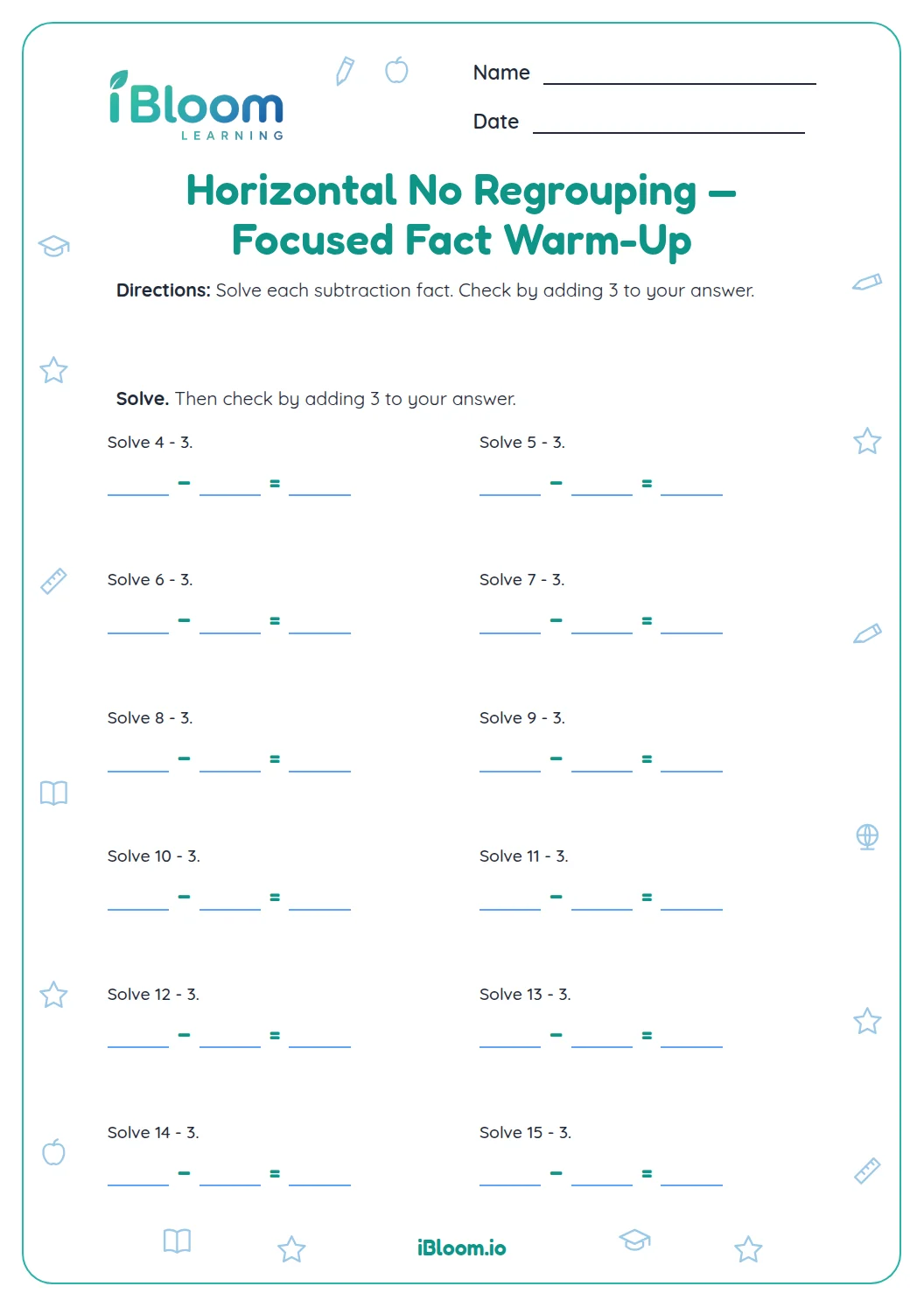
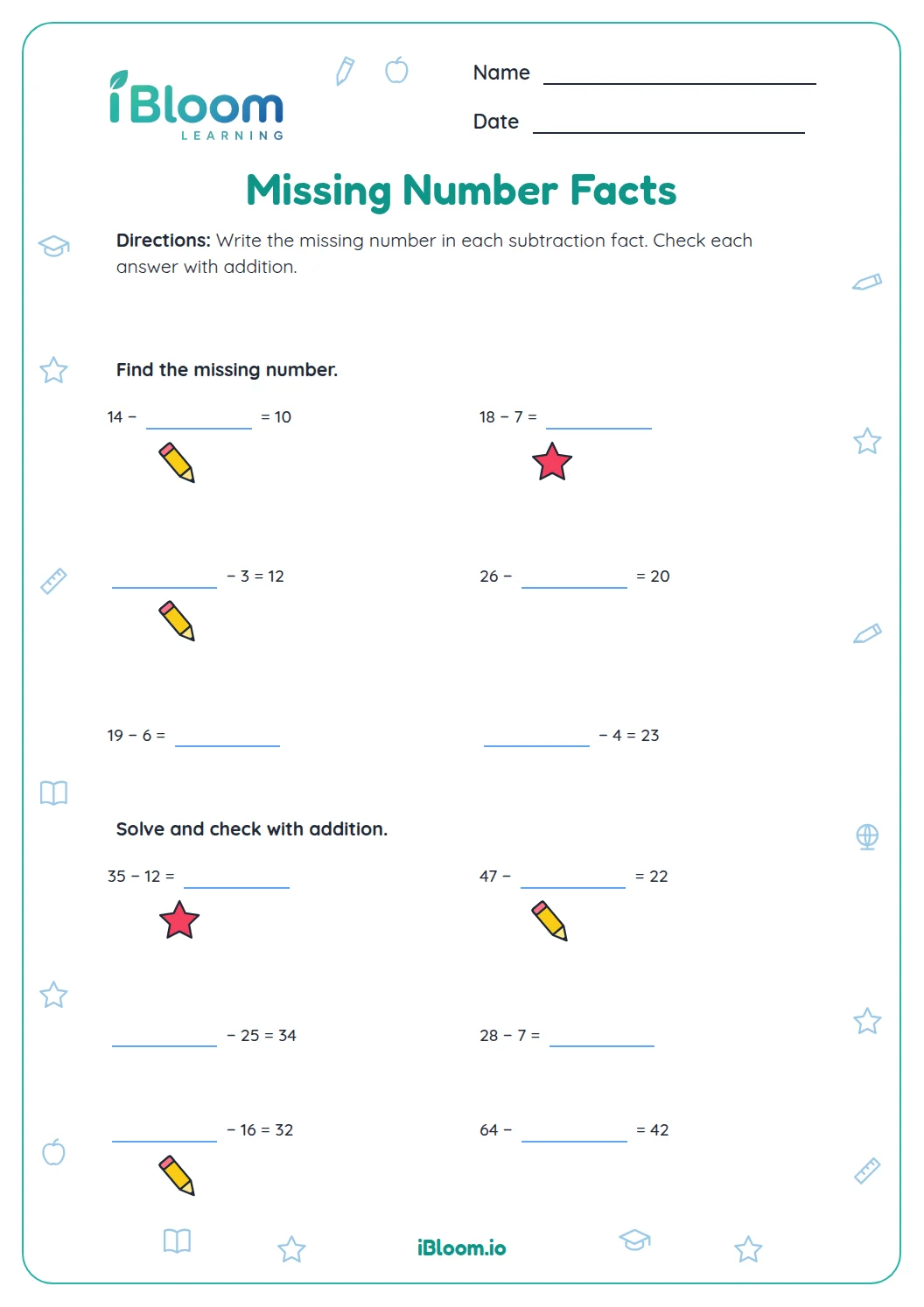
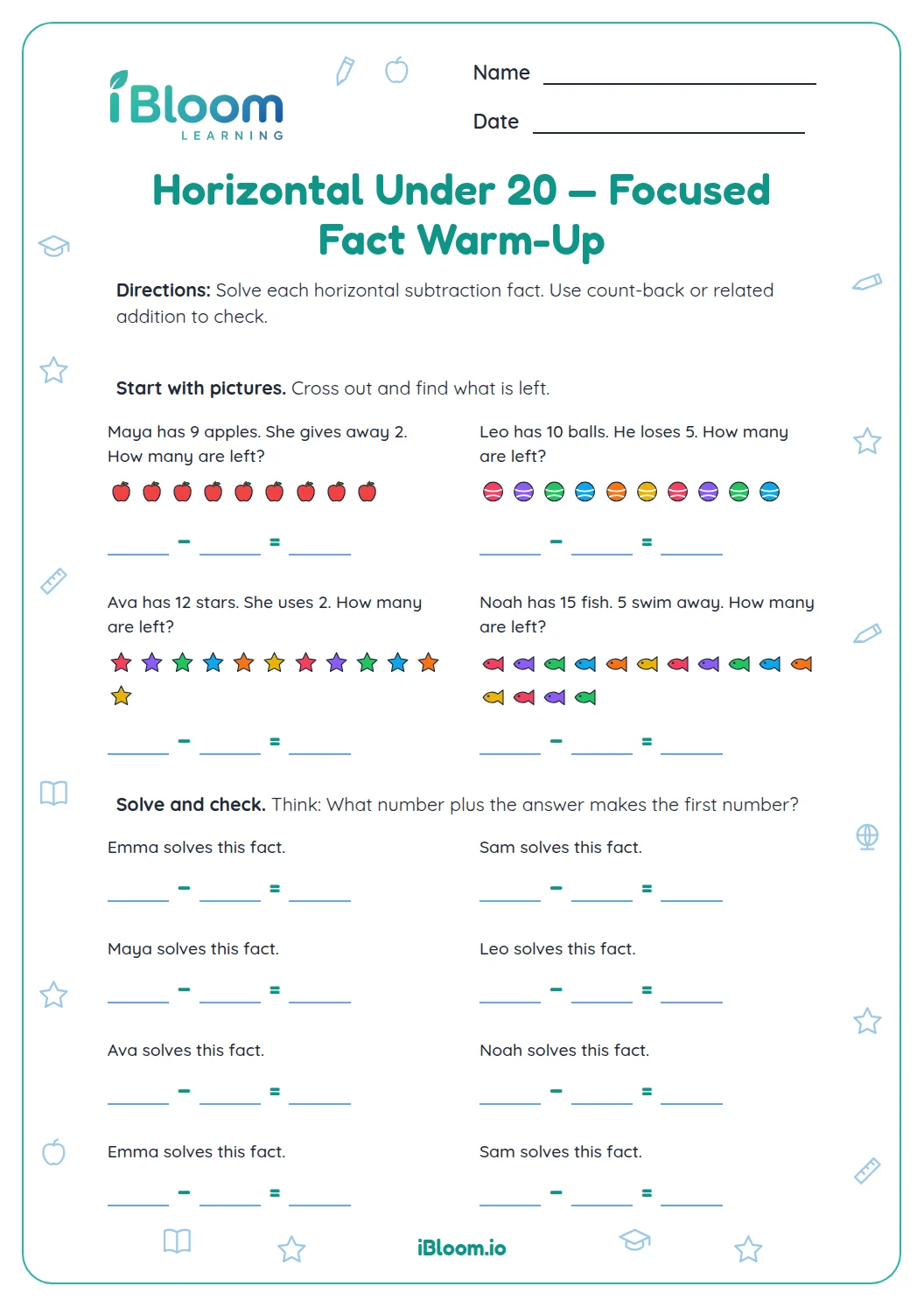
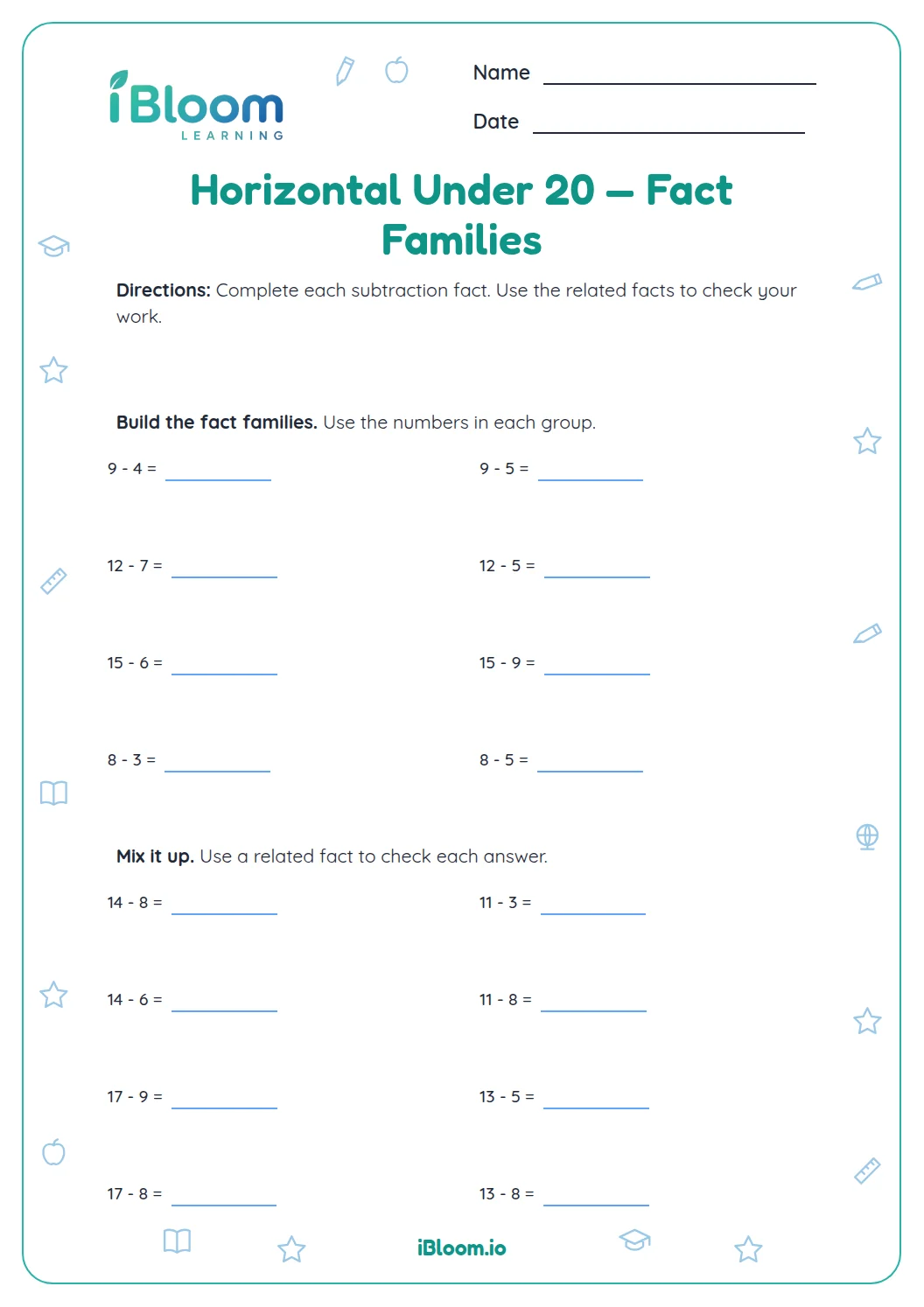
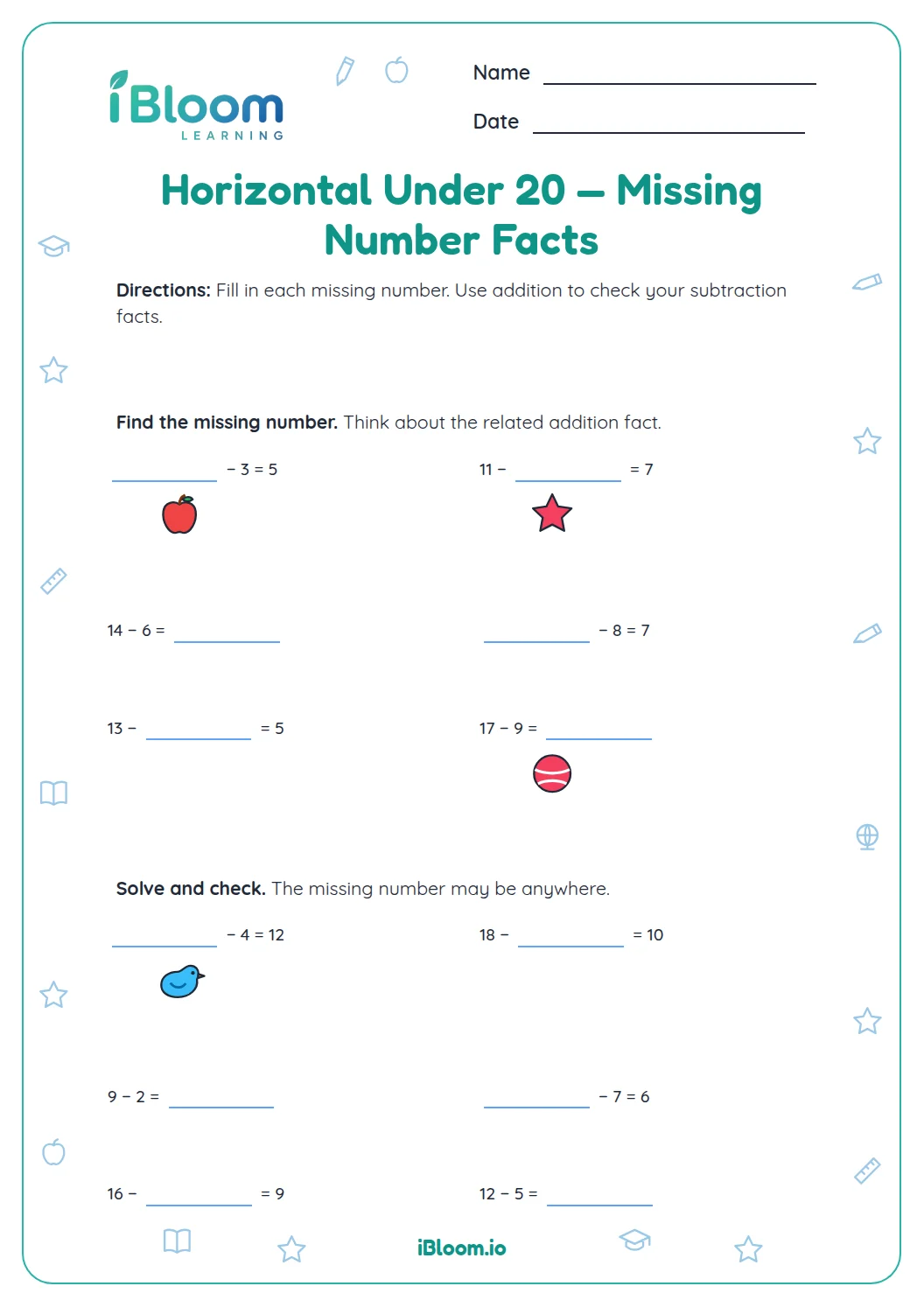
This printable gives Grade 1 and Grade 2 learners 19 horizontal subtraction facts in mixed order and one solve-and-check item. The facts stay within 20 and include differences across the full range, so students practice retrieving facts rather than following a repeated sequence. The worksheet spans two pages with a separate answer key. It supports CCSS 1.OA.C.6.
Aligned to 1.OA.C.6
Which strategy can help with a subtraction fact?
A child can count back, break apart a number to reach ten, or use a related addition fact. For 12 − 5, think 12 − 2 = 10, then take away 3 more to get 7. A familiar strategy can help a child check a fact they are still learning.
- 112 − 5
- 212 − 2 = 10
- 310 − 3 = 7
- 4So, 12 − 5 = 7
Why are the facts in mixed order?
When facts appear in a predictable sequence, students may rely on the pattern instead of recalling each difference. Mixed order gives practice shifting between different minuends and subtrahends. The 19 horizontal facts include minuends from small numbers up to 20.
- Part A: ten subtraction facts in mixed order
- Part B: nine more mixed-order facts and one addition-check item
- Timing is optional; accuracy comes first
How should students check their work?
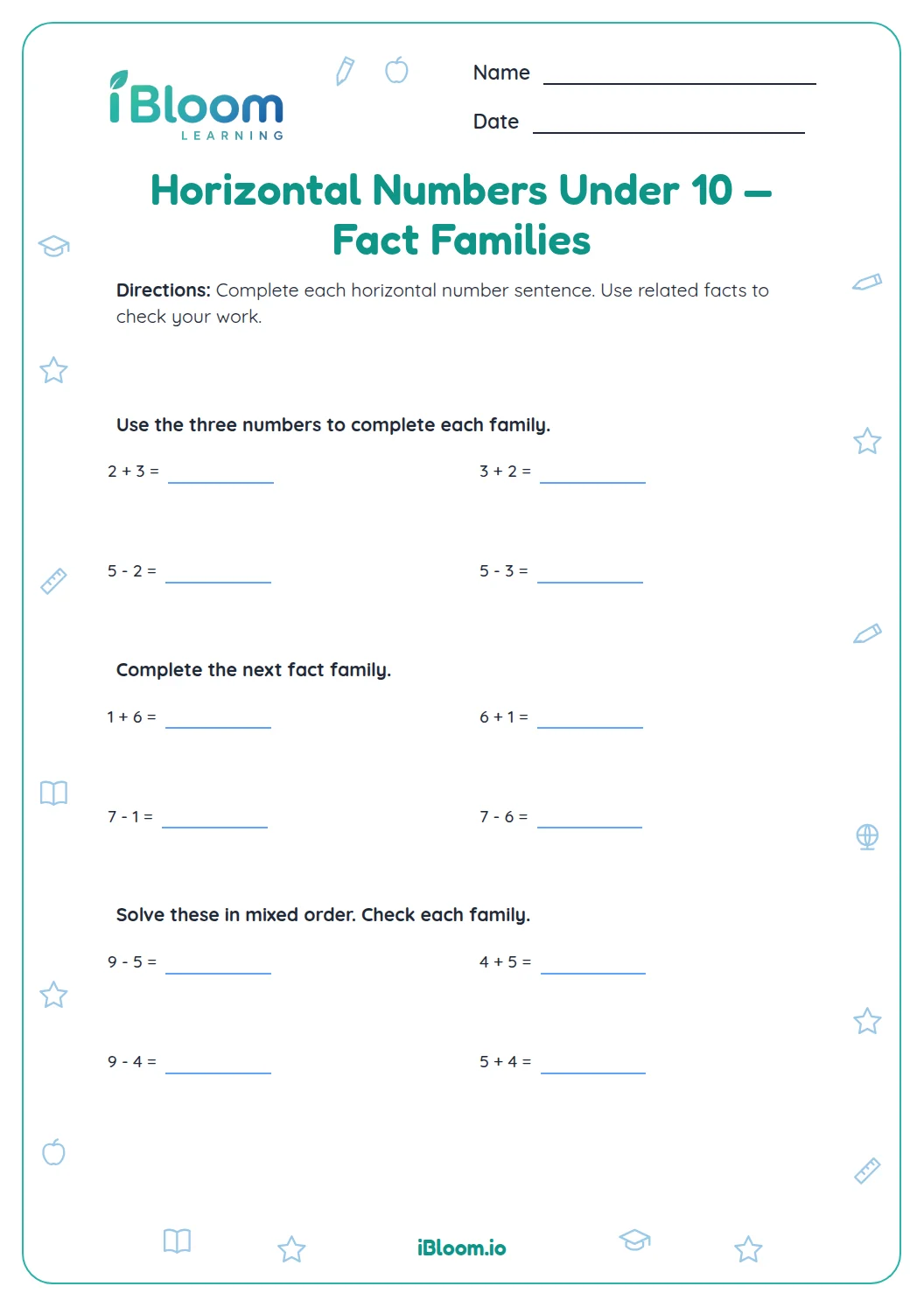
Use addition to check subtraction: add the difference to the number being subtracted. For example, 7 + 5 returns 12, confirming 12 − 5 = 7. Students can also compare their answers with the separate key.
How to use this worksheet
- 1Read the subtraction sign before solving.
- 2Choose a strategy you know, such as counting back or making ten.
- 3Write one difference in each blank.
- 4Check by adding the difference and subtrahend.
- 5Use a timer only if it feels helpful.
Common mistakes and quick fixes
The mistake
Treating the subtrahend as the answer.
The fix
Subtract it from the starting number and check with addition.
The mistake
Counting back one too many or too few.
The fix
Say the starting number first, then count back the number of steps.
The mistake
Rushing because a timer is present.
The fix
Timing is optional; accurate answers are the goal of this practice.
Common Core alignment
These facts support accurate subtraction within 20.
Subtract within 20 and use strategies to build fluency.
On this sheet: Students practice mixed subtraction facts within 20 and can check with addition.
Show the official wordingHide the official wording
Add and subtract within 20, demonstrating fluency for addition and subtraction within 10. Use strategies such as counting on; making ten (e.g., 8 + 6 = 8 + 2 + 4 = 10 + 4 = 14); decomposing a number leading to a ten (e.g., 13 - 4 = 13 - 3 - 1 = 10 - 1 = 9); using the relationship between addition and subtraction (e.g., knowing that 8 + 4 = 12, one knows 12 - 8 = 4); and creating equivalent but easier or known sums (e.g., adding 6 + 7 by creating the known equivalent 6 + 6 + 1 = 12 + 1 = 13).
What to practice next
Make more practice
Further reading
Questions parents and teachers ask
Is the timed part required?
No. A timer is optional. Children can solve the 20 facts at a comfortable pace and focus on accuracy. If you use a timer, treat it as a personal check rather than a race, then review any facts that need another strategy.
What does mixed order mean here?
The facts are not arranged as a counting pattern or grouped by one subtraction number. Each item asks children to read the expression and recall or work out its difference. The worksheet has 19 horizontal facts and one related-addition check; the answer key lists the results.
How can addition help check a subtraction answer?
Add the difference to the number that was subtracted. For question 1, 12 − 5 = 7; checking gives 7 + 5 = 12. If the sum matches the starting number, the difference is correct. Question 20 asks children to show this related-fact check.
Are all answers less than 20?
Yes. Each starting number is 20 or less, and every difference is nonnegative. The facts include small differences and larger ones, so students practice a range of subtraction combinations within 20. The optional strategy check also uses values within 20.
Can my child use fingers or count back?
Yes. Counting back, using fingers, breaking a number apart, and checking with a related addition fact are useful while facts become familiar. The goal is to solve accurately and gradually recall more facts with ease. Timing is optional.