



About this worksheet
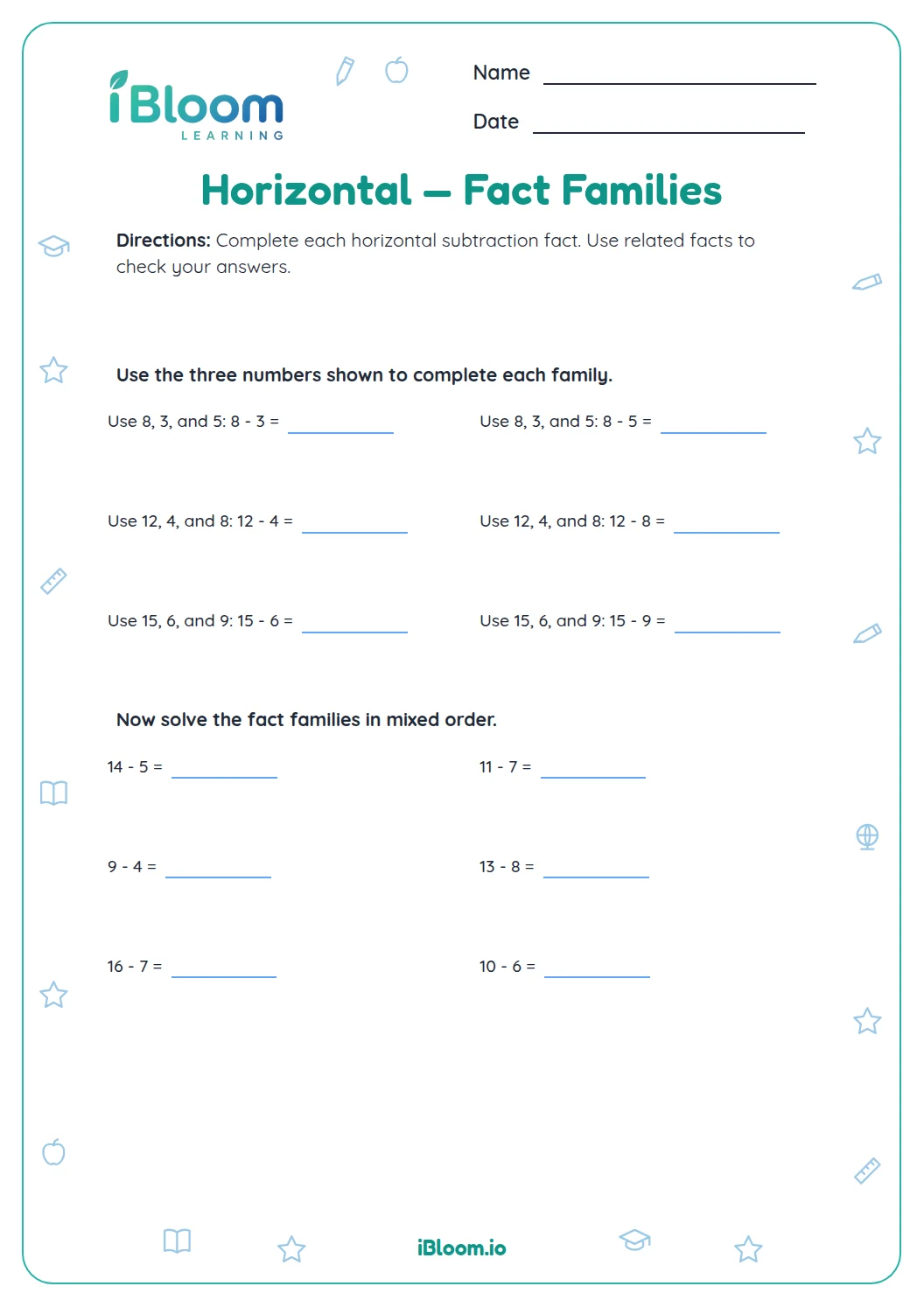
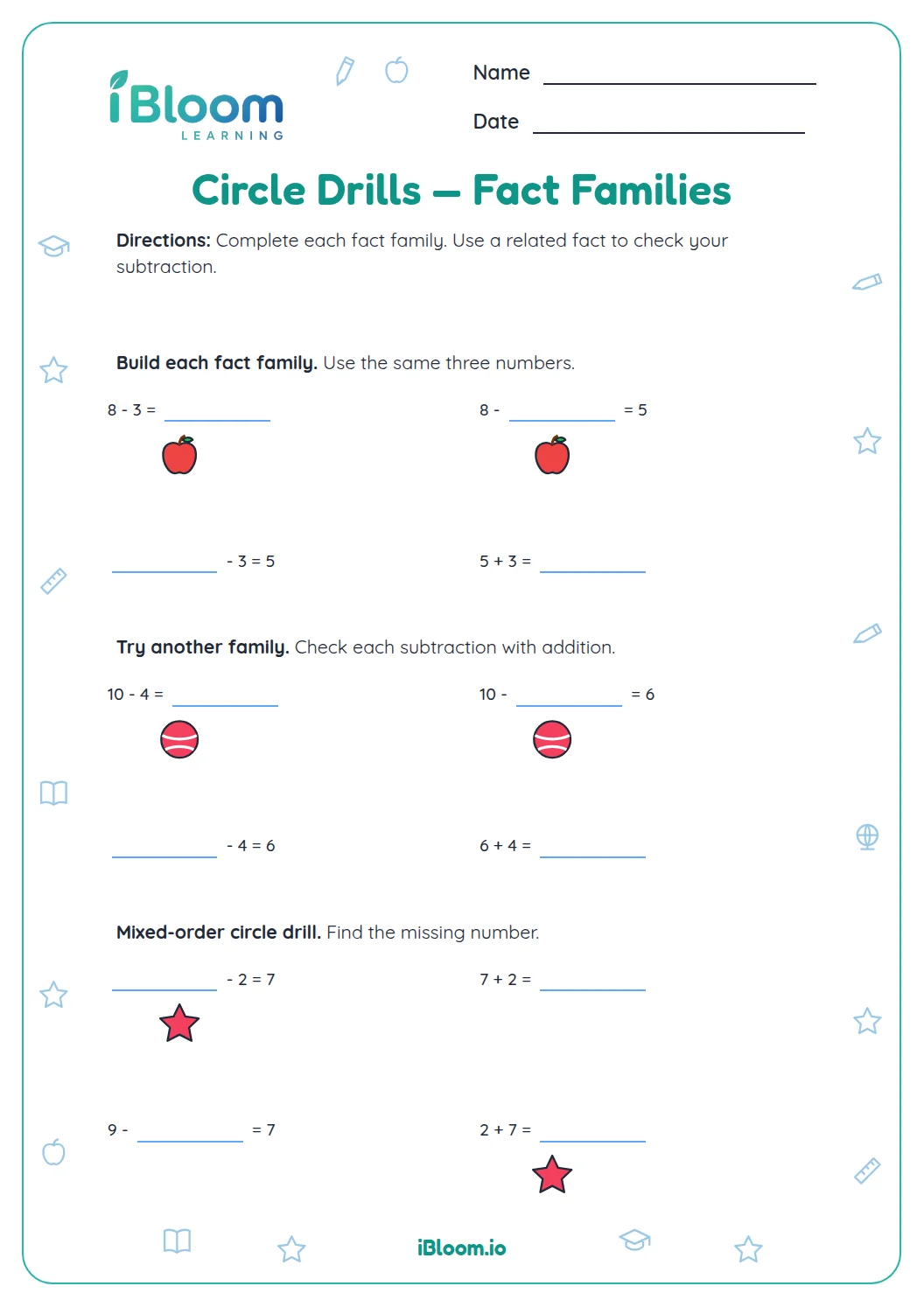
This Grade 2 printable practices horizontal subtraction facts within 20. The first part asks students to find differences; the second places the unknown in different positions so they solve for a missing number. All 18 answers make equations within 20, and the key supports checking with addition or another strategy. It practices CCSS.MATH.CONTENT.2.OA.B.2.
Aligned to CCSS.MATH.CONTENT.2.OA.B.2
How do you find each difference?
Subtract the second number from the first. Students can count back, use a known fact, or think of the related addition fact.
- 114 − 6 = 8
- 2Check with addition: 8 + 6 = 14.
How do you solve when a number is missing?
First identify the unknown: it may be the starting number or the number being subtracted. Use the complete equation to find a value that makes both sides equal.
How can you check an answer?
For a subtraction fact, add the difference and the subtrahend. The sum should match the starting number. For a missing number, substitute it into the equation and verify that the statement is true.
A quick practice routine
- 1Solve each fact at a steady pace.
- 2For missing-number equations, name which number is unknown before solving.
- 3Check a few answers with addition.
- 4Use the key to find any fact to practice again.
Check these subtraction slips
The mistake
Subtracting the smaller digit from the larger digit without considering place in the equation.
The fix
Start with the first number and count back or use a related addition fact.
The mistake
Writing the subtrahend as the difference.
The fix
Check by adding the proposed difference and subtrahend; together they should make the minuend.
Common Core alignment
The page practices subtraction facts within 20 and related unknowns.
Fluently add and subtract within 20.
On this sheet: All subtraction calculations stay within 20, including equations with an unknown.
Show the official wordingHide the official wording
Fluently add and subtract within 20 using mental strategies. By end of Grade 2, know from memory all sums of two one-digit numbers.
What to practice next
Make more practice
Further reading
Questions parents and teachers ask
What numbers does this mastery check use?
The difference is 52. Subtract 4 ones from 6 ones to get 2 ones, then subtract 3 tens from 8 tens to get 5 tens. Check the result because 52 + 34 equals 86, the original minuend.
How can a student check a difference?
Checking a claim encourages students to compute instead of copying a result. When an answer is wrong, recomputing the subtraction and using addition helps locate the error in the place-value work and explain how to repair it.
Can children use counting strategies?
The 14 items include four multiple-choice checks, six missing-difference computations, and four written corrections. The answer key gives the right result for every item, including corrected subtraction answers and the addition equations used to verify them.
Is this worksheet timed?
Add the difference and the subtrahend. If their sum equals the minuend, the subtraction is correct. For 75 − 23 = 52, check 52 + 23 = 75 to confirm the difference and show the inverse relationship.
Which numbers are missing in the second part?
No regrouping means each digit in the top number is large enough to subtract the matching digit below it. In 86 − 34, 6 is at least 4 and 8 tens is at least 3 tens, so each place can be subtracted directly.
Can a student use addition to check a subtraction answer?
Yes. Add the difference to the number that was subtracted. For 14 − 6 = 8, check that 8 + 6 equals 14. For an equation with a missing number, put the answer back in its blank and see whether the equation is true.