








About this worksheet
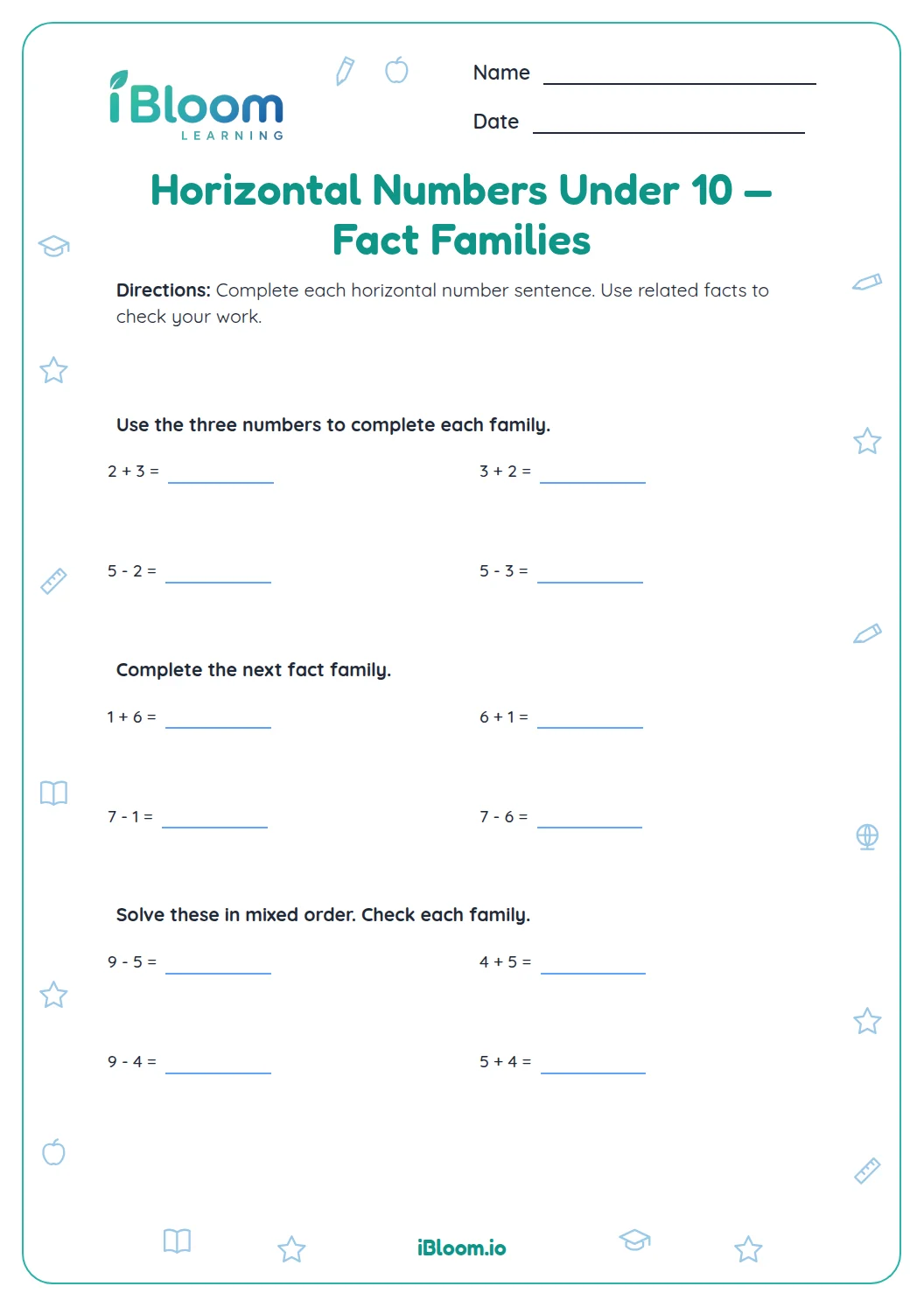
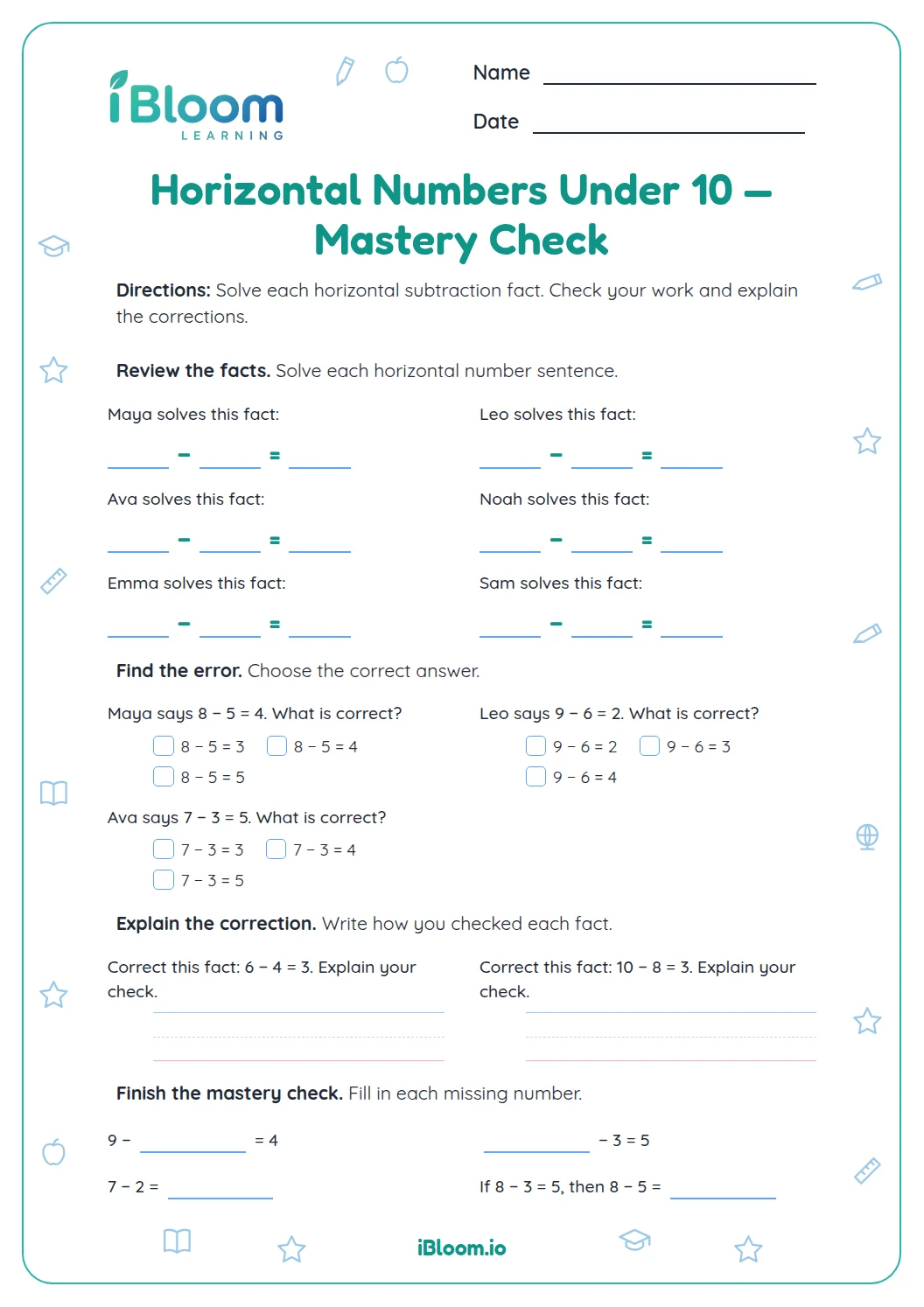
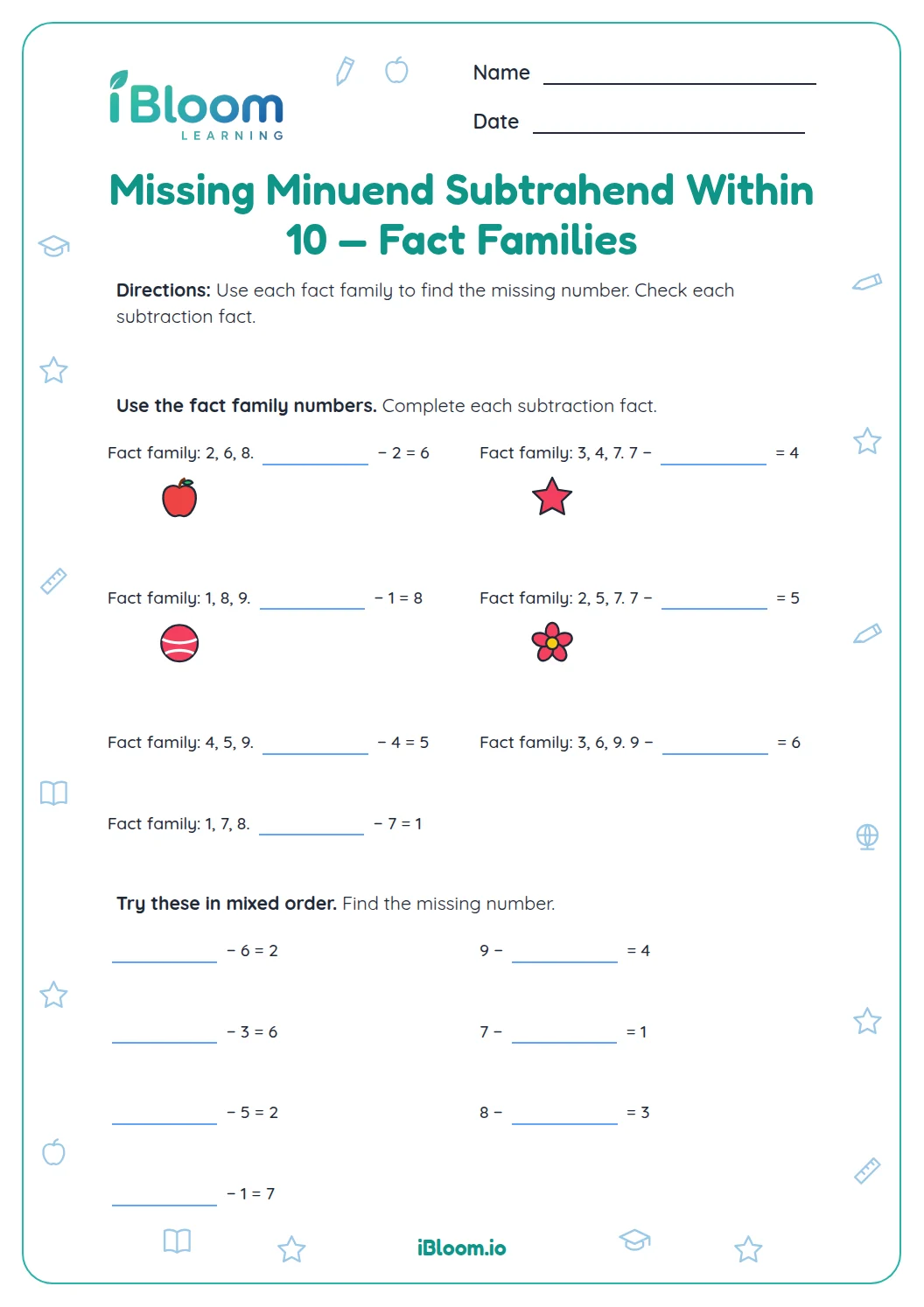
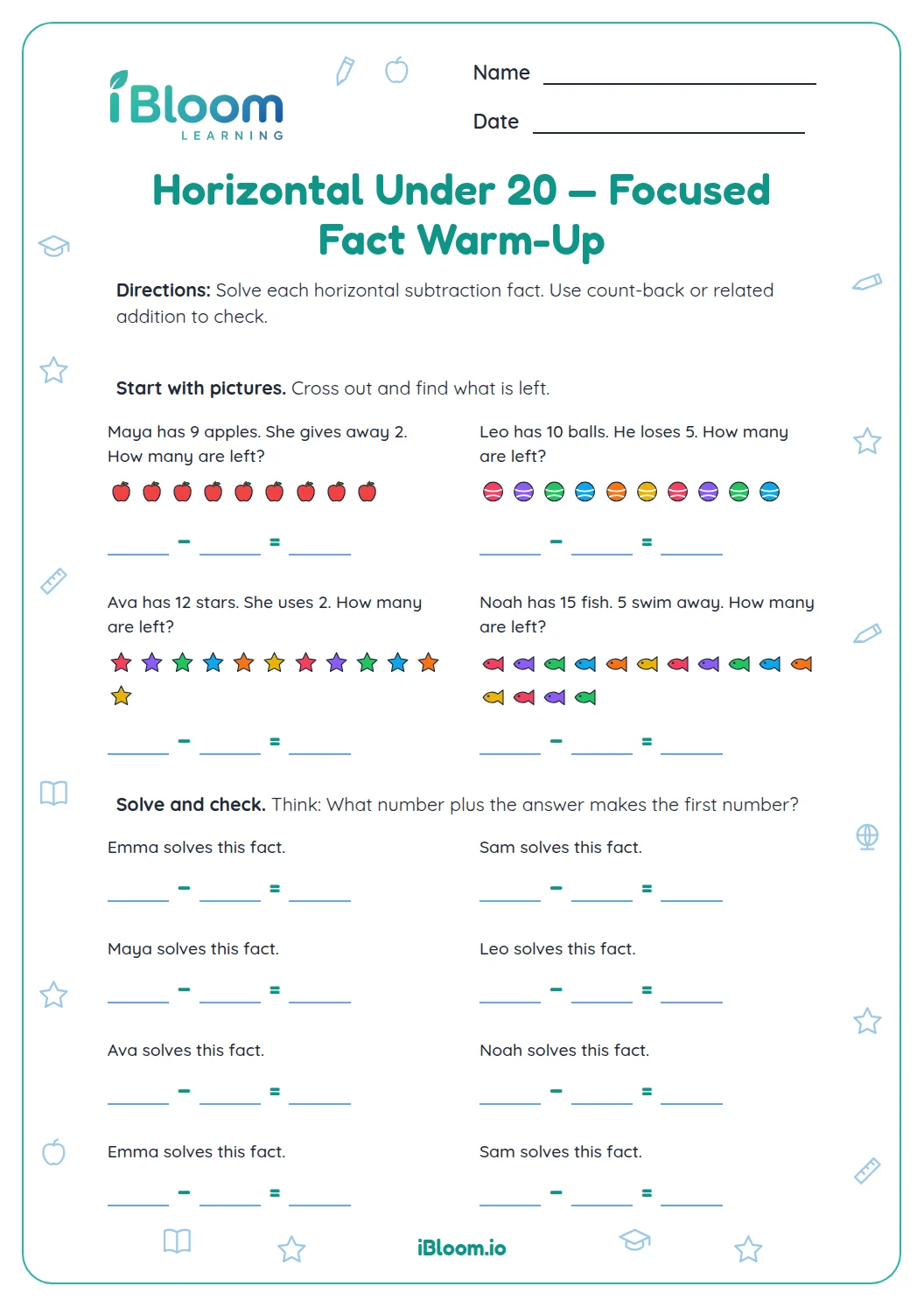
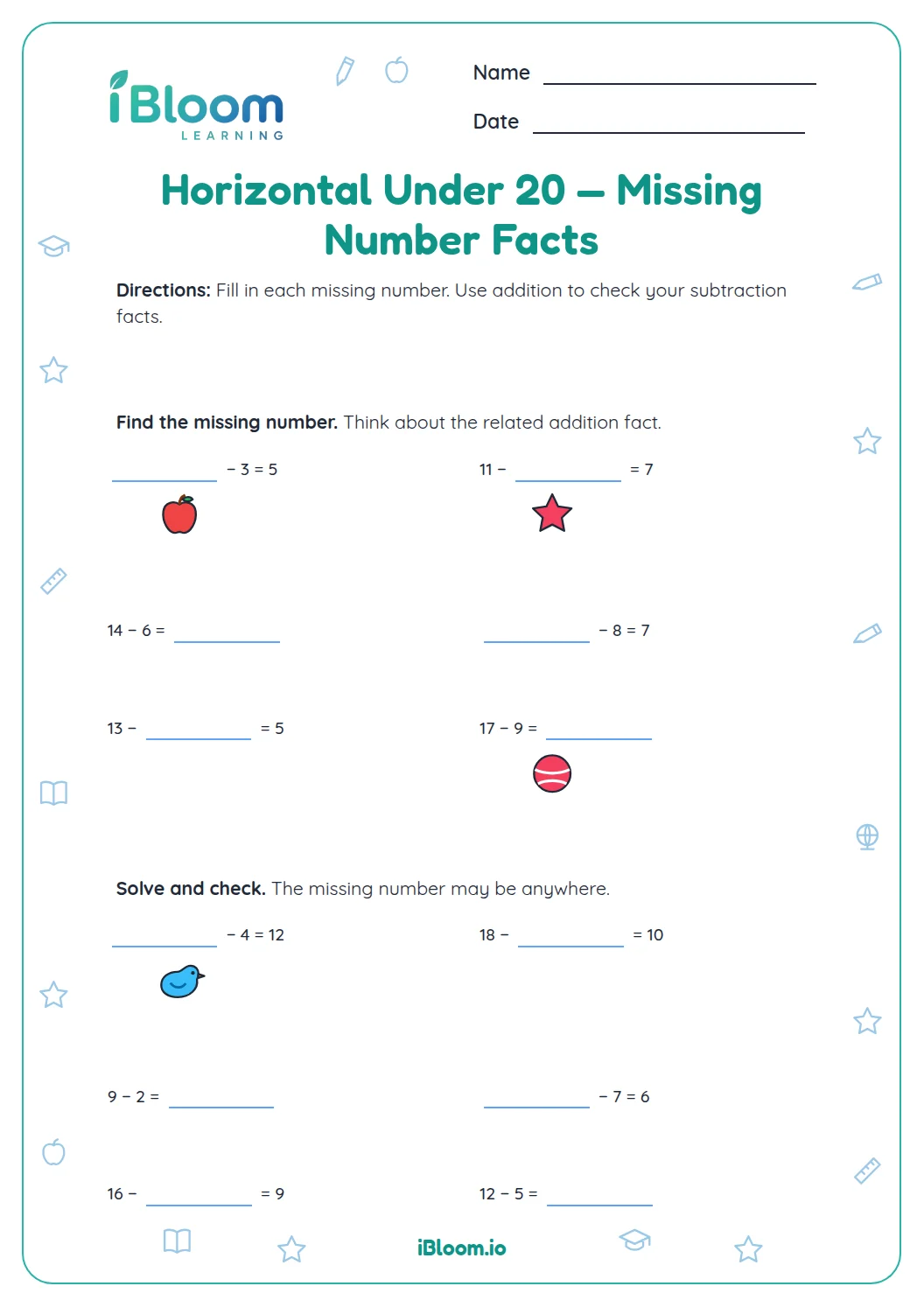
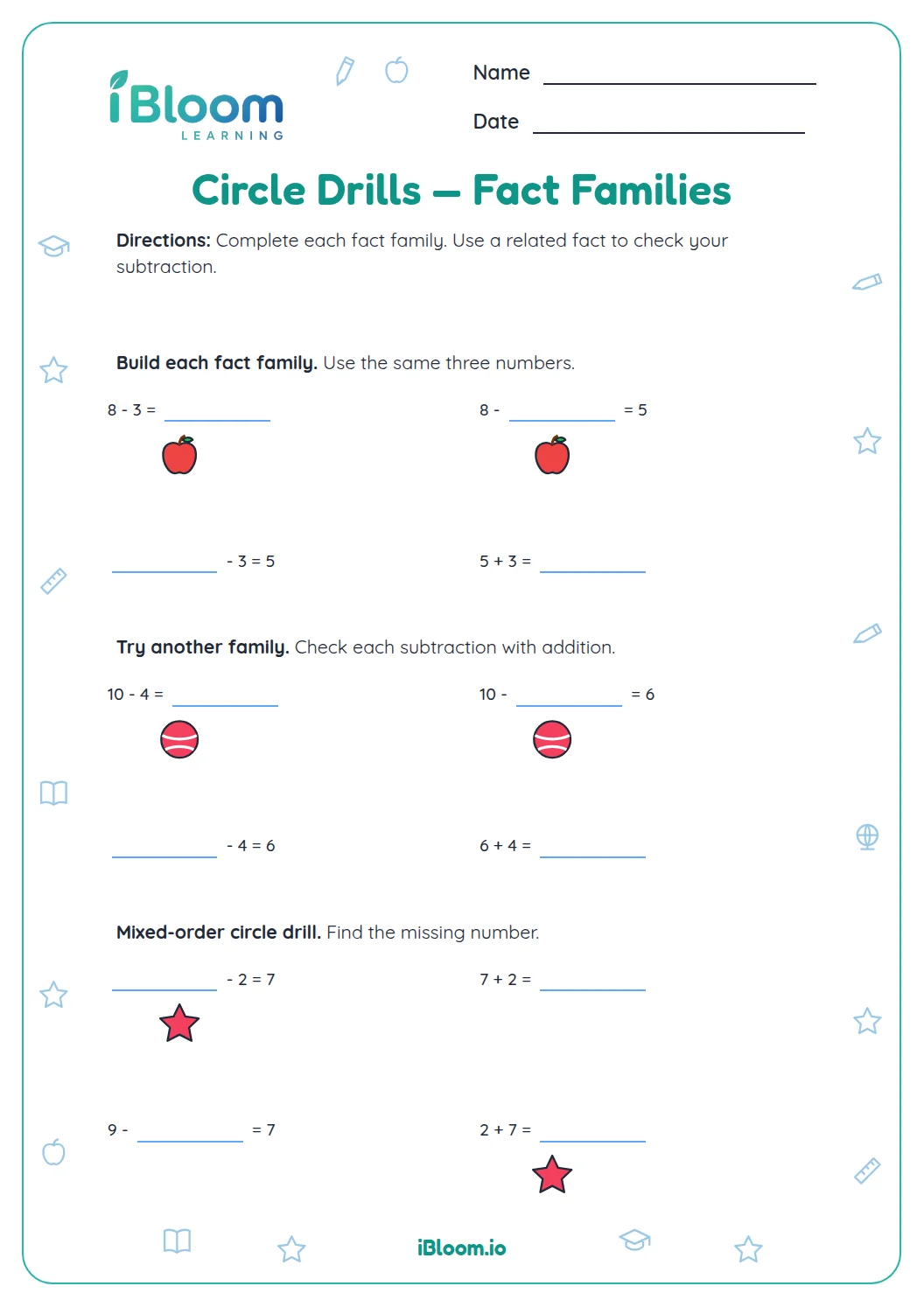
This printable subtraction drill is for learners practicing facts within 10. It has 20 horizontal equations in two parts: missing parts and missing starting numbers. Each blank has one value that makes the equation true, and the answer key gives all 20 answers.
Aligned to 1.OA.D.8
How can you find a missing subtraction number?
A subtraction equation stays true when the missing number completes the relationship. For 9 − ___ = 5, ask what added to 5 makes 9. The missing number is 4, since 5 + 4 = 9.
How do you check a subtraction fact?
For ___ − 3 = 7, add the known part and the difference: 3 + 7 = 10. Substitute 10 into the blank to check that 10 − 3 equals 7.
- 1For 9 − ___ = 5, use 5 + 4 = 9.
- 2For ___ − 3 = 7, use 3 + 7 = 10, then check 10 − 3 = 7.
What does the drill review?
Part A asks for a missing part; Part B asks for the starting number. Questions 19 and 20 add an explicit check with addition. All 20 equations use numbers from 0 through 10.
How to solve a missing-number fact
- 1Read the equation and locate the blank.
- 2For a missing part, compare the starting number and the difference.
- 3For a missing starting number, add the known part and difference.
- 4Substitute the answer and verify the subtraction.
- 5Check all 20 answers with the key when done.
Common mistakes and quick fixes
The mistake
Subtracting the difference from the starting number even when the blank is the starting number.
The fix
For ___ − 3 = 7, add 3 and 7 to find 10.
The mistake
Writing the known difference in the missing-part blank.
The fix
Use the related addition fact to find the part that was taken away.
The mistake
Leaving a blank when the missing number is zero.
The fix
Check equal numbers: 5 − 0 = 5.
Common Core alignment
This worksheet practices the listed skill through its questions.
Find an unknown number in an addition or subtraction equation.
On this sheet: Find the unknown whole number in subtraction equations with numbers within 10.
Show the official wordingHide the official wording
Determine the unknown whole number in an addition or subtraction equation relating three whole numbers.
What to practice next
Make more practice
Further reading
Questions parents and teachers ask
How can addition help find a missing subtraction number?
Use the related addition fact. For 9 − ___ = 5, ask what number added to 5 makes 9. Since 5 + 4 = 9, the missing number is 4. Substitution confirms that 9 − 4 equals 5, so the original equation is true.
Are the facts within 10?
Yes. The facts use numbers from 0 through 10. The worksheet includes missing parts, such as 9 − ___ = 2, and missing starting numbers, such as ___ − 3 = 7. Each item has a single whole-number answer.
How do you find a missing starting number?
When the starting number is missing, add the number being subtracted to the difference. For ___ − 3 = 7, calculate 3 + 7 = 10. Then check 10 − 3 = 7. This inverse-operation strategy works for the starting-number facts on the sheet.
What is in the answer key?
The separate answer key lists the missing number for each of the 20 equations. Learners can compare answers after working and use addition to check any fact that felt uncertain. The last two problems explicitly ask learners to check with addition.
What does the horizontal format help learners practice?
Each equation appears on one line, so learners can focus on the operation and the location of the blank. Some blanks stand for the amount taken away, while others stand for the starting amount. Reading the equation first helps select the right strategy.