





About this worksheet
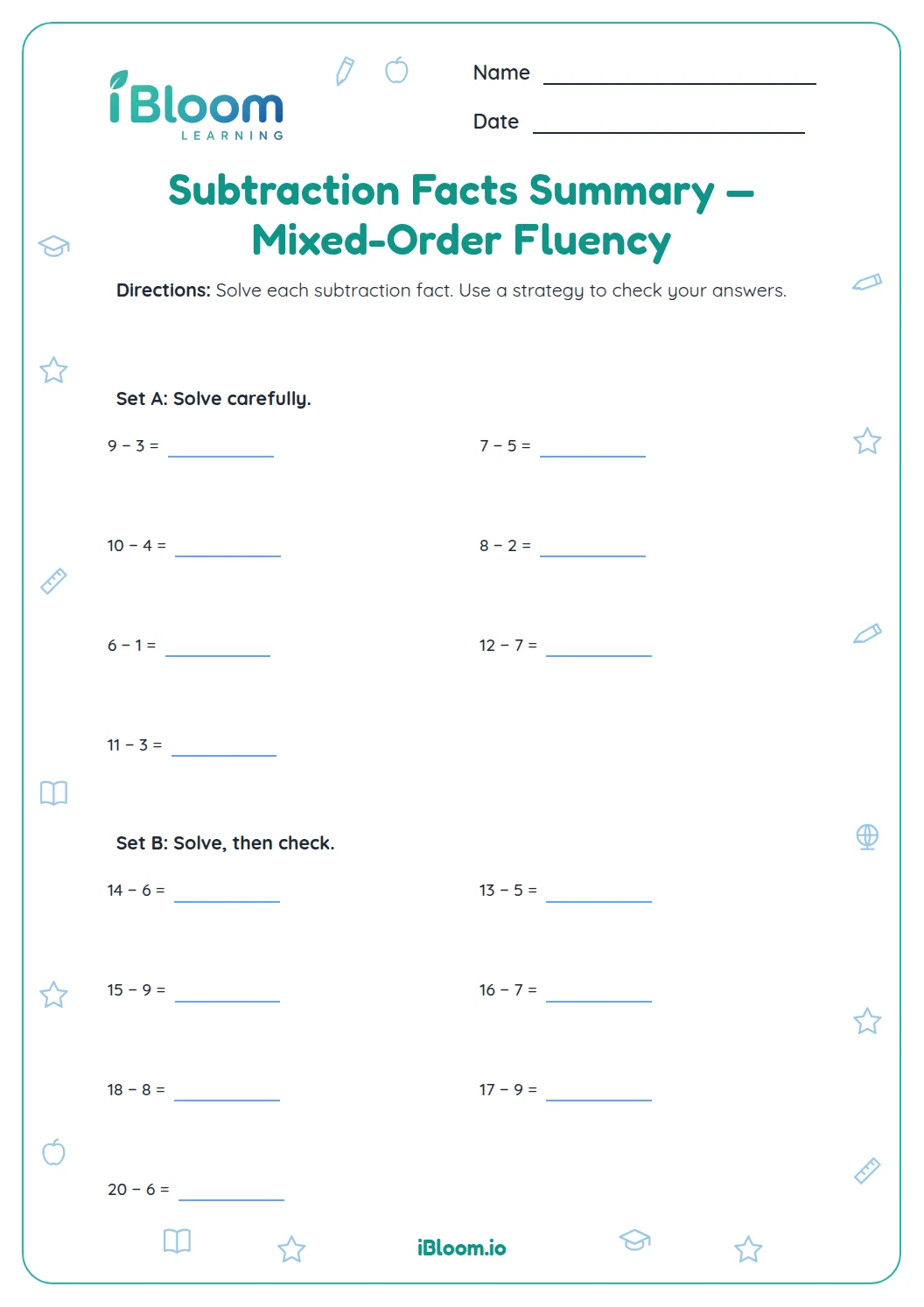
This printable gives Grade 1 and Grade 2 learners 20 mixed-order subtraction facts within 10. The set includes zero facts, equal-number facts, and other subtraction combinations in an unpredictable order. Students can use a related addition fact to check a difference. The two-page worksheet includes room to solve, and a separate answer key lists each result. It supports CCSS 2.OA.B.2 fluency with addition and subtraction within 20.
Aligned to 2.OA.B.2
How does mixed order build fact fluency?
The facts appear in an unpredictable order, so a learner must read each pair rather than follow a counting pattern. A related addition fact can help find or check a difference.
- 19 − 4 = ___
- 2Think: 4 + 5 = 9
- 3So 9 − 4 = 5
How can a child check a difference?
Add the difference to the number being subtracted. For question 1, 5 + 4 returns 9, the starting number. If it does not, review the subtraction.
Which facts get extra attention?
The set includes subtracting zero and subtracting a number from itself, alongside other facts within 10. These examples make it easy to notice when the answer stays the same or becomes zero.
How to use this worksheet
- 1Read the subtraction sign before choosing a strategy.
- 2Think of a related addition fact when it helps.
- 3Write one difference in each blank.
- 4Check a few answers by adding the subtrahend back.
- 5Use the key to find any fact to practice again.
Common mistakes and quick fixes
The mistake
Subtracting in the wrong direction
The fix
Name the starting number first; the difference must be no greater than it.
The mistake
Changing the sign in a zero fact
The fix
Taking away zero leaves the starting number unchanged.
The mistake
Skipping a fact when moving quickly
The fix
Point to each item and mark it only after writing its answer.
Common Core alignment
This fluency practice aligns with the Grade 2 operations standard.
Use mental strategies to add and subtract within 20.
On this sheet: Learners solve subtraction facts within 20 and check with related addition.
Show the official wordingHide the official wording
Fluently add and subtract within 20 using mental strategies. By end of Grade 2, know from memory all sums of two one-digit numbers.
What to practice next
Make more practice
Further reading
Questions parents and teachers ask
How many problems are on the sheet?
There are 20 subtraction facts, all within 10. The mixed order includes zero facts, equal-number facts, and other combinations. Learners can use a related addition fact to check a difference. Invite the child to explain one check before reviewing the remaining answers with the key.
Can a student use addition to solve these?
Yes. A related addition fact can help find a difference. For example, 1 + 9 = 10 helps solve 10 − 1 = 9. Learners can check many answers this way after solving. This check helps connect subtraction and addition instead of treating each fact as an isolated problem.
Does the worksheet include an answer key?
Yes. The separate two-page answer key gives the difference for each of the 20 numbered questions. Check after completing the worksheet, then revisit any facts that need more practice. Invite the learner to explain one answer aloud and use addition to check a few more.
How long should this take?
Plan for about 15 minutes, with extra time if the learner writes addition checks beside several facts. A steady pace matters more than timing, speed, or finishing before a classmate. If a fact feels difficult, pause to use counters or a number path, then return to the mixed-order practice.
What should I do with missed facts?
Ask the learner to build the fact with counters or say the related addition sentence. Then cover the answer and try that same fact again later to strengthen recall and confidence. A quick oral review of missed facts can help the learner notice which number relationships are already familiar.