
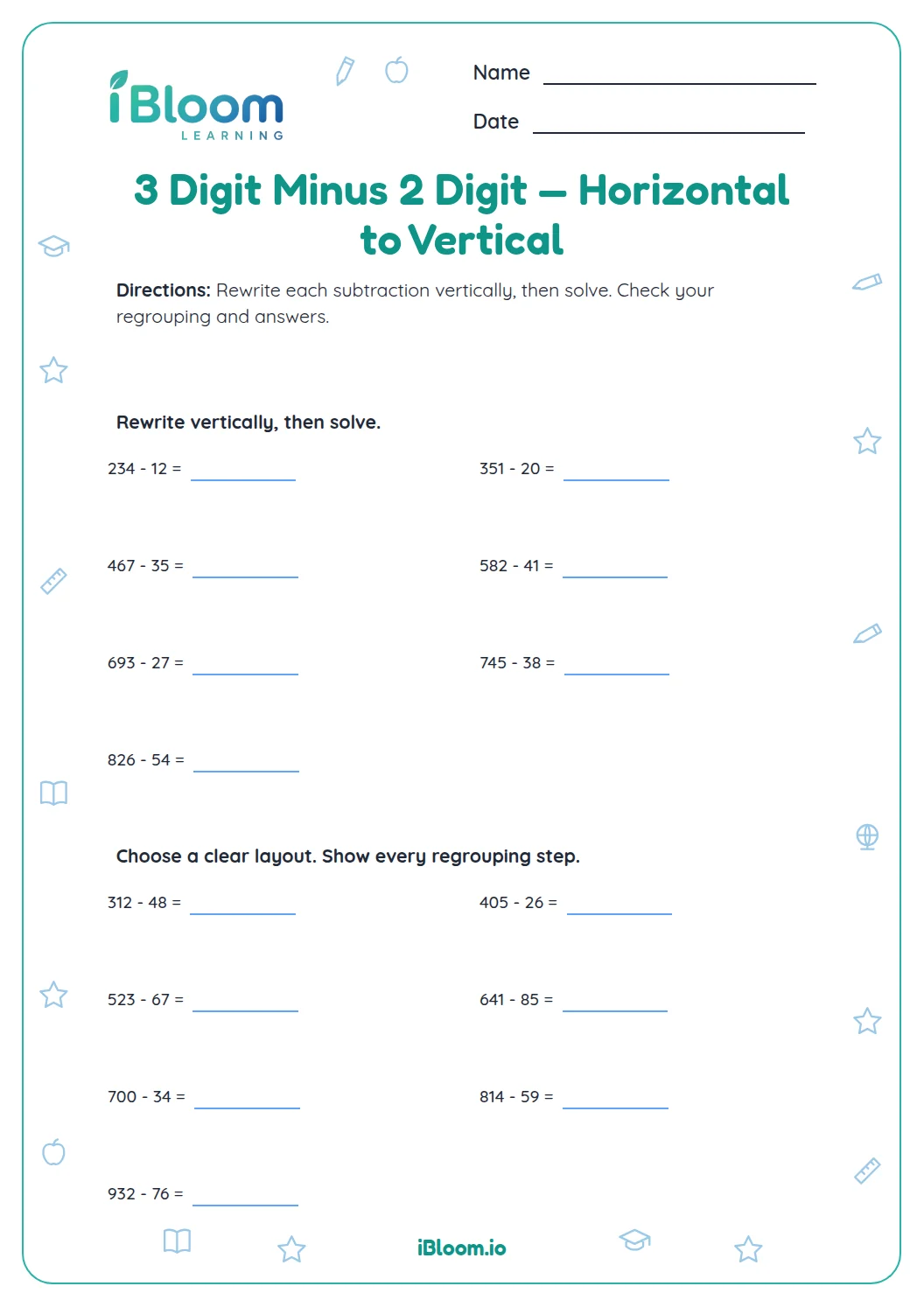


About this worksheet
This warm-up gives students repeated practice subtracting a two-digit number from a three-digit number. The problems progress through ordinary regrouping and trickier cases where a zero is in the ones or tens place. Students can check each difference by adding the subtrahend back. The set practices the Grade 4 multi-digit subtraction algorithm in CCSS 4.NBT.B.4.
Aligned to 4.NBT.B.4
What does this subtraction warm-up practice?
The sixteen questions keep the same operation and number sizes so students can focus on accurate place-value regrouping. Some require one exchange; others require regrouping across a zero.
- Problems include three-digit minuends and two-digit subtrahends.
- No difference is negative.
- The key lists each difference in question order.
How do you subtract across a zero?
Trade from the next nonzero place, then make each place value explicit. In 704 − 26, trade 7 hundreds for 70 tens, then trade one ten for 10 ones. Subtract 6 from 14, 2 from 9 tens, and keep 6 hundreds: 678.
How to use this worksheet
- 1Read the direction and solve each number sentence from right to left by place value.
- 2Write regrouped digits clearly above the minuend if that helps.
- 3Check uncertain answers by adding the subtrahend to the difference.
- 4Review any error by identifying the place where the exchange was missed.
Common mistakes and quick fixes
The mistake
Subtracting the smaller ones digit from the larger one when the top digit is smaller.
The fix
Regroup one ten as ten ones before subtracting.
The mistake
Writing 704 − 26 as 6 hundreds, 10 tens and 14 ones, then forgetting to subtract the 2 tens.
The fix
After regrouping, subtract in every place: 14 − 6, 9 − 2, then 6 hundreds.
Common Core alignment
This set practices multi-digit subtraction with place-value regrouping.
Fluently add and subtract multi-digit whole numbers.
On this sheet: Each problem subtracts a two-digit number from a three-digit number, including regrouping across a zero.
Show the official wordingHide the official wording
Fluently add and subtract multi-digit whole numbers using the standard algorithm.
What to practice next
Make more practice
Further reading
Questions parents and teachers ask
How should students regroup in these problems?
Start in the ones place. When the top digit is too small, trade one ten for ten ones; if there is a zero, regroup from the next nonzero place. Then subtract each place value and check by adding the subtrahend to the difference.
Does the set include subtraction across a zero?
Yes. Several questions require regrouping across a zero, including examples such as 704 − 26 and 901 − 75. Students should rename the hundreds and tens before subtracting, then check that the difference and subtrahend add back to the original number.
What skill does this worksheet practice?
The page practices subtracting a two-digit whole number from a three-digit whole number. The numbers stay positive, while regrouping varies from a single exchange to exchanges across a zero. Students can use the same place-value algorithm for every question. Students can check one problem at a time before moving to the next row.
How can a student check a subtraction answer?
Add the subtrahend to the difference. If the sum equals the original minuend, the subtraction is correct. For example, after solving 143 − 28, add 115 + 28 and check that the total returns to 143. This inverse-operation check catches many regrouping slips.
How can a student check a subtraction answer?
Add the difference to the number being subtracted. For example, 143 − 28 = 115 checks because 115 + 28 = 143. If the sum does not return to 143, revisit the regrouping and subtract each place value again. Use the same addition check with each story problem that asks for a difference.