


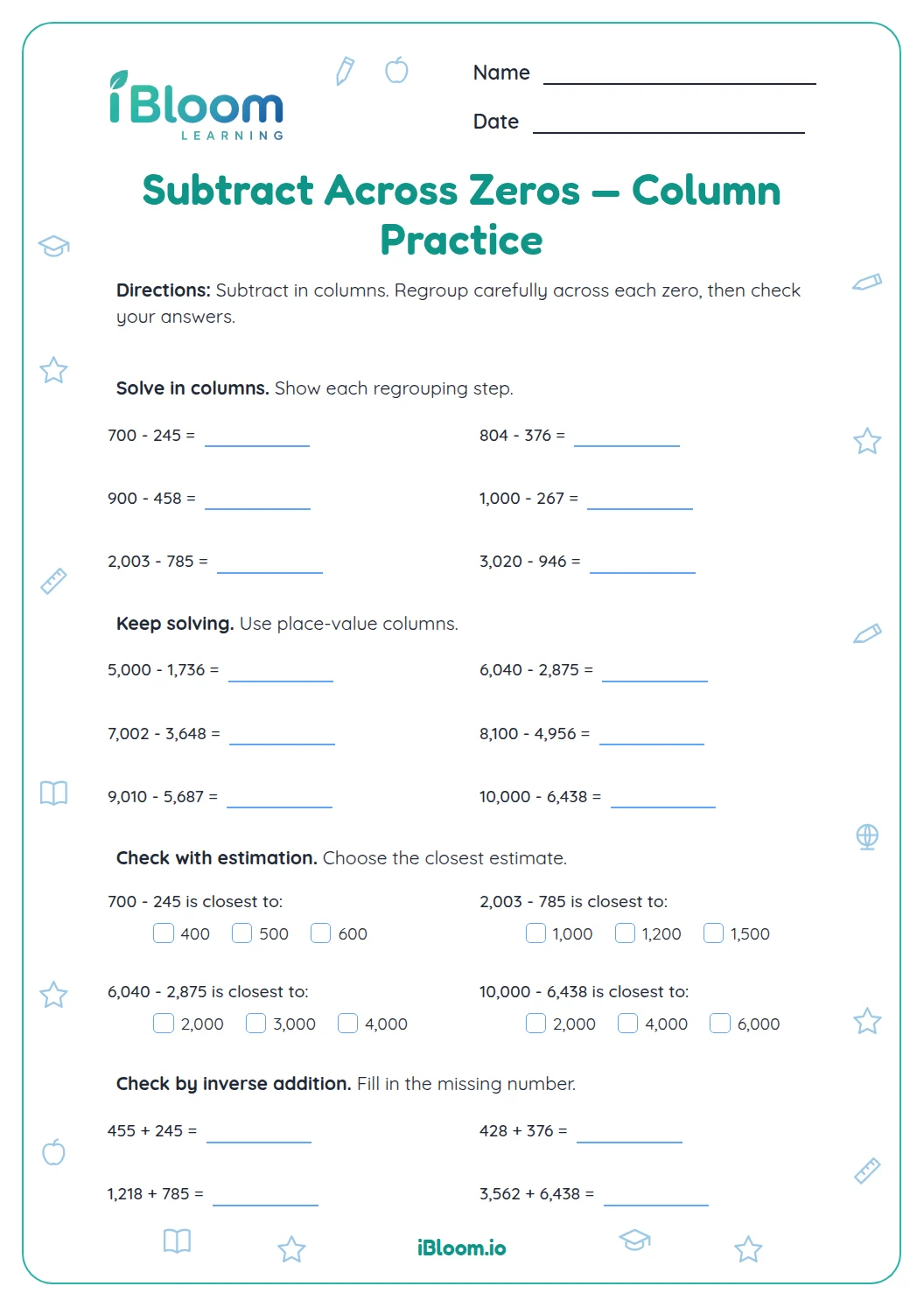
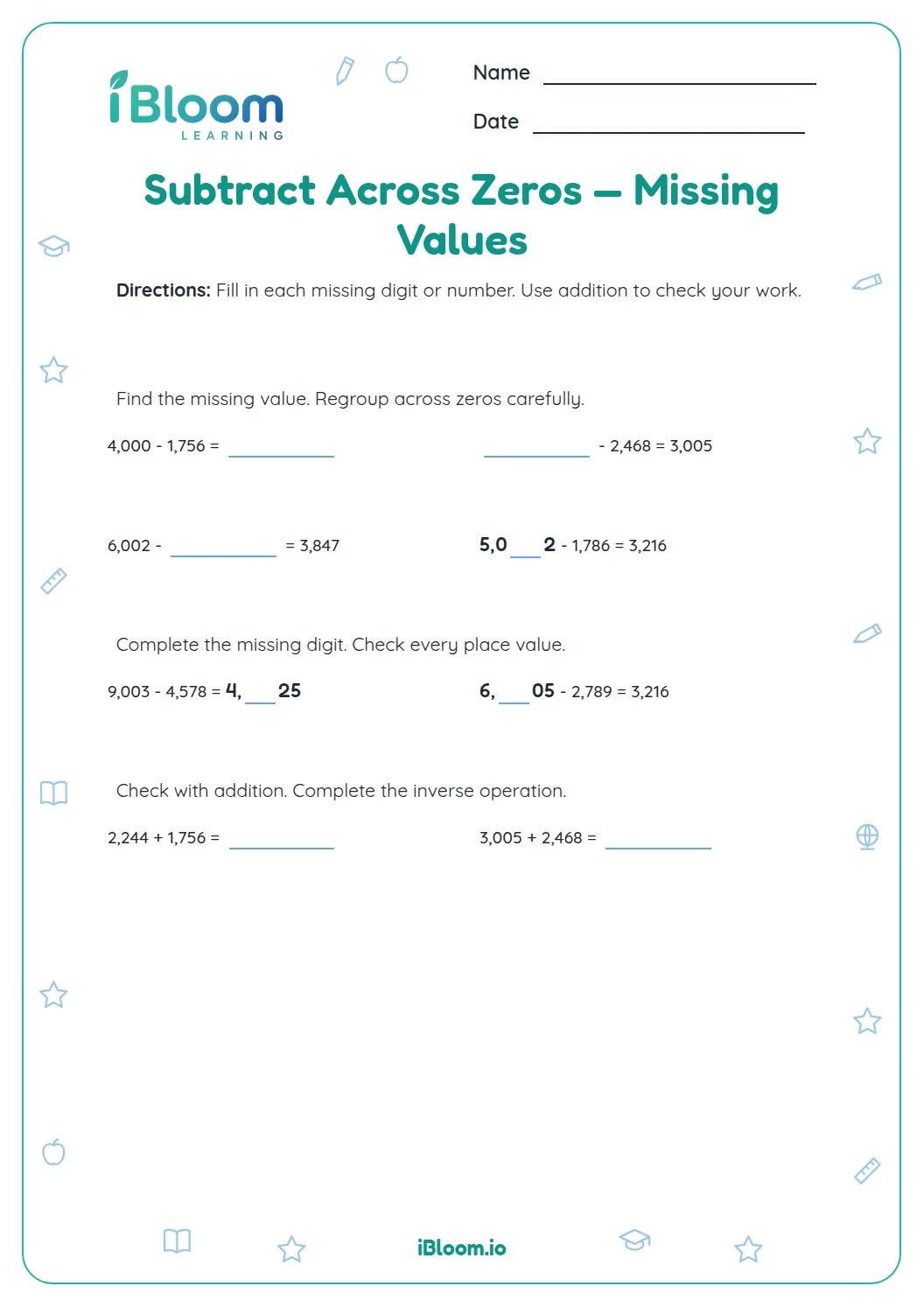
About this worksheet
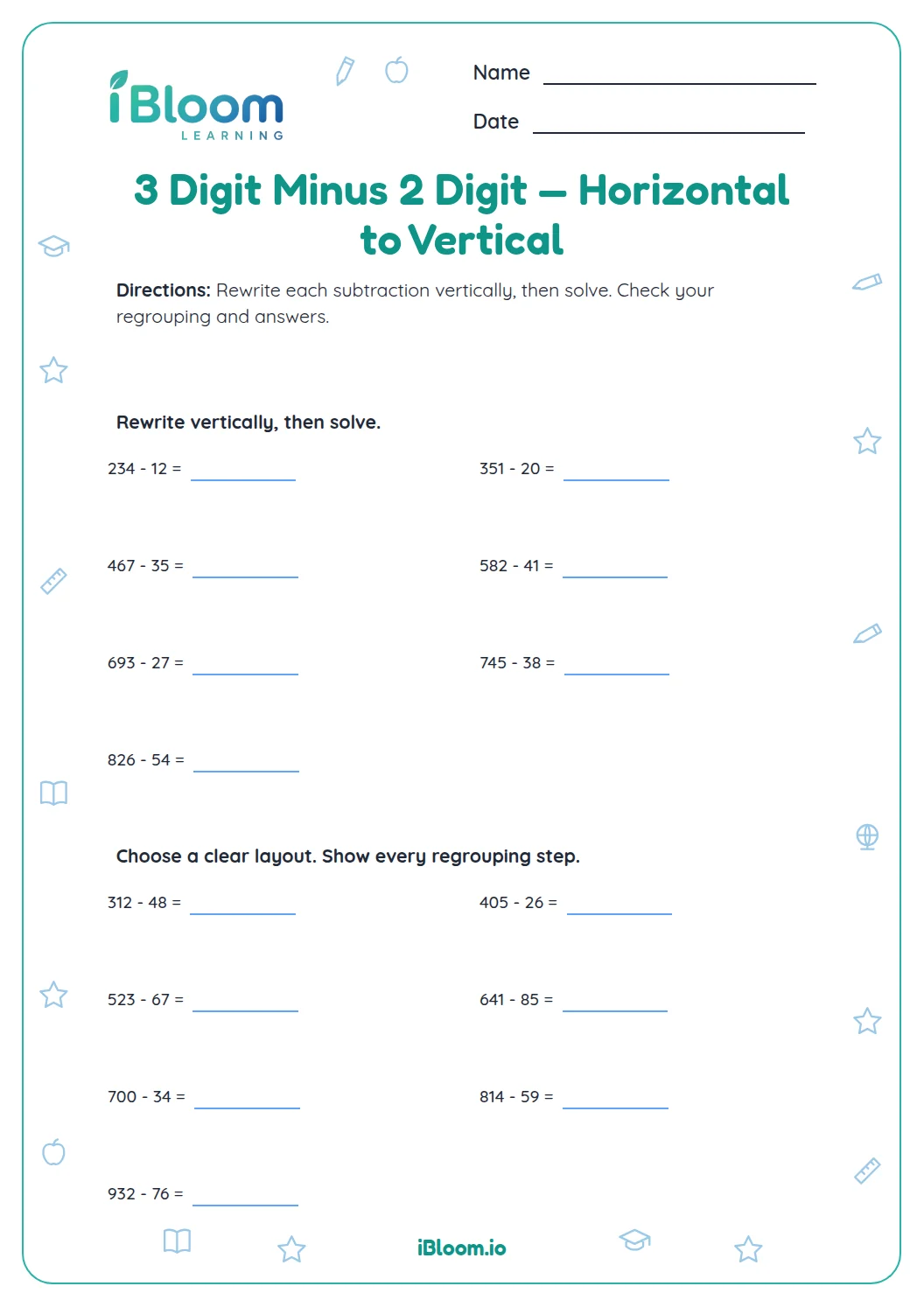
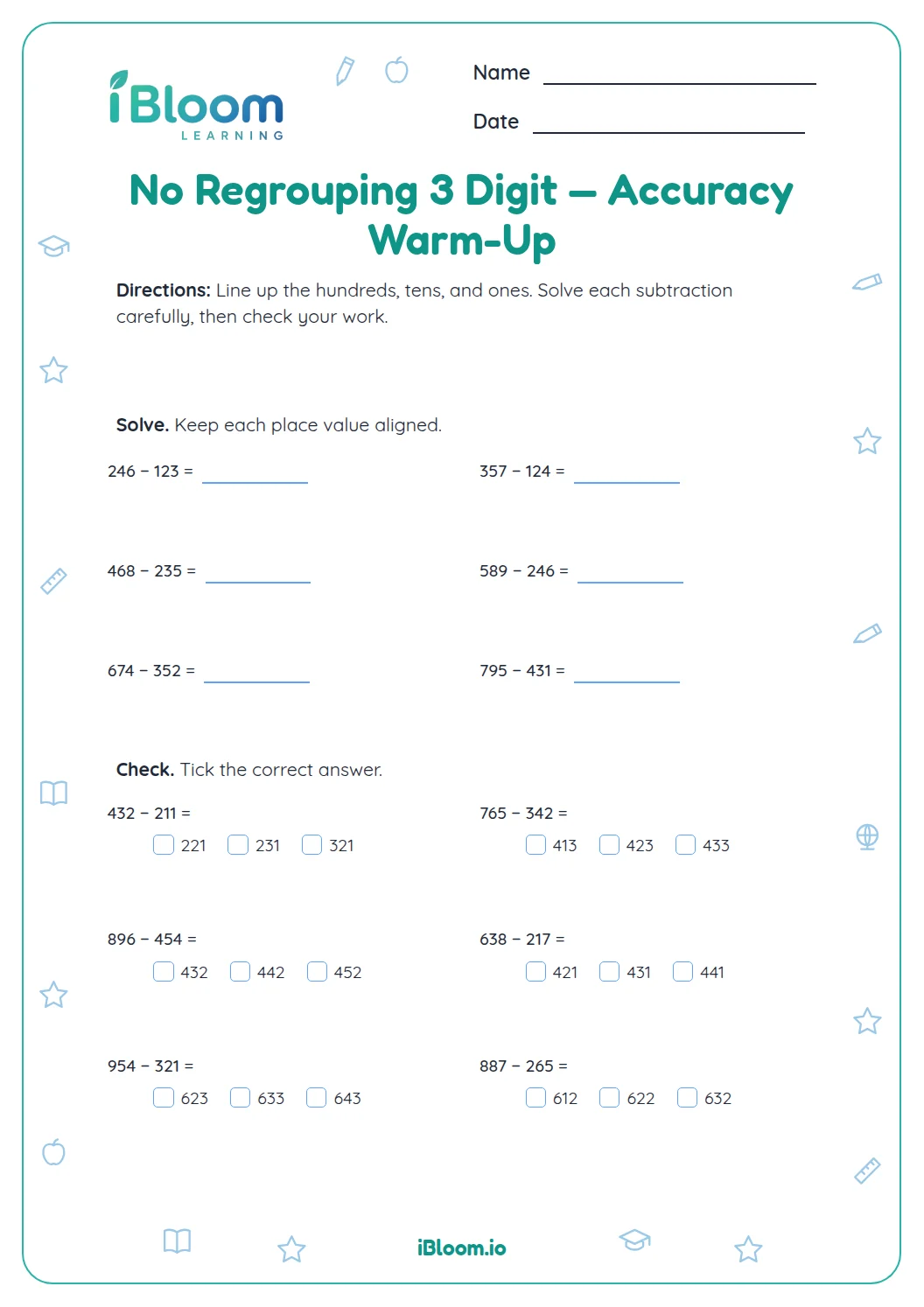
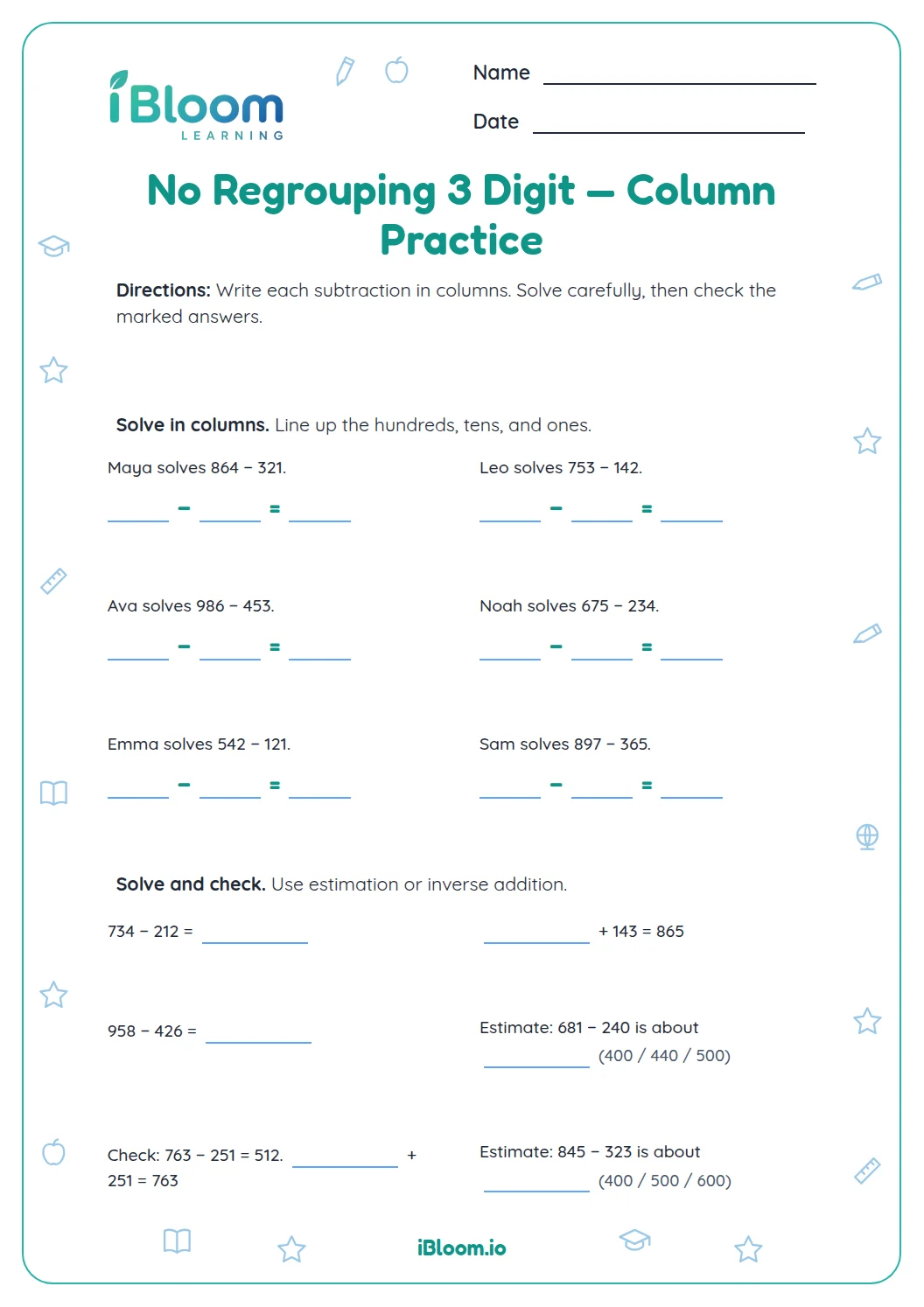
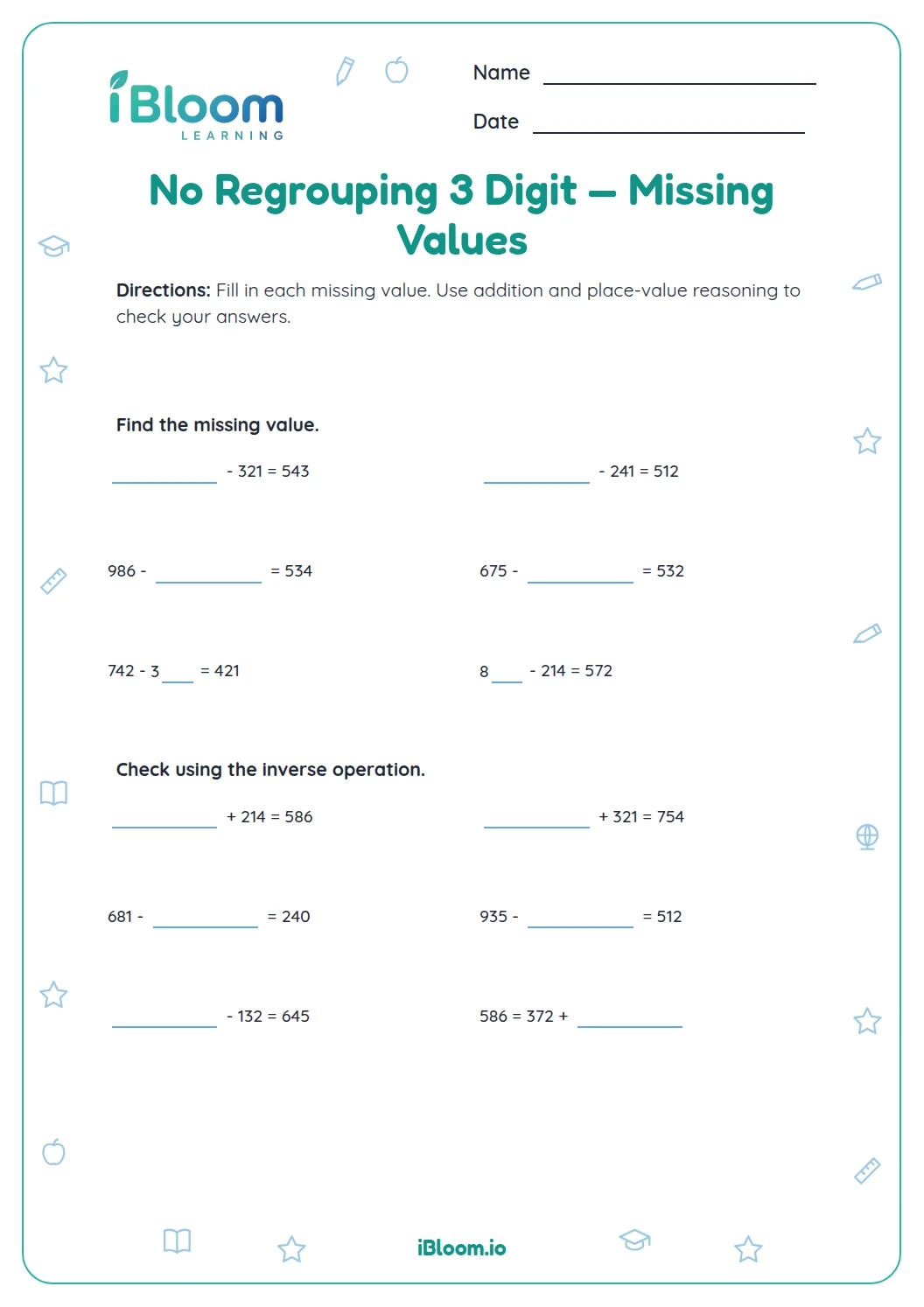
This free worksheet gives Grades 3–4 students 14 short error-analysis problems. Part A asks students to identify four regrouping and place-value slips; Parts B and C ask them to correct ten incorrect differences. Students can verify a result by adding the difference and subtrahend. The practice supports Common Core 3.NBT.A.2. A separate answer key lists the place-value fixes and corrected differences.
Aligned to 3.NBT.A.2
What place-value slips appear first?
Part A checks regrouping decisions in three-digit minus two-digit subtraction. When one ten is exchanged for ten ones, the tens digit decreases by one at the same time the ones increase by ten. Keep the digits in their correct places before subtracting.
How can students repair an incorrect difference?
Subtract the two-digit number from the three-digit number, then compare the correct difference with the displayed work. For question 11, 432 − 18 = 414. The answer key lists each corrected difference.
- 1Incorrect: 432 − 18 = 424
- 2Rename 432 as 400 + 20 + 12.
- 3Subtract 10 + 8 to leave 400 + 10 + 4.
- 4Correct: 432 − 18 = 414.
How can addition check a corrected difference?
Add the subtrahend to the difference. The sum should equal the starting number. For question 12, 667 + 38 = 705. This inverse-operation check helps catch a subtraction slip before the answer is compared with the key.
How to use this worksheet
- 1Read the place-value situation in Part A.
- 2Choose the repair that keeps the number’s value unchanged.
- 3Correct the displayed differences in Part B.
- 4For each answer, add the subtrahend to the difference.
- 5Compare the corrected values with the answer key.
Mistakes to notice and fix
The mistake
Subtracting the smaller ones digit from the larger regardless of position.
The fix
Keep the subtraction order and exchange one ten when the top ones digit is too small.
The mistake
Adding ten ones without reducing the tens.
The fix
Cross out and rewrite both place values during the same exchange.
The mistake
Leaving ten tens after passing one ten to the ones column.
The fix
Track the second exchange: ten tens becomes nine tens and the ones increase by ten.
Common Core alignment
Correct three-digit minus two-digit subtraction using place value and addition checks.
On this sheet: Students identify regrouping errors, calculate corrected differences, and verify a subtraction with addition.
Show the official wordingHide the official wording
Fluently add and subtract within 1000 using strategies and algorithms based on place value, properties of operations, and/or the relationship between addition and subtraction.
What to practice next
Make more practice
Further reading
Questions parents and teachers ask
Are the displayed calculations correct?
The ten calculations in Parts B and C show incorrect differences. Recalculate each subtraction and write the corrected result in the blank. The four Part A questions are multiple-choice checks about regrouping and place value, rather than completed calculations.
Why use error analysis for subtraction?
Error analysis asks students to notice how place values change during regrouping. Part A isolates four decisions, and the remaining questions give practice correcting differences. Students can use addition to check each result before looking at the key.
Can students use scratch paper?
Yes. Scratch paper gives room to set up each horizontal subtraction vertically. Align ones with ones and tens with tens, then record every exchange. Write the corrected difference in the worksheet blank after checking it. This gives time to record the exact exchange before solving.
How does question 4 handle zero in the tens place?
In 305 − 47, trade one hundred for ten tens, then trade one of those tens for ten ones. The working values become 2 hundreds, 9 tens, and 15 ones. Nine tens remain after both exchanges, so the correct choice is 9 tens.
How can addition confirm question 12?
Question 12 asks for the correct difference in 705 − 38. The difference is 667, and 667 + 38 = 705. Reversing the addends in the check is also correct because addition is commutative. It checks both the subtraction and the final total.