

About this worksheet
What does this subtraction worksheet practice?
Aligned to 2.NBT.B.5
What skill does this page practice?
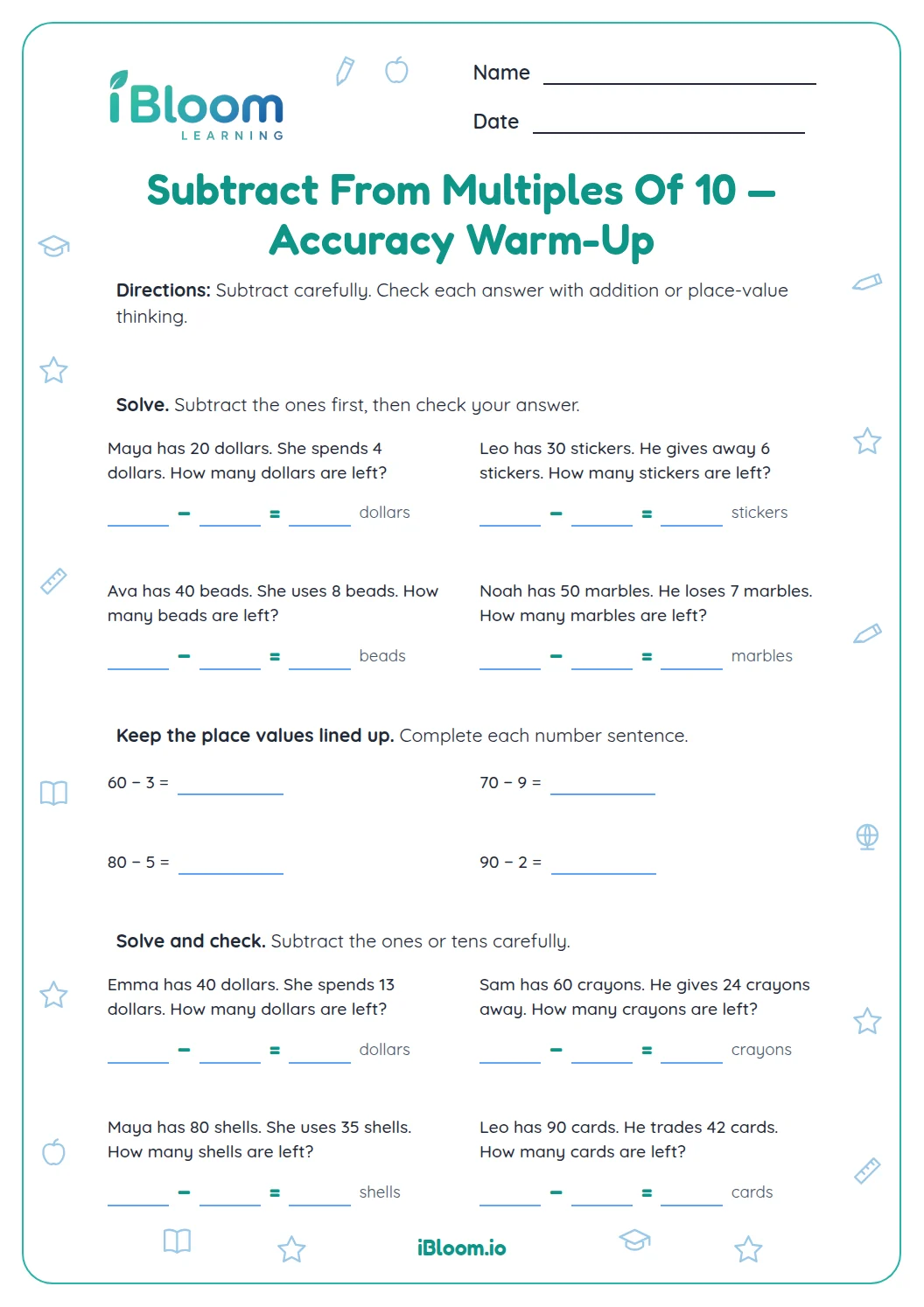
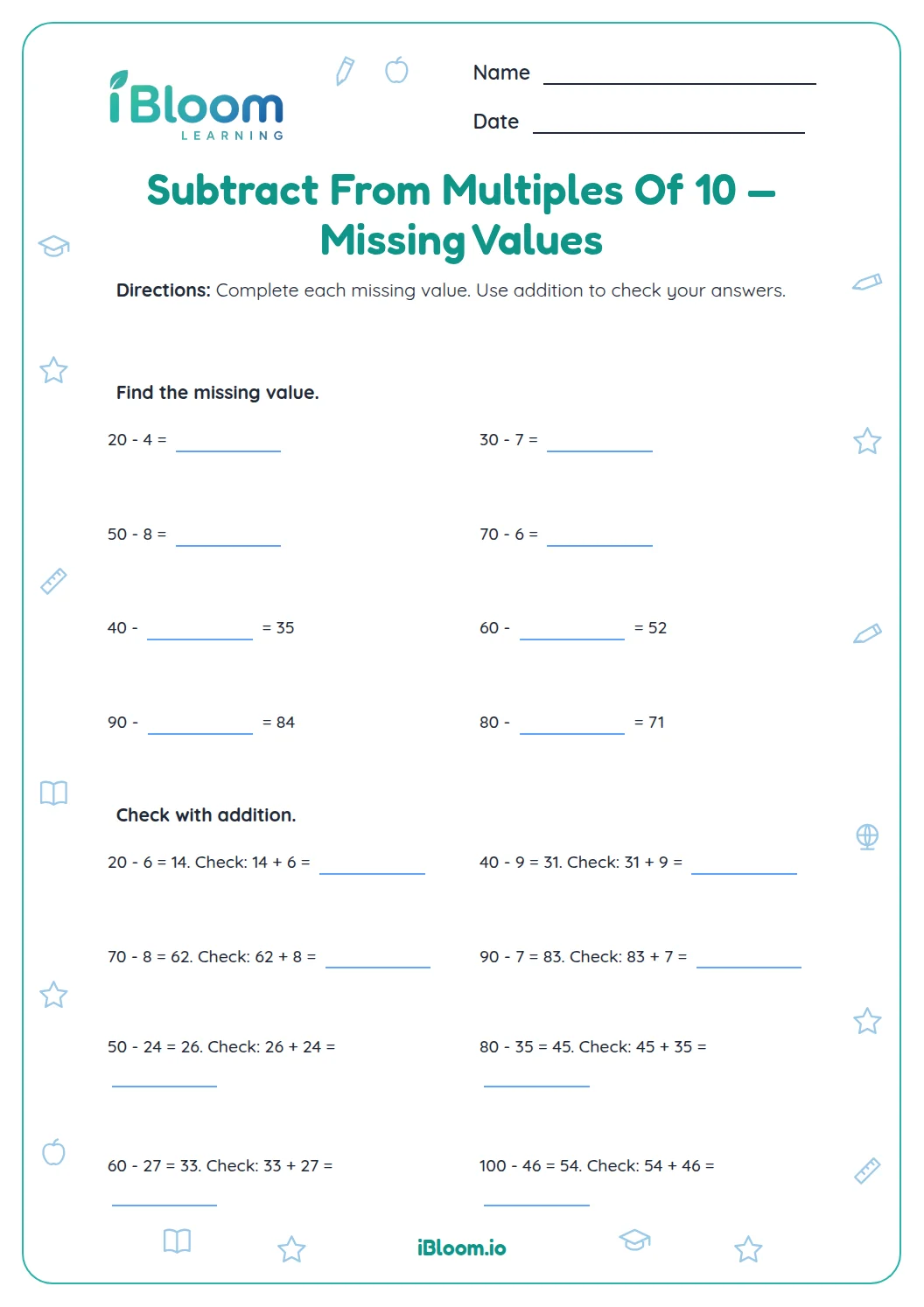
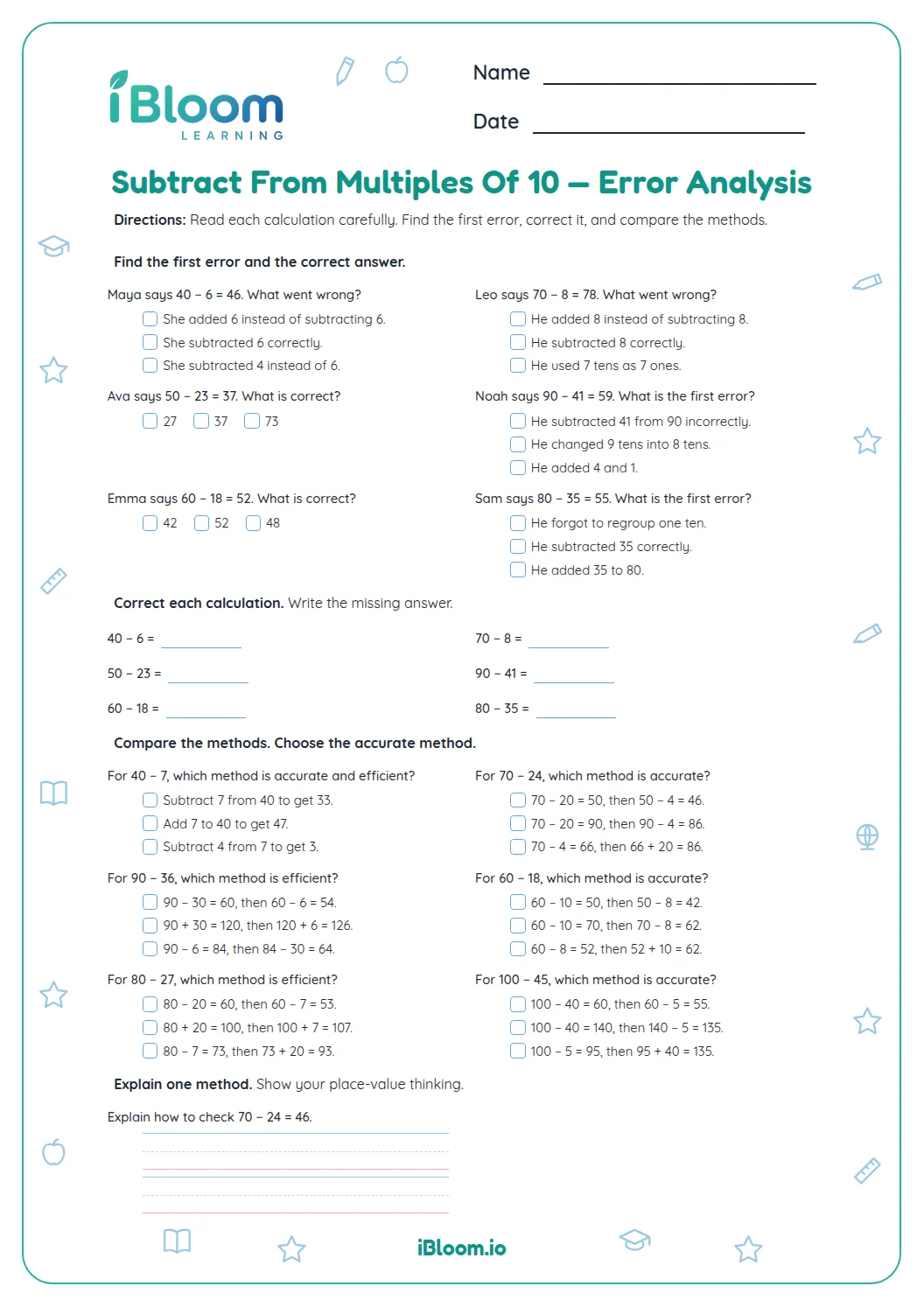
Subtract a two-digit number from a multiple of 10, then use addition to check a difference. The final four equations ask learners to find a missing starting number or subtrahend.
Try the worked example with a pencil, then use the same check on the practice items.
- 160 − 27 = 33
- 2Check: 33 + 27 = 60.
- 3The add-back equation confirms the subtraction.
How is the practice organized?
Part A practices direct subtraction from multiples of 10. Part B uses the same relationship to find an unknown number in a subtraction equation.
How can families check the work?
Use the key after completing a part. Ask the learner to point to the clue, equation, or spelling decision that supports one answer.
How to use this worksheet
- 1Subtract the ones, regrouping one ten when needed.
- 2Subtract the tens and combine the parts.
- 3For a missing starting number, add the subtrahend to the difference.
- 4For a missing subtrahend, subtract the difference from the starting number.
- 5Check by adding the difference and subtrahend.
Common mistakes and quick fixes
The mistake
Subtracting digits without regrouping.
The fix
Rename one ten as 10 ones before subtracting the ones.
The mistake
Treating the difference as the starting number in a missing-minuend equation.
The fix
Add the known subtrahend and difference.
The mistake
Forgetting that subtraction and addition undo each other.
The fix
Use addition to check each completed equation.
Common Core alignment
This worksheet practices the following Common Core skill.
Subtract within 100 using place value and addition to check.
On this sheet: The questions directly ask learners to apply this skill.
Show the official wordingHide the official wording
Fluently add and subtract within 100 using strategies based on place value, properties of operations, and/or the relationship between addition and subtraction.
What to practice next
Make more practice
Further reading
Questions parents and teachers ask
How do you subtract from a multiple of 10?
Subtract the ones first. If there are not enough ones, rename one ten as 10 ones, then subtract the tens. For example, 60 − 27 = 33; adding 27 + 33 returns 60. A number line or quick tens-and-ones sketch can make the regrouping visible.
How do you find a missing starting number?
Add the amount being subtracted to the difference. If ___ − 26 = 40, then 40 + 26 = 66, so the missing starting number is 66. For example, 40 + 26 = 66, which supplies the missing starting number.
How do you find a missing subtrahend?
Subtract the difference from the starting number. In 90 − ___ = 54, compute 90 − 54 = 36, so the missing subtrahend is 36. The subtraction equation can be checked by adding 54 and 36 to get 90.
How many questions are included?
There are 16 questions on one worksheet page: 12 direct subtraction problems and four missing-number equations. The separate answer key is also one page. The questions are grouped on one practice page, with the key printed separately. Learners can finish the page before using the matching key to self-check.
What is a quick way to check a difference?
Add the difference to the number that was subtracted. The sum should equal the original starting number. For example, after 80 − 46 = 34, check 34 + 46 = 80. This check works because addition reverses the subtraction in the original equation.