
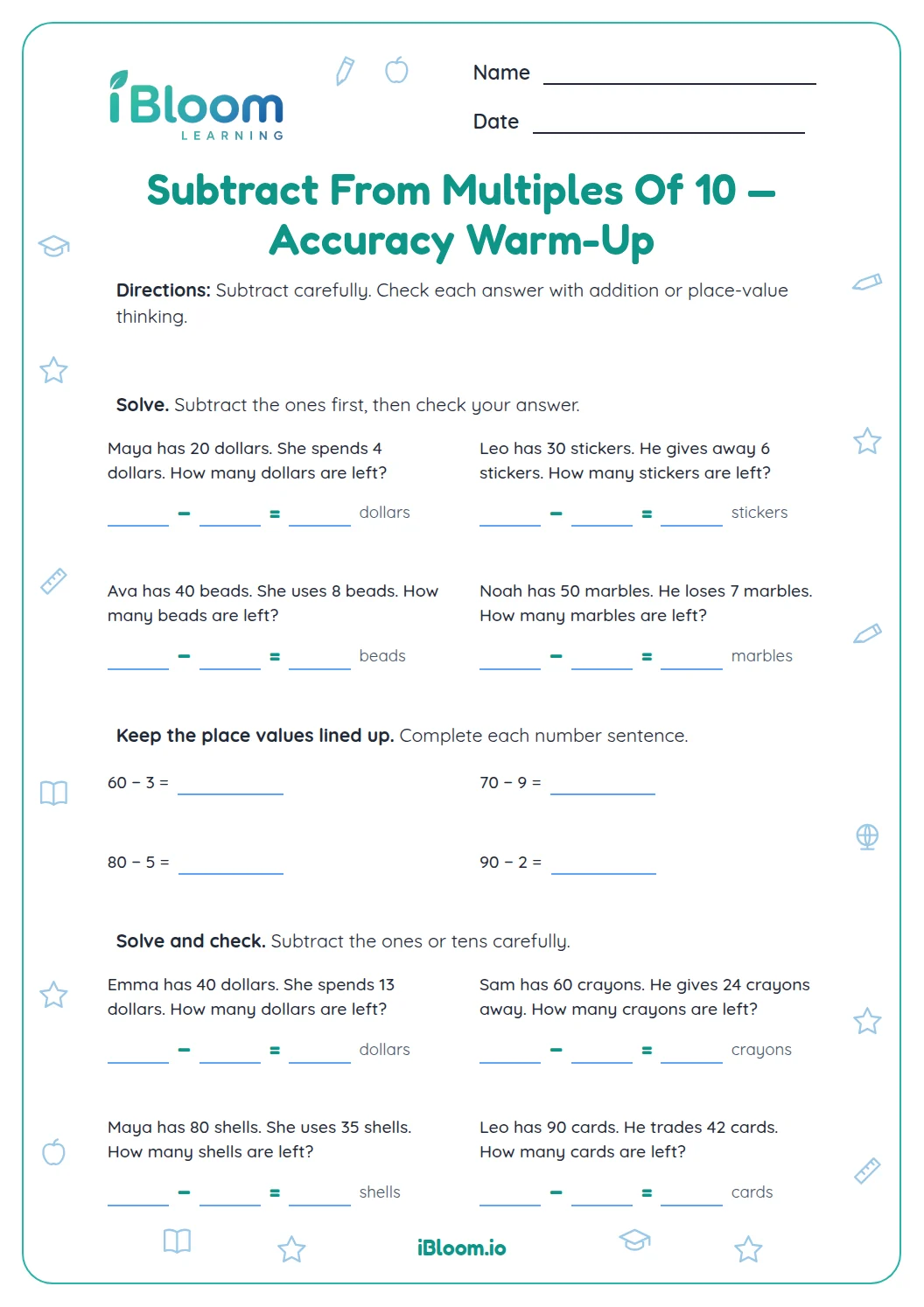

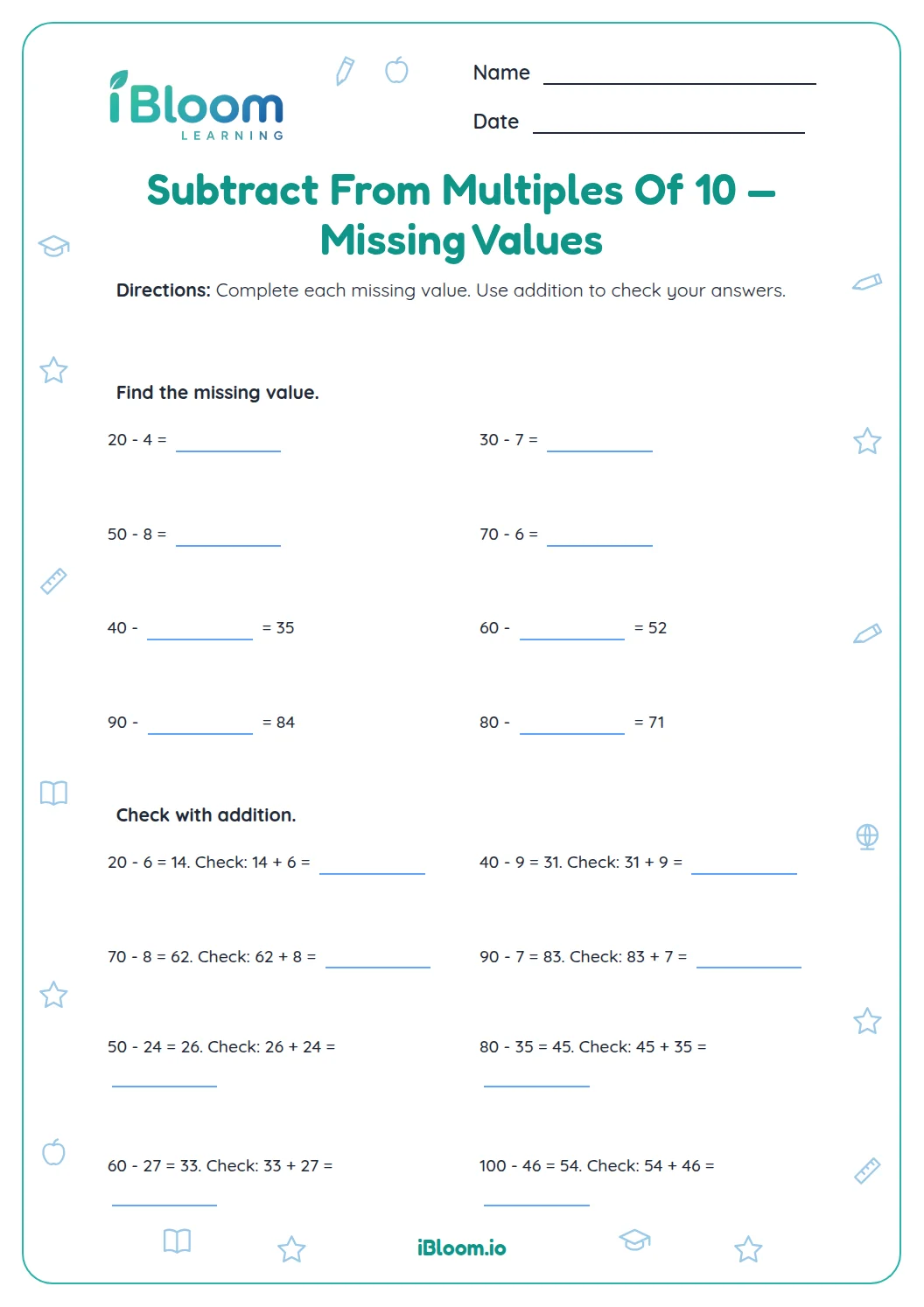
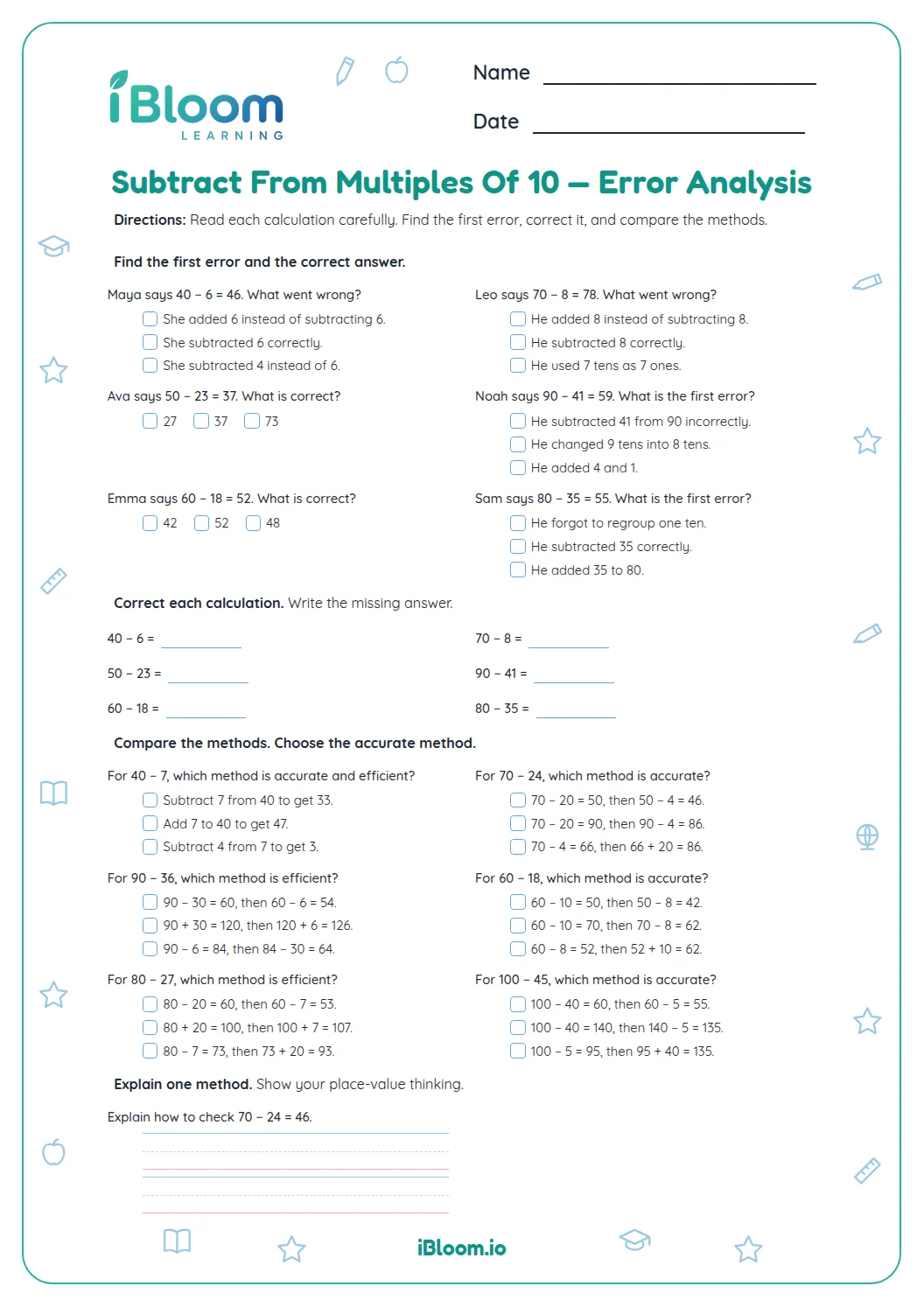
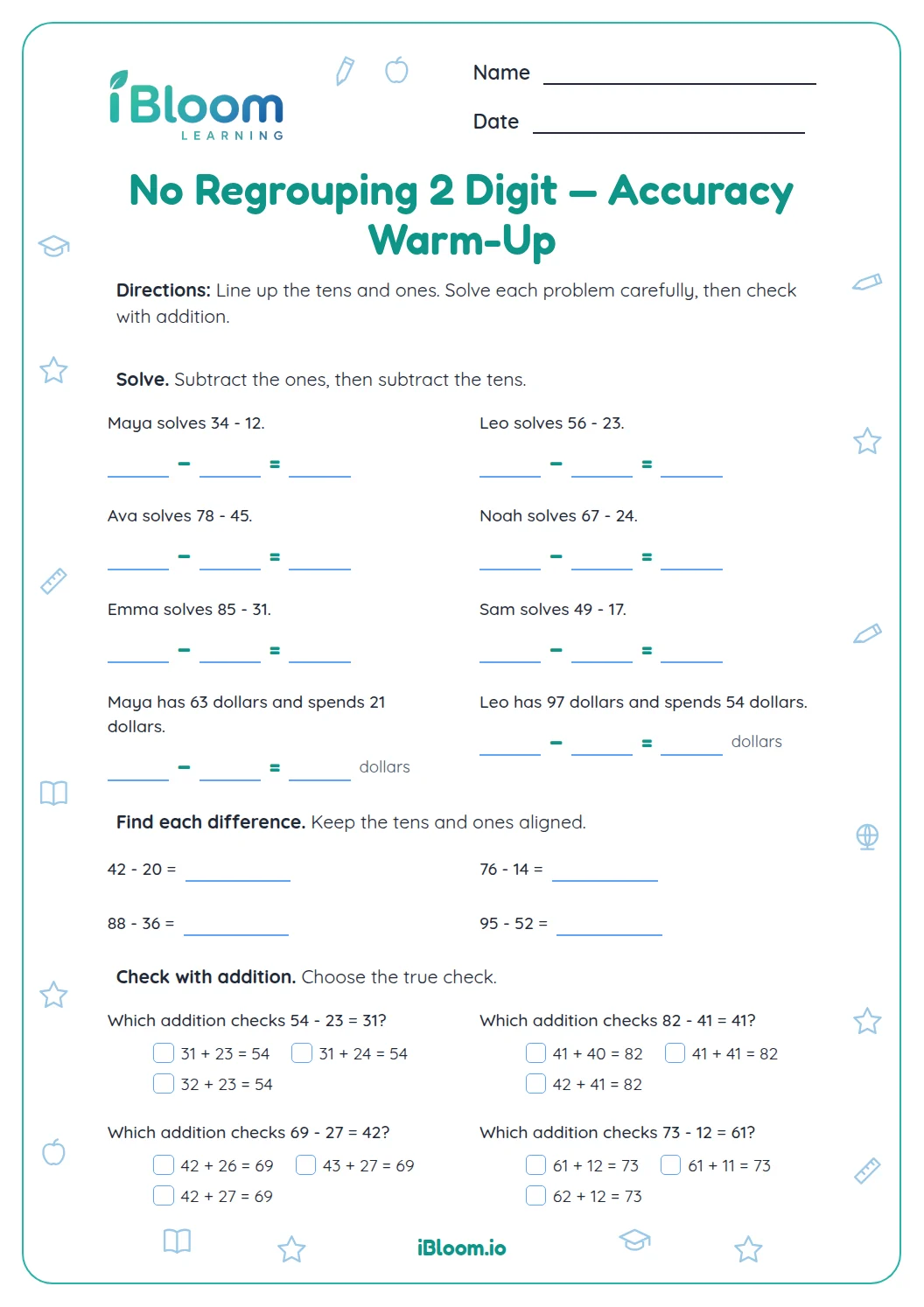




About this worksheet
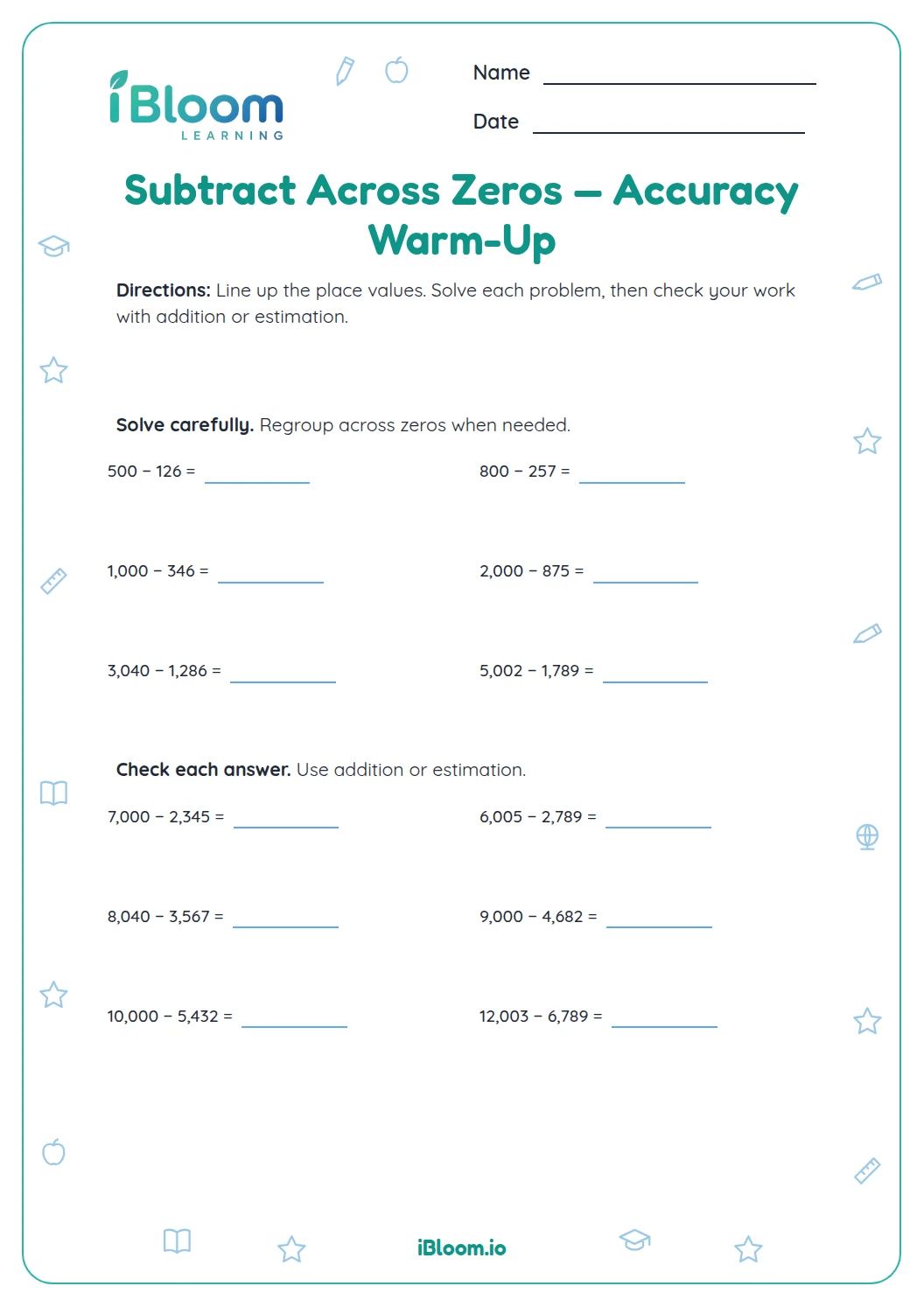
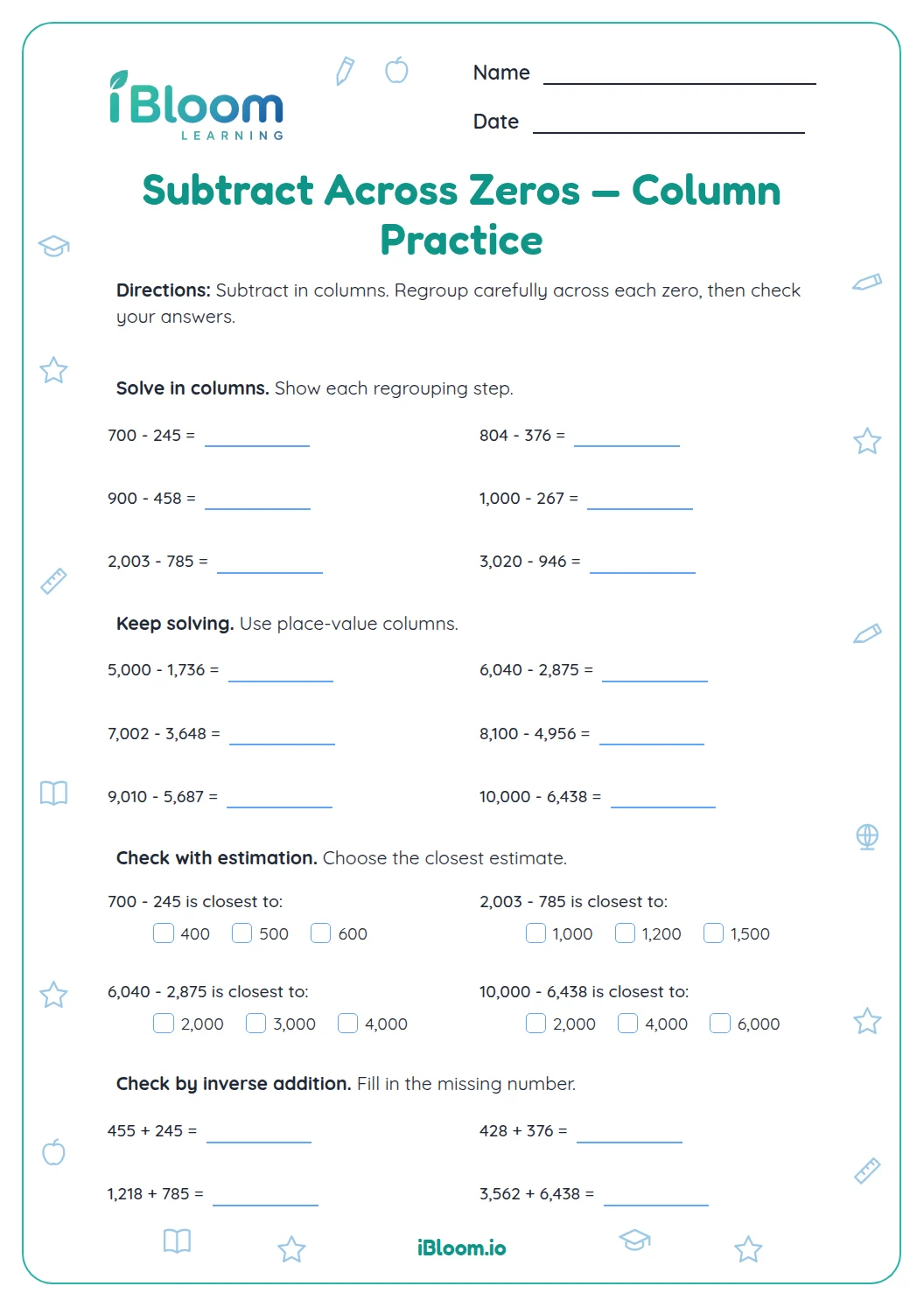
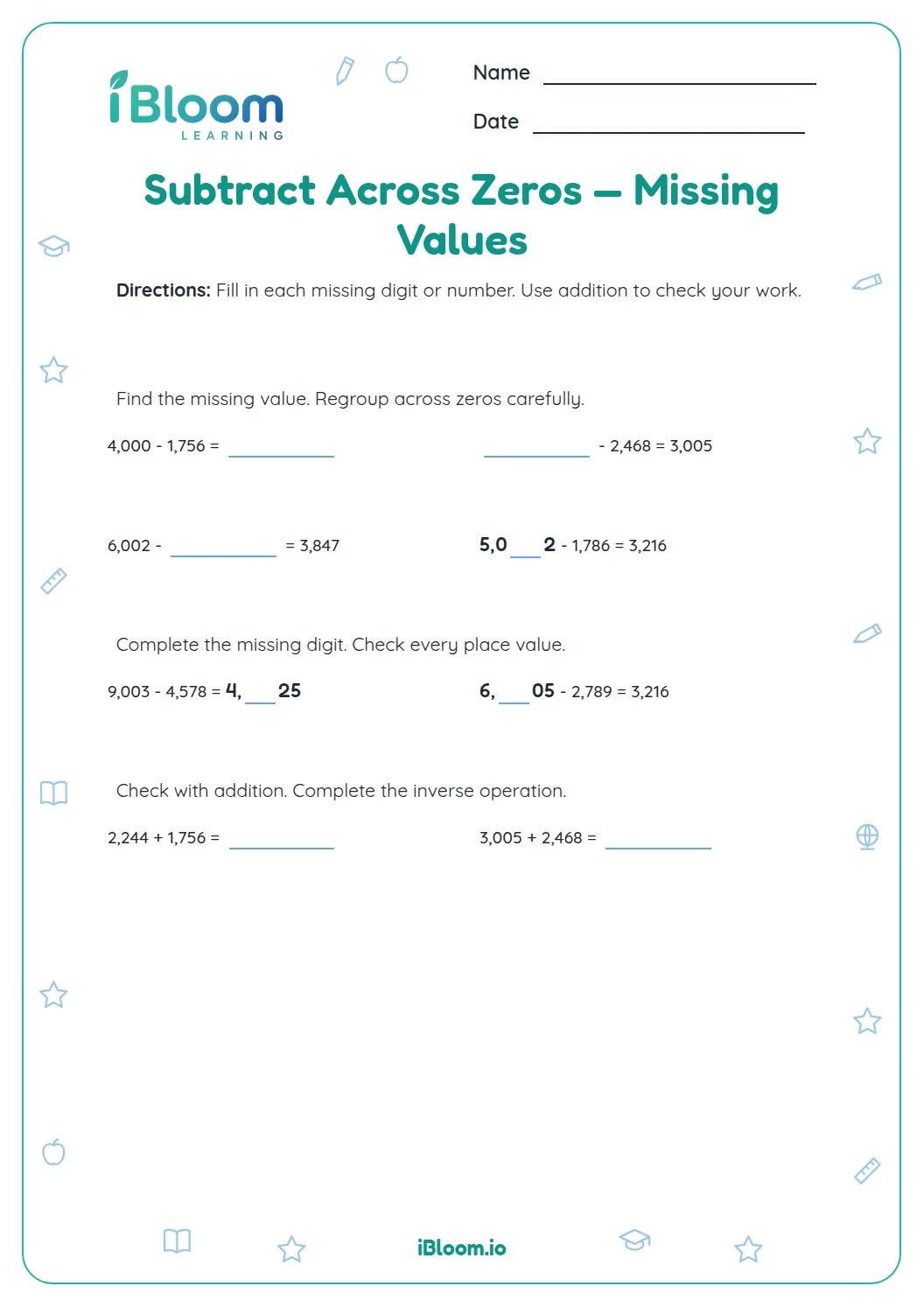
This free worksheet gives students in Grades 2–4 sixteen horizontal subtraction problems to rewrite vertically. Every starting number is a multiple of ten. Part A begins with one-digit numbers and whole tens to subtract; Part B moves to two-digit numbers; Part C includes 100, 120, 150, and 200 as starting values. Each problem has room for a vertical layout and regrouping marks. The sheet practices place-value subtraction under CCSS 2.NBT.B.5 and 3.NBT.A.2, and the separate answer key gives the sixteen differences.
Aligned to 2.NBT.B.5 and 3.NBT.A.2
What does horizontal to vertical mean?
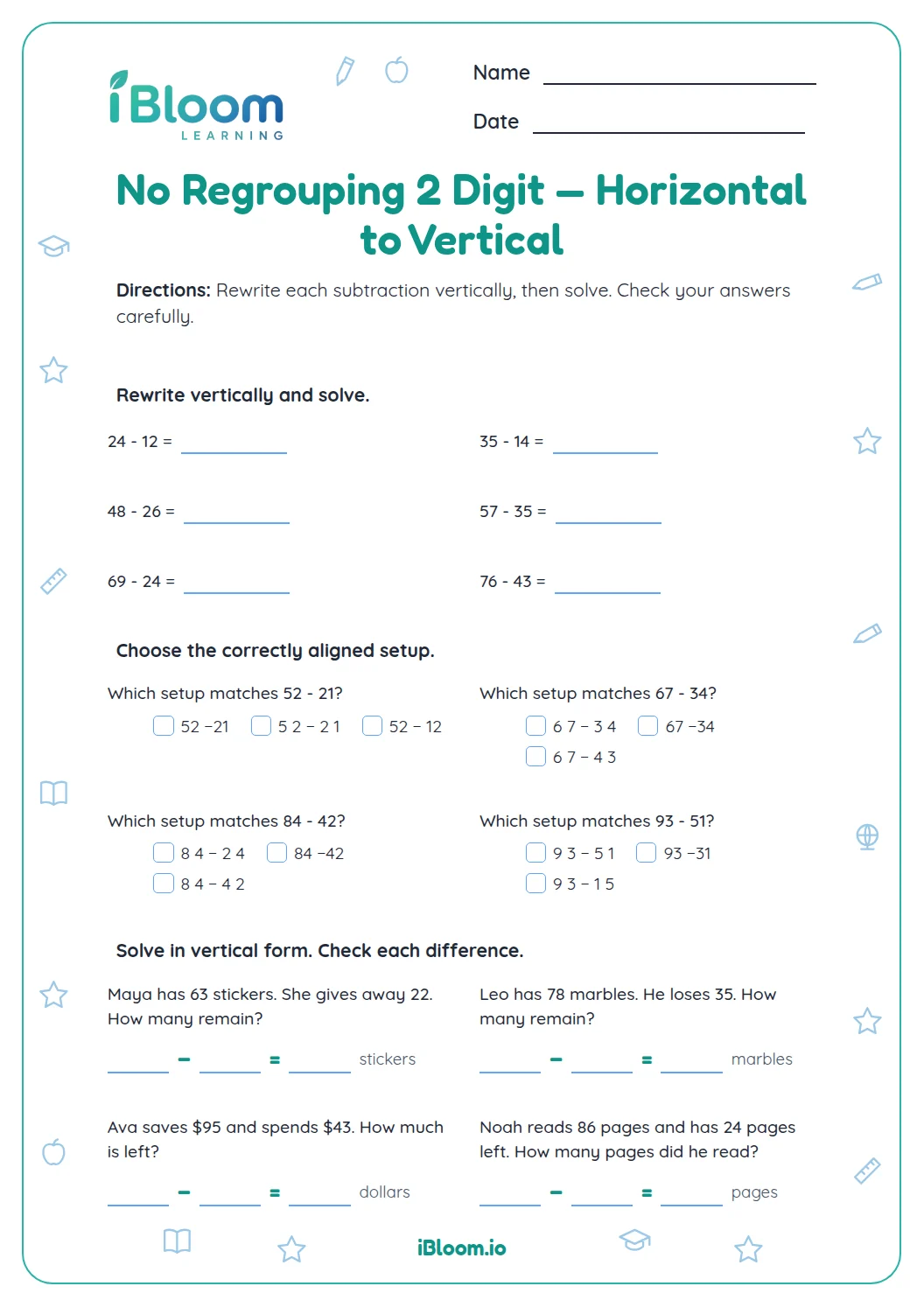
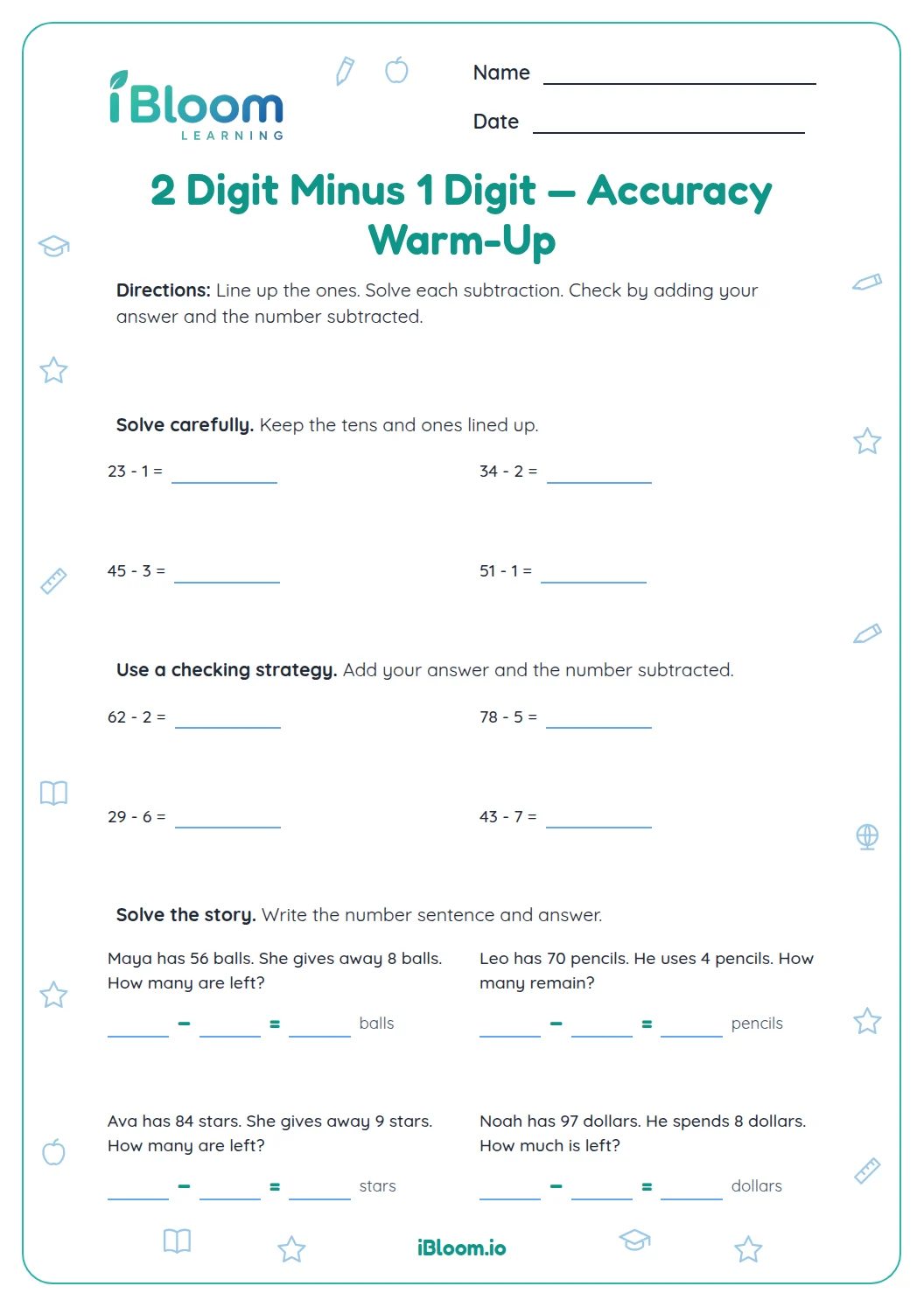
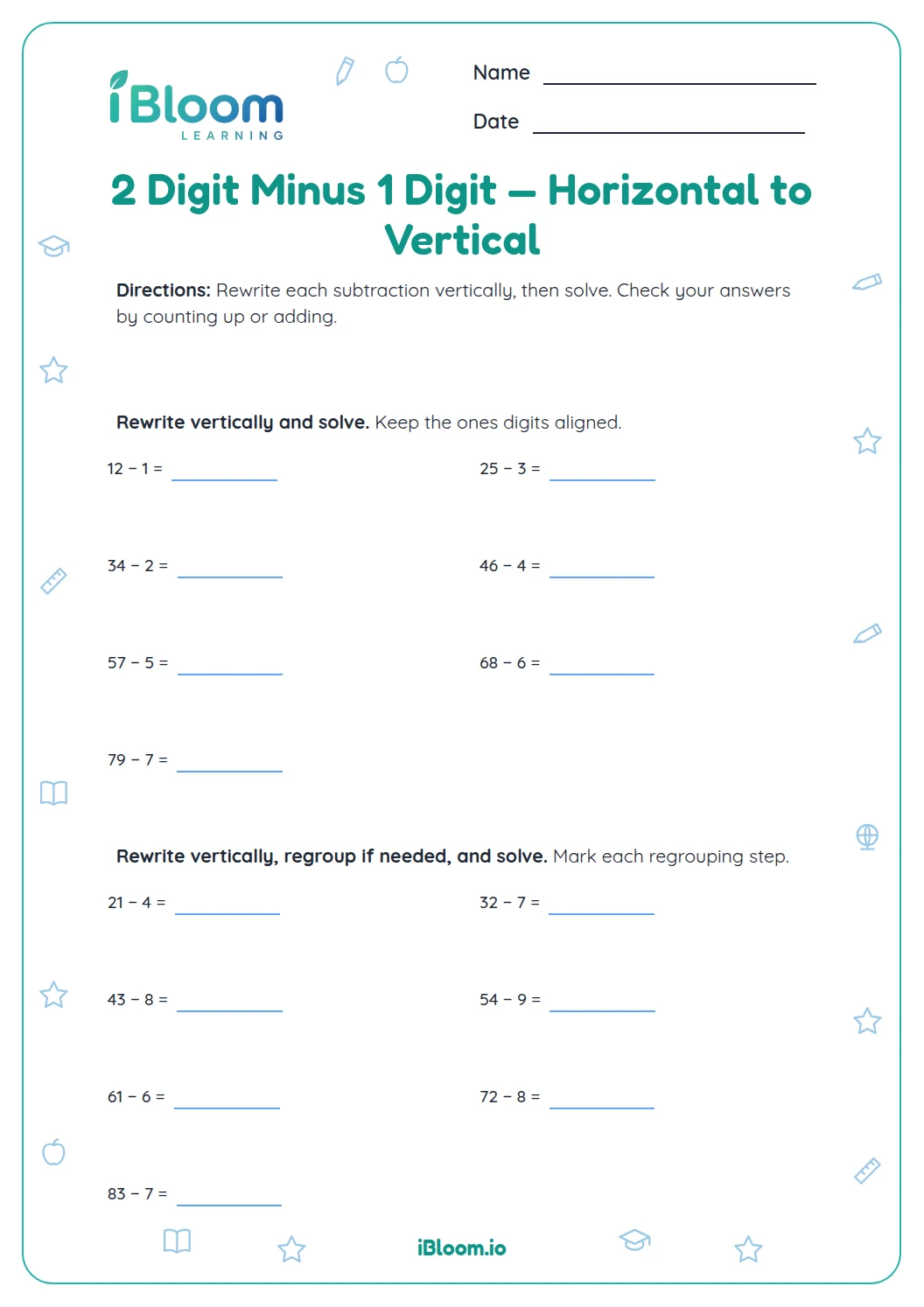
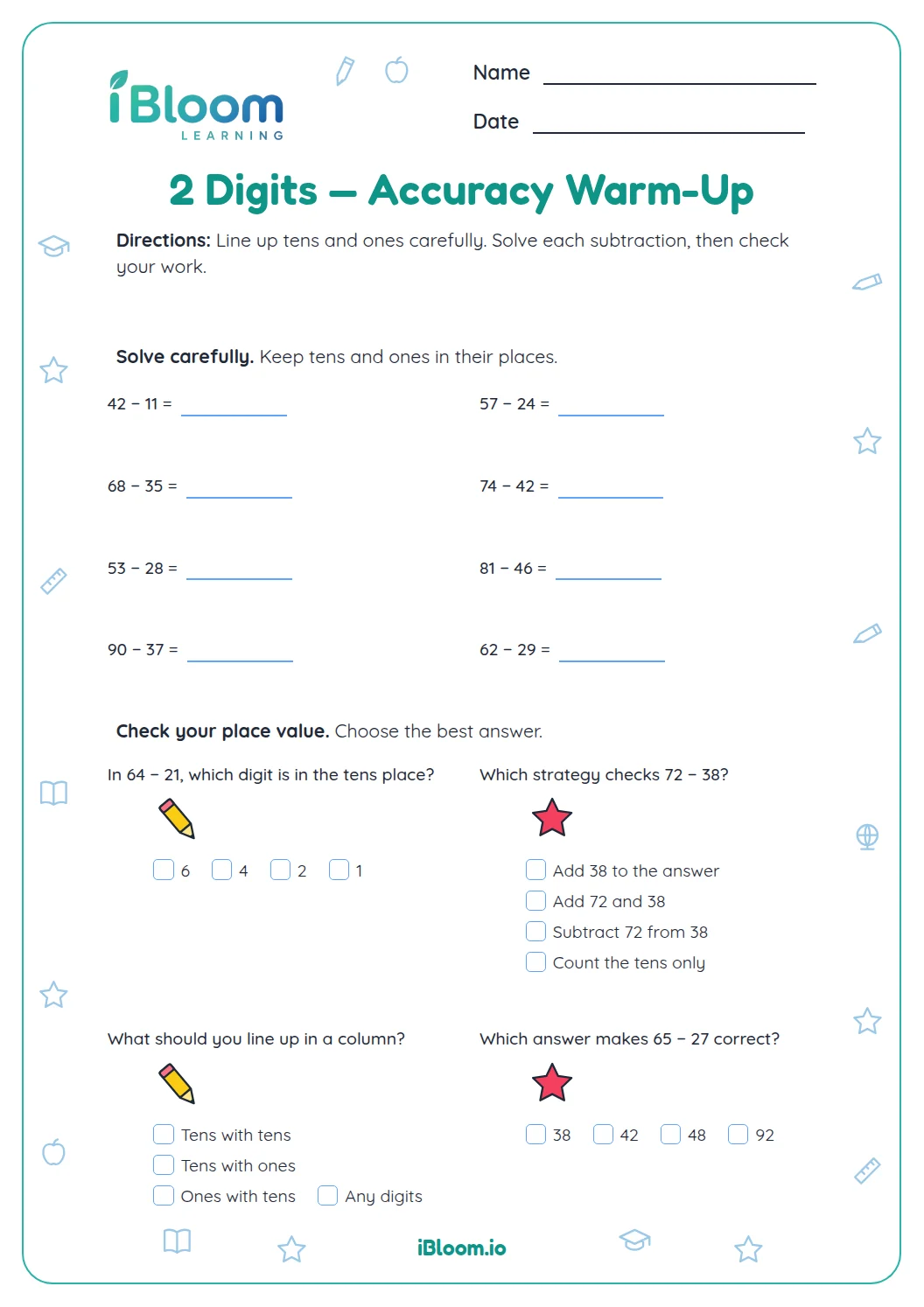
Horizontal subtraction is written across a line, such as 70 − 28. To write it vertically, place 70 above 28 with tens under tens and ones under ones. Put the minus sign beside the lower number and draw an answer line.
Every problem has working space so children can actually rewrite it. Check the layout before checking the result: the order of the two numbers must stay the same.
How can we take eight ones from zero ones?
Rename one of the tens as ten ones. In question 8, seven tens becomes six tens and ten ones. Now the ones subtraction is possible, and the remaining tens still need to be subtracted.
- 170 − 28
- 2Stack 70 above 28, with the ones digits aligned.
- 3Rename 70 as 6 tens and 10 ones.
- 410 − 8 = 2 ones; 6 − 2 = 4 tens.
- 5The difference is 42. Check: 42 + 28 = 70.
What happens when both tens and ones are zero?
For 100 − 46, exchange the hundred for ten tens. Exchange one of those tens for ten ones, leaving nine tens and ten ones. Subtract six ones and four tens to get 54.
Part C includes another example with 200. Renaming 200 as one hundred, nine tens, and ten ones gives enough ones to subtract 73. When checking with the key, look at the written exchanges as well as the final difference.
Use the sheet step by step
- 1Copy question 1 vertically, keeping 4 in the ones column under 0.
- 2Complete Part A and notice that subtracting whole tens needs no ones exchange.
- 3In Part B, cross out the tens digit and record one fewer ten before writing ten ones.
- 4For Part C, name the hundreds, tens, and ones after every exchange.
- 5Check each difference by adding back the number subtracted.
Mistakes to watch for
The mistake
Writing 30 − 4 = 34 by subtracting the smaller ones digit from the larger.
The fix
Keep the subtraction order. Rename 30 as 2 tens and 10 ones, then take away 4 ones.
The mistake
Changing zero ones to ten but leaving all the original tens.
The fix
The ten ones came from one ten, so decrease the tens digit by one at the same time.
The mistake
Putting 86 under the hundreds and tens positions in 120 − 86.
The fix
Line up from the right: 6 belongs under 0, and 8 belongs under 2.
Common Core alignment
Subtract within 100 by aligning tens and ones and regrouping when needed.
On this sheet: Parts A and B practice subtraction from whole tens within 100.
Show the official wordingHide the official wording
Fluently add and subtract within 100 using strategies based on place value, properties of operations, and/or the relationship between addition and subtraction.
Subtract within 1,000 using place-value exchanges.
On this sheet: Part C applies the vertical method to starting values of 100, 120, 150, and 200.
Show the official wordingHide the official wording
Fluently add and subtract within 1000 using strategies and algorithms based on place value, properties of operations, and/or the relationship between addition and subtraction.
What to practice next
Make more practice
Further reading
Questions parents and teachers ask
Must my child rewrite every problem vertically?
Yes. Rewriting the problem is part of this worksheet’s task, even when a child can find the difference mentally. Ask for aligned columns and visible regrouping marks when needed. The key gives final differences; you can review the child’s layout separately to check how the result was found.
Do all sixteen problems require regrouping?
No. The two whole-ten subtractions in Part A can be solved without exchanging a ten for ones. The other problems subtract a number with a nonzero ones digit from a starting value ending in zero. Compare these cases so your child decides when an exchange is needed.
How should we explain 100 − 46?
Rename one hundred as ten tens, then exchange one ten for ten ones. That leaves nine tens and ten ones. Subtract six ones to leave four, then subtract four tens to leave five. The difference is 54, and adding 46 back gives 100 as a check.
Can Grade 2 students work on the whole sheet?
Use the sections that match the child’s current subtraction work. Parts A and B use starting values below 100, while Part C uses hundreds as well as tens and ones. Work through the first hundreds exchange together, then ask the child to explain why the total value stays the same.
What should I check besides the final answers?
Check that the top number stays on top, the ones digits line up, and every regrouping mark reflects an equal exchange. A child may find the right difference mentally but still need practice recording the layout. Adding the difference and the subtracted number provides another useful check.