






About this worksheet
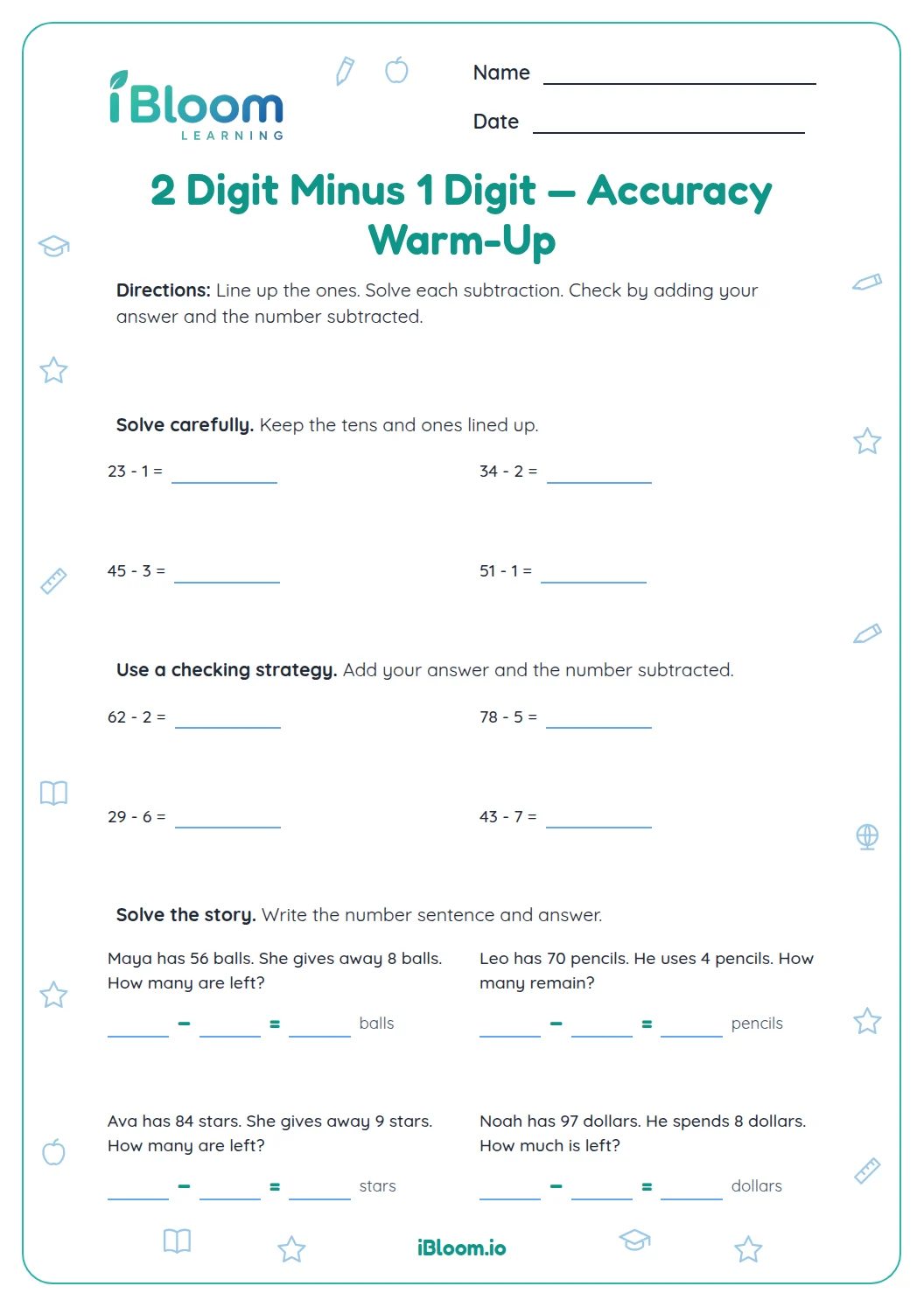
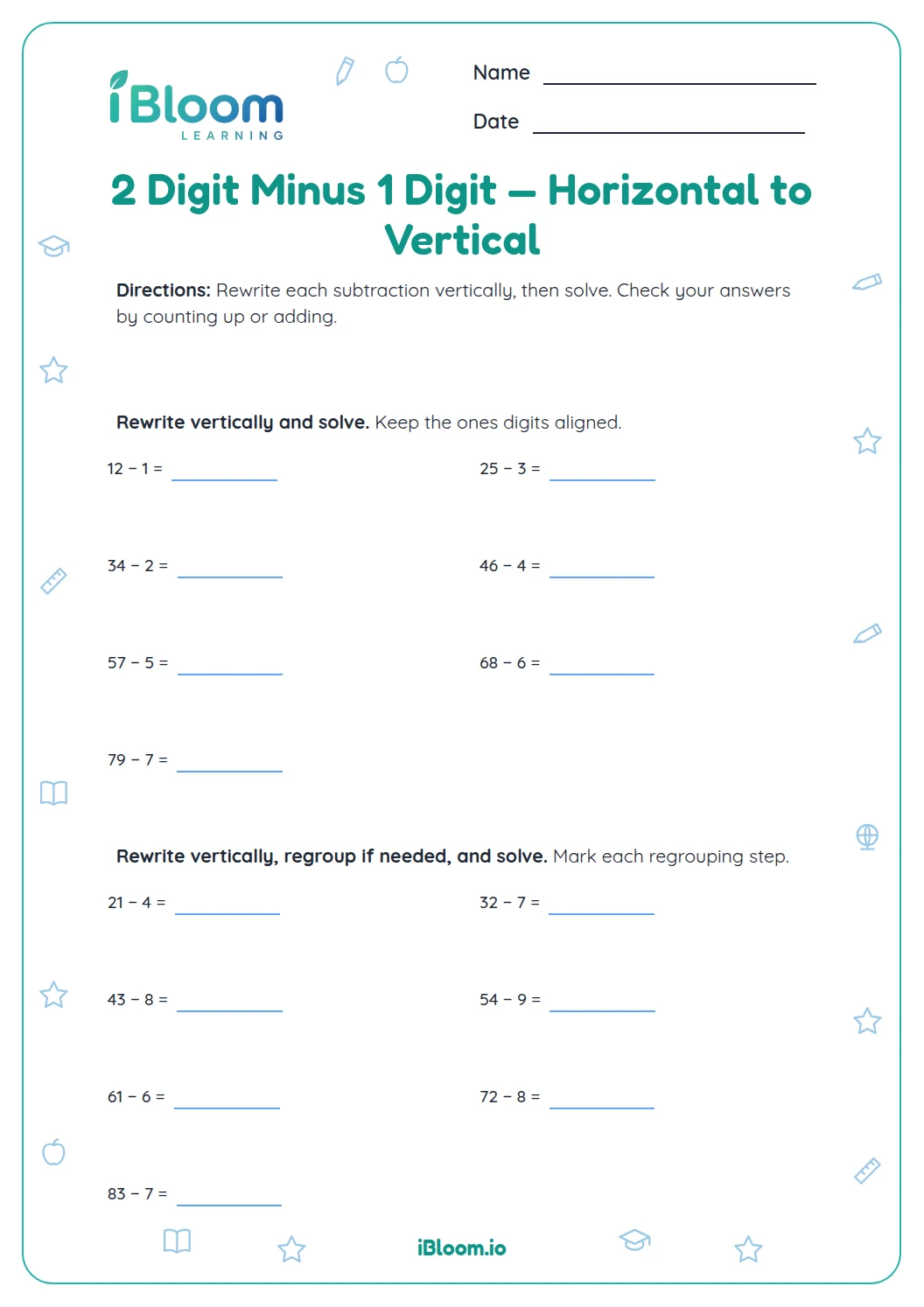
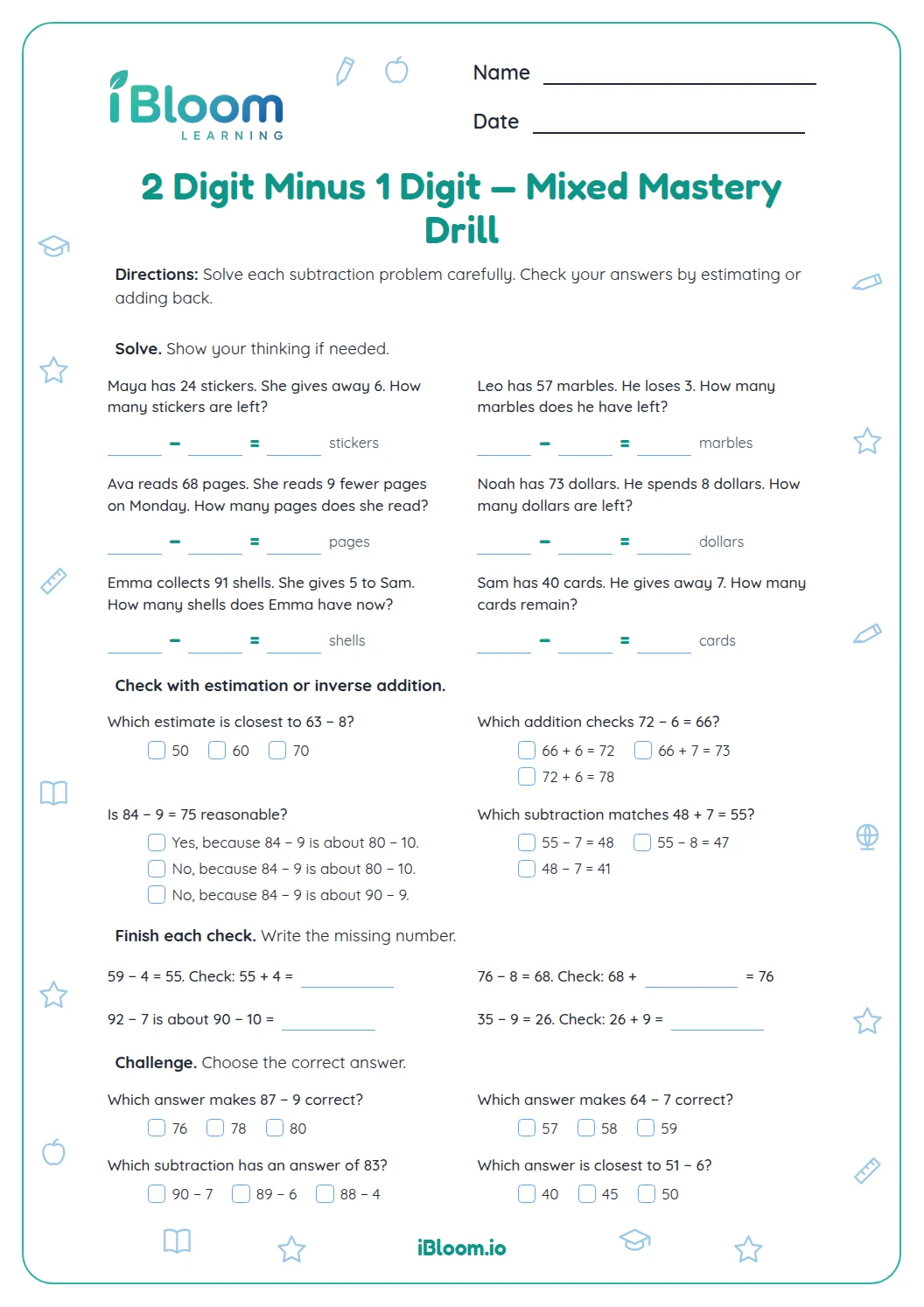
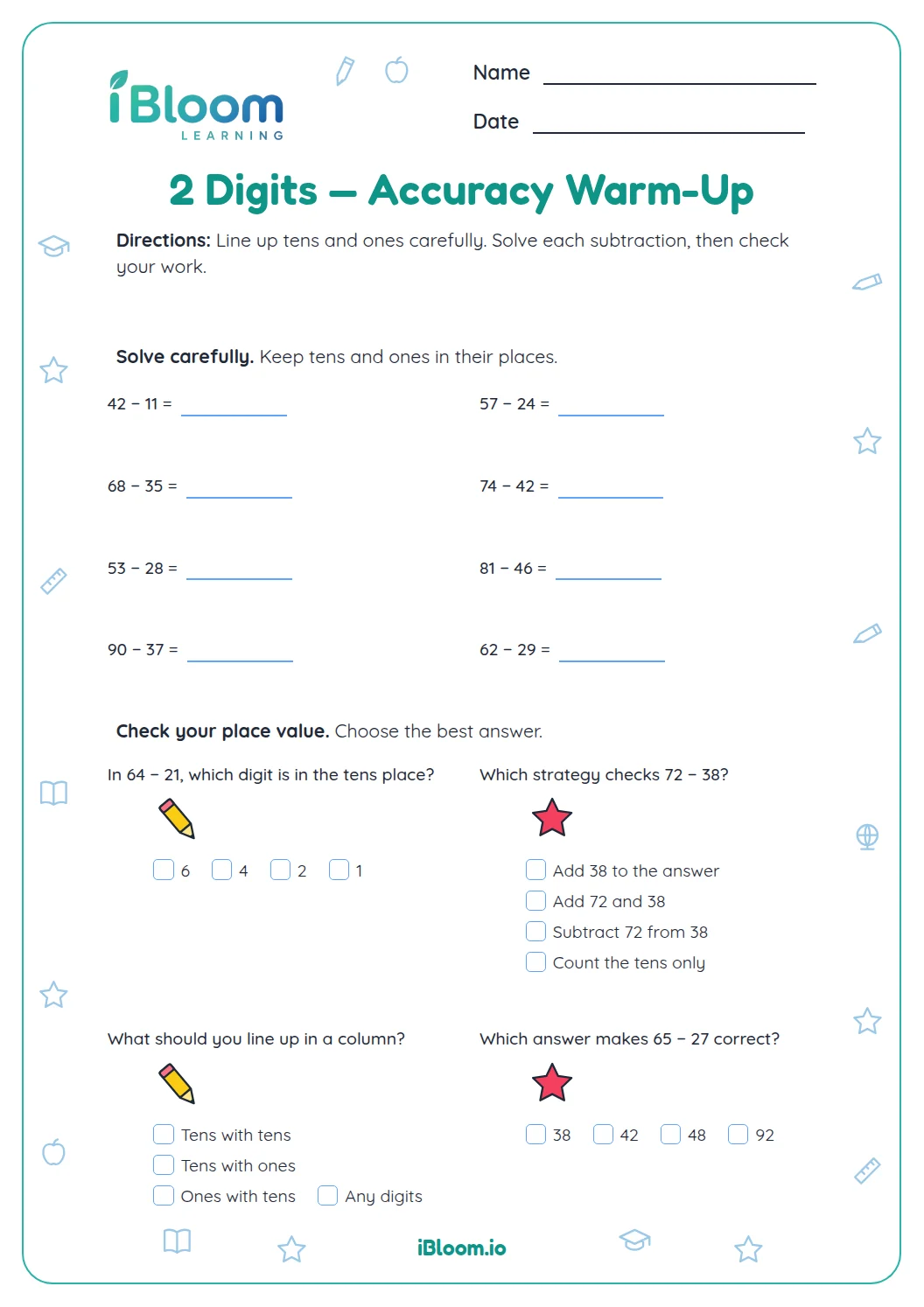
This Grade 2 math drill gives students 16 missing-value equations using two-digit numbers and one-digit subtrahends. The questions progress from finding a difference to finding the starting number or the number being subtracted. Each item has one blank, and the separate answer key makes independent checking straightforward. The practice aligns with CCSS 2.NBT.B.5: subtraction within 100 and the relationship between subtraction and addition.
Aligned to 2.NBT.B.5
What can the blank stand for?
In a subtraction equation, the blank may be the difference, the starting amount (minuend), or the number taken away (subtrahend). Identify the blank’s position before calculating.
When the starting amount is missing, add the subtrahend and difference. When the number taken away is missing, subtract the difference from the starting amount.
- 1___ − 6 = 28
- 2The starting number must be 6 more than 28.
- 328 + 6 = 34
- 4Answer: 34
How is the practice organized?
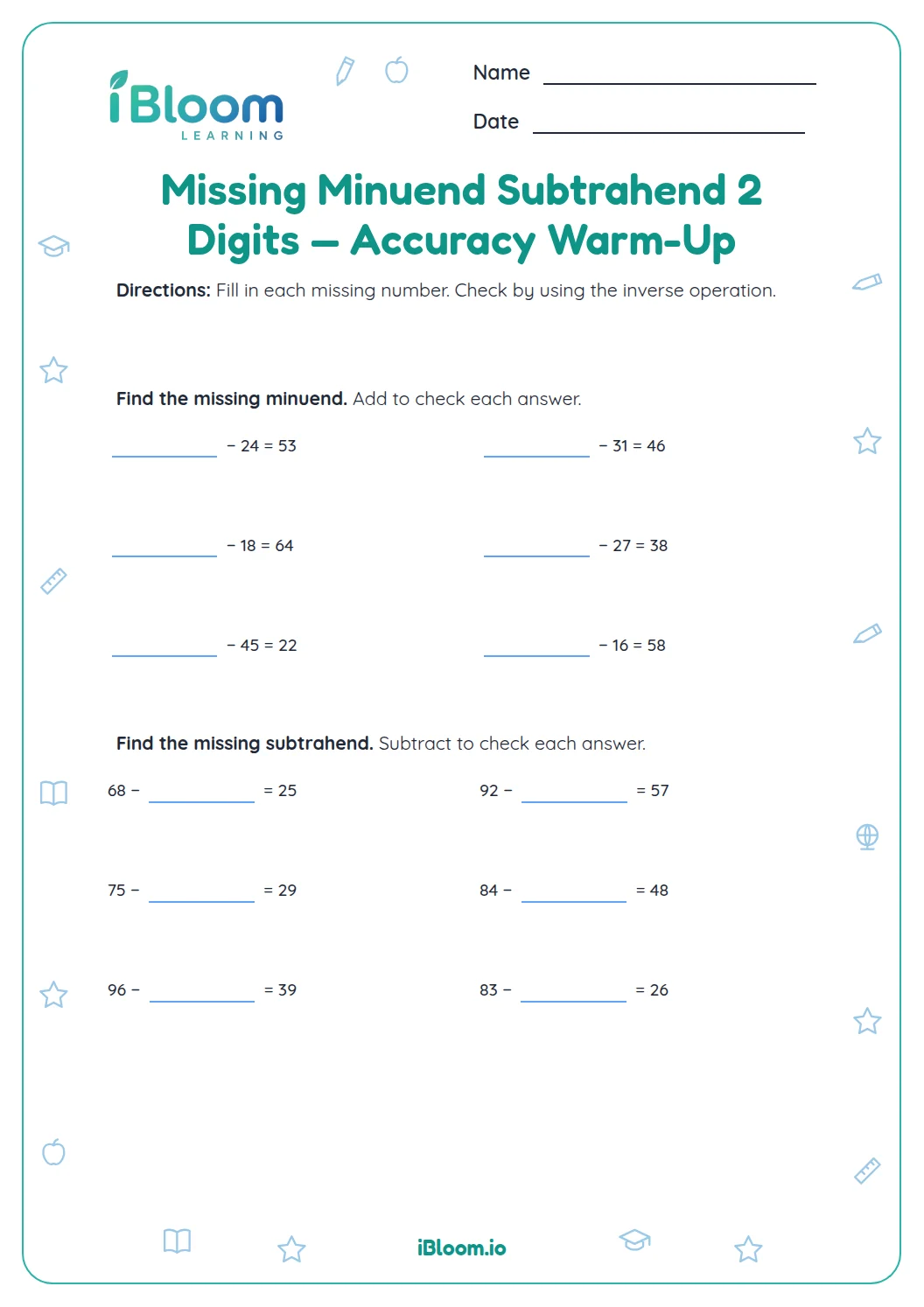
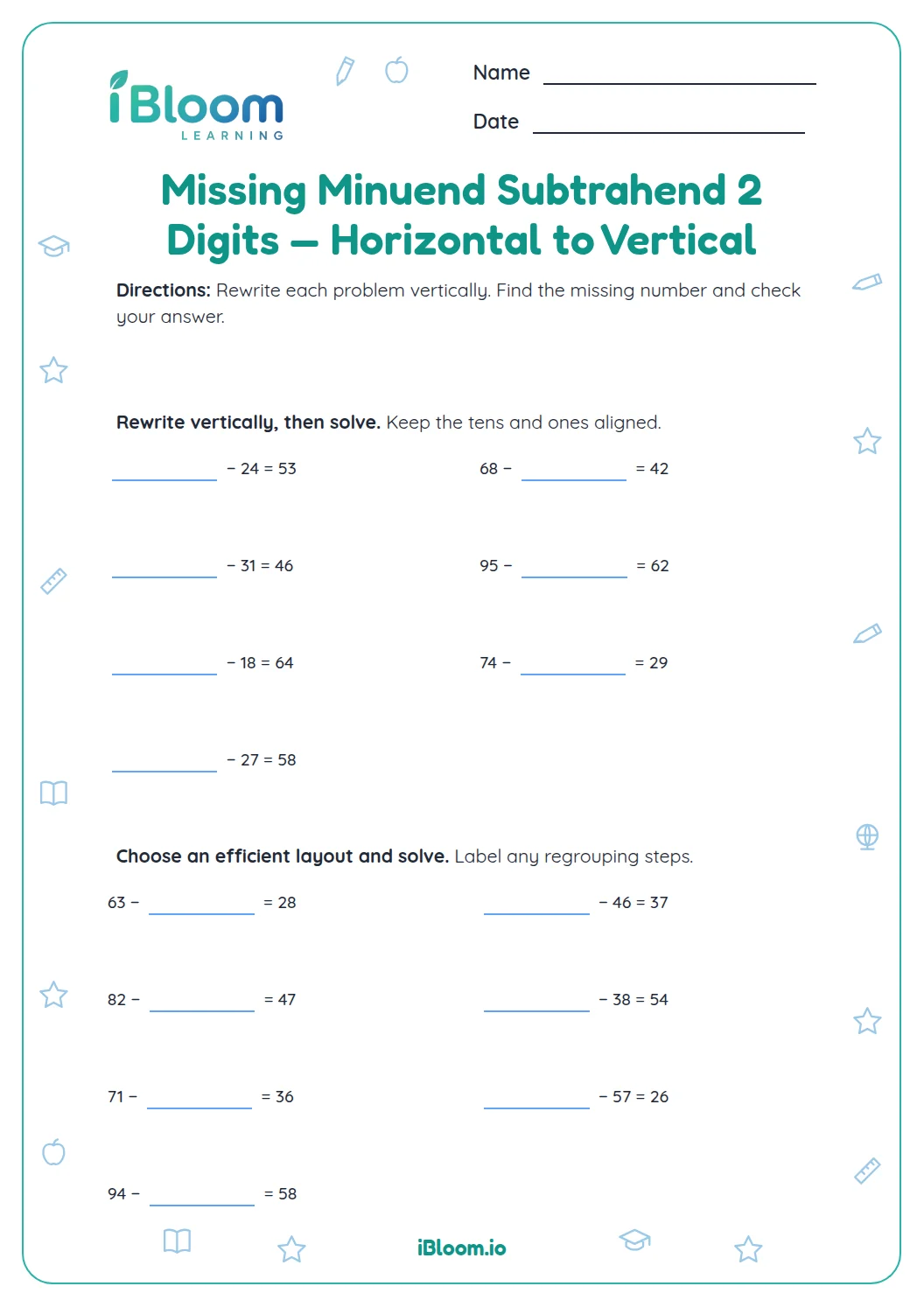
Part A asks for four differences. Part B asks for four missing starting amounts. Part C asks students to find the number subtracted in eight equations.
Each equation has a two-digit starting number and a one-digit number subtracted. The missing value may be the difference, starting number, or number taken away.
How can students check an answer?
Put the number back in the blank and calculate both sides. For a missing subtrahend, check that the starting number minus the answer gives the stated difference. The answer key lists each missing number.
How to use this worksheet
- 1Locate the blank and name its role.
- 2Use the numbers given to choose subtraction or related addition.
- 3Calculate the missing value.
- 4Put it back in the equation.
- 5Check that both sides match.
Common mistakes and quick fixes
The mistake
Treating every blank as the difference.
The fix
Check whether the blank appears before or after the minus sign.
The mistake
Subtracting in the wrong direction to find a missing subtrahend.
The fix
Use minuend minus difference to find what was taken away.
The mistake
Writing a number without checking the equation.
The fix
Replace the blank with your answer and verify the result.
Common Core alignment
These activities give children focused practice with the named grade-level skill.
Subtract within 100 using place value and related operations.
On this sheet: Each missing-value equation asks students to use subtraction and the inverse relationship to find a number within 100.
Show the official wordingHide the official wording
Fluently add and subtract within 100 using strategies based on place value, properties of operations, and/or the relationship between addition and subtraction.
What to practice next
Make more practice
Further reading
Questions parents and teachers ask
What is a missing minuend?
The minuend is the starting number in a subtraction equation. In ___ − 6 = 28, the missing minuend is 34 because 34 − 6 = 28. It comes before the subtraction sign and can be found by adding the subtrahend to the difference.
How do I find a missing subtrahend?
Subtract the known difference from the starting number. In 51 − ___ = 4, calculate 51 − 4 to find 47; then check that 51 − 47 equals 4. Replacing the blank confirms that the equation is true.
Does the worksheet include regrouping?
Some difference questions require regrouping across the tens and ones, such as 24 − 6. The missing-value sections add another way to reason about subtraction. Students can use place value or the related addition fact, then verify the completed equation.
What is included in the answer key?
The key gives one missing number for each of the 16 equations. Students can verify an answer by replacing the blank and checking that both sides of the equation match. This makes the key useful for independent practice or a quick adult check.
How can I support a student who is unsure where to start?
Ask the student to point to the blank and identify whether it is before the minus sign, after it, or after the equals sign. That position tells which value is missing; then use the matching inverse operation and substitute the result to check.