



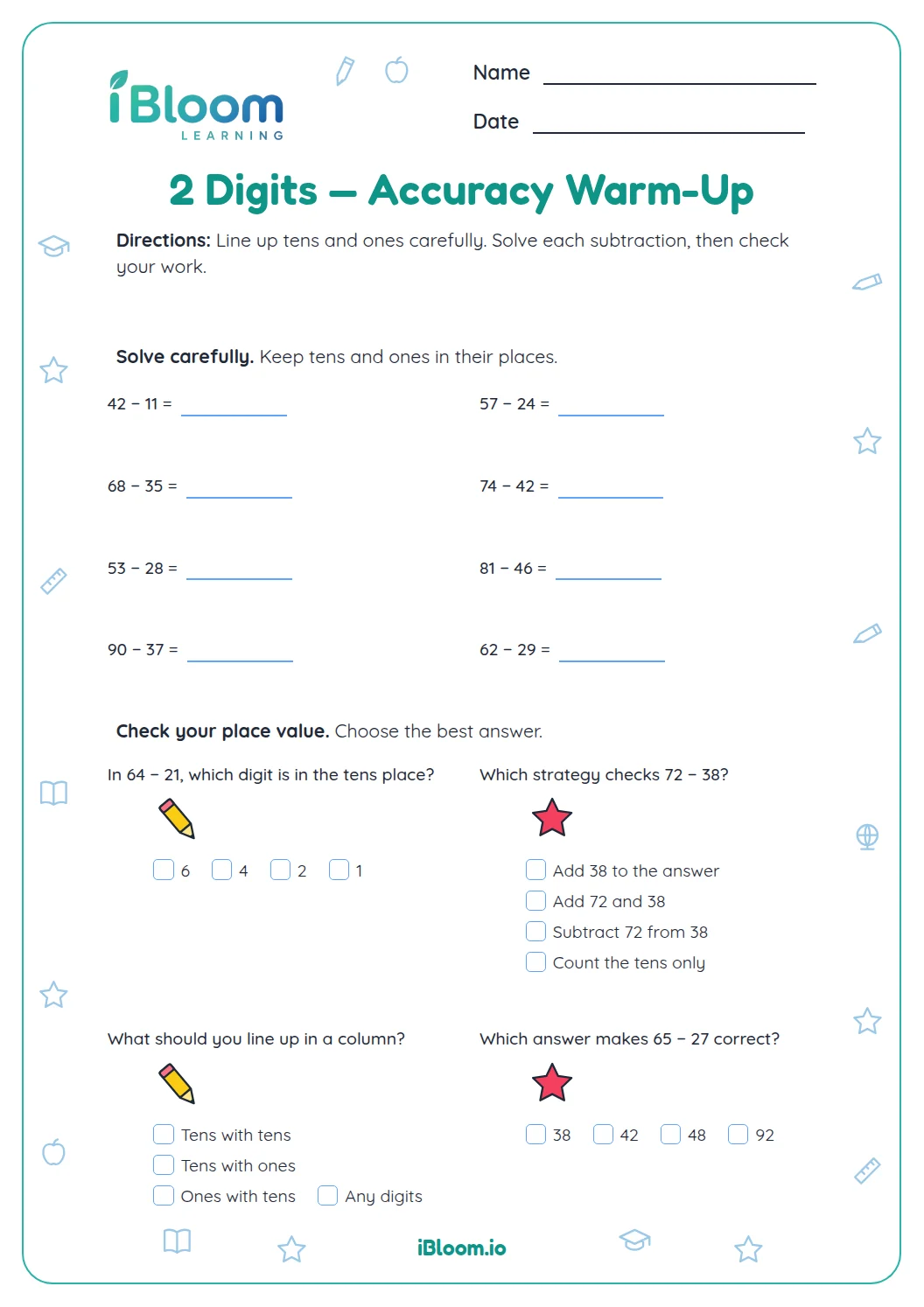


About this worksheet
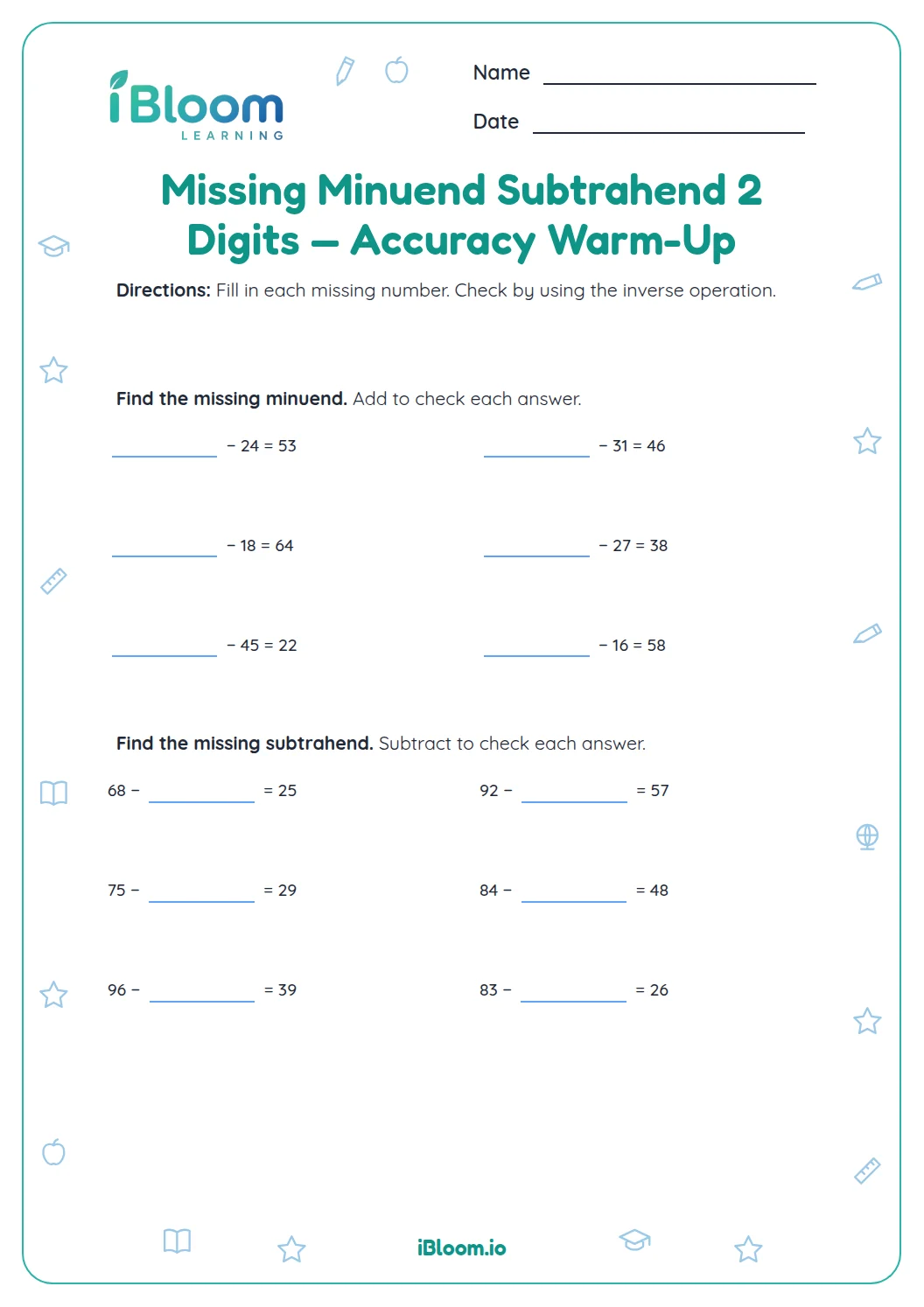
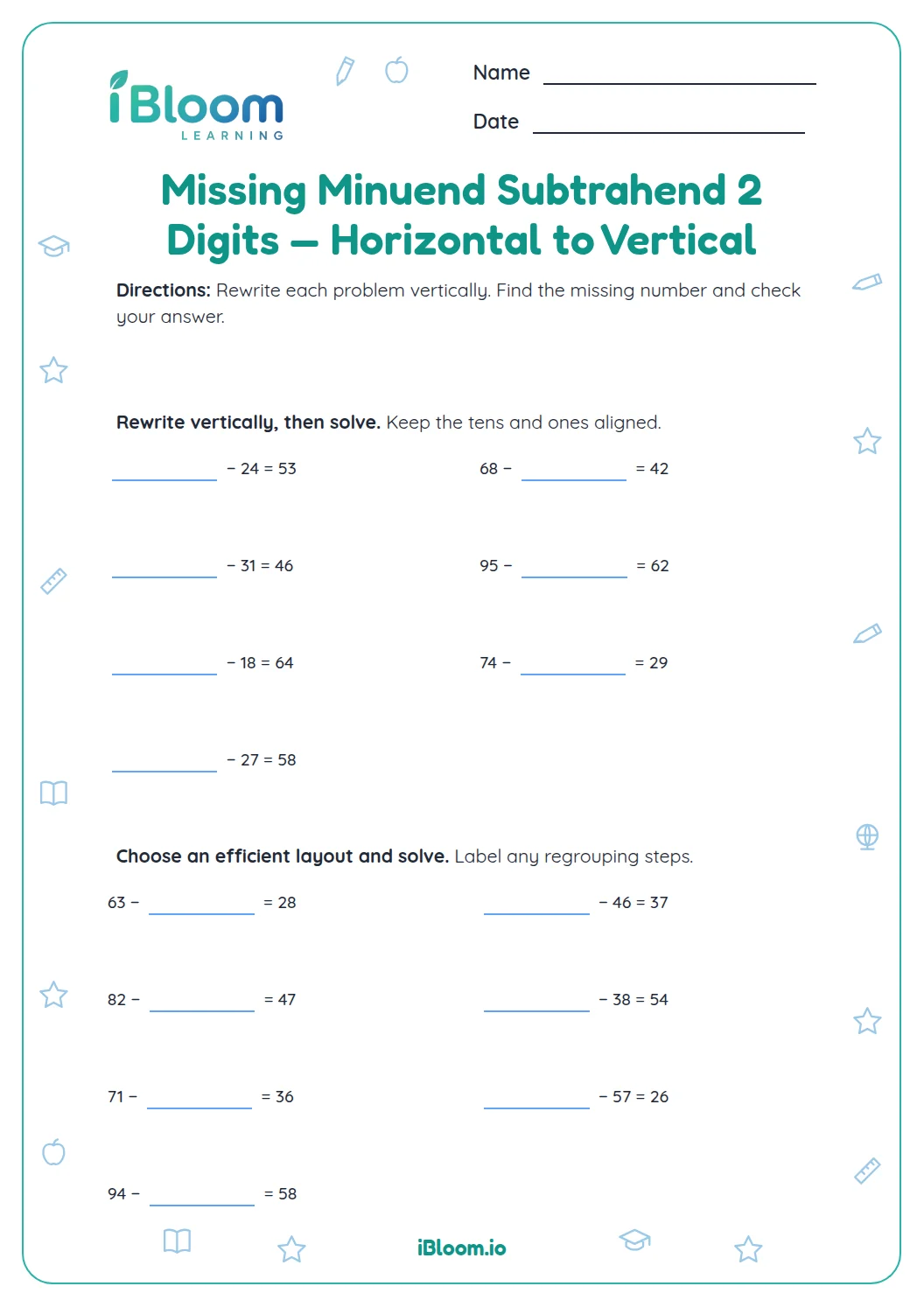
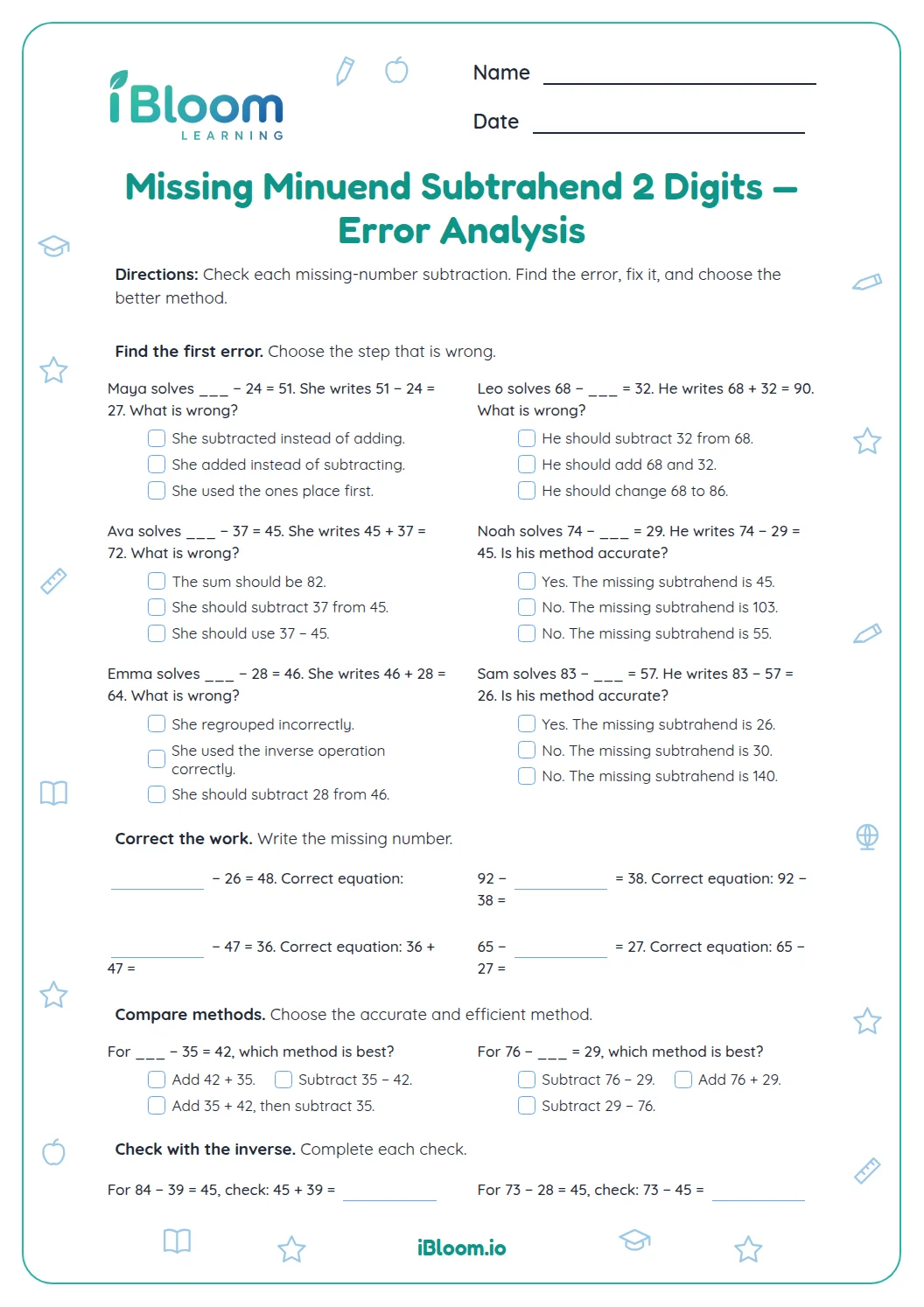
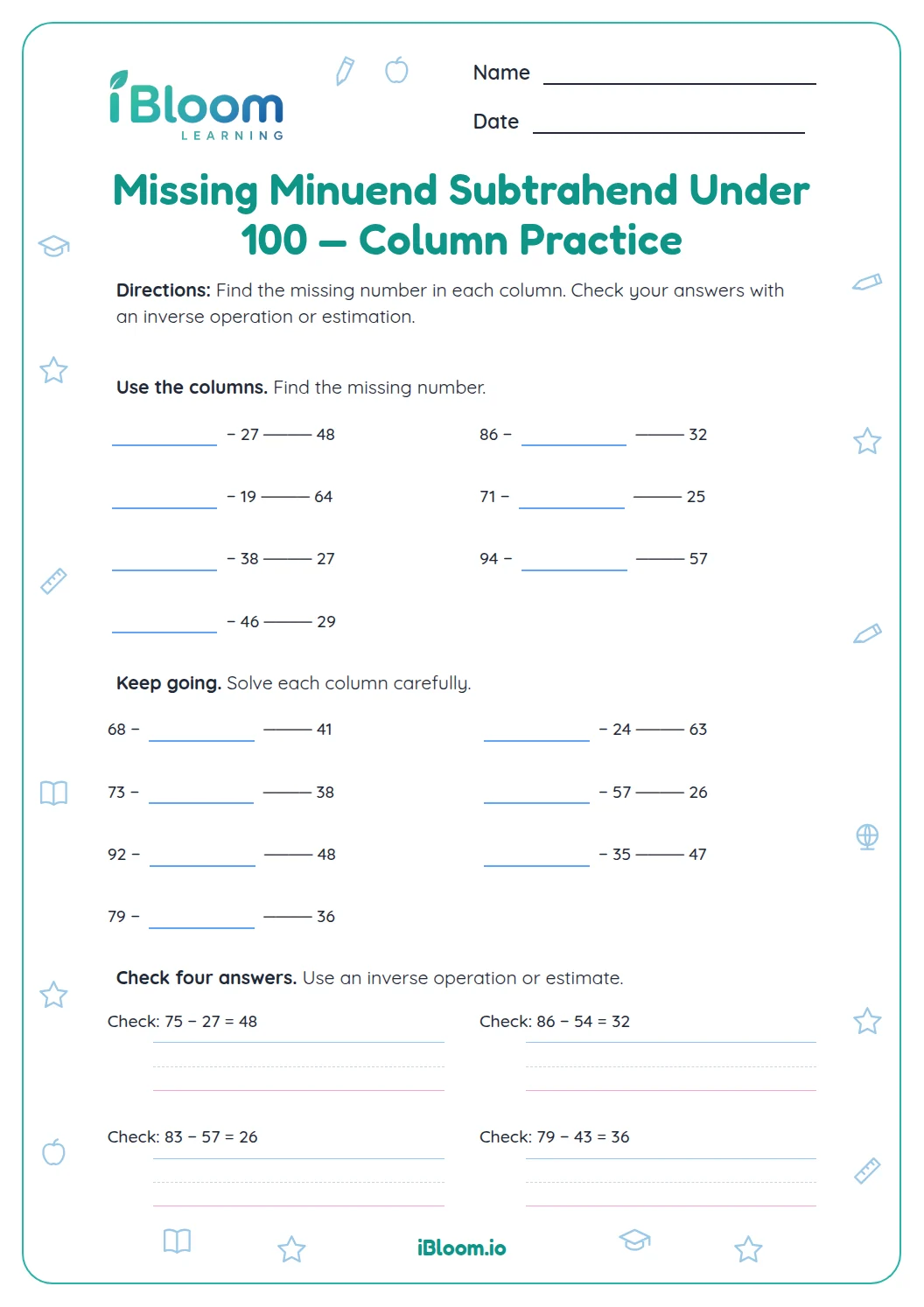
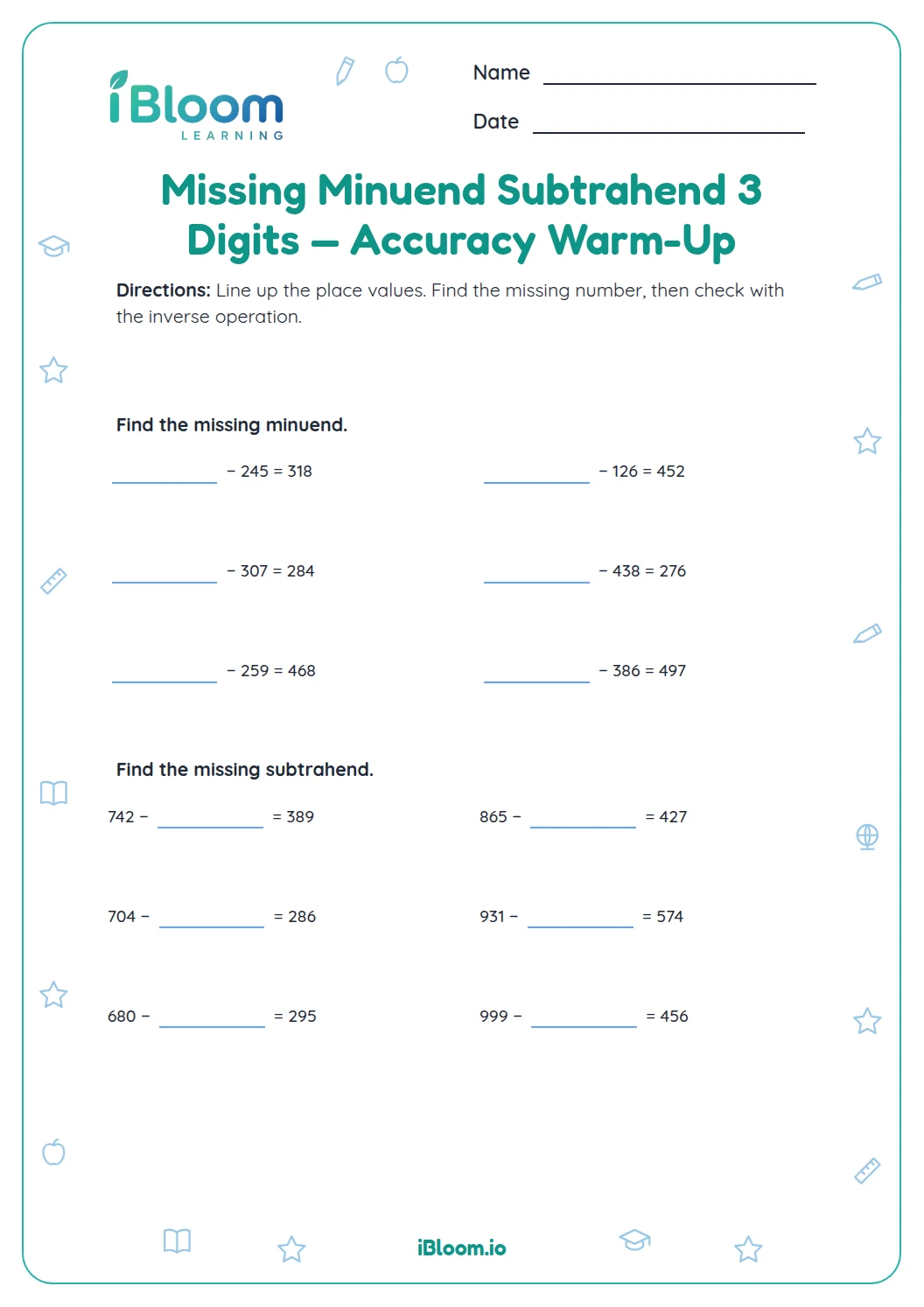
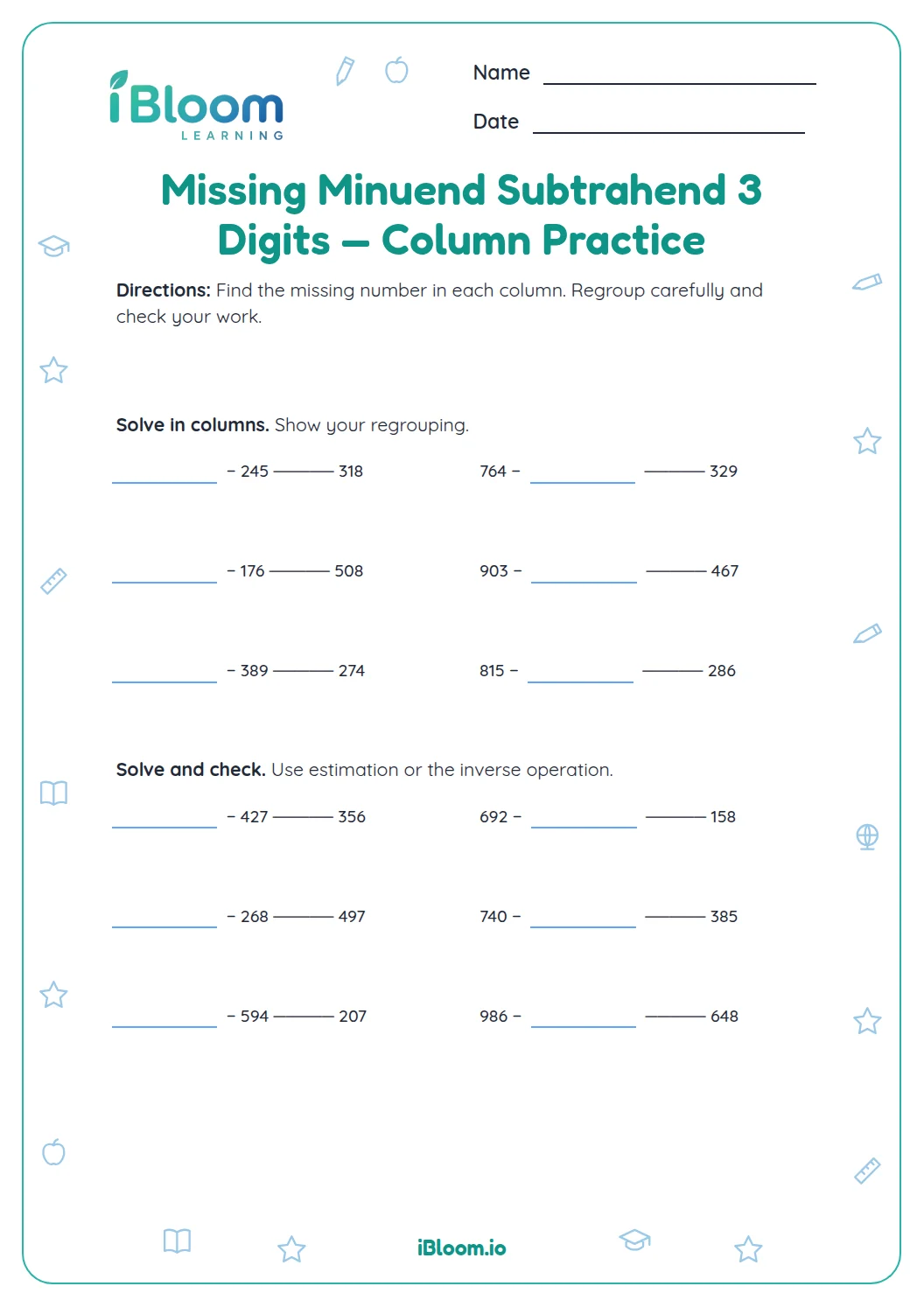
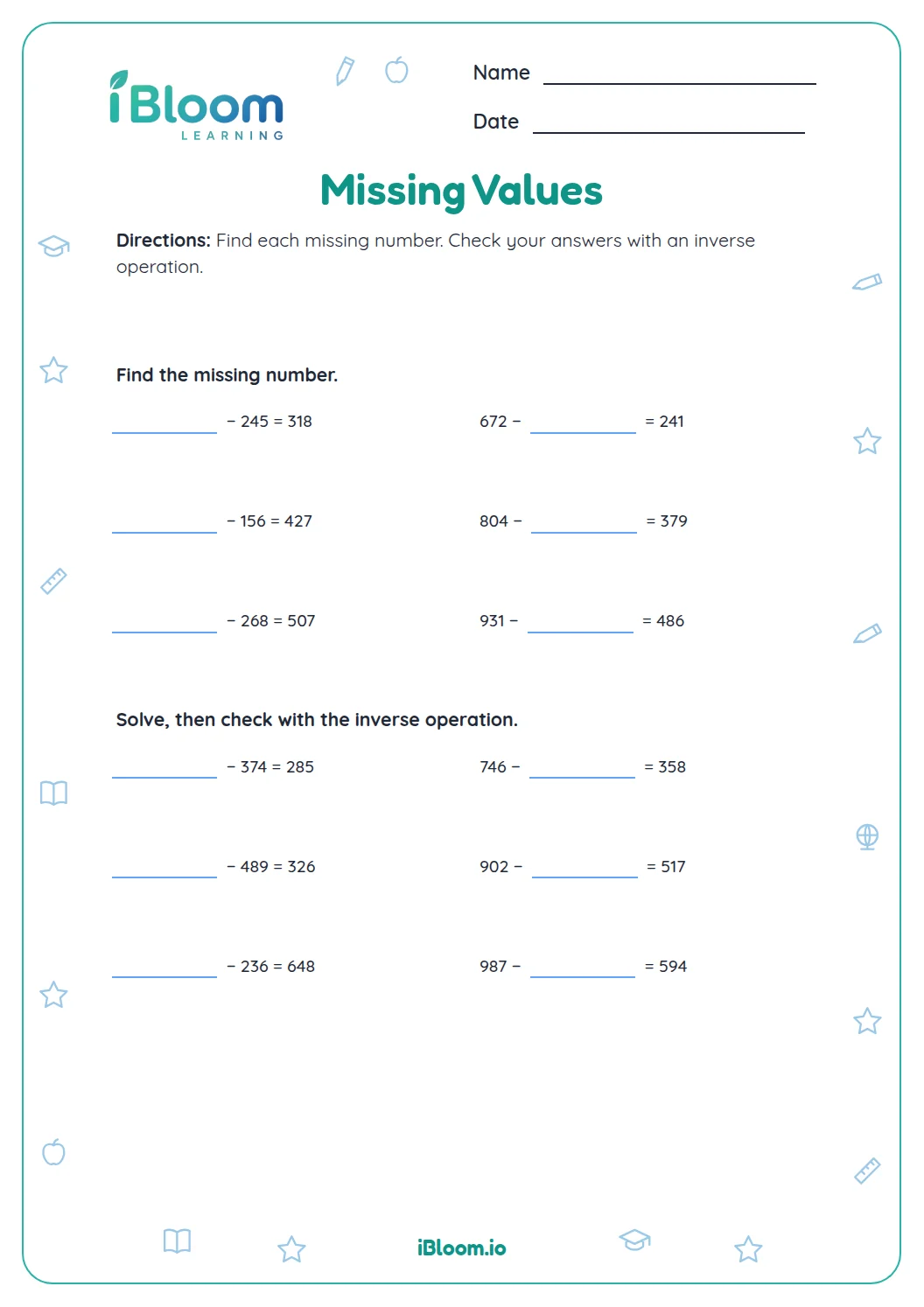
This free printable gives learners 16 two-digit subtraction problems with a missing minuend, subtrahend, or difference. The first part builds the inverse-operation idea with short equations; the second adds checks, a correction, and two short situations. The sheet replaces a plain column drill with equation-based missing-value practice while keeping the focus on two-digit subtraction. It practices CCSS 2.NBT.B.5 through place-value and addition-subtraction relationships.
Aligned to 2.NBT.B.5
How do you find a missing minuend?
The minuend is the number being subtracted from. If it is missing, add the subtrahend and the difference. In question 1, ___ − 24 = 35, so 24 + 35 = 59.
Check by putting 59 back in the original equation: 59 − 24 = 35. If the check does not match, revisit the addition.
- 1___ − 24 = 35
- 224 + 35 = 59
- 359 − 24 = 35
- 4Missing minuend: 59
How do you find a missing subtrahend?
When the subtrahend is missing, compare the starting number and the difference. For question 2, 76 − ___ = 42. The missing amount is 76 − 42 = 34; checking 76 − 34 gives 42.
Keep the original order in mind: the minuend comes first, then the number being subtracted.
What is on the practice pages?
Part A has eight two-digit equations with missing values. Part B has eight additional checks and applications, including short word problems. All values and differences stay within 100. Each item provides work space for column subtraction or a related addition check.
How to use this worksheet
- 1Set out each two-digit equation in columns, keeping tens under tens and ones under ones.
- 2For a missing minuend, add the subtrahend and difference.
- 3For a missing subtrahend, subtract the difference from the minuend.
- 4For a missing difference, subtract as usual.
- 5Check by replacing the blank in the original equation.
Common mistakes and fixes
The mistake
Adding the minuend and subtrahend instead of using the difference.
The fix
For ___ − 24 = 35, use 24 + 35 because those are the two parts that make the starting amount.
The mistake
Subtracting the minuend from the difference when the subtrahend is missing.
The fix
Calculate 82 − 36 to find the amount taken away.
The mistake
Writing an answer that does not make the original equation true.
The fix
Substitute the answer into the original equation and calculate both sides.
Common Core alignment
This worksheet practices the standard below through its own question set.
Use place-value and inverse-operation strategies to solve two-digit subtraction equations.
On this sheet: The missing-value equations use subtraction within 100 and addition to recover an unknown minuend or subtrahend.
Show the official wordingHide the official wording
Fluently add and subtract within 100 using strategies based on place value, properties of operations, and/or the relationship between addition and subtraction.
What to practice next
Make more practice
Further reading
Questions parents and teachers ask
What is a minuend?
The minuend is the number from which another number is subtracted. In 76 − 34 = 42, 76 is the minuend, 34 is the subtrahend, and 42 is the difference. This worksheet asks learners to find one of those missing values.
How do I find a missing minuend?
Add the subtrahend and the difference. For ___ − 24 = 35, add 24 + 35 to get 59, then check 59 − 24 = 35. This confirms that the missing starting number makes the original equation true.
How do I find a missing subtrahend?
Subtract the difference from the minuend. In 76 − ___ = 42, calculate 76 − 42 to find 34, then check that 76 − 34 equals 42. This uses subtraction to undo the original subtraction and check the missing place.
Are the problems written vertically?
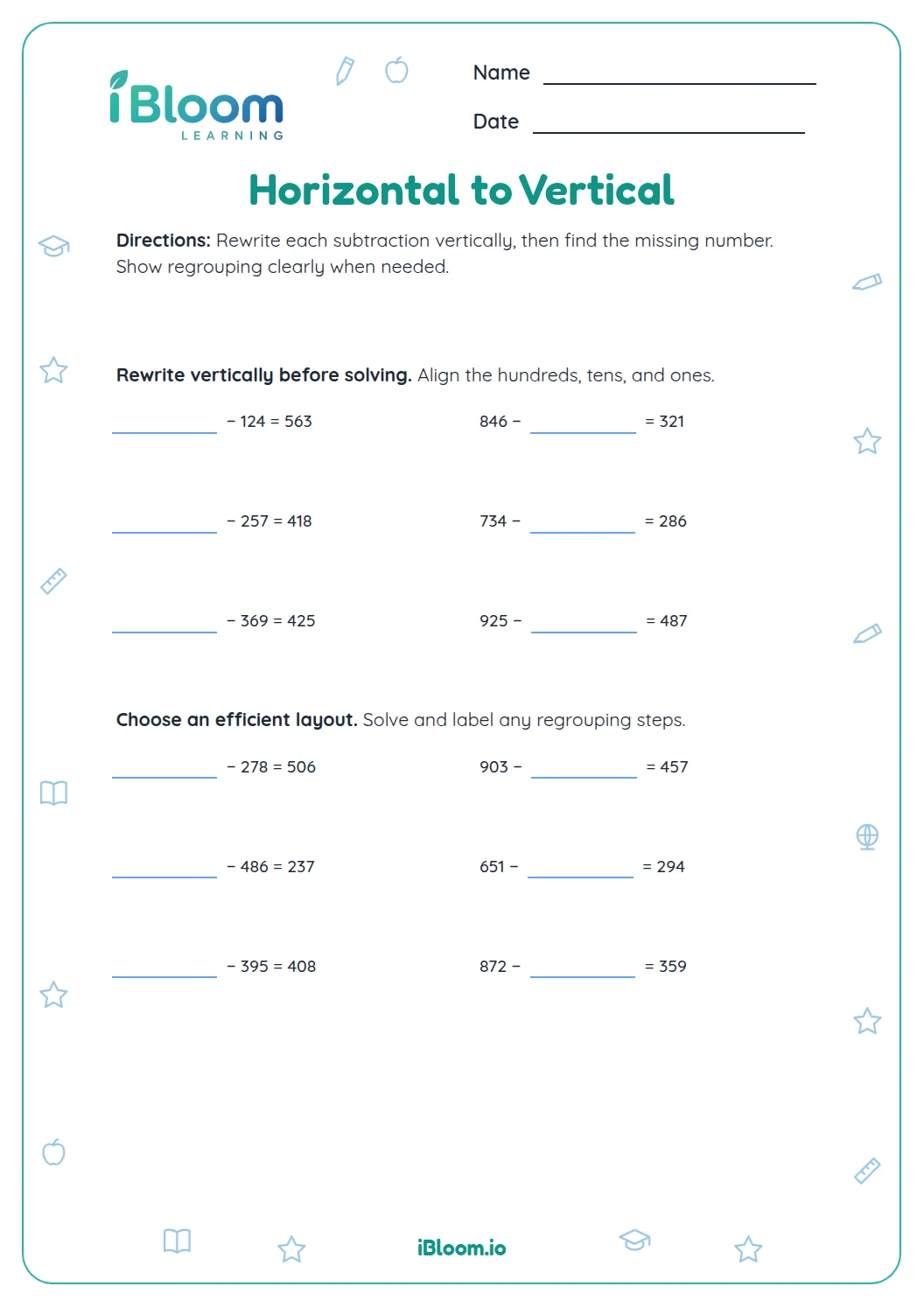
The worksheet prints the equations horizontally so the blank position is easy to see. Learners can set out the numbers in columns in the working boxes, keeping tens under tens and ones under ones while they solve each subtraction fact.
How many problems are included?
There are 16 problems in two parts. The first eight are missing-value equations; the second eight add checks, a correction, and short situations. All values stay within 100, and the answer key shows each missing number and supports checking.
What skill comes next?
After checking two-digit unknowns, learners can practice three-digit missing values or review complete two-digit subtraction equations. The related worksheet links above move to those skills while keeping the addition-subtraction relationship in use with larger values and new checks.