





About this worksheet
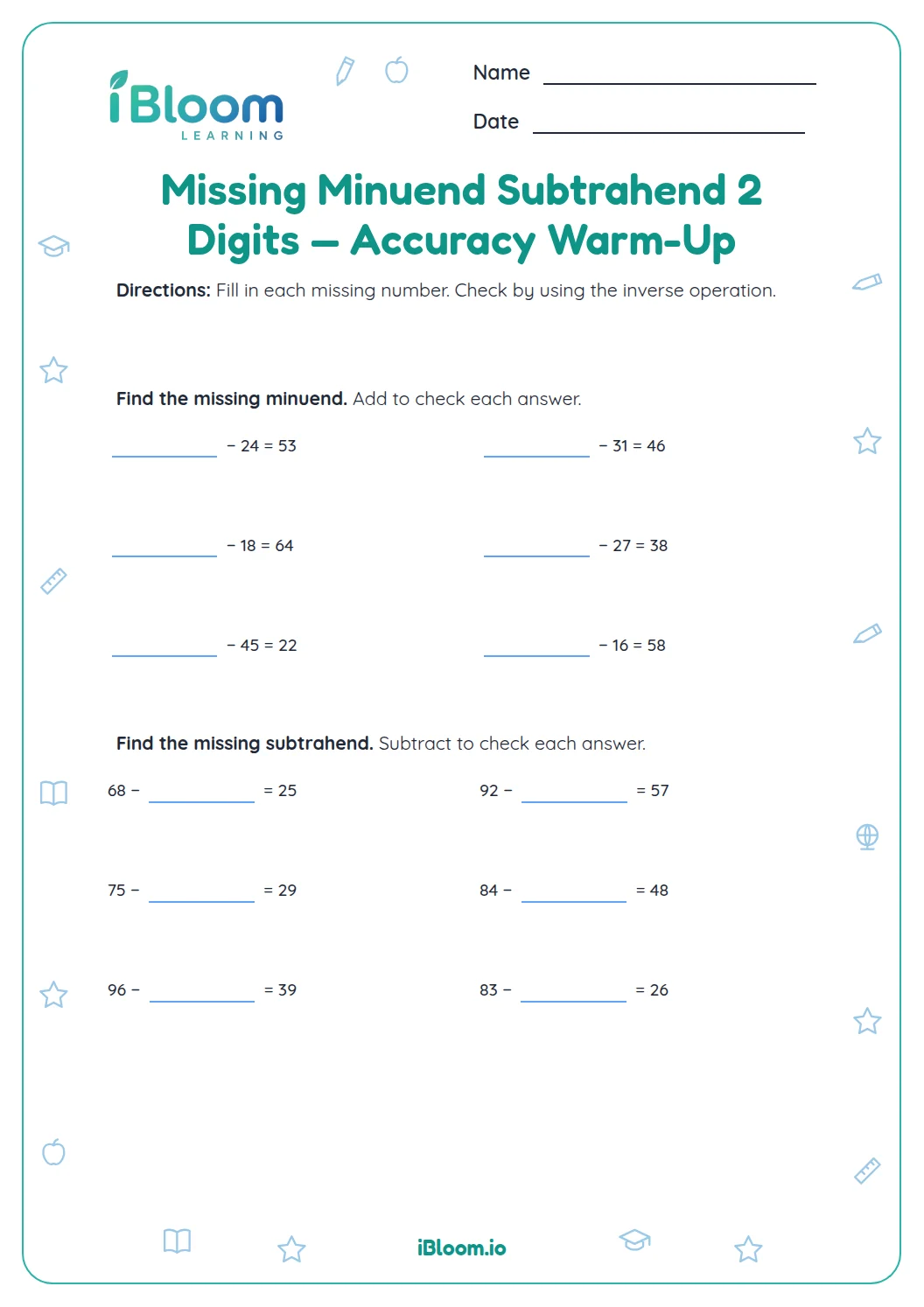
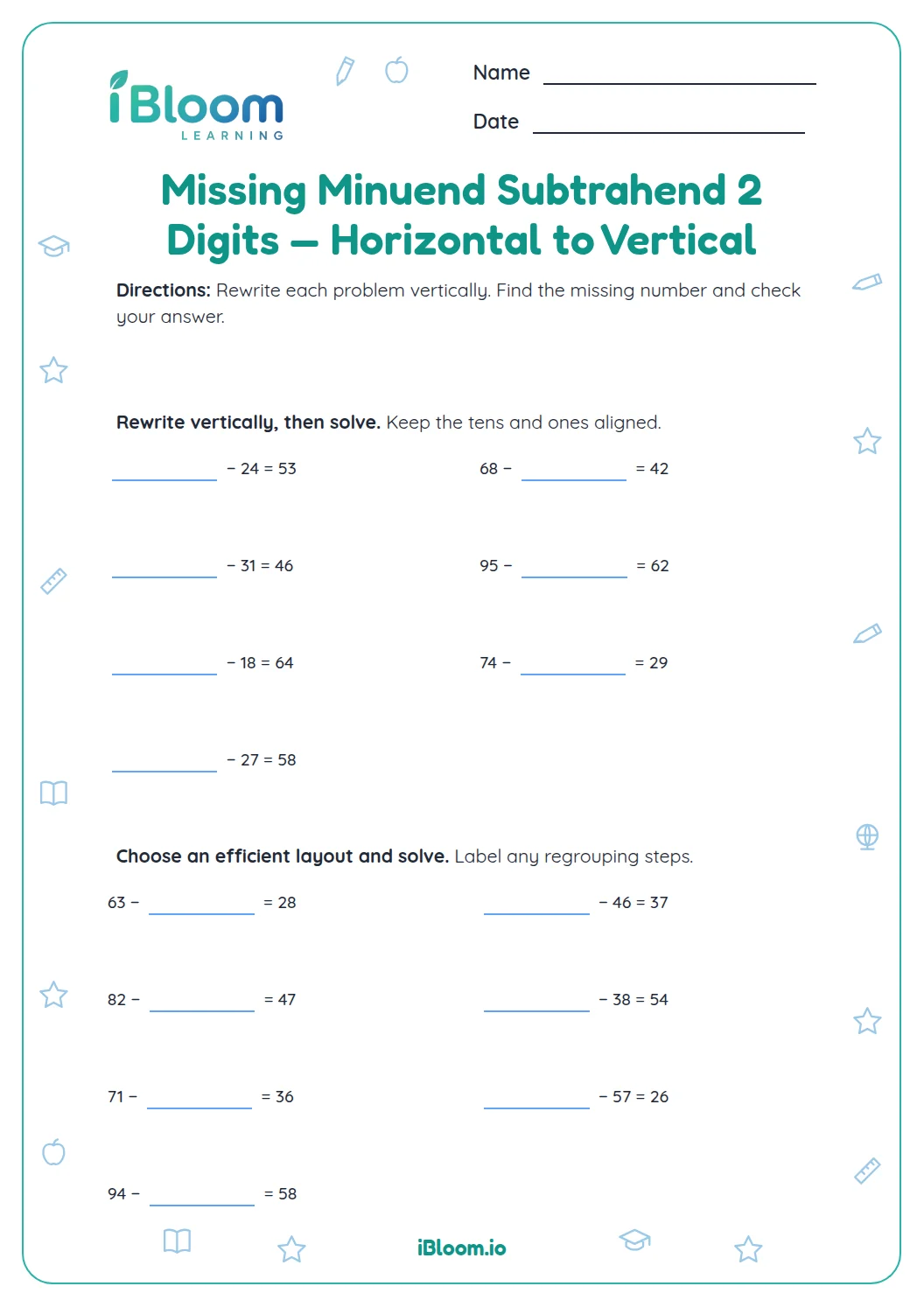
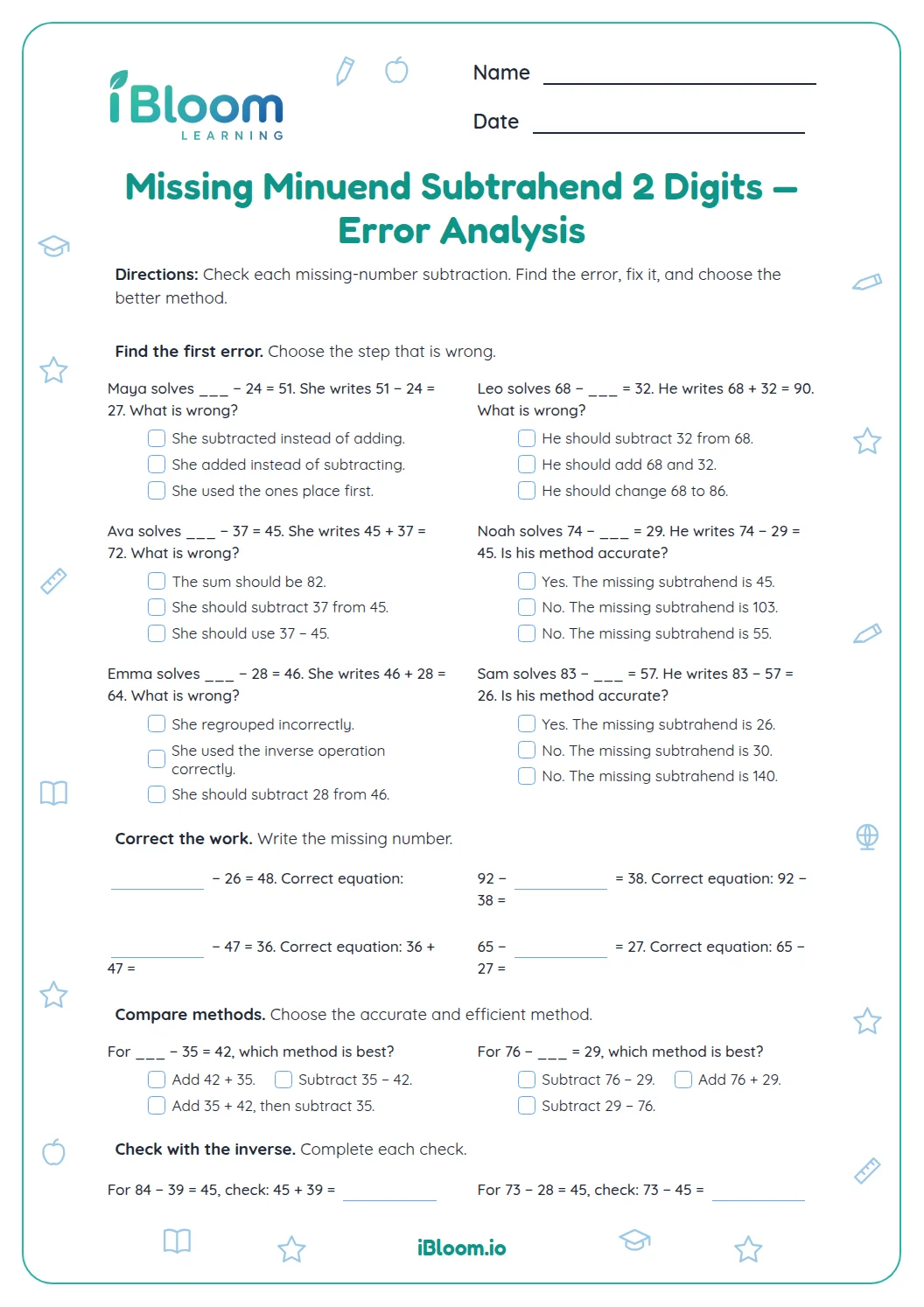
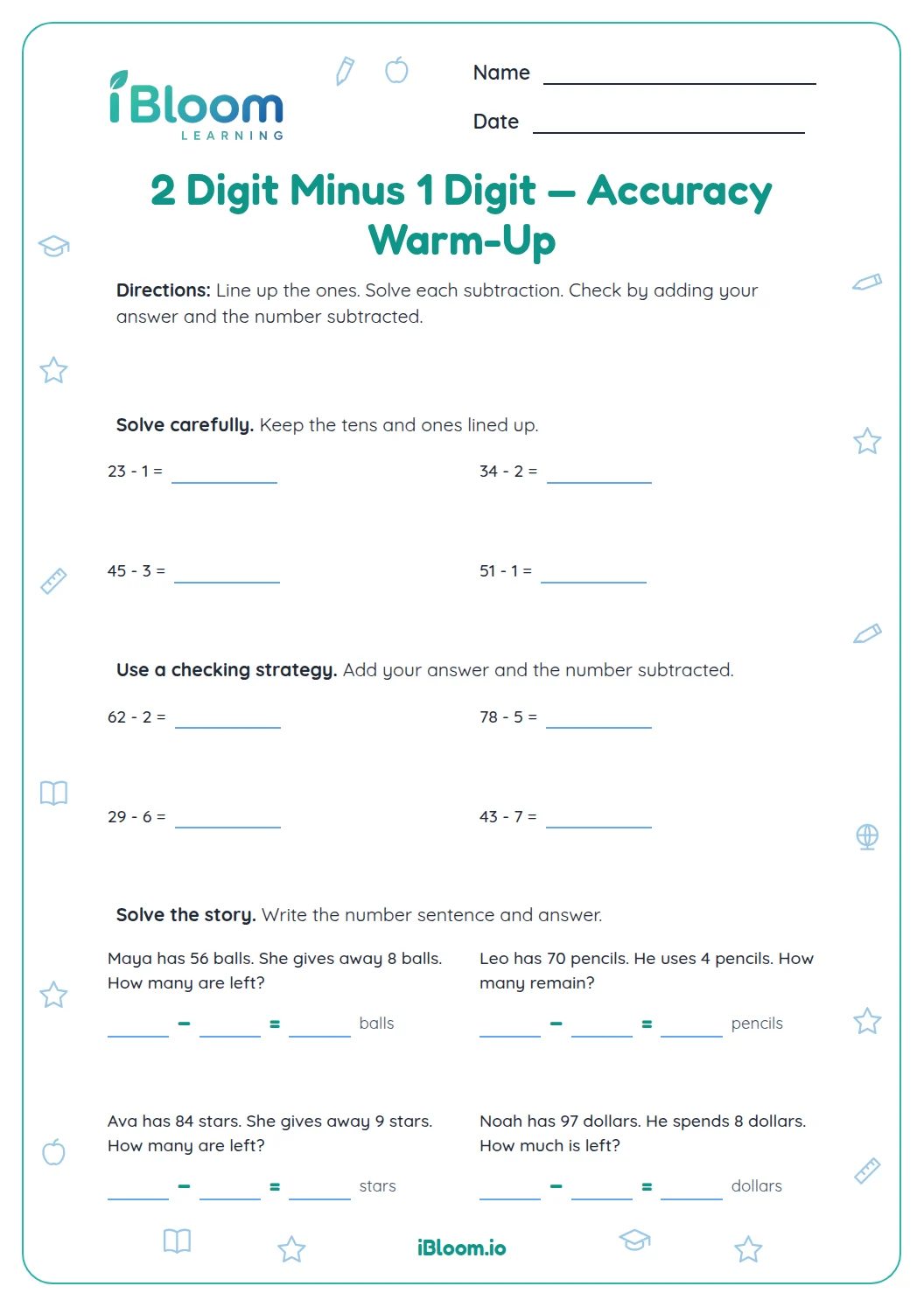
This Grade 2 subtraction printable focuses on finding a missing minuend or subtrahend in two-digit equations, then applying the same relationships in five short stories. Students solve 16 questions and can check each missing value with addition. It replaces the old inverse-check and estimate section with a more direct progression from missing-number equations to everyday subtraction situations. It aligns with 2.NBT.B.5.
Aligned to 2.NBT.B.5
What does the missing-number drill include?
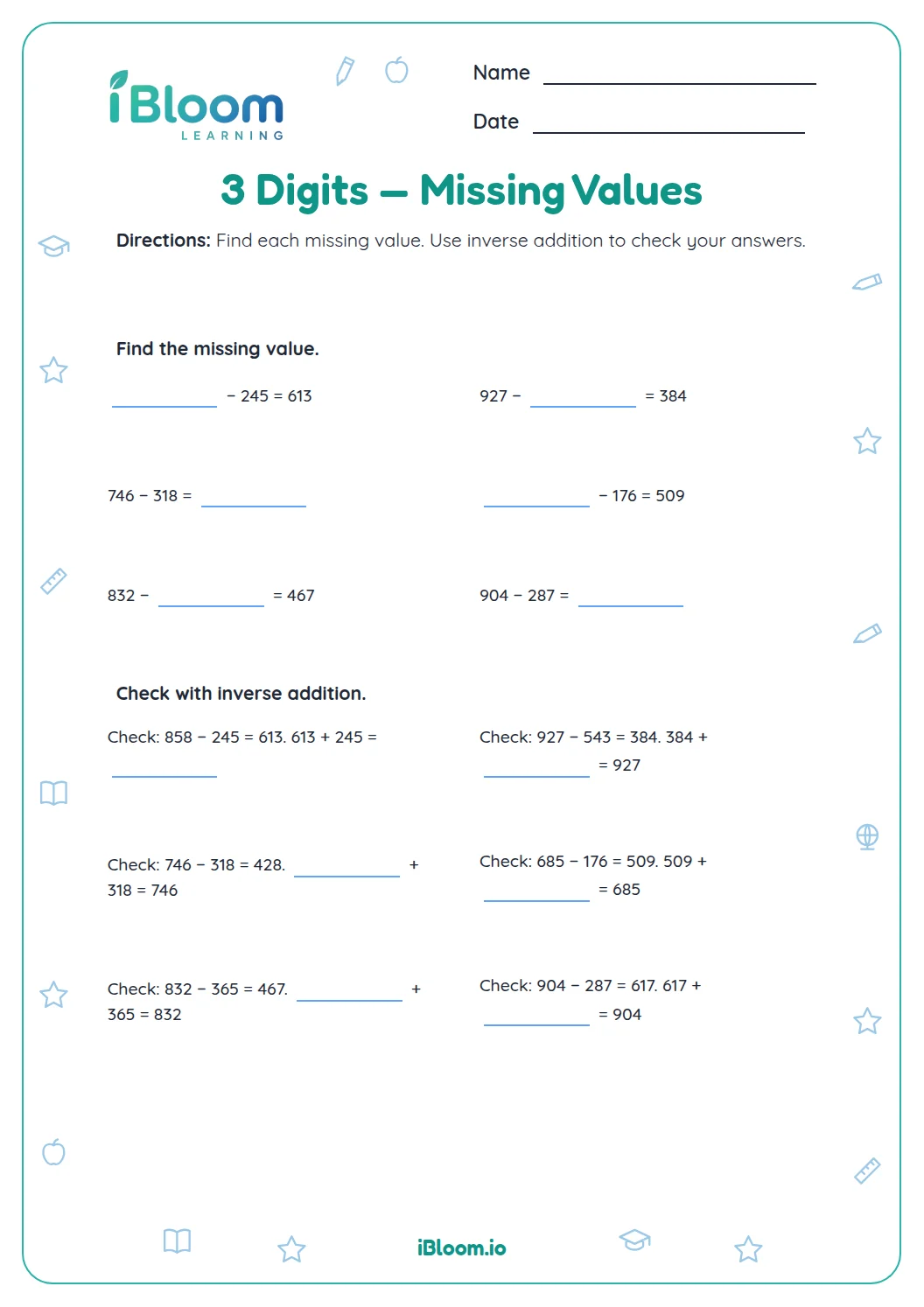
The first two parts contain 11 equations with a missing minuend or subtrahend. The last part has five stories about lengths, books, buttons, a trail, and apples.
Every problem uses two-digit numbers. Story answers include the requested unit or object.
How does addition help find a missing number?
For a missing minuend, add the subtrahend and difference. For a missing subtrahend, compare the minuend with the difference. Then substitute the answer to check the subtraction.
- 1___ − 24 = 35
- 2Answer: 59
How should students solve the story problems?
Identify the starting amount, the amount taken away, and what remains. Write the subtraction relationship, solve, and include the unit or object named in the question.
How to use this worksheet
- 1Read the equation and locate the blank.
- 2Decide whether the start or the amount taken away is missing.
- 3Use the related addition fact to find the blank.
- 4Check by putting the number into the subtraction equation.
- 5For a story, label the answer with the correct unit or object.
Common mistakes and quick fixes
The mistake
Subtracting the two visible numbers in the same order every time.
The fix
First decide whether the blank is the starting number or the amount taken away.
The mistake
Using the remainder as the missing subtrahend.
The fix
Check that the start minus the missing amount equals the stated remainder.
The mistake
Leaving off the unit in a story answer.
The fix
Reread the question and include centimeters, books, buttons, miles, or apples as needed.
Common Core alignment
Use place-value strategies and addition-subtraction relationships to solve within 100.
On this sheet: Use place-value strategies and addition-subtraction relationships to solve within 100.
Show the official wordingHide the official wording
Fluently add and subtract within 100 using strategies based on place value, properties of operations, and/or the relationship between addition and subtraction.
What to practice next
Make more practice
Questions parents and teachers ask
What is a missing minuend?
The minuend is the number a subtraction starts with. If it is missing, add the subtrahend and the difference to find it. For example, in ___ − 24 = 35, add 24 and 35 to get the missing starting number, 59.
How does a student find a missing subtrahend?
Use the known starting number and the difference to work out how much was taken away. Then substitute that amount and confirm the subtraction is true. Checking the equation helps catch a number that was placed in the wrong role.
How many problems are on the worksheet?
There are 16 questions: 11 missing-value equations and five subtraction stories. The separate answer key gives the number answers and includes units or objects for story problems, such as centimeters, books, buttons, miles, and apples. Students can use the key after finishing to review every equation and story.
Are the problems within Grade 2 number range?
Yes. Each problem uses two-digit numbers and the story quantities stay below 100. Students can use place-value strategies and the relationship between addition and subtraction to find the missing values, then check each result in the original equation.
How can a student check an answer?
Put the missing value into the original equation and compute the subtraction. For example, 59 − 24 equals 35, so 59 fits the first equation. For a story, also check that the answer includes the unit or object asked for.