
About this worksheet
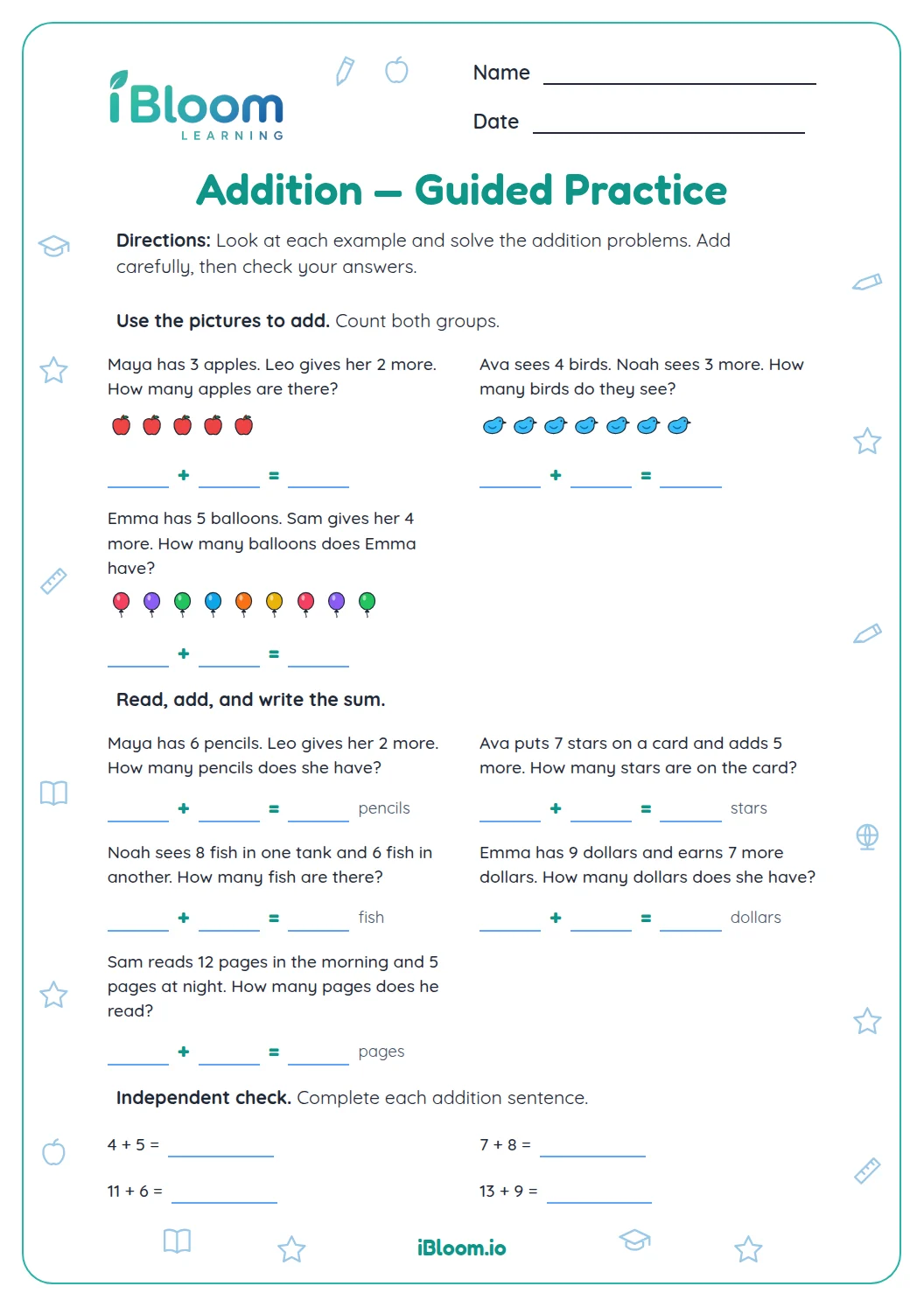
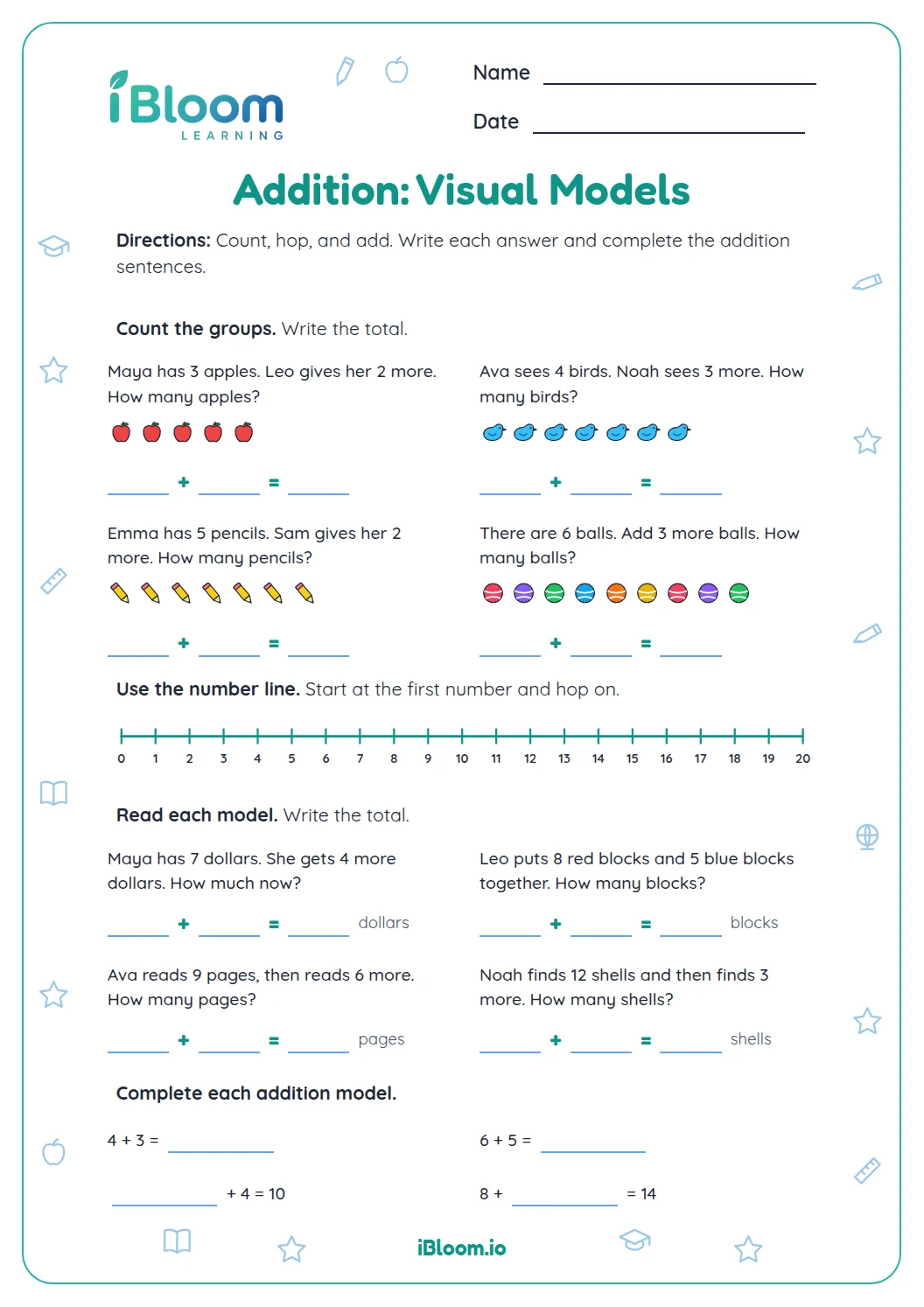
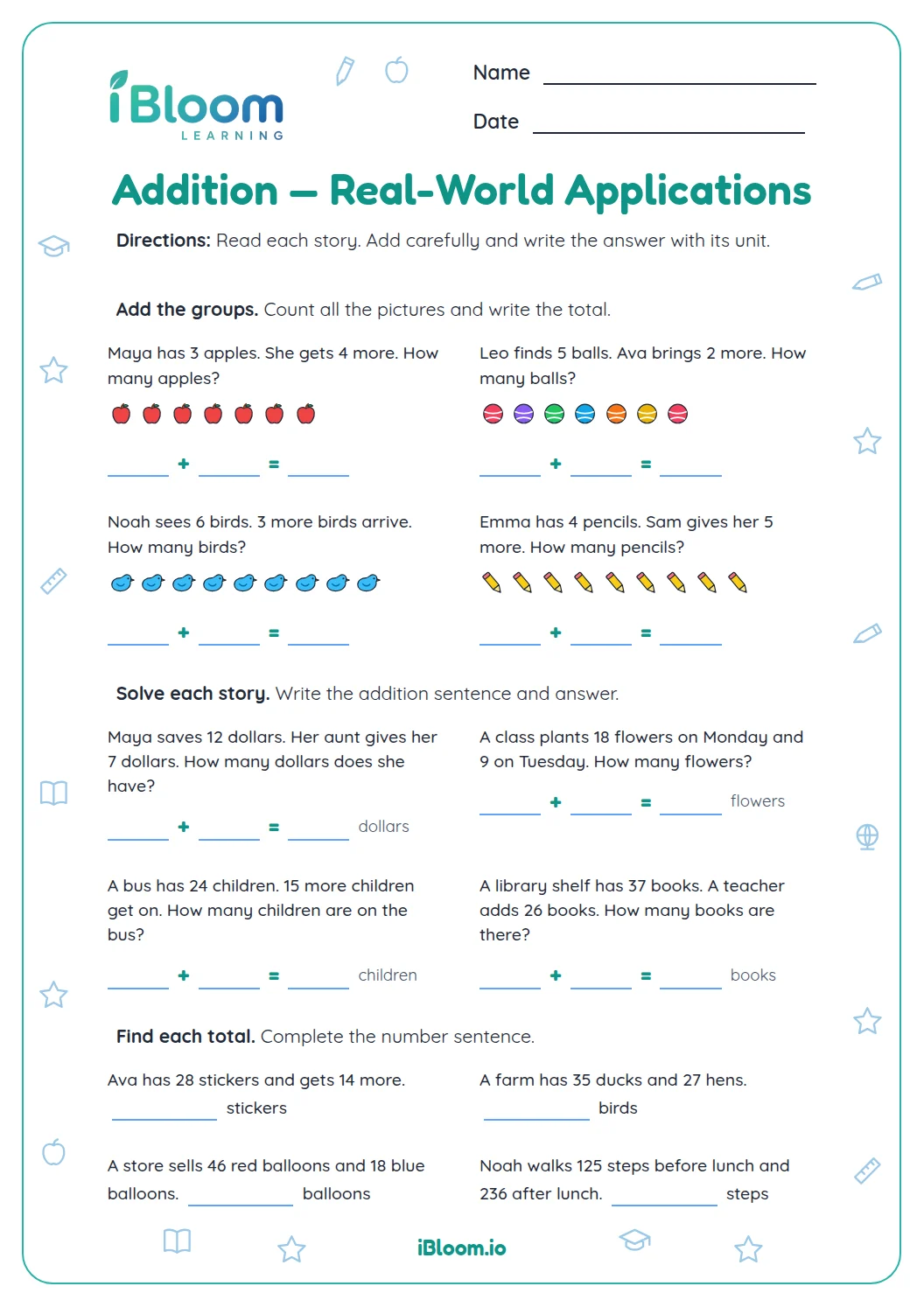
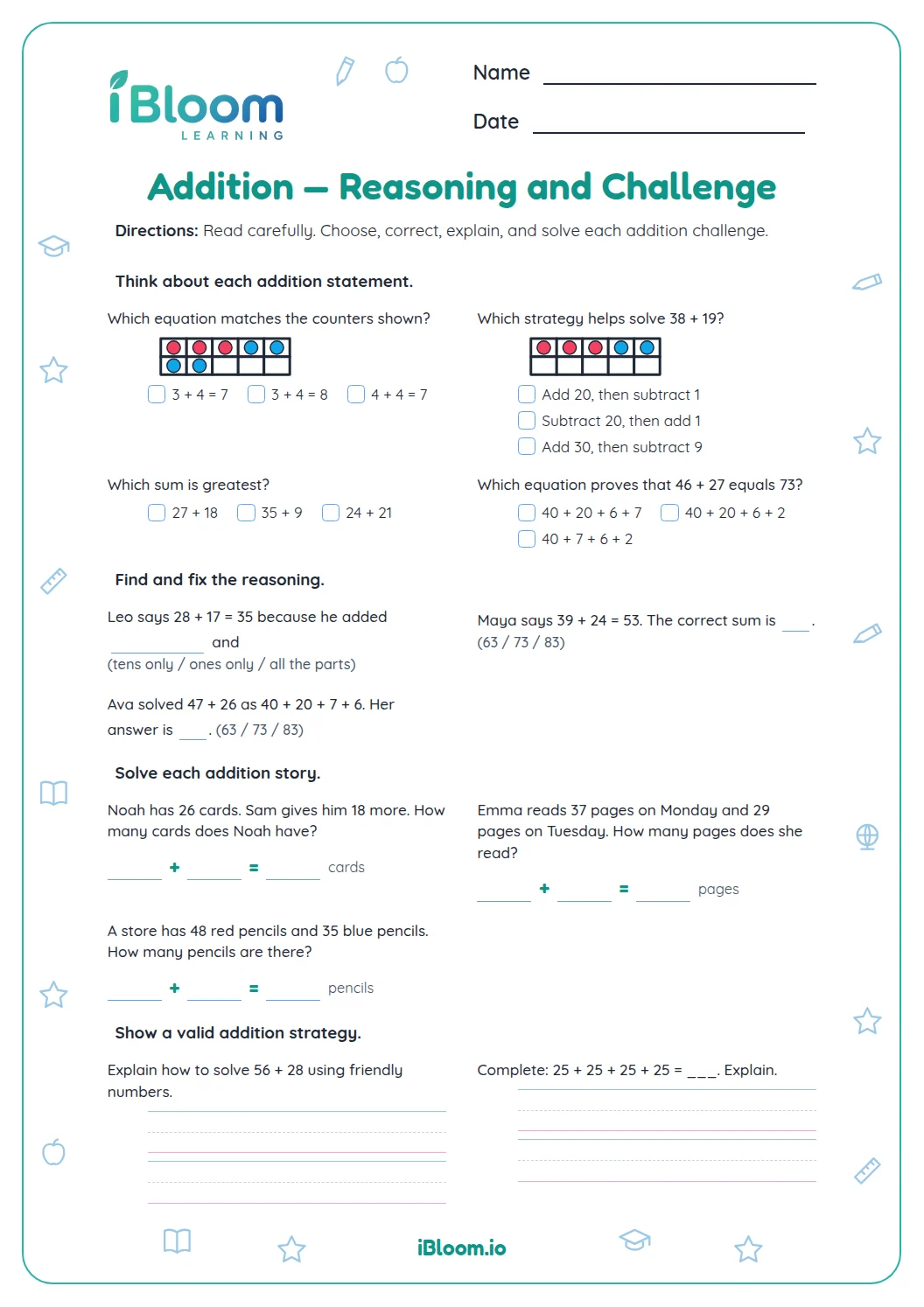
This printable addition review has 23 problems in four parts. Learners begin with sums within 20, add tens, then solve two- and three-digit sums and short story problems. Regrouping appears in the larger sums, and a separate answer key shows each result.
Aligned to 1.OA.C.6 and 2.NBT.B.7
What does the addition practice include?
The sequence starts with familiar facts, then moves to tens and larger numbers. The final three questions put addition into short stories about shells, books, and tomatoes.
- Part A: 5 sums within 20
- Part B: 3 sums adding tens
- Part C: 12 multi-digit sums, including regrouping
- Part D: 3 addition story problems
How does regrouping work?
Add the ones first. If they total ten or more, write the ones digit and carry one ten to the tens column. If the tens total ten or more, regroup ten tens as one hundred.
How can a learner solve a story sum?
In the shells problem, Mia starts with 26 and finds 18 more, so the quantities join. Write 26 + 18, regroup 14 ones as 1 ten and 4 ones, then add the tens to get 44 shells.
How to work through the sums
- 1Solve the within-20 facts using a strategy you know.
- 2For tens problems, add the tens and keep the ones place in mind.
- 3Line up hundreds, tens, and ones for larger sums.
- 4Regroup when a column reaches ten or more.
- 5For each story, identify both amounts and write an addition equation.
- 6Check each result with the answer key.
Addition mistakes to check
The mistake
Adding digits in a column but forgetting a carried ten.
The fix
Mark the regrouped ten above the next column before continuing.
The mistake
Combining story numbers without checking what the question asks.
The fix
Identify the starting amount and the amount added, then write a plus equation.
The mistake
Dropping a zero in a tens problem.
The fix
Keep the place value: 47 + 20 adds two tens, giving 67.
Common Core alignment
This worksheet practices addition facts and place-value addition.
Add and subtract within 20.
On this sheet: The first five items practice addition facts within 20.
Show the official wordingHide the official wording
Add and subtract within 20, demonstrating fluency for addition and subtraction within 10.
Add within 1,000 using place-value strategies.
On this sheet: The later items add two- and three-digit numbers, including regrouping.
Show the official wordingHide the official wording
Add and subtract within 1000, using concrete models or drawings and strategies based on place value, properties of operations, and/or the relationship between addition and subtraction.
What to practice next
Make more practice
Further reading
Questions parents and teachers ask
How many questions are included?
There are 23 problems in four parts: five facts within 20, three sums that add tens, twelve larger number sentences, and three word problems. The answer key gives an answer for each one. Each part builds on the place-value ideas used in the next group.
Does the worksheet include regrouping?
Yes. Several two- and three-digit sums require regrouping from ones to tens or tens to hundreds. The story problems also use addition, and learners have working space to show an equation. Learners can pause after each column to check the carried value.
What is one way to solve 26 + 18?
Add the ones first: 6 + 8 = 14, so write 4 ones and regroup 1 ten. Then add 2 tens, 1 ten, and the regrouped ten to get 4 tens. The sum is 44. Keeping the ones and tens in view helps prevent a place-value slip.
Can a child use a strategy other than columns?
Yes. The number sentences can be solved with place-value strategies, mental addition, or a written method. For the story questions, the working grid gives space to write an addition equation and show a method. The working space supports either a drawing or a written equation.
How should the answer key be used?
Have the learner finish a part before checking it. If an answer differs, revisit the place values or story equation and redo the calculation. For a story problem, check that the answer also names the correct quantity, such as books or shells.