

About this worksheet
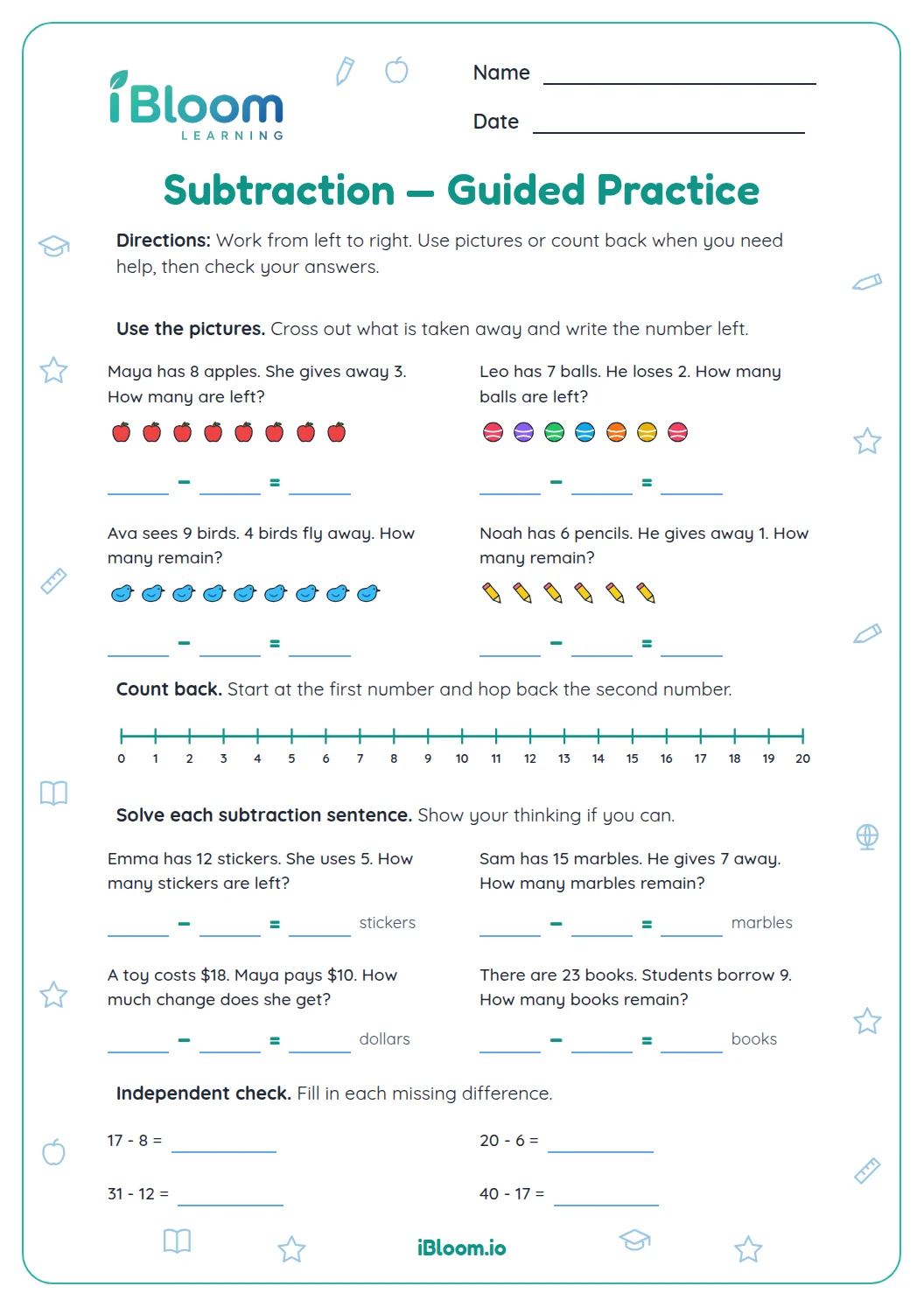
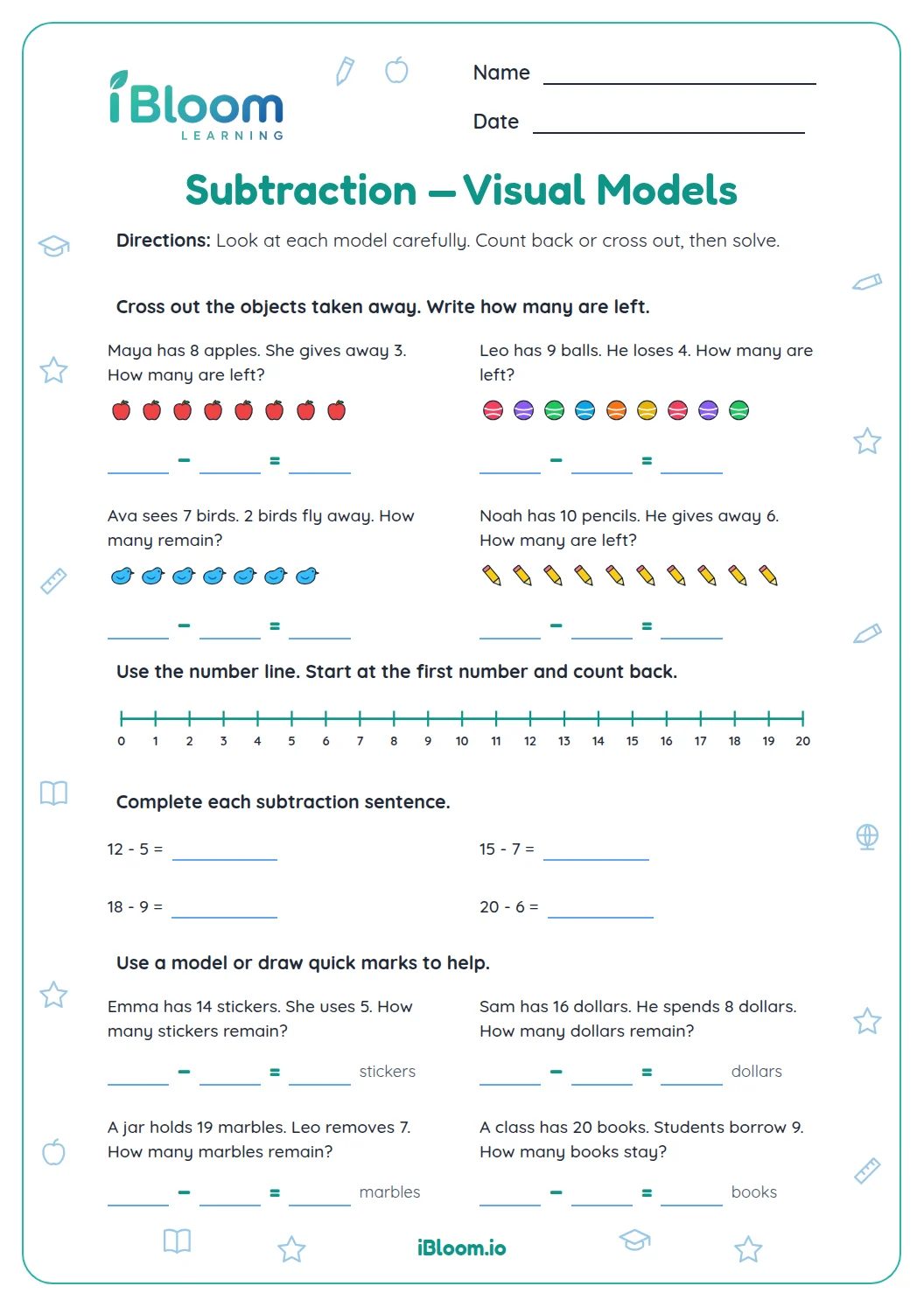
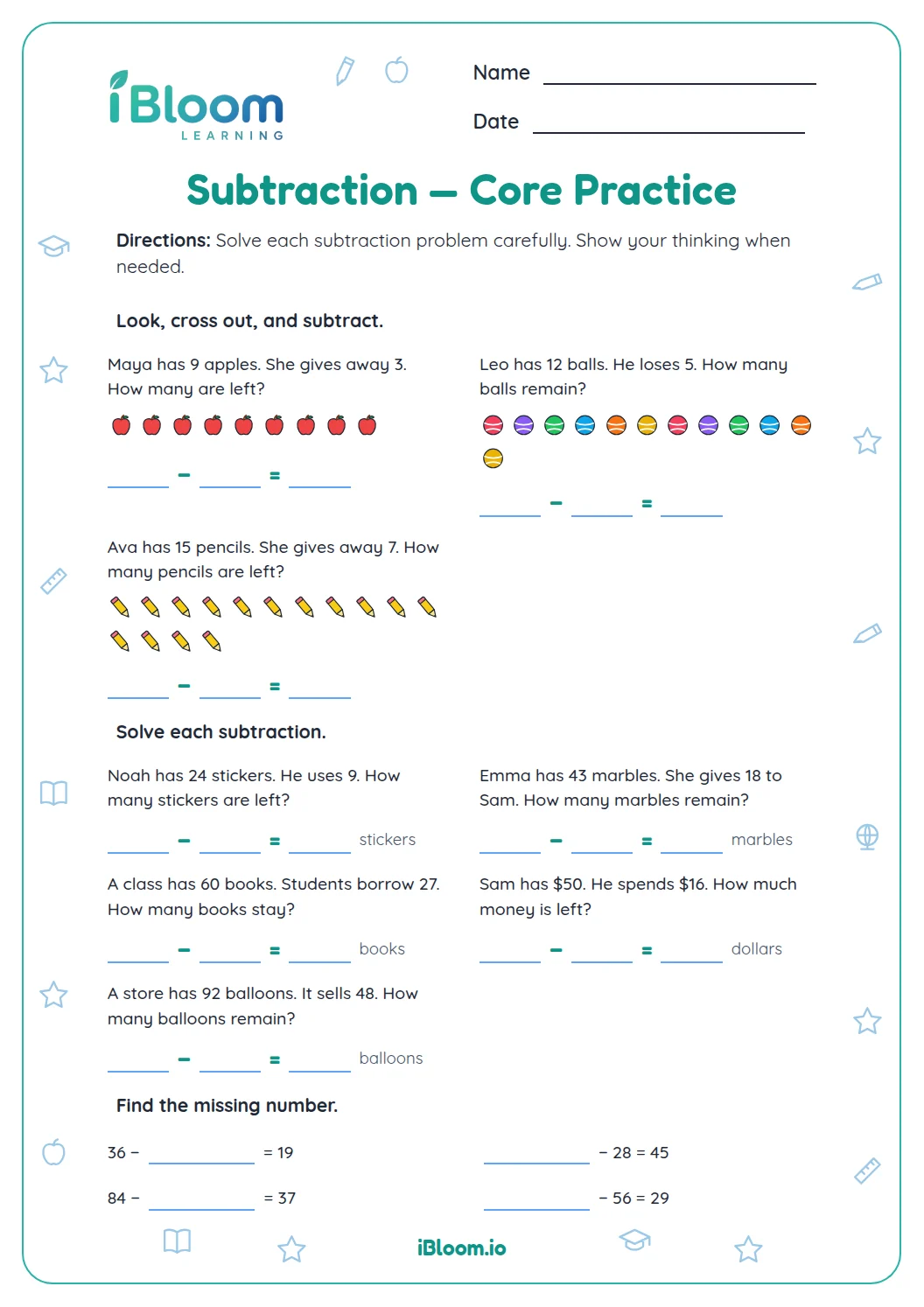
This printable turns subtraction into familiar situations: stickers shared, fruit left, scores compared, and distances still to go. Across 16 questions, learners choose what the starting amount and change mean, then solve with space to show their work. The number range grows from teen facts to three-digit contexts, so families can select questions that fit their learner. The page connects to CCSS 2.OA.A.1 and includes a separate answer key.
Aligned to 2.OA.A.1
What can subtraction tell us?
Subtraction can tell how many remain after some are used, how far apart two amounts are, or how much changed when a start and finish are known.
How do you choose an operation?
If 42 apples were in a basket and 16 were used, the remaining amount is 42 − 16 = 26. The word used signals that the starting group became smaller.
What situations appear on the sheet?
Questions move from small take-away stories to comparisons and missing-change situations.
- Part A: find what remains
- Part B: compare amounts
- Part C: work backward from what remains
A simple problem-solving routine
- 1Read the whole story before choosing numbers.
- 2Name the starting amount and what is taken away or compared.
- 3Write a subtraction equation in the work area.
- 4Solve and label the answer if the story uses a unit.
- 5Check that the answer is smaller than the starting amount when something was removed.
Common subtraction slips
The mistake
Subtracting the smaller digit from the larger digit in every column.
The fix
Regroup from the next place when the top digit is too small.
The mistake
Using addition for a comparison because the question says more.
The fix
Subtract the smaller amount from the larger to find the gap.
The mistake
Reporting the amount used instead of the amount left.
The fix
Return to the story and check whether it asks for used or remaining.
Common Core alignment
The scenarios build one-step addition and subtraction problem solving within 100, with later problems extending the same reasoning to larger quantities.
Solve one- and two-step word problems within 100.
On this sheet: Parts A and B use one-step take-away and comparison stories within 100.
Show the official wordingHide the official wording
Use addition and subtraction within 100 to solve one- and two-step word problems involving situations of adding to, taking from, putting together, taking apart, and comparing, with unknowns in all positions, e.g., by using drawings and equations with a symbol for the unknown number to represent the problem.
What to practice next
Make more practice
Further reading
Questions parents and teachers ask
How can a child tell whether to subtract?
Look for a starting amount that gets smaller, or two amounts whose difference is requested. “How many remain?” signals take-away, while “how many more?” asks for a comparison. In both cases, the story gives a whole amount and asks for a smaller difference.
Do the problems all use the same size numbers?
The source page is listed for Grades 1–4. Problems progress from two-digit differences to larger amounts, so an adult can choose a suitable starting point. Learners ready for more challenge can attempt the later contexts and explain how they regrouped to find each difference.
What should be written in the work area?
Write a subtraction equation using the amounts in the story, then solve it. For a story about 42 apples with 16 used, the equation is 42 − 16 = 26. Include the unit in the answer when the story names one, such as meters or liters.
How can the answer key support practice?
Use the separate key after the learner has attempted each item. If an answer differs, reread the story to confirm which amount is the start and which amount is removed or compared. Then check the subtraction steps and label the answer with the unit named in the story.
How many problems are on the worksheet?
There are 16 word problems in three parts. The first six ask what remains, the next five compare two amounts, and the final five ask for a missing change or remaining amount. Each item has space to write an equation and solve.