
About this worksheet
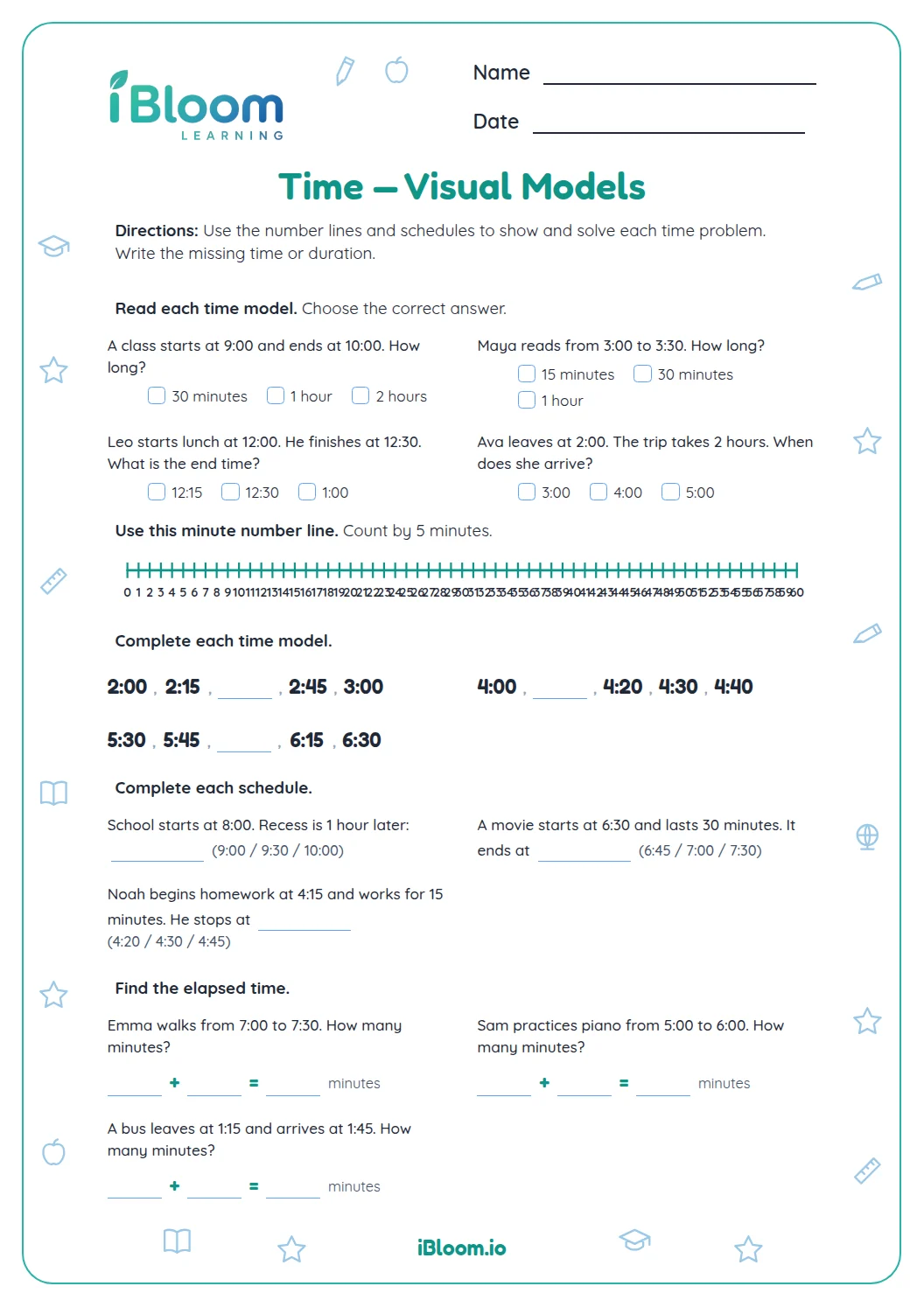
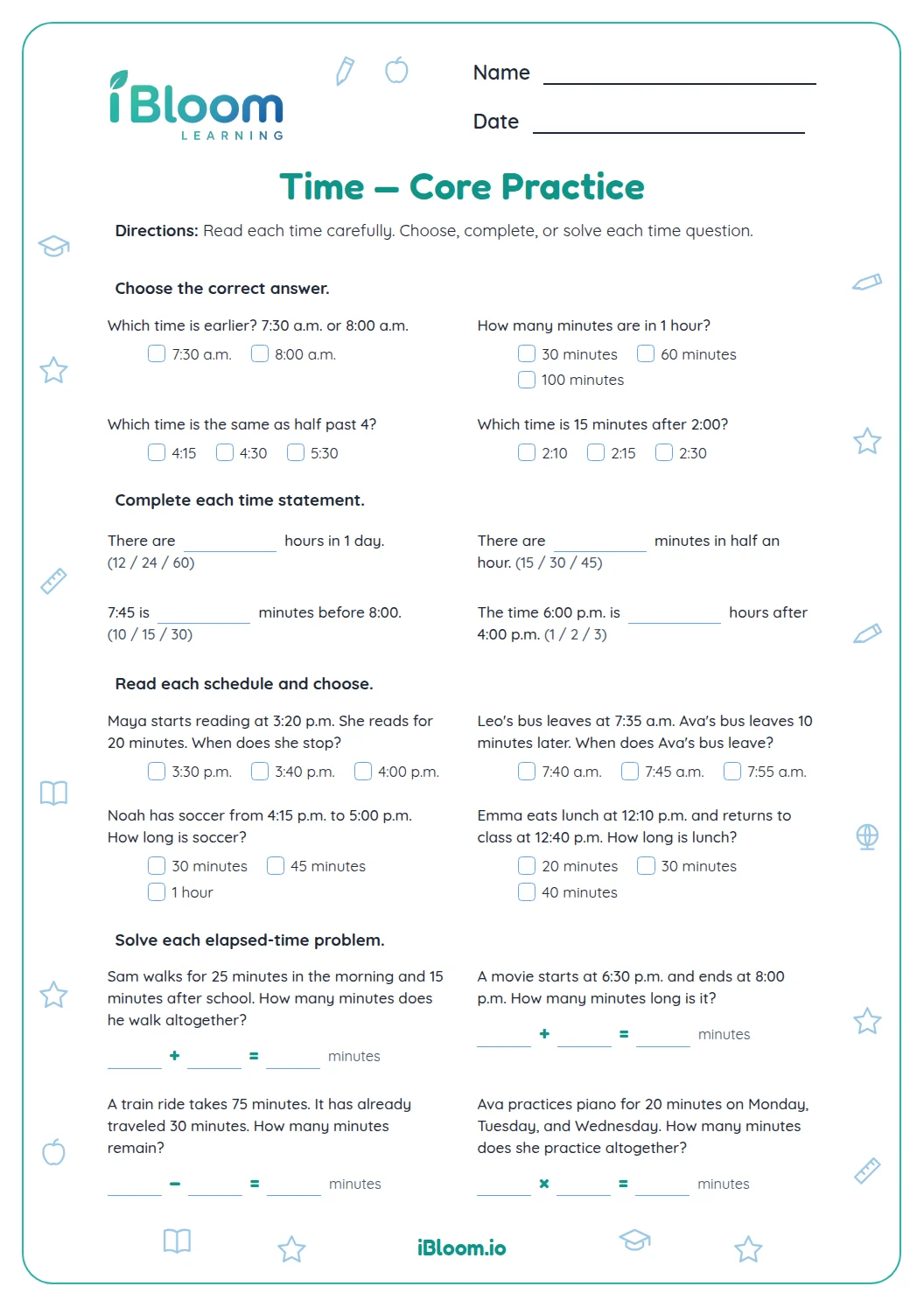
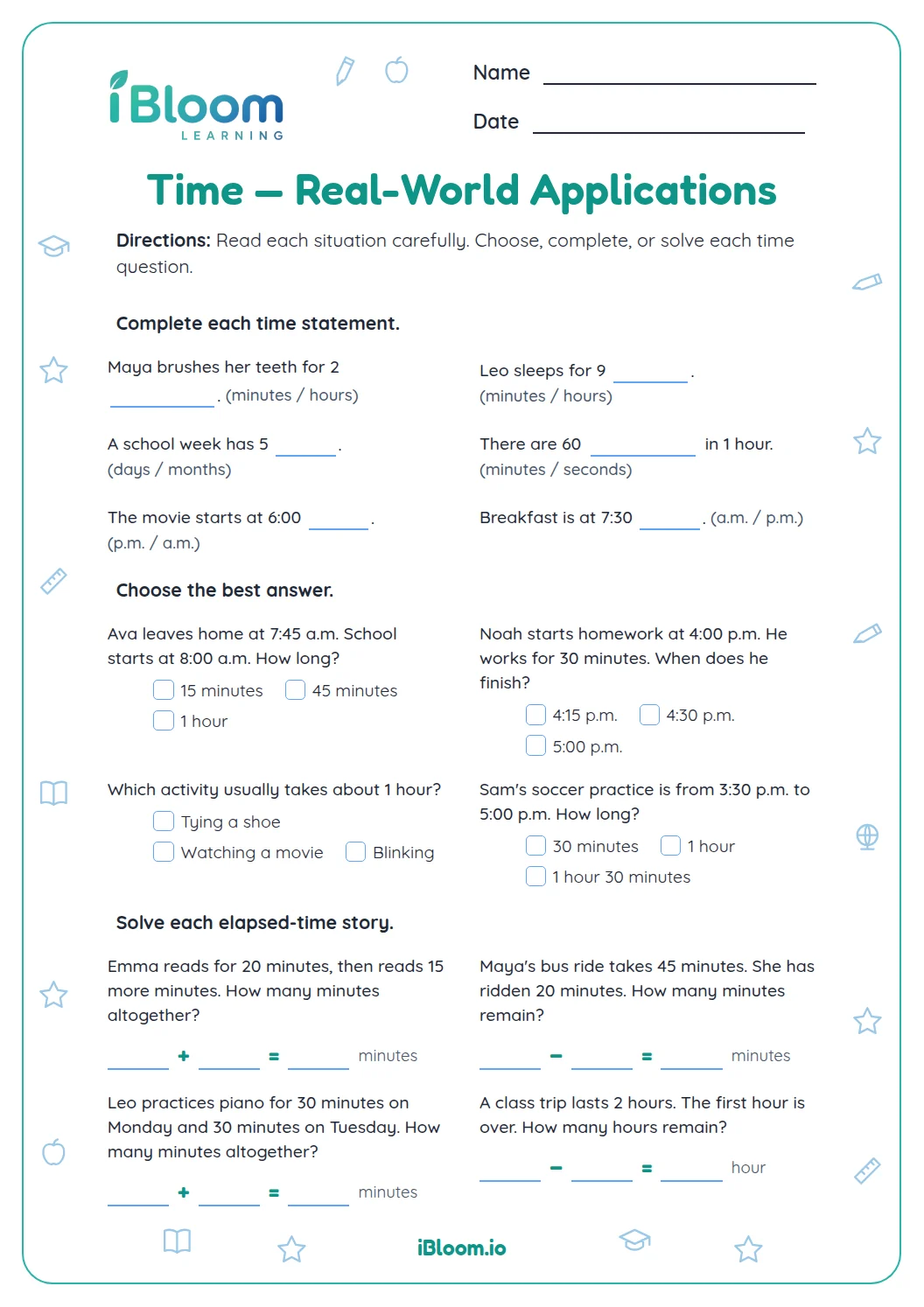
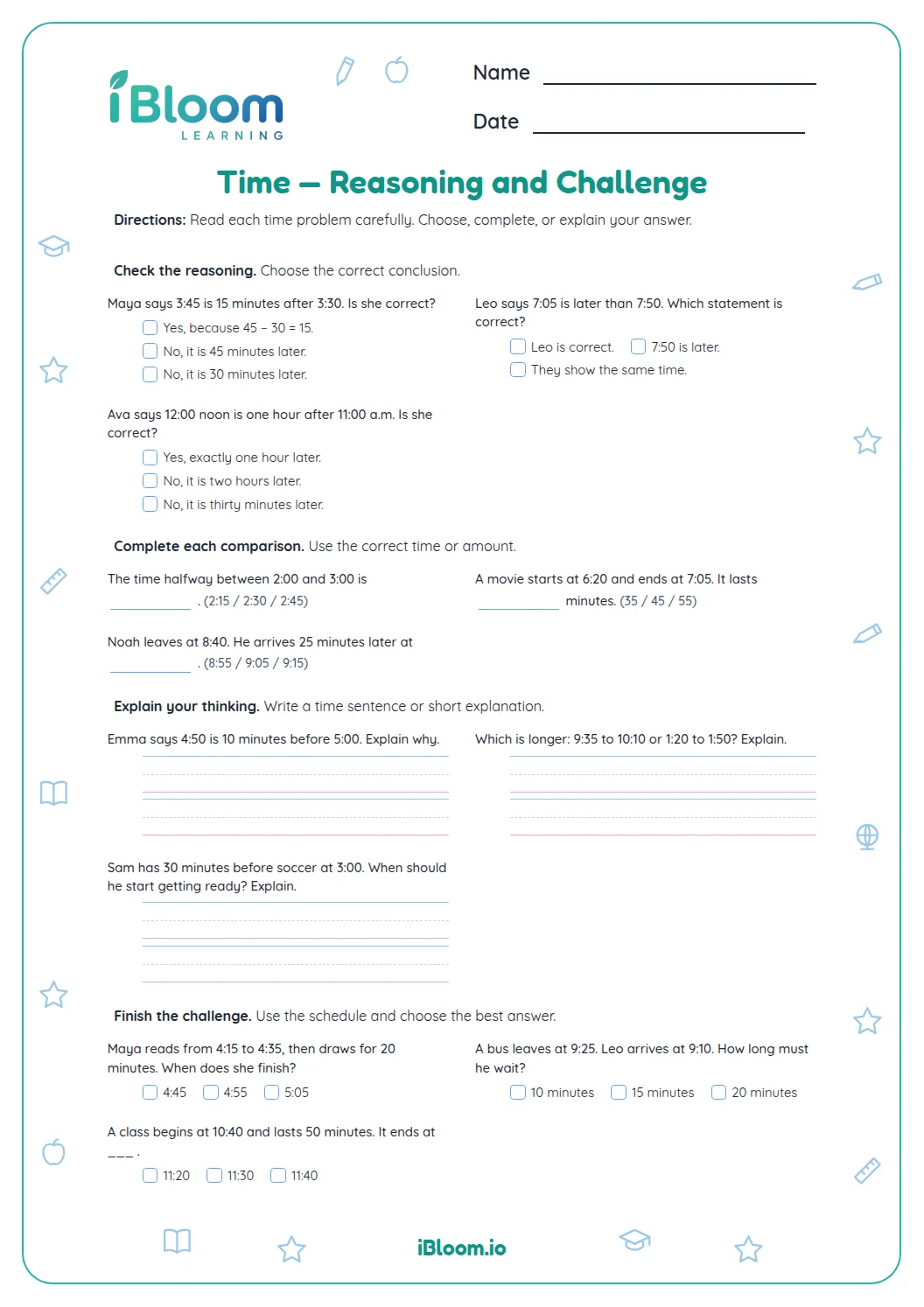
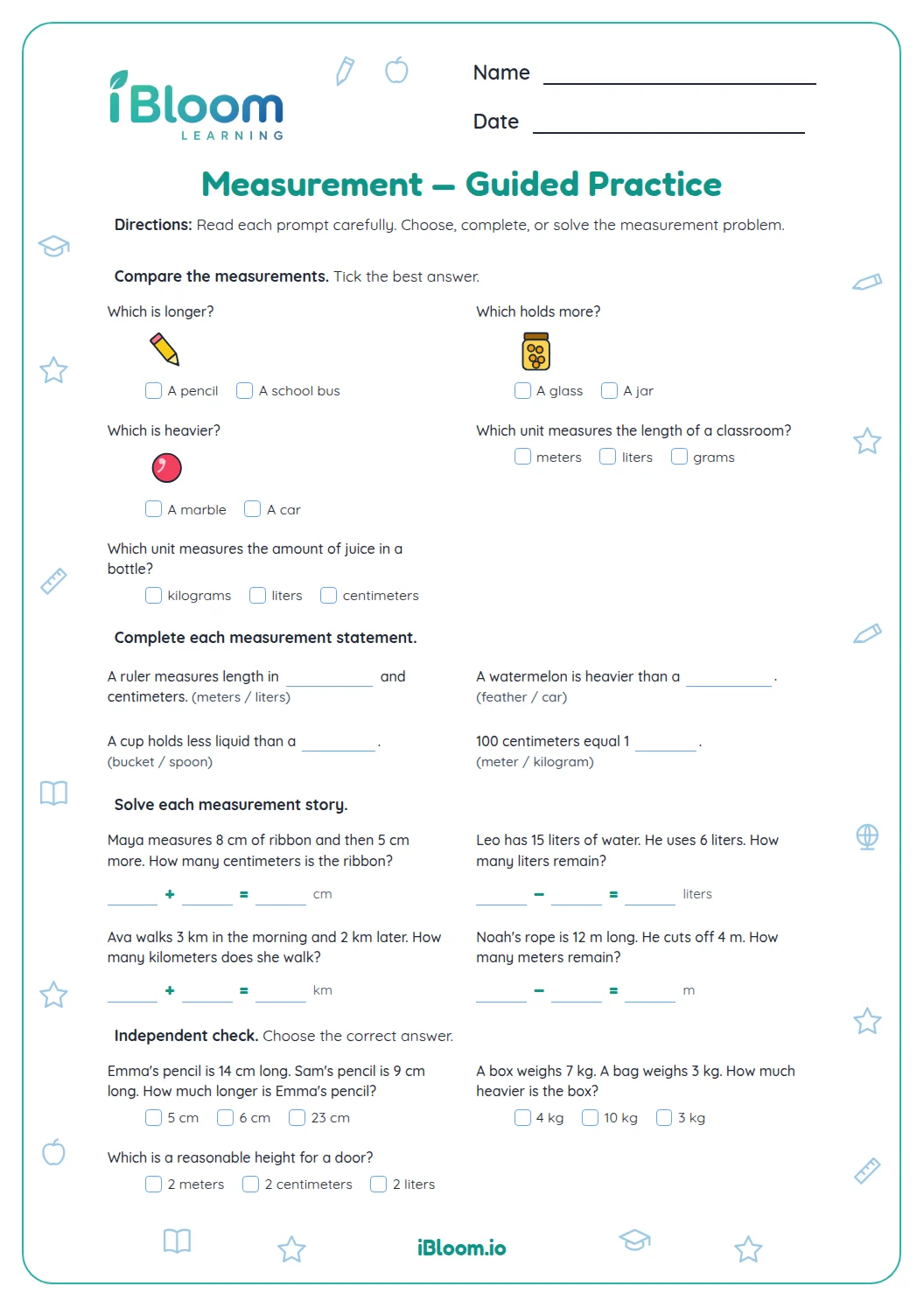
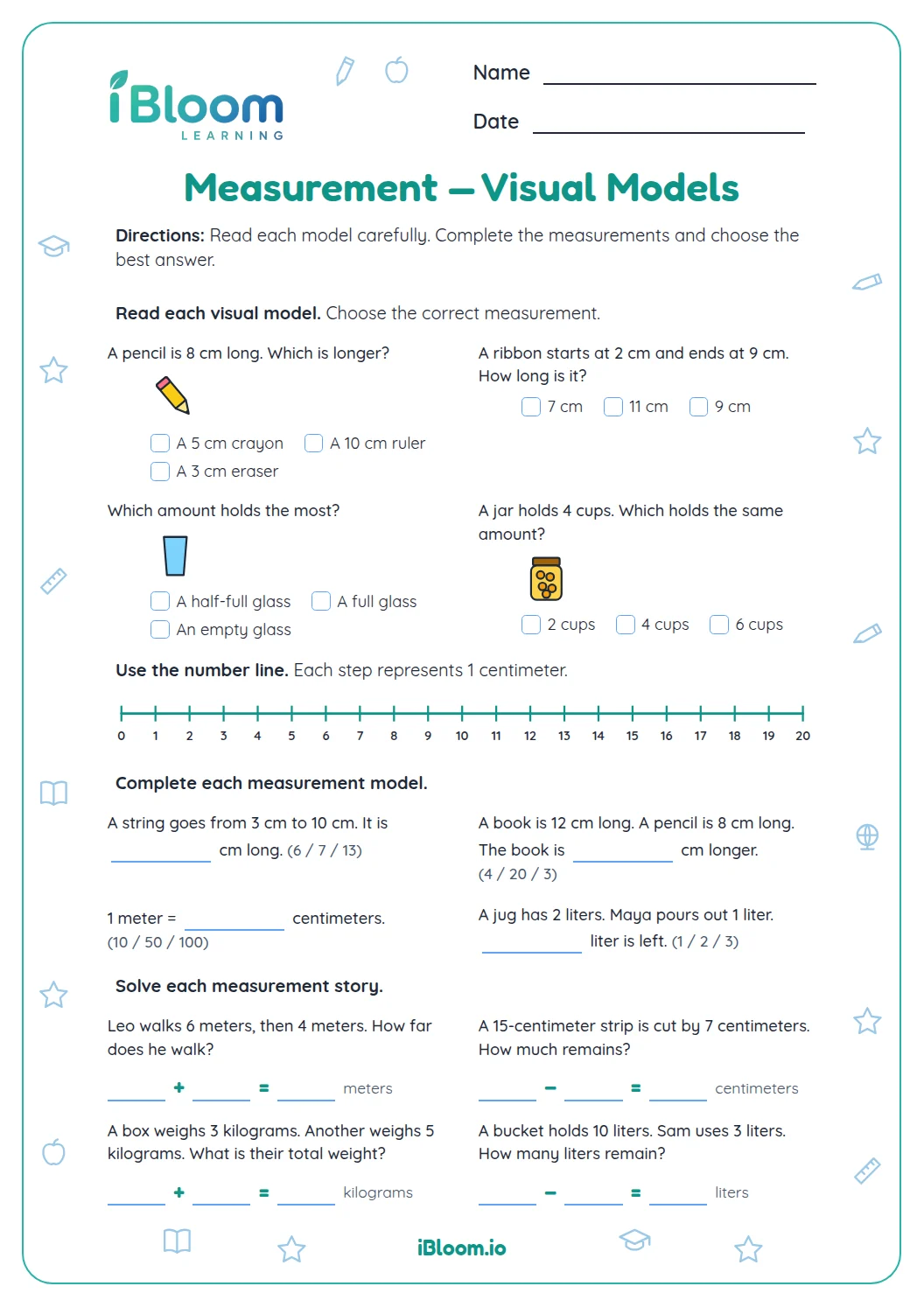
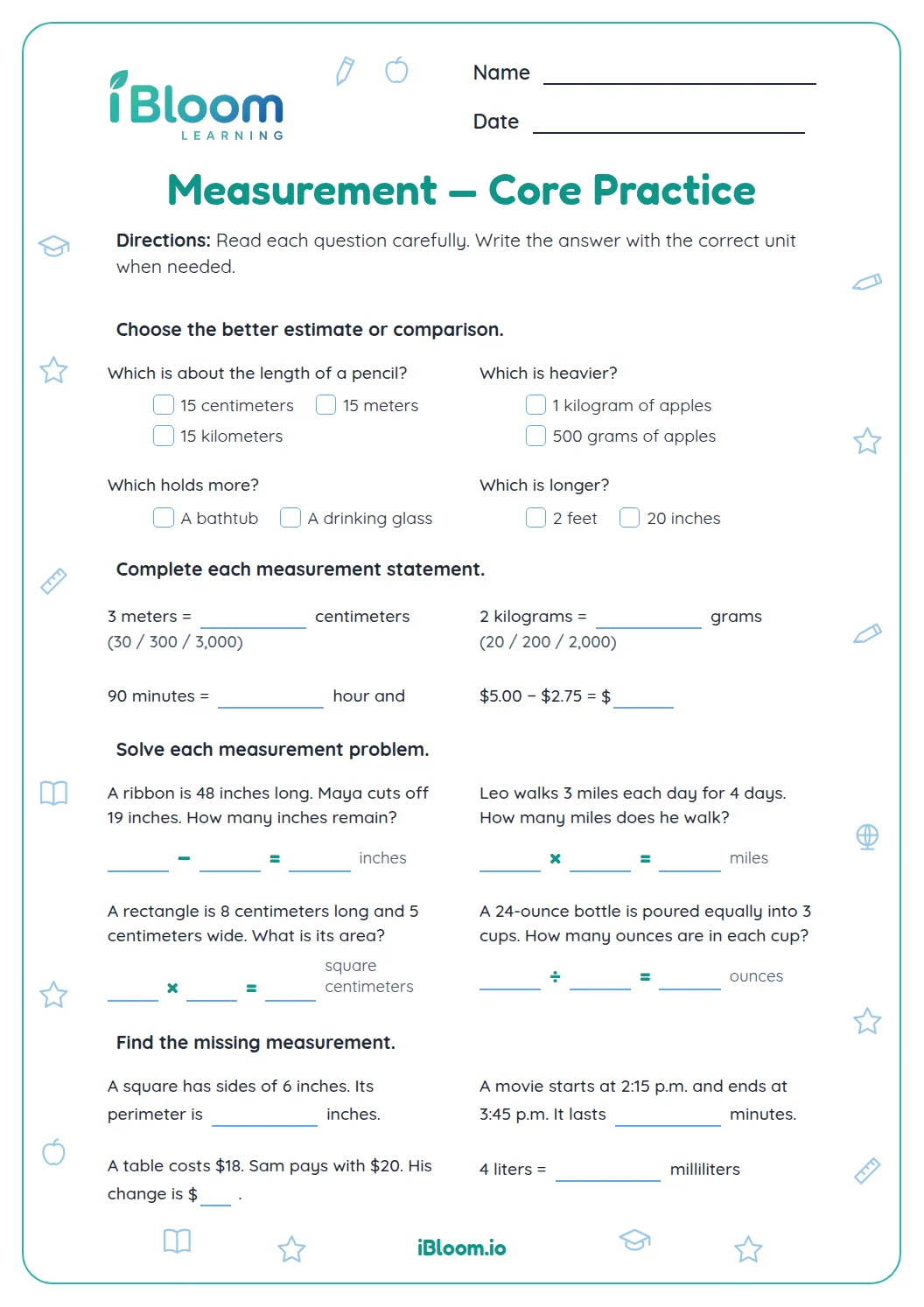
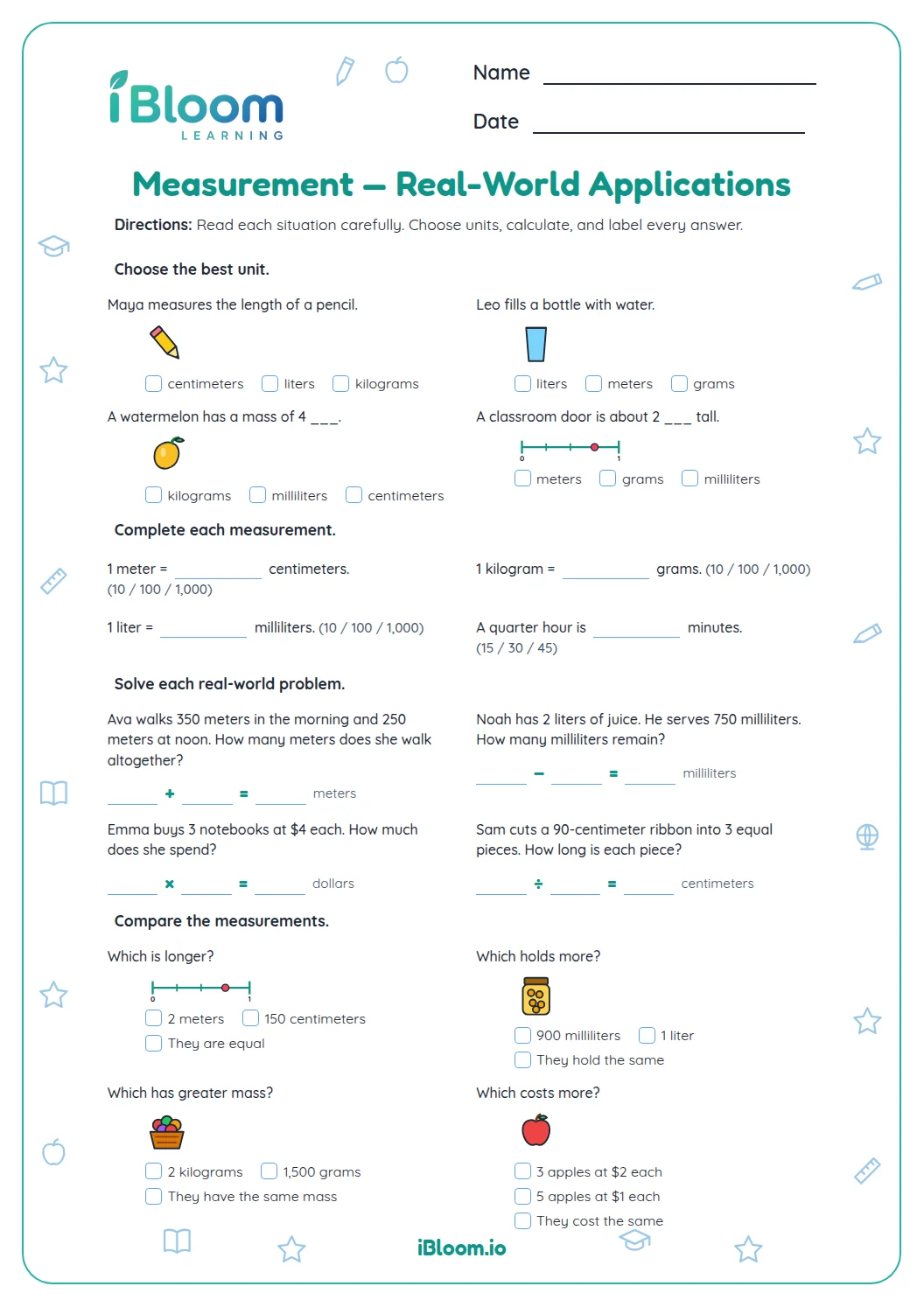
This guided practice sheet reviews time facts, two analog clock readings, and simple elapsed-time situations. Students complete 14 questions in three parts, moving from time facts to clock reading and time intervals. A separate answer key lists each response.
Which time facts help with the problems?
One hour has 60 minutes, half an hour has 30 minutes, and a quarter hour has 15 minutes. These facts help students decide whether to add or subtract minutes.
- 1One quarter hour = 15 minutes
- 2Answer: 15 minutes
How do I read an analog clock?
The short hand tells the hour and the long hand tells the minutes. Questions 6 and 7 show 3:00 and 7:30 on analog clocks. In question 8, add 15 minutes to 10:15 to get 10:30.
How can I find an ending time?
Start at the beginning time and move forward by the duration. For one hour after 11:30, the time becomes 12:30. For minutes, count to the next hour when needed.
How to use this worksheet
- 1Recall the 60-minute hour and the 30-minute half hour.
- 2For each clock, read the short hand first and the long hand second.
- 3Add or subtract minutes by moving forward or backward from the start time.
- 4For an hour-long event, keep the minutes the same and move the hour forward.
- 5Check that the final time follows the start time by the stated duration.
- 6Use the key to review all 15 answers.
Common mistakes and quick fixes
The mistake
Confusing the short and long clock hands.
The fix
Find the hour with the short hand, then count minutes with the long hand.
The mistake
Adding 15 minutes as if it were an hour.
The fix
A quarter hour is 15 minutes; move only to the next quarter mark.
The mistake
Leaving out the hour change after 60 minutes.
The fix
Move the time forward through the next hour when needed.
What to practice next
Make more practice
Further reading
Questions parents and teachers ask
How many questions are included?
There are 14 questions in three parts: time facts, two analog clock readings, and elapsed-time situations. The answer key lists a response for every item, so families can check facts and ending times after practice. Students can work through one part at a time.
How many minutes are in a quarter hour?
A quarter hour is 15 minutes because 60 minutes divided into four equal groups gives 15 minutes in each group. Question 3 asks students to recall that fact and use it when thinking about clock time. The fact also supports adding a quarter hour.
How do I read the clock drawings?
Use the short hand for the hour and the long hand for minutes. The two clock drawings show 3:00 and 7:30. Question 8 gives 10:15 in text and asks students to add 15 minutes, making 10:30. The minute hand points to twelve and six, respectively.
What does elapsed time mean?
Elapsed time is how long passes between a starting time and an ending time. For example, a 30-minute practice that starts at 9:00 ends at 9:30. The final part practices adding or subtracting familiar intervals. The worksheet uses quarter-hour and half-hour intervals.
Why does 11:30 become 12:30 after an hour?
Adding 60 minutes makes the minute hand complete one full turn. It returns to the 30-minute mark, while the hour hand advances from 11 to 12. This explains why the ending time is 12:30. The minute hand returns to the same place.
Is an answer key included?
Yes. A separate key lists the time facts, the two clock readings, and the ending or arrival times for the elapsed-time questions. Use it after students have tried each item and explained their steps. It also helps confirm the number of minutes passed.