Free printable practice
Fractions Practice Activities
Class 1 fractions worksheets help children recognise halves, equal parts, parts of a whole, groups, colouring, words, and simple fraction writing.
Explore Fractions
Free printable worksheet PDFs
Preview every available page, then download the free worksheet PDF for home, homeschool, tutoring, or classroom practice.
Preview the exact activity before downloading it.
Practice that builds confidence
Building the idea of equal parts
These Class 1 fractions practice activities introduce children to the idea that a whole object or a group can be split into fair, equal parts. Children practise words such as whole, half, equal, part, and group while looking at shapes, sets of objects, and simple visual models.
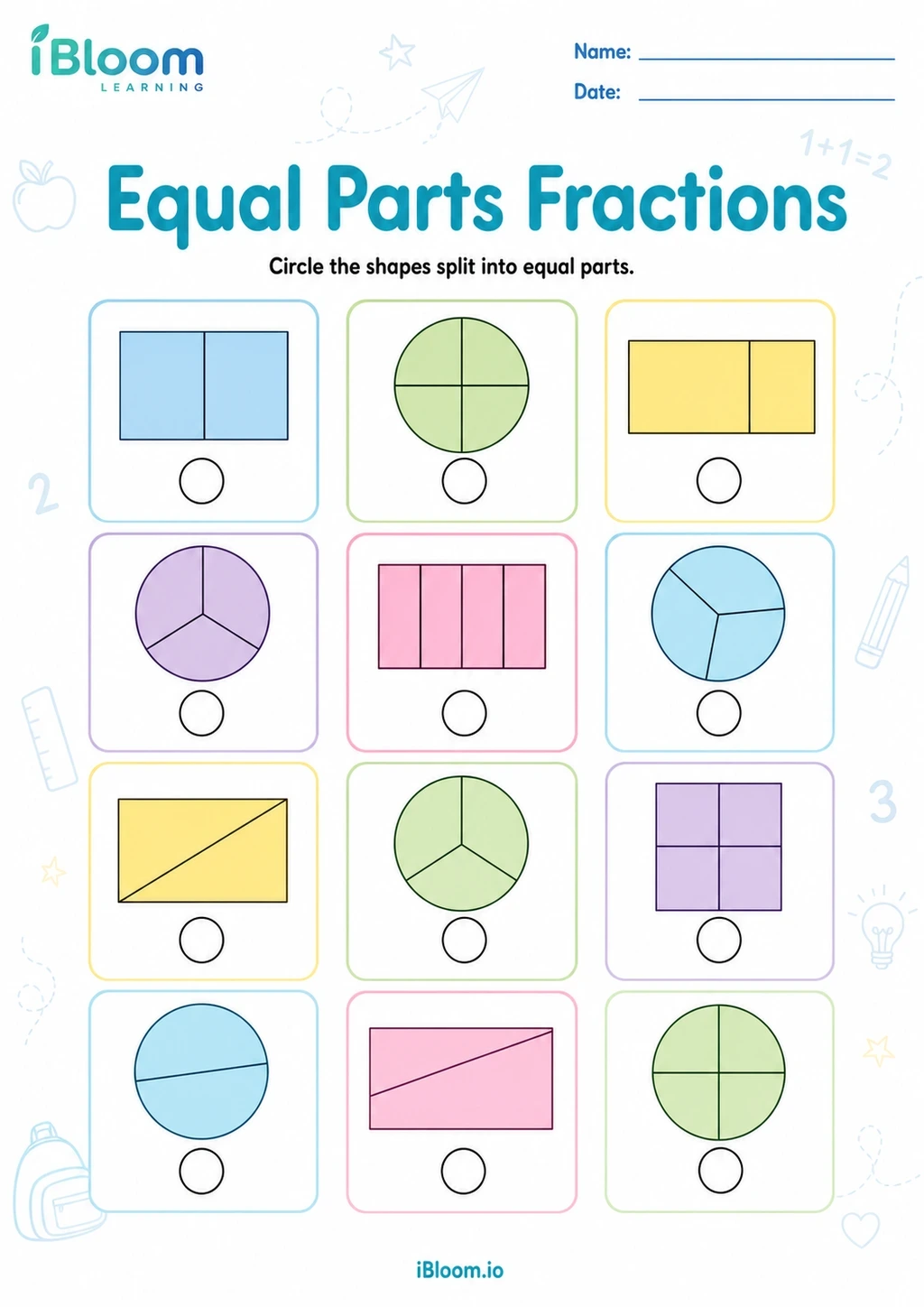
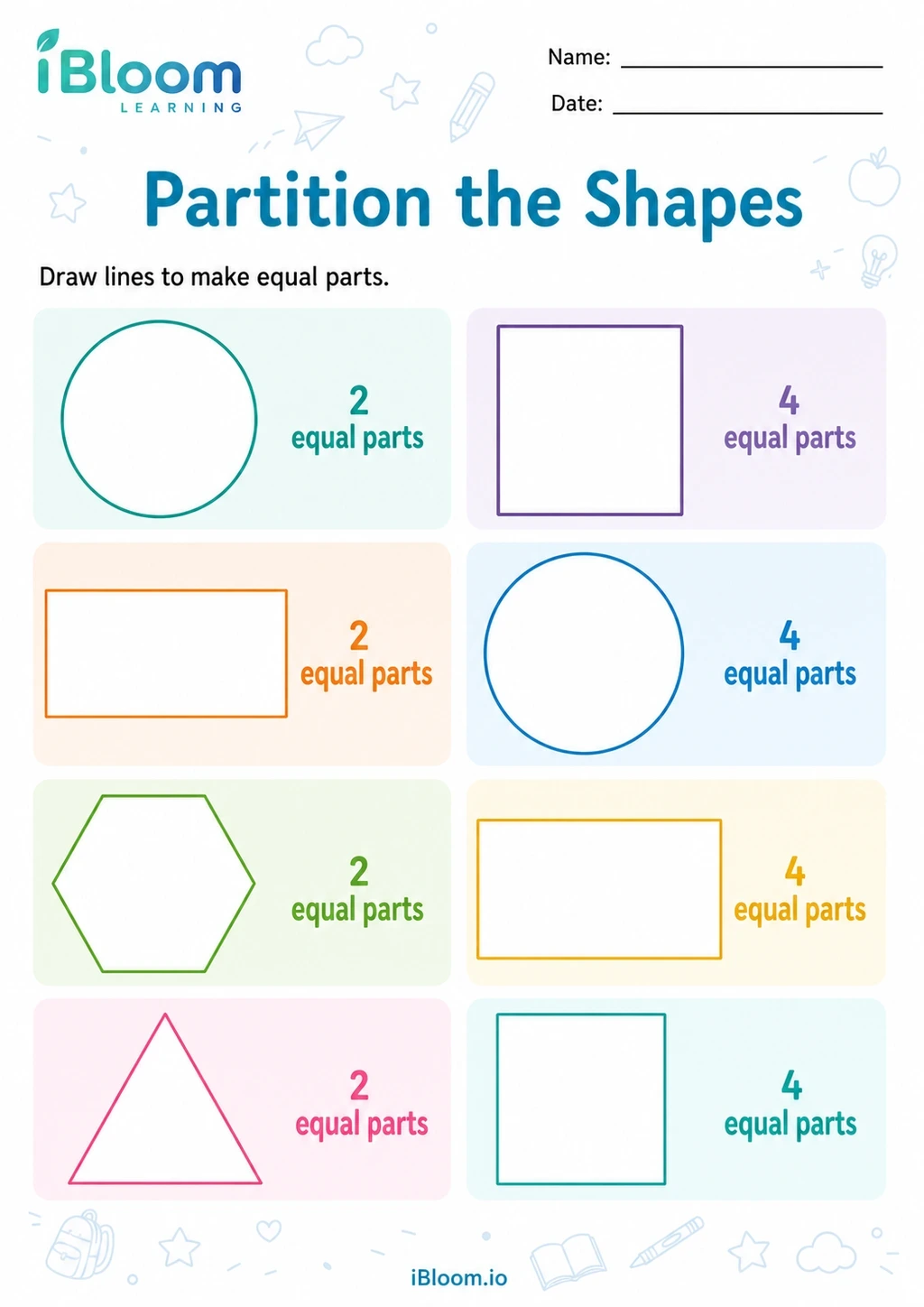
The printable worksheets include colouring shapes, identifying equal and unequal parts, matching fraction words, writing basic fraction ideas, finding parts of a whole, and dividing shapes into equal parts. The activities move from seeing and colouring to describing and writing.
At this level, fractions begin with fairness. A circle cut into two same-size pieces shows two equal parts, while a shape split into one big and one small piece does not. Worksheets on equal parts and divide equal parts help children compare pieces visually before using any formal symbols. They learn that the number of parts matters, but the parts must also be the same size.

From shapes to groups
The collection includes colouring shapes, parts of whole, and group set activities. A child may colour one part of a rectangle, choose half of a set of fruits, or mark a group that has been shared equally. These tasks show that fractions are not only about flat shapes; they can also describe a set of objects shared into equal groups.
Reading, saying, and writing fraction ideas
Words and writing worksheets support early maths language. Children practise saying “one half”, “two equal parts”, “part of a whole”, and “whole shape”. Some pages ask them to trace or write simple answers after looking carefully at the model. This connects visual understanding with correct vocabulary, which is important before children meet more fraction notation later.
A simple home routine
Use everyday objects before the worksheet. Fold a roti, paper circle, or napkin into two equal parts and ask, “Are both parts fair?” Then show an unequal fold and let your child explain why it is not half. After this, complete one printable page together: first observe, then colour, then say the fraction word aloud. End by asking the child to draw one shape and divide it equally.

Classroom and centre use
Teachers can use these worksheets after a hands-on sharing activity with counters, paper shapes, or picture cards. They work well for small-group maths centres, quick concept checks, revision, or notebook practice. Pages on colouring shapes are useful for independent practice, while group set tasks can prompt discussion: “How do you know the groups are equal?”

Common mistakes and a child-friendly strategy
Watch for children who colour any one piece without checking size, count lines instead of parts, or think every cut shape shows a fraction. A helpful strategy is: “Check, count, colour, say.” Check if the parts are equal, count the parts, colour the asked part, and say the fraction word. Why iBloom worksheets help: the pages use clear visuals and small steps, so children first see fractions, then talk about them, and finally write simple fraction ideas with confidence.
Free printable PDF download
Use this class 1 fractions worksheet page to preview the activity, print it, or download it as a PDF for quick practice. It works well for homework, homeschool lessons, tutoring, morning work, revision, and classroom centers.
Answers and answer key support
After the child completes the worksheet independently, parents and teachers can use the answer support or answer key information to check the work, review mistakes, and choose the next practice step.
Helpful answers
Frequently asked questions
What fraction skills do these Class 1 worksheets cover?
They cover recognising equal parts, colouring parts of shapes, identifying parts of a whole, working with simple group sets, using fraction words, and dividing shapes into equal parts.
Are these worksheets suitable before teaching fraction symbols?
Yes. The activities focus mainly on visual understanding and words such as whole, half, equal, and part, which helps children build meaning before using more formal fraction notation.
How can I explain equal parts to a Class 1 child?
Use the idea of fair sharing. Show two pieces of paper or food that are the same size and say they are equal parts. Then show unequal pieces and ask the child why the share is not fair.
Do the worksheets include fractions of groups as well as shapes?
Yes. Along with colouring and dividing shapes, the collection includes group set activities where children look at objects shared or selected in equal parts.
What common fraction mistakes should I watch for?
Children may count the dividing lines instead of the parts, colour a piece without checking if all parts are equal, or assume every divided shape shows a correct fraction. Encourage them to check equality first.
Is this class 1 fractions worksheet free?
Yes. You can preview it for free and use the printable worksheet for home or classroom practice.
Can I download this class 1 fractions worksheet as a PDF?
Yes. Use the worksheet download option to save a printable PDF, or print the worksheet directly from the page.
Does this class 1 fractions worksheet include answers or an answer key?
When the activity has fixed answers, iBloom includes answer support so parents and teachers can check the completed worksheet.