Free printable practice
Divide Equal Parts Practice Activities
Class 1 maths worksheets that help children split shapes and everyday objects into fair, equal parts before naming simple fractions.
Free printable worksheet PDFs
Preview every available page, then download the free worksheet PDF for home, homeschool, tutoring, or classroom practice.
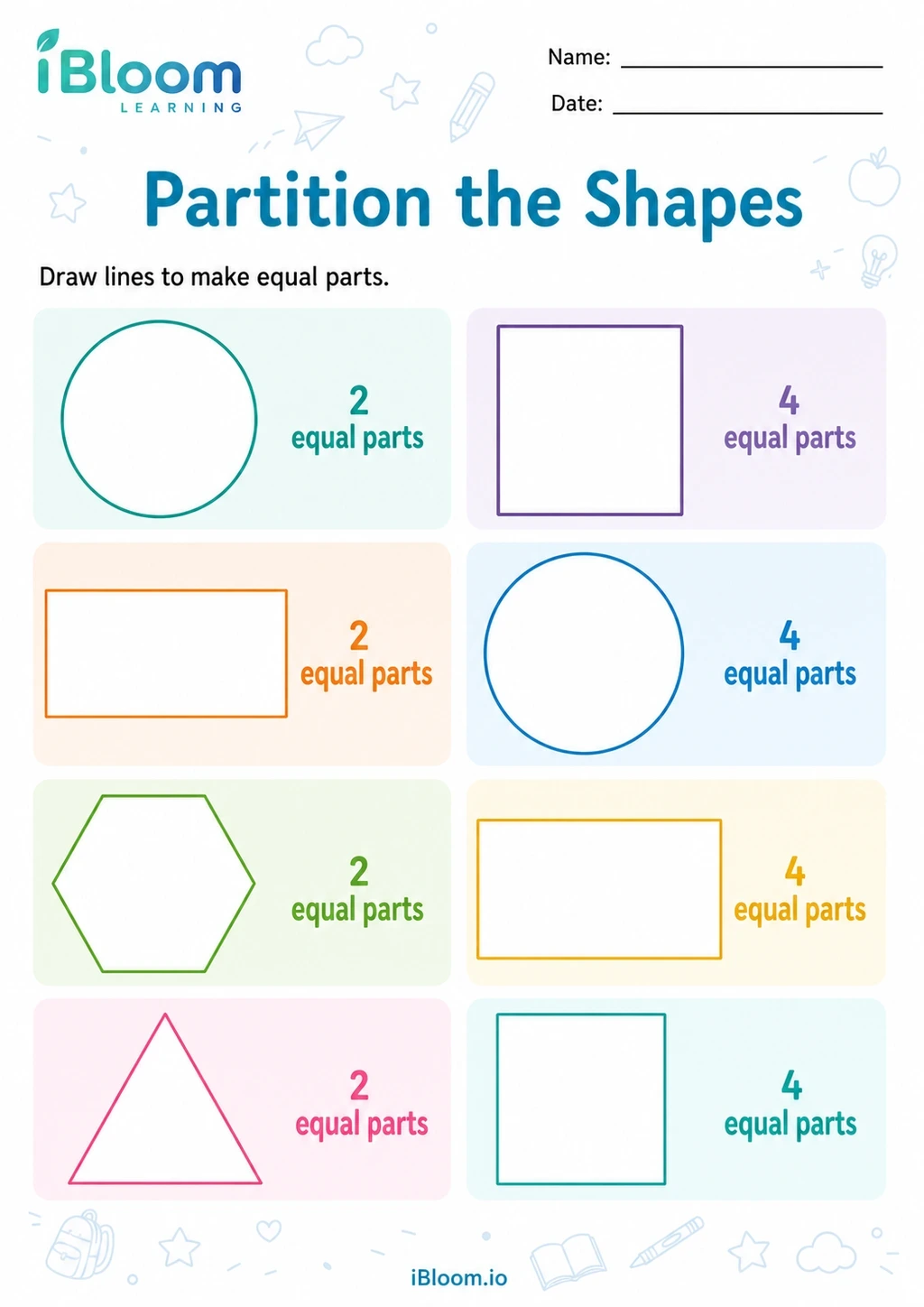
Preview the exact activity before downloading it.
Practice that builds confidence
What children learn first
These Class 1 fractions worksheets help children understand what it means to divide a shape, picture, or group into equal parts. Children practise seeing whether each part is the same size, not just whether the drawing “looks split.”
The printable activities include colouring equal parts, drawing dividing lines, matching fair shares, and spotting unequal partitions. The focus is on visual understanding before children move towards fraction names such as halves and quarters.
Children begin by looking at familiar shapes such as circles, squares, rectangles, and simple objects. They decide whether a shape has been divided fairly: two pieces must be the same size for equal parts, and four pieces must be balanced in size if the whole is split into four. This builds the idea that a fraction is about one whole being shared fairly.

How the practice progresses
The worksheets move from recognising equal and unequal parts to creating equal parts independently. A child may first tick the shape that is divided into equal parts, then colour one equal part, and later draw a line to split a shape into two equal pieces. Some pages use everyday sharing situations, such as cutting a sandwich or sharing a chocolate bar, so the maths feels meaningful.
Parent routine for home practice
At home, use one worksheet along with a real object. Fold a roti, paper square, or napkin into two equal parts and ask, “Are both parts the same size?” Then try a deliberately uneven fold and compare. After the worksheet, let your child draw one shape and divide it fairly. This short routine connects paper practice with real sharing.

Classroom uses for teachers
Teachers can use these printables during a fractions introduction, maths centres, or small-group support. They are useful for oral questioning: “How do you know these parts are equal?” Children can also sort cards into equal and not equal groups, then explain their reasoning using words such as whole, part, share, half, equal, and unequal.

Common mistakes to watch for
Many Class 1 children think any line through a shape makes equal parts. Others count the number of parts but ignore their size. Watch for drawings where one part is much bigger, curved partitions that create unequal spaces, or colouring that does not match the requested part. Encourage children to compare size, not just count pieces.
Free printable PDF download
Use this class 1 divide equal parts worksheet page to preview the activity, print it, or download it as a PDF for quick practice. It works well for homework, homeschool lessons, tutoring, morning work, revision, and classroom centers.
Answers and answer key support
After the child completes the worksheet independently, parents and teachers can use the answer support or answer key information to check the work, review mistakes, and choose the next practice step.
Why iBloom worksheets help
iBloom worksheets keep the focus on clear pictures, gradual difficulty, and repeated reasoning. A child-friendly strategy is: “Look at the whole, count the parts, then check if every part is the same size.” This simple check helps children slow down, explain their answer, and build a strong foundation for fractions in later classes.
Helpful answers
Frequently asked questions
What does “divide equal parts” mean in Class 1 maths?
It means splitting one whole shape, object, or picture into parts that are the same size. Children learn that fair sharing depends on equal size, not just the number of pieces.
Do these worksheets teach fraction symbols?
The main focus is visual understanding of equal parts. Some activities may prepare children for words like half or quarter, but the priority is recognising and making fair partitions.
How can I explain equal parts at home?
Use a roti, paper, fruit slice, or chocolate bar. Show one fair split and one unfair split, then ask your child which sharing is equal and why.
What mistakes are common when children divide shapes?
Children often draw a line anywhere and assume the parts are equal. They may also count two or four parts without checking whether each part is the same size.
Are these worksheets suitable for extra practice after school?
Yes. They are designed for Class 1 children who need repeated visual practice with fair shares, colouring equal parts, and drawing simple partitions.
Is this class 1 divide equal parts worksheet free?
Yes. You can preview it for free and use the printable worksheet for home or classroom practice.
Can I download this class 1 divide equal parts worksheet as a PDF?
Yes. Use the worksheet download option to save a printable PDF, or print the worksheet directly from the page.
Does this class 1 divide equal parts worksheet include answers or an answer key?
When the activity has fixed answers, iBloom includes answer support so parents and teachers can check the completed worksheet.