Free printable practice
Mirror Images Symmetry Practice Activities
Class 1 geometry worksheets for practising mirror images, line of symmetry, matching halves, and completing simple symmetrical shapes.
Free printable worksheet PDFs
Preview every available page, then download the free worksheet PDF for home, homeschool, tutoring, or classroom practice.
Preview the exact activity before downloading it.
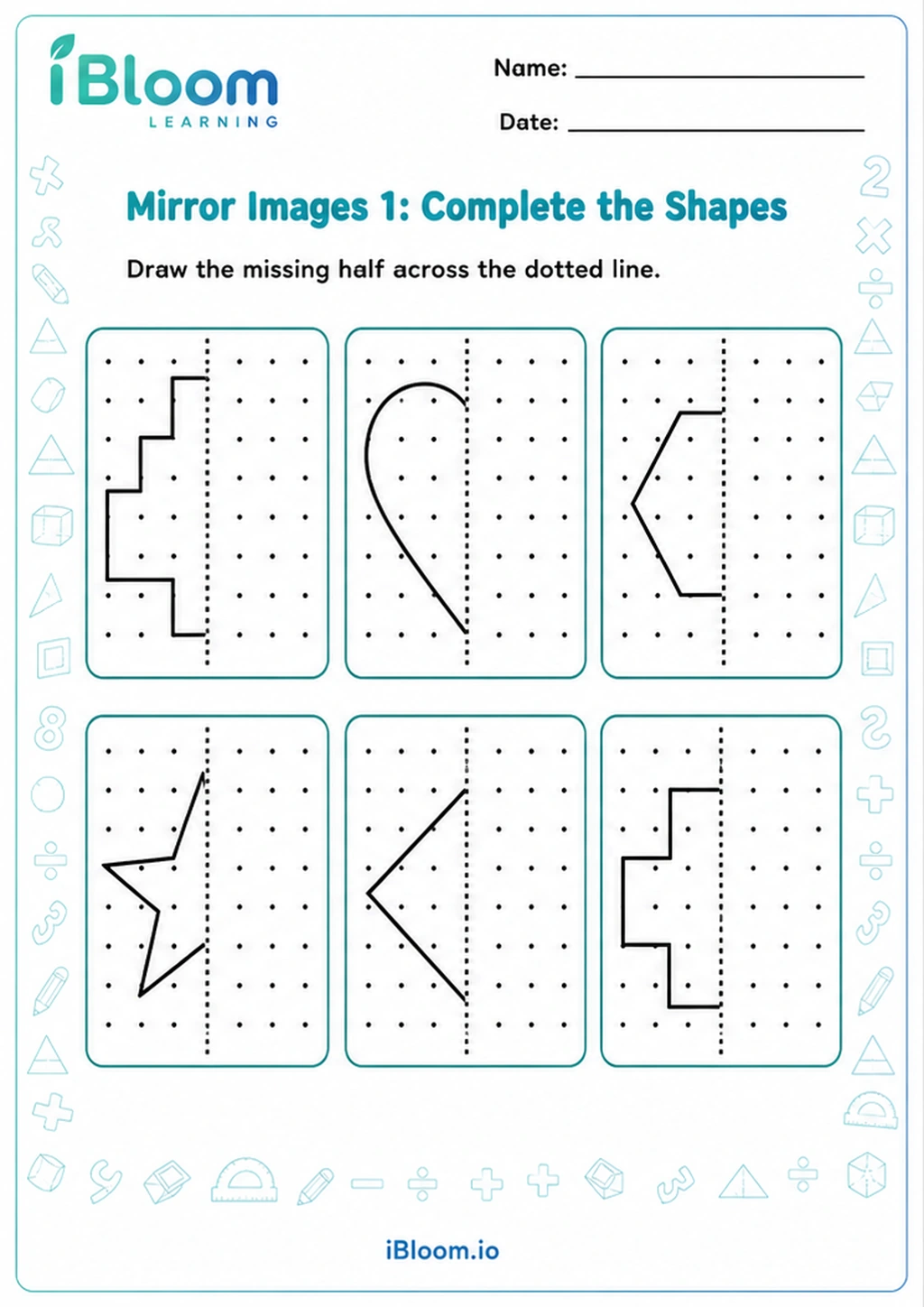 Mirror Images 1: Complete the ShapesClass 1 printable practice for Mirror Images and Symmetry.Class 1Free PDF preview
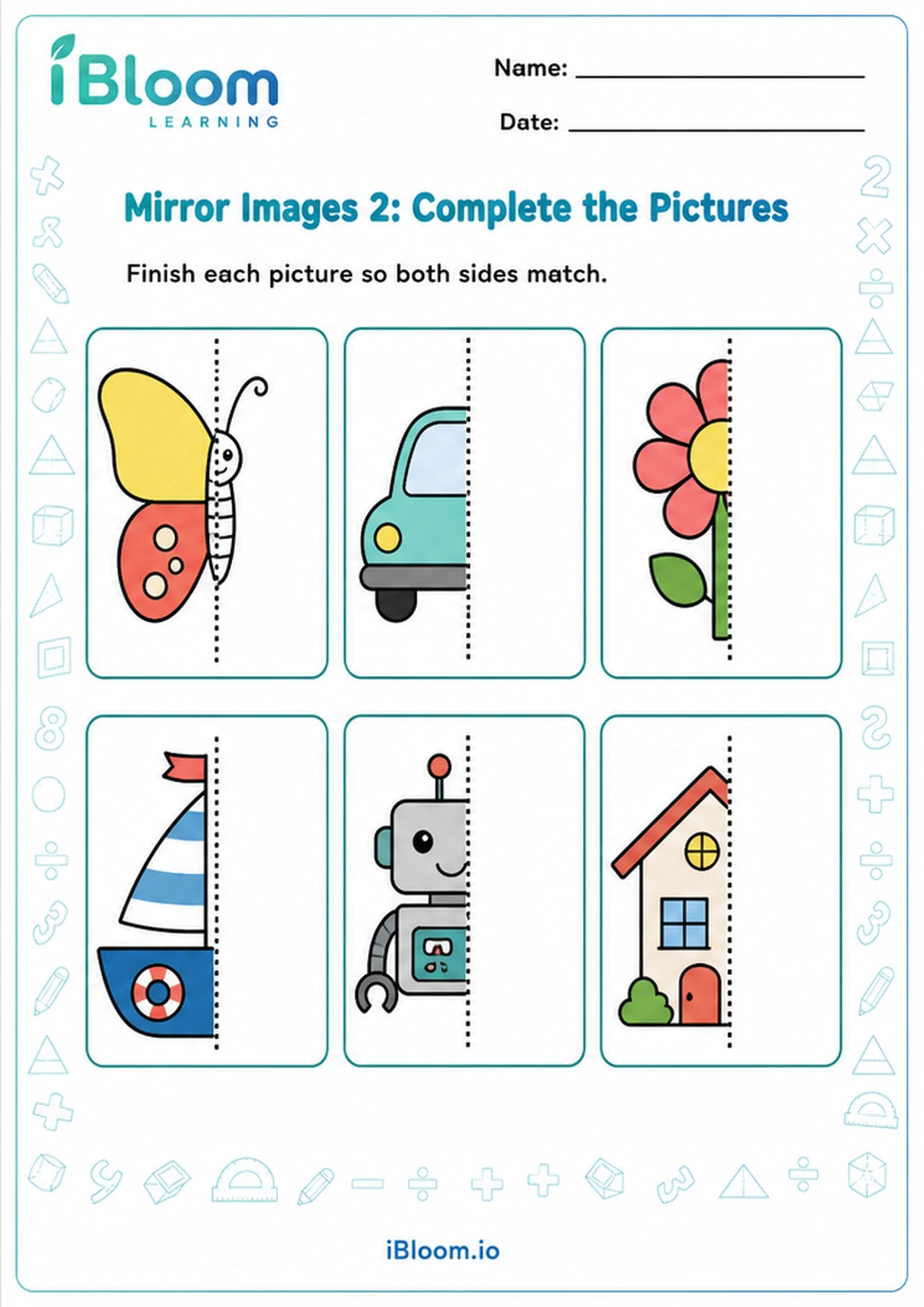 Mirror Images 2: Complete the PicturesClass 1 printable practice for Mirror Images and Symmetry.Class 1Free PDF preview
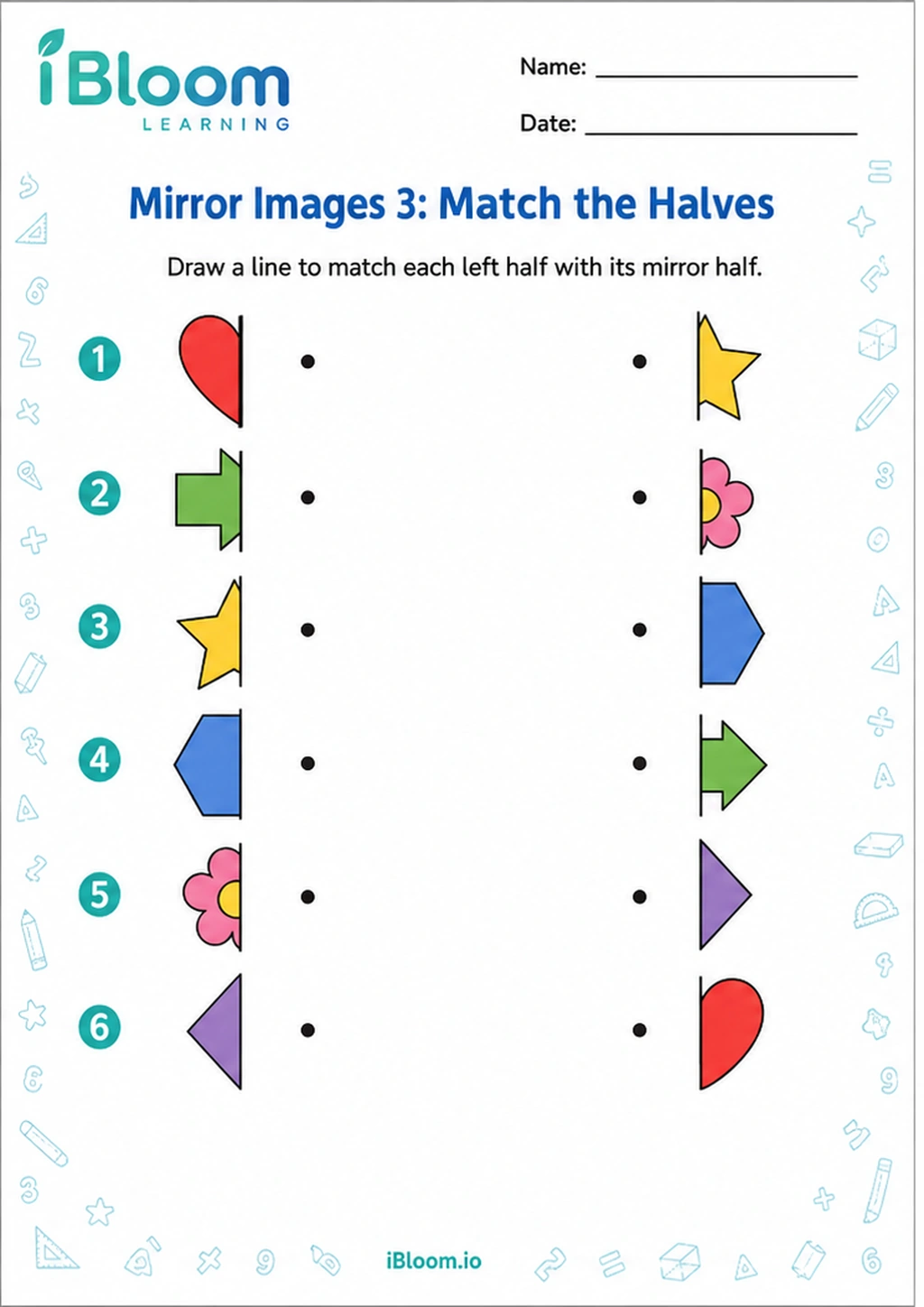 Mirror Images 3: Match the HalvesClass 1 printable practice for Mirror Images and Symmetry.Class 1Free PDF preview
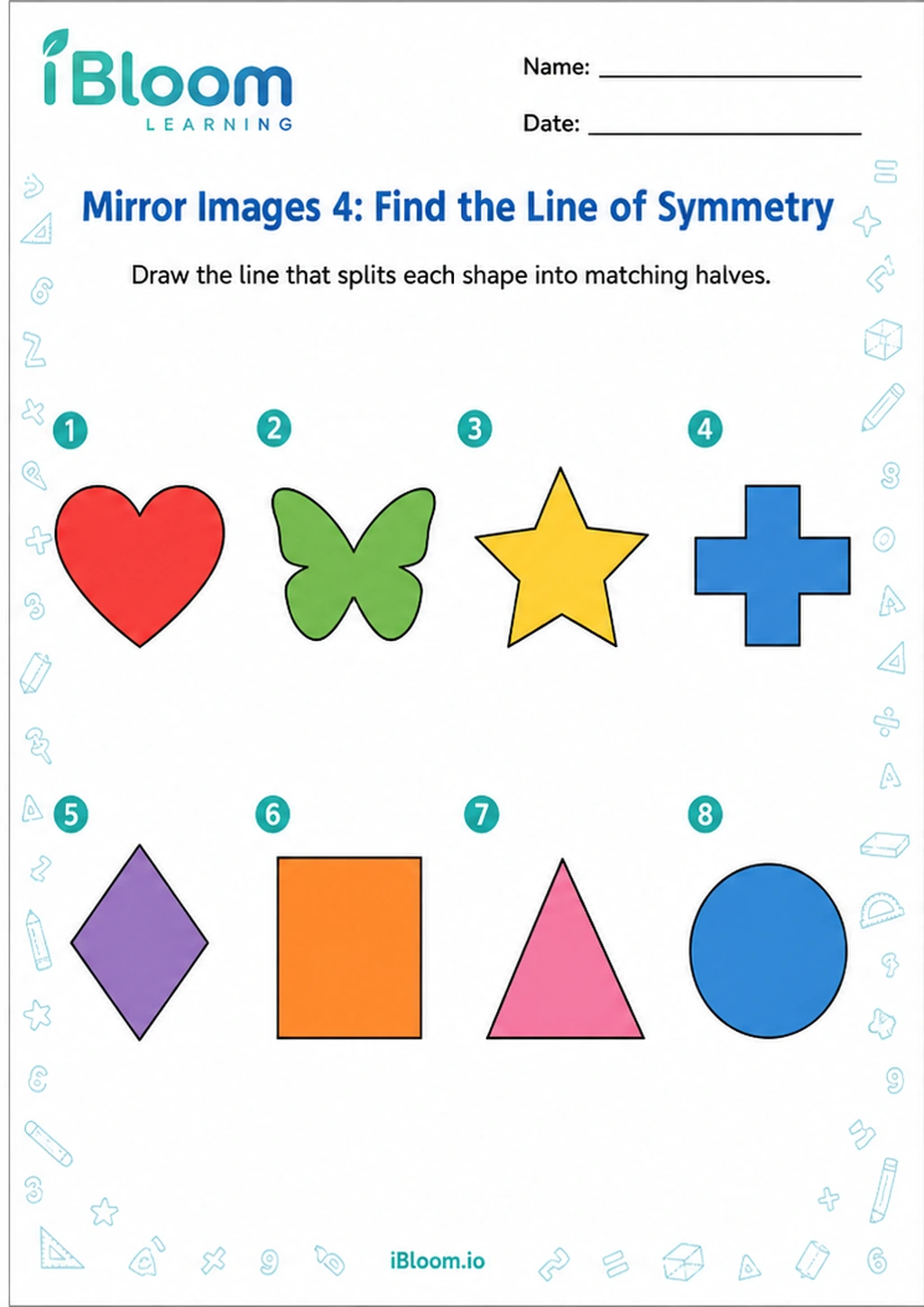 Mirror Images 4: Find the Line of SymmetryClass 1 printable practice for Mirror Images and Symmetry.Class 1Free PDF preview
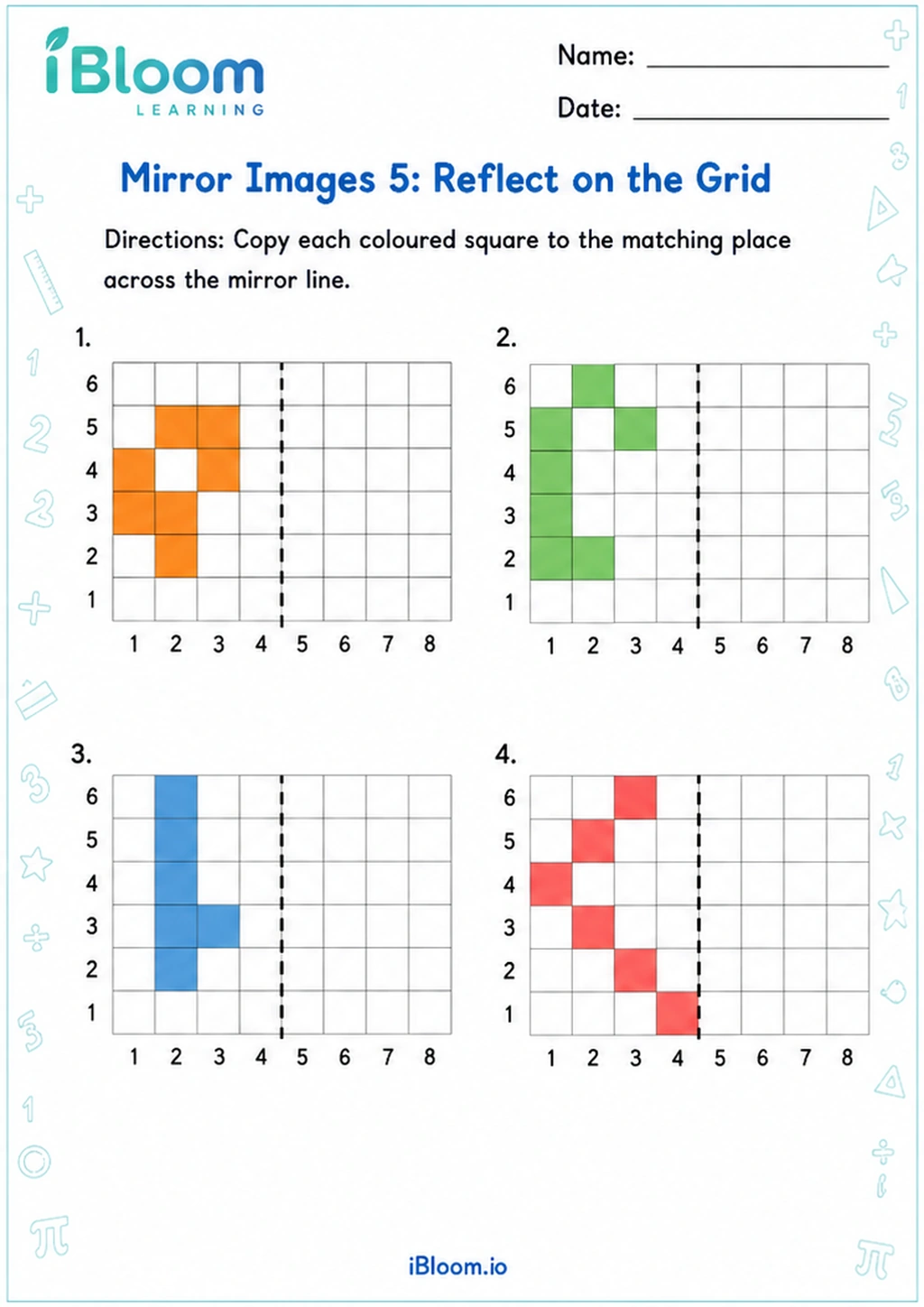 Mirror Images 5: Reflect on the GridClass 1 printable practice for Mirror Images and Symmetry.Class 1Free PDF preview
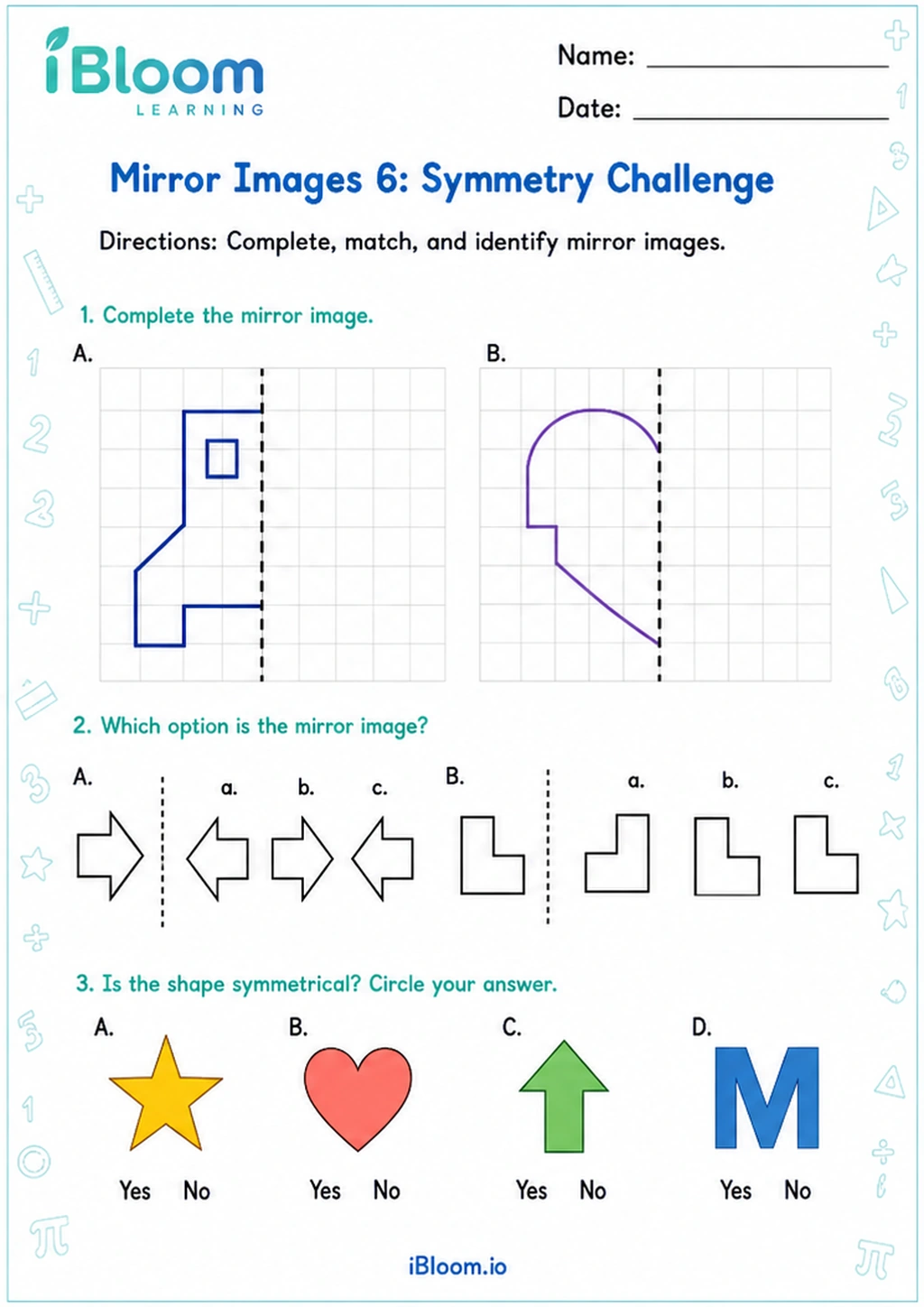 Mirror Images 6: Symmetry ChallengeClass 1 printable practice for Mirror Images and Symmetry.Class 1Free PDF preview
Practice that builds confidence
What children learn
These Class 1 maths worksheets help children understand mirror images and symmetry through simple shapes, pictures, and half-completed designs. Children practise noticing whether two sides look the same when folded or reflected across a line.
The printable activities include matching mirror halves, drawing the missing side, colouring symmetrical pictures, and identifying lines of symmetry. Each task builds visual thinking while keeping the work age-appropriate for early geometry learners.
Mirror image practice helps children see that a shape can have two equal-looking halves on either side of a line. In Class 1, the focus is not on formal definitions but on observation: left and right, top and bottom, same shape, same size, and same position across a mirror line.

Skill progression
The worksheets begin with clear pictures where the mirror line is easy to see. Children may match two halves of a butterfly, leaf, kite, or simple object. They then move to completing missing halves using dots, boxes, or outlines as support. Later activities ask them to decide whether a picture is symmetrical and to colour both sides in the same way.
Parent routine at home
Start with a real mirror. Hold up a spoon, toy car, or paper shape and ask, “What do you see on the other side?” Then fold a paper heart or square to show two matching halves. After this, use one worksheet page: first trace the mirror line with a finger, then compare one point on the left with the matching point on the right. Encourage neat, slow drawing rather than rushing.

Classroom uses
Teachers can use these printables during geometry lessons, maths centres, early finisher tasks, or revision. Pair work is useful: one child describes the missing half while the other draws it. Completed sheets can also lead to a quick discussion using vocabulary such as mirror line, same, half, match, left, right, above, and below.

Common errors to watch for
Some children copy the same side instead of flipping it, so the image is not a true mirror image. Others change the size of the missing half or place details too far from the line. Colouring errors are also common; for example, colouring one wing red and the matching wing blue when the task asks for symmetry. Ask children to compare distance from the mirror line.
A child-friendly strategy
Teach the “look, count, draw” method. Look at one side, count how many spaces or dots it is from the mirror line, then draw the matching part the same distance on the other side. This simple routine makes mirror images feel like a pattern rather than a guess.
Free printable PDF download
Use this Class 1 mirror images symmetry worksheet page to preview the activity, print it, or download it as a PDF for quick practice. It works well for homework, homeschool lessons, tutoring, morning work, revision, and classroom centers.
Answers and answer key support
After the child completes the worksheet independently, parents and teachers can use the answer support or answer key information to check the work, review mistakes, and choose the next practice step.
Why iBloom worksheets help
iBloom worksheets keep the visuals clean, the instructions short, and the steps gradual for Class 1 learners. The activities move from recognition to completion, giving children repeated practice with symmetry while strengthening fine motor control, spatial awareness, and confidence in geometry.
Helpful answers
Frequently asked questions
What is a mirror image for Class 1 children?
A mirror image is what a shape or picture would look like in a mirror. For Class 1, children learn that the two sides should look the same in size and position across a mirror line.
How do these worksheets teach symmetry?
They use simple pictures and shapes where children match halves, draw missing parts, identify symmetrical images, and colour both sides in the same pattern.
Should my child be able to draw perfect mirror images?
No. At this stage, the goal is to understand matching halves and position. Neat attempts, careful counting, and correct placement are more important than perfect drawing.
How can I explain the line of symmetry at home?
Fold a paper shape into two equal halves and show the crease. Explain that the crease is like the mirror line, and both sides should match when the paper is folded.
What mistakes are common in mirror image activities?
Children may copy the shape without flipping it, draw the missing half too large or too small, or colour matching parts differently. Asking them to check distance from the mirror line helps.
Is this Class 1 mirror images symmetry worksheet free?
Yes. You can preview it for free and use the printable worksheet for home or classroom practice.
Can I download this Class 1 mirror images symmetry worksheet as a PDF?
Yes. Use the worksheet download option to save a printable PDF, or print the worksheet directly from the page.
Does this Class 1 mirror images symmetry worksheet include answers or an answer key?
When the activity has fixed answers, iBloom includes answer support so parents and teachers can check the completed worksheet.