Free printable practice
Length Non Standard Units Practice Activities
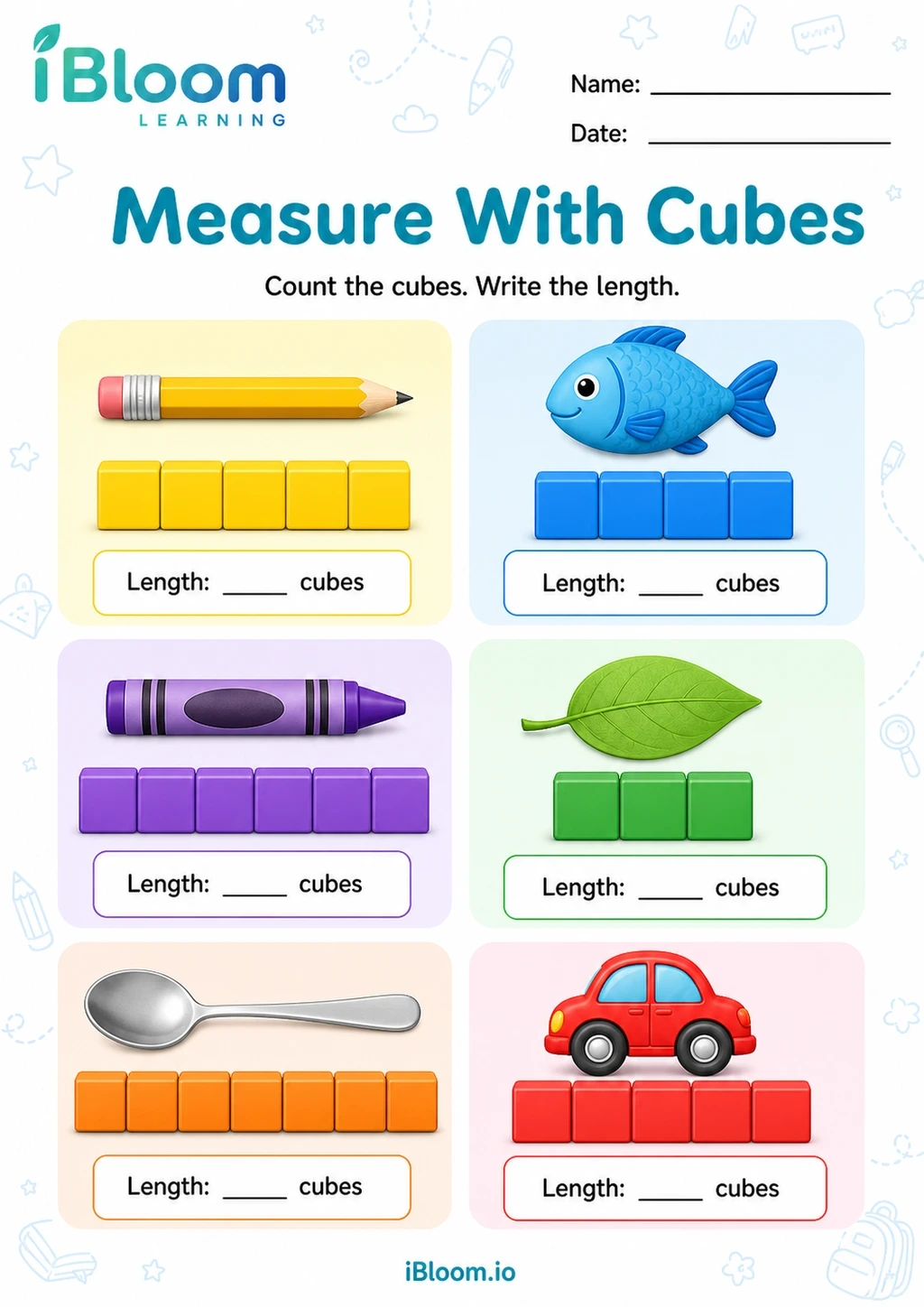
Class 1 maths worksheets for measuring length with non-standard units such as blocks, clips, hand spans and steps.
Free printable worksheet PDFs
Preview every available page, then download the free worksheet PDF for home, homeschool, tutoring, or classroom practice.
Preview the exact activity before downloading it.
Practice that builds confidence
What children learn
These Class 1 measurement worksheets help children understand length before they start using rulers. Learners compare objects as longer, shorter or equal, then measure them with non-standard units such as cubes, paper clips, hand spans, crayons or footsteps.
The printable activities include counting repeated units, choosing a suitable unit, ordering objects by length and spotting correct measuring methods. Children practise placing units end to end and learn why using the same unit matters.
Length in Class 1 begins with direct comparison: one pencil may be longer than another, a ribbon may be shorter than a book, and two lines may be about the same length. These worksheets move children from looking and comparing to measuring by counting equal units. They learn words such as length, longer, shorter, tallest, shortest, equal, unit and measure.

Building measurement sense
Non-standard units make measurement visible and hands-on. A child may measure a table with hand spans, a line with blocks, or a path with footsteps. The important idea is not the exact real-world length, but the process: start at one end, place each unit in a straight line, avoid gaps and overlaps, and count carefully. Activities progress from picture-based comparisons to counting unit marks and selecting the better unit for an object.
Parent routine for home
Choose one printable page and keep a few real objects nearby, such as spoons, crayons or coins. First ask, “Which is longer?” Then let your child measure the same object with one chosen unit. Say the rule aloud: “No spaces, no piling up, same unit each time.” After the worksheet, ask them to measure a book or mat and tell the result in units, for example, “The book is 5 crayons long.”

Classroom use for teachers
Teachers can use these pages after a demonstration with blocks or paper strips. They work well in maths centres, partner work, notebook practice or quick checks after an activity on length. A useful follow-up is to let pairs measure the same desk with different units and discuss why the numbers are different.

Common errors and a child-friendly strategy
Watch for children leaving gaps, overlapping units, mixing different unit sizes, starting away from the edge or counting the object instead of the units. A simple strategy is: “Touch the start, line them up, count the units.” Encourage children to point to each unit as they count and to check that every unit is the same size.
Free printable PDF download
Use this Class 1 length non standard units worksheet page to preview the activity, print it, or download it as a PDF for quick practice. It works well for homework, homeschool lessons, tutoring, morning work, revision, and classroom centers.
Answers and answer key support
After the child completes the worksheet independently, parents and teachers can use the answer support or answer key information to check the work, review mistakes, and choose the next practice step.
Why iBloom worksheets help
The practice is designed for early maths learners who are still connecting objects, pictures and number words. Tasks use familiar classroom and home examples, so children can reason instead of memorising. Mixed question styles help them compare, count, circle, match and explain, which strengthens both measurement vocabulary and number sense.
Helpful answers
Frequently asked questions
What are non-standard units of length for Class 1?
Non-standard units are everyday units used to measure length, such as blocks, paper clips, crayons, hand spans or footsteps. They help children understand measuring before using centimetres or a ruler.
Why should children use the same unit while measuring?
Using the same unit keeps the count fair. If a child measures one object with small clips and another with large crayons, the numbers cannot be compared correctly.
What mistakes do children commonly make in these worksheets?
Common mistakes include leaving spaces between units, overlapping units, starting away from the edge, mixing different unit sizes and forgetting to count every unit.
How can I practise this skill at home without special materials?
Use objects already at home, such as spoons, matchboxes, crayons or bottle caps. Ask your child to place them end to end along a book, mat or toy and count how many units long it is.
Should Class 1 children measure in centimetres yet?
Some children may see centimetres later, but non-standard units come first because they build the idea of length, equal units and careful counting in a concrete way.
Is this Class 1 length non standard units worksheet free?
Yes. You can preview it for free and use the printable worksheet for home or classroom practice.
Can I download this Class 1 length non standard units worksheet as a PDF?
Yes. Use the worksheet download option to save a printable PDF, or print the worksheet directly from the page.
Does this Class 1 length non standard units worksheet include answers or an answer key?
When the activity has fixed answers, iBloom includes answer support so parents and teachers can check the completed worksheet.