Free printable practice
Counting Before After Practice Activities
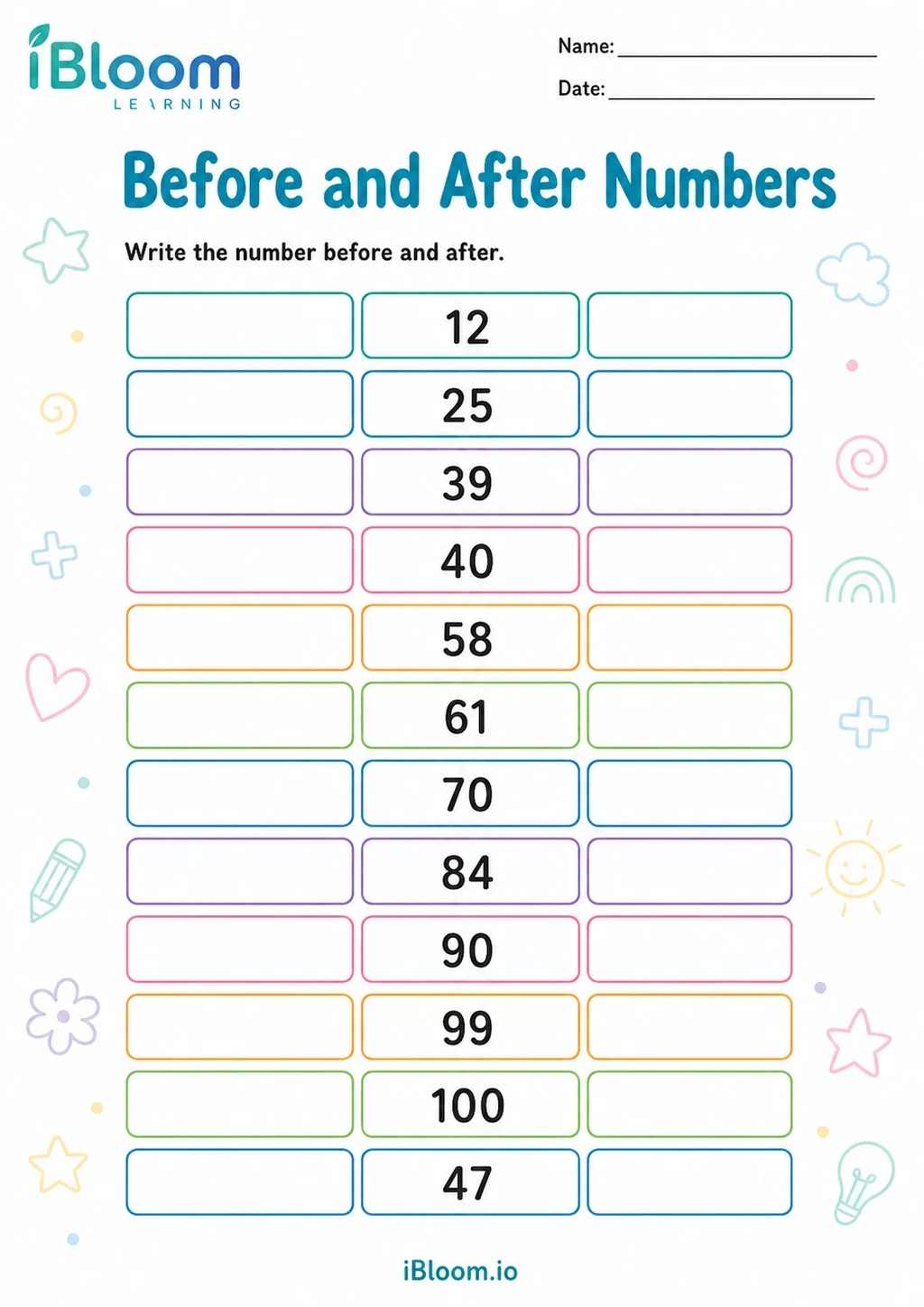
Printable Class 1 maths activities for practising numbers that come before, after, and between using number chart thinking.
Free printable worksheet PDFs
Preview every available page, then download the free worksheet PDF for home, homeschool, tutoring, or classroom practice.
Preview the exact activity before downloading it.
Practice that builds confidence
What children learn
These Class 1 maths worksheets help children practise identifying the number that comes before, the number that comes after, and missing numbers in simple counting sequences.
The printable activities use number-chart style practice, fill-in-the-blank questions, and short counting patterns so children build confidence with order, direction, and number vocabulary.
Counting before and after is an early number sense skill. Children learn that numbers have a fixed order and that each step forward adds one, while each step backward takes away one. In these worksheets, they practise language such as before, after, between, next, previous, more, and less while working with familiar Class 1 number sequences.

Building from simple to confident counting
The practice can begin with small forward sequences such as 4, 5, 6 and move towards questions like “What comes before 20?” or “What comes after 49?” Number chart thinking helps children see patterns across rows: numbers increase as we move forward, and decrease as we move back. This supports later work with comparing numbers, skip counting, addition, and subtraction.
Parent routine at home
Choose one worksheet and keep a 1–100 number chart nearby if your child needs support. Ask your child to point to the given number, say it aloud, then move one step left or backward for before and one step right or forward for after. For a quick oral warm-up, say three numbers in a row and pause: “16, 17, __.” Then ask, “How did you know?” This encourages reasoning rather than guessing.

Classroom uses for teachers
Teachers can use these printables for maths centres, morning revision, small-group support, or quick checks after teaching number order. They also work well for pairing: one child reads the number and the other writes the before or after number. For learners who need extra help, a number chart, counters, or a simple number line can make the movement visible.

Common errors to watch for
Some children reverse before and after, especially when questions are mixed. Others can count forward easily but struggle to count backward, or they may pause at transitions such as 19 to 20 or 29 to 30. Encourage them to read the whole sequence aloud and check whether the answer is one less or one more than the given number.
Free printable PDF download
Use this counting before after worksheets class 1 page to preview the activity, print it, or download it as a PDF for quick practice. It works well for homework, homeschool lessons, tutoring, morning work, revision, and classroom centers.
Answers and answer key support
After the child completes the worksheet independently, parents and teachers can use the answer support or answer key information to check the work, review mistakes, and choose the next practice step.
Why iBloom worksheets help
These worksheets give repeated, focused practice without adding unnecessary difficulty. The tasks vary the format so children do not only memorise one pattern; they must read the instruction, locate the number, and decide the correct direction. A child-friendly strategy is: “Find the number, say it, step back for before, step ahead for after, then check by counting aloud.”
Helpful answers
Frequently asked questions
What skill do these counting before and after worksheets build?
They build number order understanding by asking children to identify the number that comes before, the number that comes after, and sometimes the number between two given numbers.
Should my child use a number chart while solving these worksheets?
Yes, a number chart is useful at first. It helps children see that moving forward gives the after number and moving backward gives the before number. Gradually, they can try without support.
Why does my child confuse before and after?
This is common in Class 1 because children may focus on the given number but not the direction. Ask them to say, “before means one less” and “after means one more” before writing the answer.
How can I practise this concept orally at home?
Say a number and ask, “What comes before?” or “What comes after?” You can also say short sequences with a blank, such as “27, 28, __” or “__, 35, 36,” and let your child complete them.
Are these worksheets useful for backward counting?
Yes. Questions about the number before help children practise counting backward by one, which prepares them for subtraction and understanding one less.
Is this counting before after worksheets class 1 free?
Yes. You can preview it for free and use the printable worksheet for home or classroom practice.
Can I download this counting before after worksheets class 1 as a PDF?
Yes. Use the worksheet download option to save a printable PDF, or print the worksheet directly from the page.
Does this counting before after worksheets class 1 include answers or an answer key?
When the activity has fixed answers, iBloom includes answer support so parents and teachers can check the completed worksheet.